Vwo Ab Test
Vwo ab test. Run a VWO A/B test that actually moves pipeline. Covers hypothesis framing, sample size math, SmartStats interpretation, and QA checklists
Most VWO A/B test advice starts with the wrong assumption: every optimization problem should become a standard page-variant experiment. That mistake is expensive for software development agencies because limited traffic gets divided across the wrong design, weak hypotheses reach the pipeline team, and leadership mistakes an early signal for evidence. A VWO AB test is useful only when the test type, primary metric, sample requirement, implementation, and stopping rule match the business decision.
For a dev agency, the decision is usually whether a niche buyer progressed from an authority page to a qualified conversation, not whether a button received more clicks. VWO has grown from an A/B testing product established in 2009 into an experimentation platform, reporting 2,500+ customers across 90+ countries by 2019, according to VWO’s company history. The platform can support serious experimentation, but it won’t rescue an underpowered campaign or a badly chosen test design.
Choosing the Right Test Type in VWO
A standard visual A/B test is useful when one page, under one URL, needs a controlled challenger. Treating it as the default for every optimization problem wastes traffic and creates implementation risk. VWO separates A/B, split URL, multivariate, and personalization testing. Its guidance associates split URL testing with different URLs and multivariate testing with combinations of multiple elements (VWO’s test creation guidance).
Choose the test type based on what changes, where it changes, and how the business will ship it.
For an agency selling software development services, the cost of a poor choice is delayed learning. A visual editor is suitable for copy, layout, form labels, and CTA changes. A developer-led feature, routing change, application behavior, or server-side variation belongs in FullStack, rather than a fragile browser-side edit. A completely rebuilt landing page may be cleaner as a split URL test. A page with several coordinated elements may qualify for multivariate testing, but limited traffic can leave every combination inconclusive.
Match the method to the decision
The table is a decision aid, not a claim that any test type has a universal traffic threshold. Required traffic varies with the baseline conversion rate, minimum detectable effect, false positive rate, and statistical power. Treat “min monthly traffic” as a planning condition, not a platform requirement. Those inputs also determine whether the campaign can support the decision the team wants to make.
| Scenario | Test Type | Min Monthly Traffic | When to Use |
|---|---|---|---|
| Change headline, proof order, CTA, or form copy on one page | A/B | Calculate before launch | The control and variation can share the same URL and differ in a focused experience |
| Compare a redesigned page with a materially different page architecture | Split URL | Calculate before launch | The variants live at different URLs and require URL-level routing |
| Test several page elements and their combinations | Multivariate | Calculate before launch, with enough traffic for combinations | The decision depends on interaction between elements, not just one isolated change |
| Show different experiences to defined audience groups | Personalization | Calculate for each audience and outcome | The variation is intentionally relevant to a segment rather than universally better |
| Test application logic, product behavior, or backend-controlled functionality | FullStack | Calculate for the product event | The agency needs feature-level or server-side control rather than visual DOM changes |
If you need a practical primer before building a landing-page backlog, this guide to A/B testing landing pages helps separate page-level changes from broader funnel decisions. Do not copy a SaaS landing-page test onto an agency site without checking whether the conversion event represents a sales-qualified opportunity.
Why the wrong choice wastes authority
A multivariate test can answer a richer question than a simple A/B test, but it also creates more combinations to evaluate. On a low-volume niche page, variation data may look attractive while remaining unstable. Personalization can obscure the overall result if the team has not decided whether success means a segment-level improvement or a portfolio-wide pipeline outcome.
The implementation path matters as much as the design. A browser-side A/B test is a poor fit when the variation changes application logic, routing, or data handling. A split URL test requires consistent page loading, redirect behavior, tracking, and attribution across both destinations. A multivariate test requires enough observations for its combinations, not merely enough visitors for the page in general.
That discipline protects the agency’s authority. Its website is part of the proof it presents to prospects. If the experiment cannot produce a defensible decision, the agency ends up changing that proof on a guess.
Framing Hypotheses and Calculating Sample Size
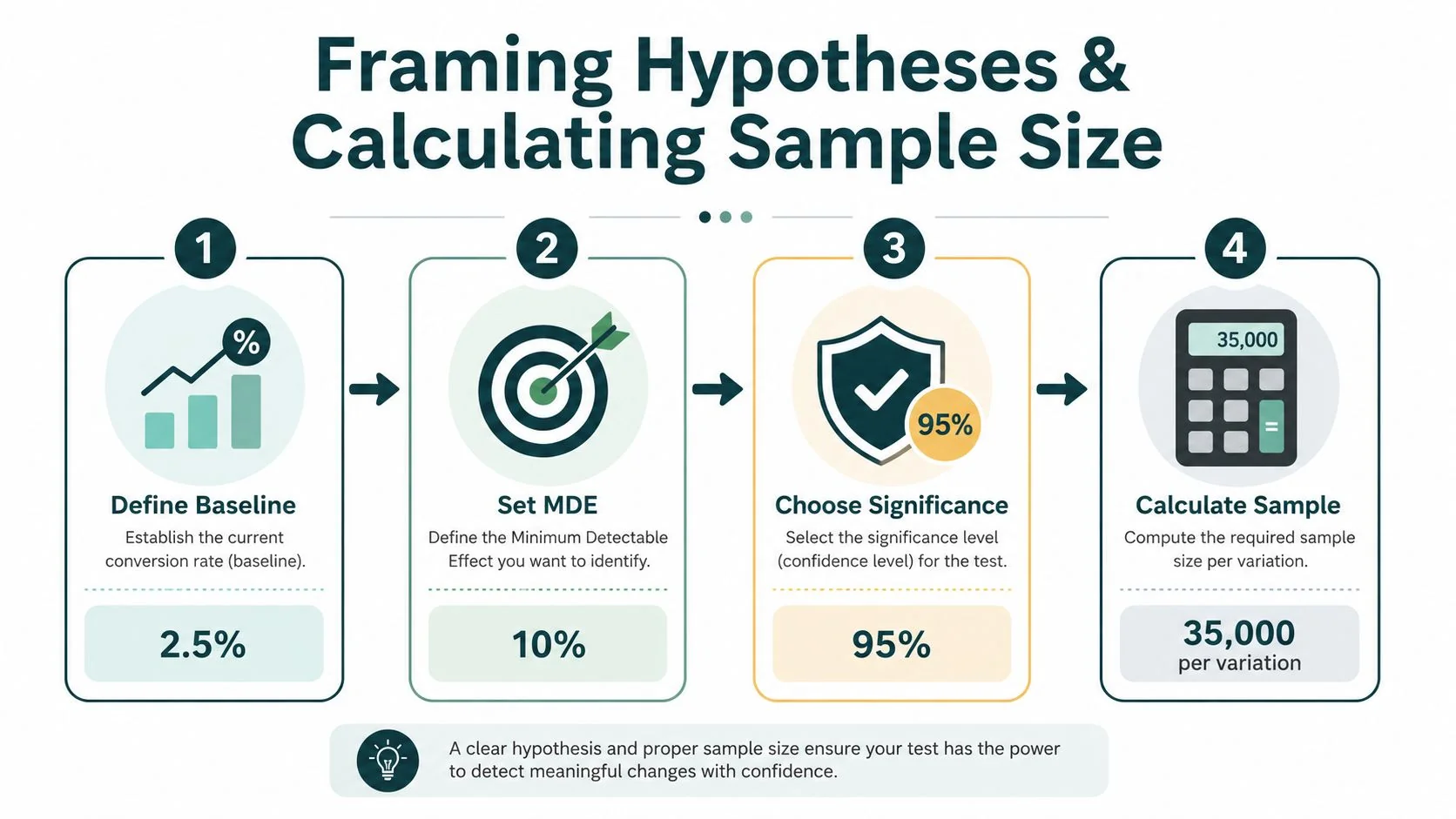
Traffic does not rescue a weak test plan. Before opening VWO, define the page’s baseline conversion rate, smallest worthwhile effect, false positive rate, statistical power, primary metric, and stopping point. Estimate the required sample before launch instead of using an informal traffic rule, as described in VWO’s campaign duration and sample-size documentation.
Turn an opinion into a testable statement
“Improve trust” cannot guide a defensible experiment. Name the change, audience, mechanism, and metric:
Adding a specific delivery proof block above the consultation CTA will increase qualified consultation submissions because buyers need evidence that the agency has handled comparable engineering constraints.
Choose a primary metric that matches the commercial decision. For an agency, that might be a completed consultation form, a qualified booking, or a CRM-confirmed opportunity. Button clicks can diagnose behavior, but they should not define success when revenue depends on qualified conversations.
A niche service page might use a 2.5% baseline conversion rate, a 10% minimum detectable effect, a 95% confidence threshold, and a planning output of 35,000 visitors per variation. These are illustrative values, not benchmarks. VWO’s calculator should derive the requirement from your own baseline, target effect, false positive rate, and power.
Understand power before you promise a date
A 90% power experiment gives a 90% chance of detecting a true uplift above the minimum detectable effect, while convention usually keeps power at 80%. Higher power generally requires more exposure, so decide whether the expected decision is worth the time and eligible traffic.
Estimate duration from the required sample and eligible daily visitors, then set the campaign around that planned window. Do not launch first and discover later that the page cannot support the experiment. If the requirement is unrealistic, select a larger effect worth detecting, improve page eligibility, use qualitative research, or postpone the test.
Sample planning also protects the pipeline. A founder needs to know whether the result can inform positioning before the next outbound sequence is written. Documenting the assumptions gives CRO, content, sales, and leadership a clear handoff. Use the results alongside a digital trust index for dev agencies when the team decides which proof elements deserve another test.
Building the Campaign in VWO
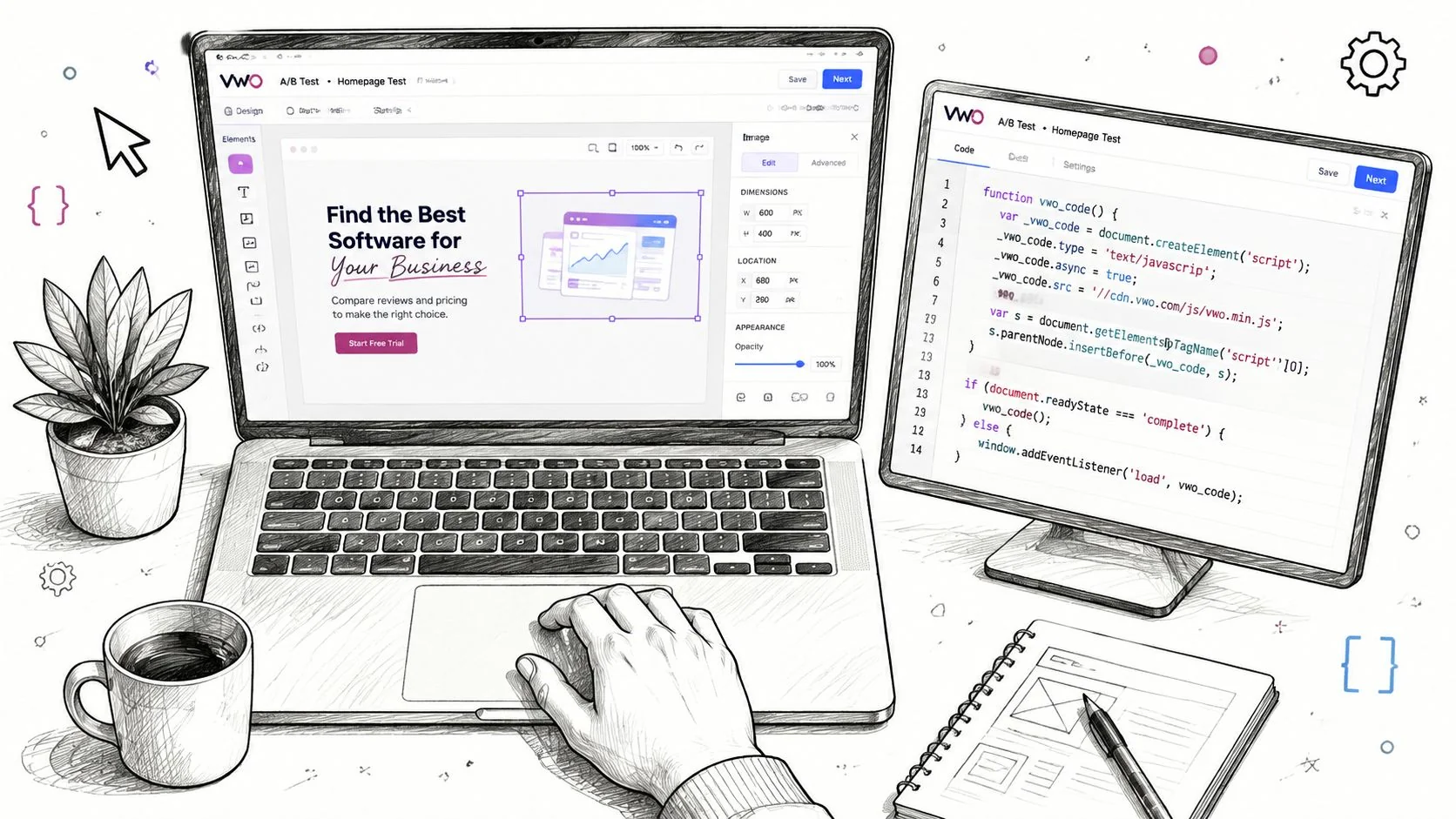
Campaign setup should follow the hypothesis, not the other way around. Use VWO’s visual editor for contained changes such as text, spacing, button treatment, or element visibility. Use code mode when the change requires precise selectors, reusable logic, responsive behavior, or implementation that a developer must review.
Build the audience before the variation
Targeting rules should protect the experiment from irrelevant traffic. Configure the campaign around the page URL or URL pattern, then add device conditions, cookie-based audiences, or custom JavaScript variables when the hypothesis requires them. A mobile-specific form problem shouldn’t be diluted with desktop sessions, and a campaign for returning prospects shouldn’t be interpreted as a universal first-visit result.
For split URL testing, VWO starts with a 50/50 control-versus-variation allocation. VWO also allows teams to set a variation to 100% traffic temporarily for validation, then rebalance it through Advanced Options (VWO’s live split URL validation guidance). That validation step is useful for checking redirects, page rendering, forms, analytics events, and application behavior before exposing the final audience split.
Configure goals that sales can use
Create one primary goal before launch. Add secondary goals only when they help diagnose the mechanism or detect harm. For a dev agency, a qualified form completion, booked consultation, or CRM-linked opportunity is more useful than a raw CTA click if the commercial question concerns pipeline quality.
| Setup Area | What to Configure | Failure to Avoid |
|---|---|---|
| Editor | Visual changes or reviewed code | Untracked DOM changes that break responsive layouts |
| Targeting | URL, device, cookie, or JavaScript audience rules | Mixing unrelated visitor groups |
| Allocation | Control and variation exposure | Changing allocation after the test begins without documenting it |
| Goals | One primary business metric and supporting diagnostics | Calling a click a pipeline win |
| Schedule | Planned start and end conditions | Stopping manually because the chart looks favorable |
Keep the pre-calculated duration in the campaign settings. Don’t alter goals, audience rules, or variation logic after launch unless you invalidate the run and document a restart. A clean campaign record matters when the result becomes evidence in a niche landing page, sales deck, or outbound claim.
Interpreting SmartStats and Knowing When to Stop
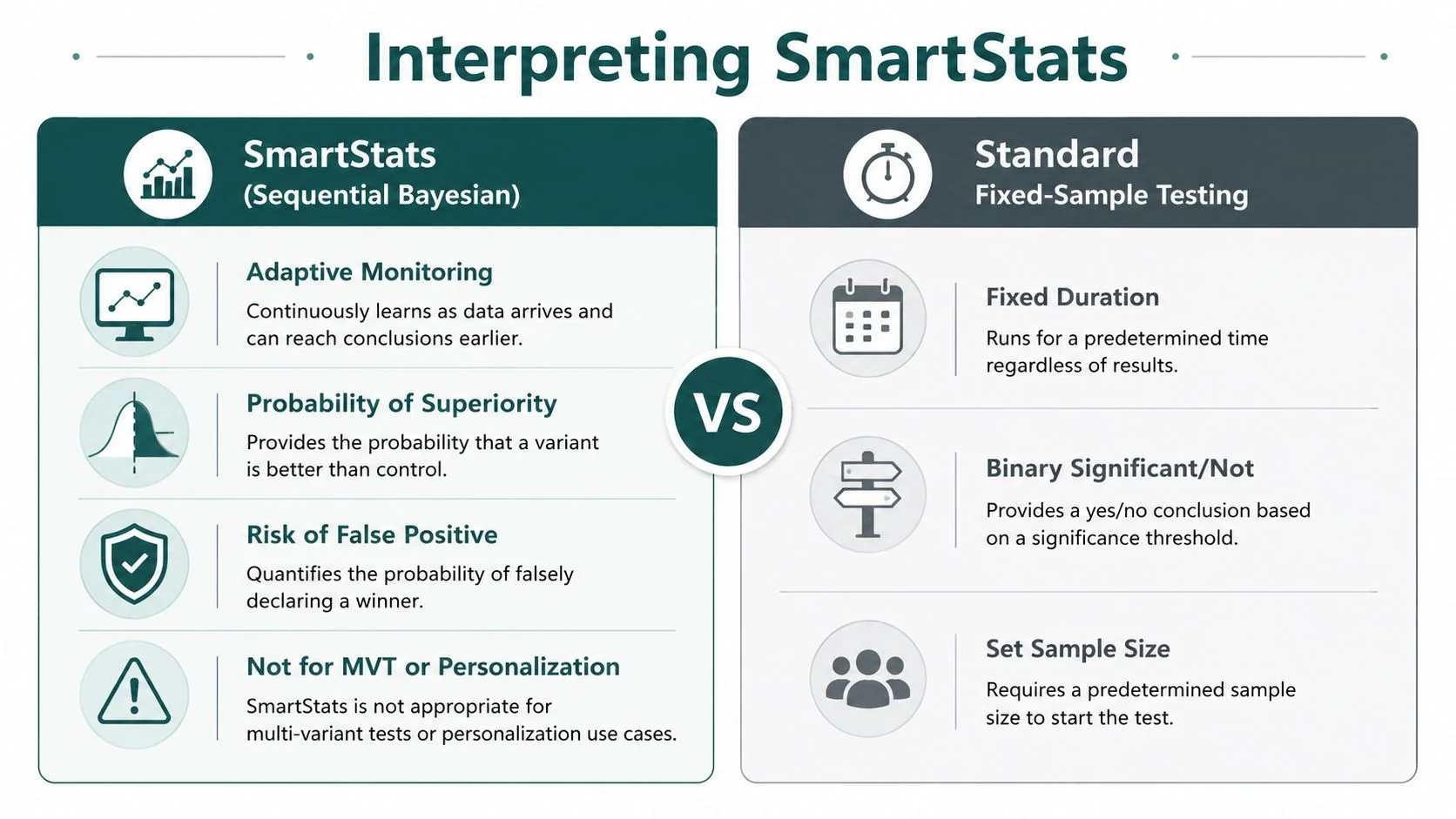
SmartStats changes how teams read a VWO result, but it doesn’t make judgment optional. VWO describes SmartStats as Bayesian-powered, designed to reduce testing time and communicate uncertainty. VWO also states that SmartStats doesn’t apply to multivariate or personalization tests (VWO’s SmartStats documentation).
That distinction matters because many teams see a probability-style result and treat it as a permission slip to ship. A sequential system is designed for ongoing monitoring, while fixed-horizon testing depends on a pre-defined sample and end point. Neither approach removes the need to define the decision before looking at the result.
Read probability as uncertainty, not certainty
A SmartStats probability communicates how strongly the observed data supports one variant over another within the model. It doesn’t prove that the result will persist for every future visitor, every traffic source, or every sales segment. A small number of conversions can produce a compelling-looking direction that later changes as more relevant traffic arrives.
Early stopping is safer when the experiment has reached the planned minimum sample, the primary metric is stable, the result is commercially meaningful, and QA has ruled out implementation errors. It is unsafe when the team checks repeatedly, stops at the first favorable threshold, or ignores the fact that a low-conversion page may need a long runtime before the signal settles.
AB Test Plan’s technical guidance identifies peeking, stopping as soon as a 95% threshold appears, and uncorrected multiple comparisons as sources of inflated false positives. The same guidance recommends pre-registering the stop date or visitor count, targeting at least 80% statistical power, and checking for sample-ratio mismatch before interpreting the result (AB Test Plan’s statistical testing guidance).
Add a commercial shipping rule
A statistical result isn’t automatically a deployment decision. Use a simple release gate:
| Question | Ship Only If |
|---|---|
| Did the primary metric move in the intended direction? | The result supports the pre-defined hypothesis |
| Is the observed effect commercially useful? | The gain matters to qualified pipeline, not only engagement |
| Did the test reach its planned evidence threshold? | The pre-set sample and stopping rule were met |
| Did secondary outcomes remain acceptable? | Form quality, downstream progression, and technical behavior didn’t degrade |
| Can the team explain the mechanism? | The change has a defensible reason, not just a favorable chart |
For agency leadership, this prevents a temporary win from becoming a public positioning claim. Use the result to decide whether to ship, rerun, segment, or reject the hypothesis. The accompanying SmartStats video walkthrough can help teams understand the interface, but the operating rule still belongs in the experiment plan.
QA Checklist and Analytics Integration
A broken experiment can run long enough to look credible. The pre-launch review must verify both the experience and the measurement. Browser rendering, goal firing, traffic assignment, redirects, and external analytics need separate checks because a page can look correct while sending incomplete or duplicated events.
Use a release checklist
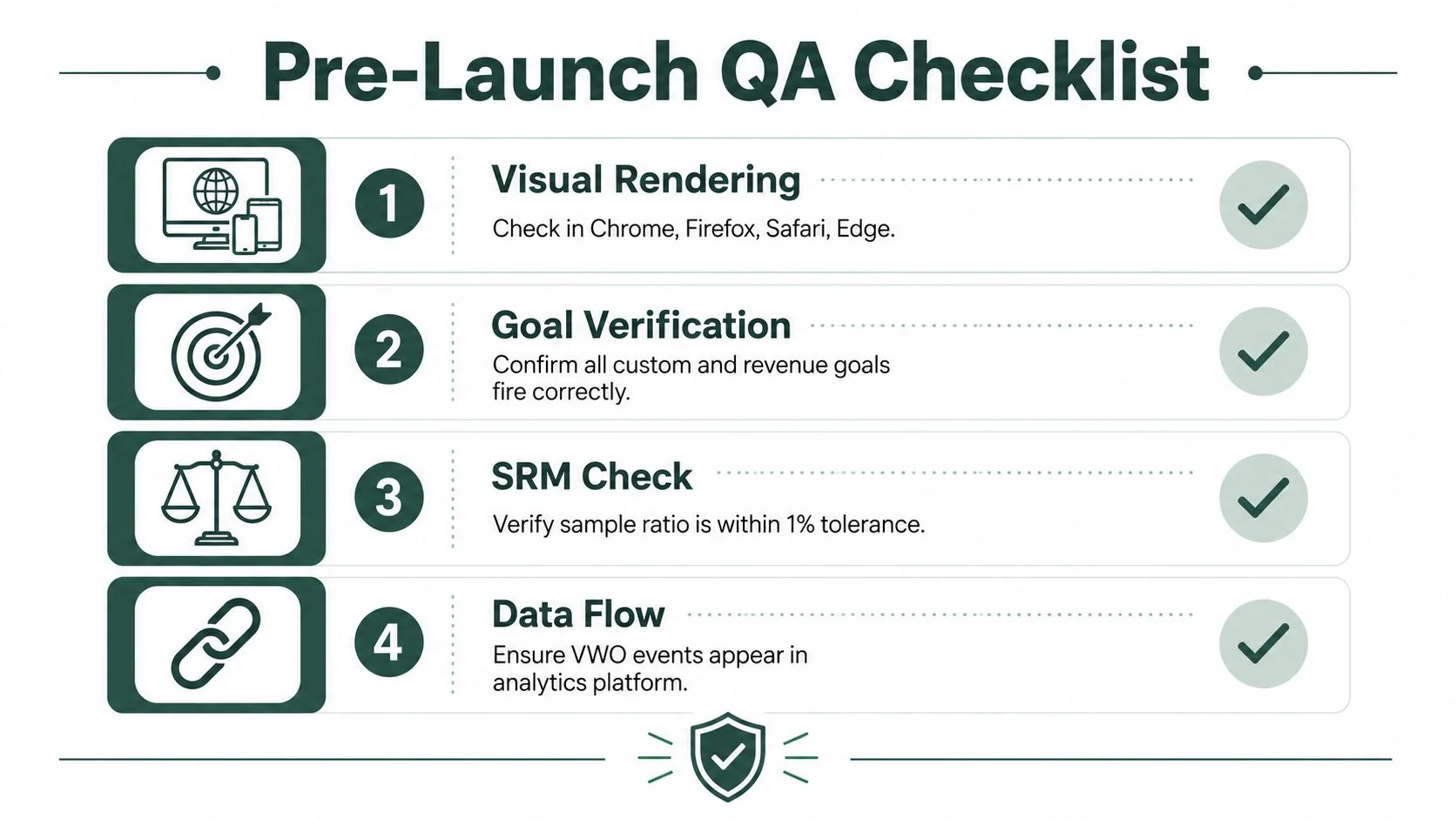
- Visual rendering: Check Chrome, Firefox, Safari, and Edge across the devices included in the audience. Confirm that the control remains unchanged and the variation doesn’t create layout shifts, hidden fields, or broken navigation.
- Goal verification: Submit every important form path and confirm that custom and revenue goals fire once in VWO. Test validation errors, thank-you states, redirects, and duplicate submissions.
- SRM check: Verify that the observed allocation doesn’t indicate a sample-ratio mismatch. A planned split is not evidence that assignment worked correctly.
- Data flow: Confirm that VWO events appear consistently in Google Analytics, Mixpanel, Segment, or the agency’s internal reporting layer. Compare event names, user identifiers, timestamps, and variation labels.
VWO explains that split URL traffic is assigned randomly visitor by visitor, so the initial allocation may not land exactly on the configured percentage. Campaign reporting is based on conversion rates between variants rather than an exact visitor count in each bucket (VWO’s split URL testing documentation). That is normal allocation drift, not a reason to manually rebalance a live test. A genuine sample-ratio mismatch is different and requires investigation before reading the outcome.
Validate after launch
Inspect the first live sessions for the control and variation. Check that redirects preserve query parameters, forms reach the intended CRM workflow, consent behavior doesn’t suppress one variant, and third-party scripts don’t overwrite VWO assignments. Review external analytics for the same primary event, but don’t replace VWO’s experiment reporting with an unplanned dashboard calculation.
An agency can use a tool such as an AI funnel builder for agencies to organize funnel assets, but automation doesn’t replace event verification. The operating standard is a signed QA record that names the campaign, audience, primary goal, implementation owner, analytics owner, and rollback condition.
Release rule: If the team can’t reproduce the conversion event from entry to CRM record, the campaign isn’t ready for interpretation.
That standard supports niche positioning because your own case studies and authority pages depend on trustworthy evidence. A prospect evaluating technical competence will notice whether the agency treats measurement as production engineering or as a marketing afterthought.
Building an Iterative Testing Program That Compounds
Niche authority comes from a backlog of tests, not from one test. VWO’s benchmark from a study covering 1M+ tests and 100K websites places SaaS experimentation at roughly 24 to 60 tests per account per year, while Media & Entertainment reaches about 65 tests per account annually (VWO’s testing benchmark). Don’t copy that pace blindly. Replace occasional “big bang” experiments with a repeatable learning system.
Tie each test to a pipeline hypothesis: which niche buyer is uncertain, which proof reduces that uncertainty, which page stage exposes the friction, and which event represents progress. Rank the backlog by expected decision value and evidence required, not by whichever copy idea arrived in the latest meeting.
A useful reporting cadence sends three outputs to leadership:
| Output | Pipeline Use |
|---|---|
| Result | Decide whether to ship or reject the change |
| Learning | Refine the niche message, proof, or objection handling |
| Next hypothesis | Create the next experiment and inform content or outbound |
After enough disciplined tests, an agency knows which technical outcomes, proof formats, and buyer concerns earn progression from the right audience. That knowledge carries website evidence into market language and strengthens search pages, LinkedIn content, sales conversations, and outbound sequences.
For a software development agency, VWO is a way to turn niche traffic into defensible evidence, provided the team selects the right test, calculates the required sample, validates the data, and ships only decisions that can survive scrutiny. Build that operating discipline into every authority page, then use the resulting insight to own a narrower category.
If your agency is wasting traffic on unplanned experiments, start with a review of your three highest-value niche pages. Define one pipeline metric for each, calculate the required sample in VWO, audit the implementation and analytics path, then turn the first validated result into a positioning asset and a targeted outbound message.