Proof for Websites: Trust Signals That Build B2B Pipeline
Learn how to use proof for websites to build trust, reduce buyer skepticism, and drive qualified pipeline for software development agencies.
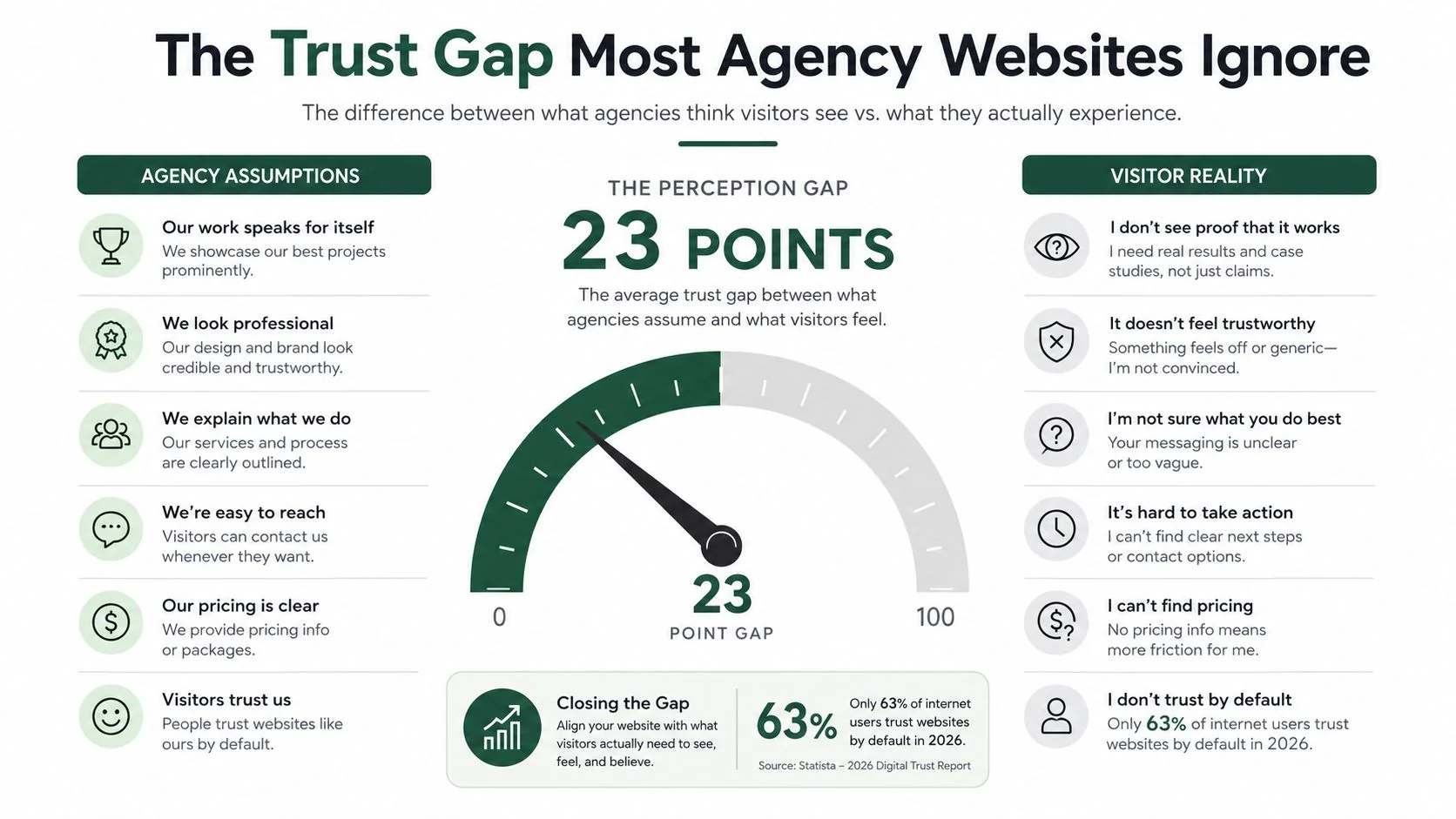
Only 23% of website visitors say they feel trust when they land, while 46% of companies believe visitors feel it, a 23-point perception gap documented by the Digital Trust Index. For software development agencies, proof for websites is the visible evidence that helps a skeptical buyer recognize your firm, validate its capabilities, and justify a supplier decision to other stakeholders. Decorative social proof added below the fold does none of that.
The broader trust environment makes that gap harder to ignore. A global benchmark found that only 63% of internet users across 20 countries trusted the internet, down 11 percentage points from a comparable 2019 survey, according to Queue-it’s consumer trust statistics. A niche agency website therefore has two jobs: reduce uncertainty for human buyers and create clear, verifiable authority that search systems and AI assistants can identify.
The Trust Gap Most Agency Websites Ignore
46% of companies believed visitors felt trust on landing, while only 23% of visitors agreed, creating the 23-point perception gap. The practical issue is recognition. Agency leaders see delivery experience, engineering talent, and familiar clients. A first-time visitor often sees a claim, a logo, a stock image, and a meeting form before finding evidence that addresses technical risk.
Agency websites usually fail because their proof is vague, delayed, or difficult to verify. That weakens both human evaluation and machine recognition. A buyer needs evidence that can be understood quickly, while search systems and AI assistants need clear entities, context, and outcomes they can cite accurately.
What skepticism looks like on an agency homepage
Technical buyers do not need more adjectives. “World-class” and “trusted partner” leave out the customer, problem, delivery conditions, and result. A row of enterprise logos has the same weakness if the agency never explains what it delivered for those companies.
Stock photography adds no evidence that engineers can modernize a regulated platform, integrate with a difficult legacy system, or coordinate delivery across distributed stakeholders. Anonymous testimonials create a similar problem. Without a name, role, company, or project context, visitors cannot assess whether the statement applies to their own decision.
Proof should answer a specific buyer concern rather than fill a page section. That is the practical foundation behind social proof psychology for CRO teams.
| Visitor concern | Weak proof | Useful proof |
|---|---|---|
| Can this agency solve our problem? | “Deep technical expertise” | A relevant case study describing the system, constraint, approach, and outcome |
| Has it worked with companies like ours? | A generic logo strip | Industry-specific customer evidence with a short delivery description |
| Will the team understand executive risk? | An unnamed quote | A named stakeholder explaining the business and technical result |
| Can procurement approve the vendor? | Decorative badges | Current, verifiable security or compliance documentation |
Review the first screen as a CTO encountering the firm for the first time. The page should establish who you serve, what you deliver, and which customer can verify it before asking for a conversation. If those answers are missing, proof is slowing pipeline rather than supporting it.
Recognition also matters after the first visit. Consistent customer names, service terms, project context, and outcomes give human stakeholders something to repeat internally and give AI systems clearer material to identify and cite. For agency-specific positioning material, browse 100Signals agency resources.
Six Proof Formats That Work for Dev Agencies
Proof earns attention when it resolves a buyer’s uncertainty at the point where that uncertainty slows a deal. A technical director assessing architecture needs different evidence from a procurement manager checking vendor risk. Treating every format as interchangeable creates clutter and weakens relevance.
| Proof Format | Awareness Stage Lift | Consideration Stage Lift | Decision Stage Lift | Best Use Case |
|---|---|---|---|---|
| Customer logos | Recognition | Moderate context | Low without detail | Establishing category and industry relevance |
| Named testimonials | Human credibility | Strong objection handling | Strong stakeholder reassurance | Supporting a CTA or service claim |
| Case studies with metrics | Problem relevance | Strong evaluation evidence | Strong validation | Showing delivery competence in a niche |
| Live activity feeds | Freshness | Limited | Limited | Demonstrating active customer or community engagement |
| Third-party reviews | Discovery credibility | Vendor comparison | Strong validation | Reducing unfamiliar-brand risk |
| Security and compliance badges | Low | Requirements support | Strong procurement evidence | Supporting regulated or enterprise deals |
1. Customer logos need context
Logos answer, “Who already buys this service?” They do not replace customer evidence. A healthcare software landing page should feature relevant organizations, then connect each logo to a project type, platform, or outcome where permission allows. This gives human buyers a recognition cue and gives AI systems clearer entities and relationships to identify.
2. Named testimonials should identify the witness
A useful testimonial includes the customer’s name, role, company, and a specific reason the agency was selected. “They were great to work with” adds little. “The agency helped us replace a fragile integration without interrupting the release schedule” gives a technical buyer a result and delivery constraint to assess.
3. Case studies should expose the delivery logic
A strong case study follows challenge, approach, and results. Put the core evidence on the page rather than inside a PDF that sales must send manually. Metrics matter when the agency explains what changed, how it was measured, and which stakeholder cared about the outcome. The case should also name the systems, constraints, and decisions that make the result recognizable to a similar buyer.
4. Live activity feeds require authenticity
Recent customer activity, event participation, or product usage can show that a company is active. Fake-looking popups and fabricated urgency undermine confidence. For a development agency, a current engineering webinar, public technical contribution, or fresh customer announcement is usually more credible than a notification claiming that someone just booked a call.
Live signals work best as supporting evidence. They age quickly and rarely explain whether the agency can deliver a comparable project.
5. Third-party reviews support unfamiliar-brand evaluation
Reviews help when buyers compare vendors away from your website. They work best when they describe the project, agency capability, communication model, and outcome. Review volume alone has limited value if the entries lack context or cannot be connected to a service.
If your review strategy spans commerce or product ecosystems, a resource covering the best product review tool for WooCommerce can clarify review collection mechanics. An agency still needs service-specific evidence, named customers, and project detail.
6. Security and compliance badges serve procurement
Badges rarely persuade a CTO to choose an architecture. They can help procurement confirm that the firm meets a stated requirement. Display the certification or compliance status beside its scope and validity, then link to supporting documentation when possible. An unlabeled badge creates another verification task instead of reducing risk.
Prioritize formats according to the pipeline problem. If prospects do not recognize your niche, start with relevant logos and concise category evidence. If opportunities stall during technical evaluation, build case studies that expose delivery decisions. If deals stop at procurement, improve security documentation, compliance evidence, and reference access. Proof should make the agency easier to recognize, evaluate, cite, and defend internally.
Matching Proof to the B2B Buying Journey
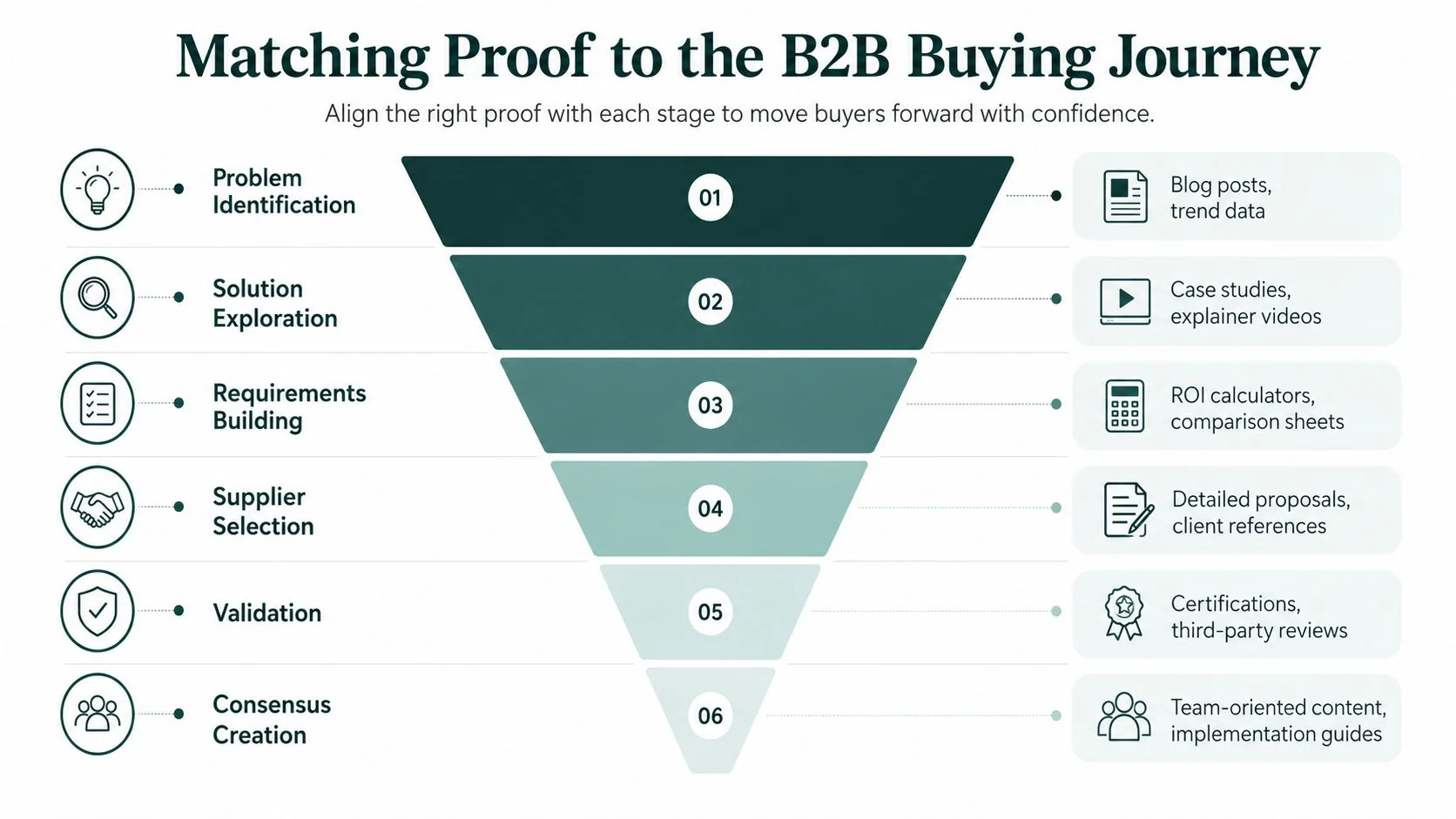
Gartner defines six B2B buying jobs: problem identification, solution exploration, requirements building, supplier selection, validation, and consensus creation, as described in its B2B buying journey framework. Most agency websites handle the first two. They publish educational articles, describe services, and explain broad solutions. They often provide much less evidence for the final four jobs, where a buying committee must decide whether the agency is safe to shortlist, approve, and defend internally.
Match evidence to the job, not the page type
| Gartner buying job | Buyer question | Proof asset |
|---|---|---|
| Problem identification | Do we have a real problem? | Diagnostic content, technical explainers, and relevant trend analysis |
| Solution exploration | What approaches could solve it? | Architecture examples, case studies, and solution walkthroughs |
| Requirements building | What must a vendor provide? | Comparison sheets, delivery models, scope definitions, and ROI logic |
| Supplier selection | Which providers belong on the shortlist? | Named customers, references, niche landing pages, and detailed capabilities |
| Validation | Can we trust the proposed supplier? | Third-party reviews, certifications, security documentation, and technical evidence |
| Consensus creation | Can every stakeholder support the choice? | Implementation guides, risk explanations, executive summaries, and stakeholder-specific proof |
The CTO and CFO don’t need the same page. A CTO wants evidence about architecture, integration constraints, testing, reliability, and technical ownership. A CFO needs commercial clarity, delivery risk control, and a credible explanation of value. Procurement looks for security, compliance, insurance, contractual readiness, and references.
The late-stage proof gap is expensive because sales teams often discover it only after an opportunity has already slowed. Audit five recent opportunities and record the question each stakeholder asked before the deal advanced. Then map every question to a page, document, customer reference, or proof block. If no asset answers the question, the website is creating avoidable work for sales.
Placement matters as much as format. Independent credibility research summarized by Product Philosophy found that trust signals performed best when they addressed specific uncertainty and appeared near the primary call to action, particularly for first-time buyers and unfamiliar brands. A homepage can create recognition. A niche page must help a buyer build an internal case.
Proof That Works for AI Search and Human Buyers
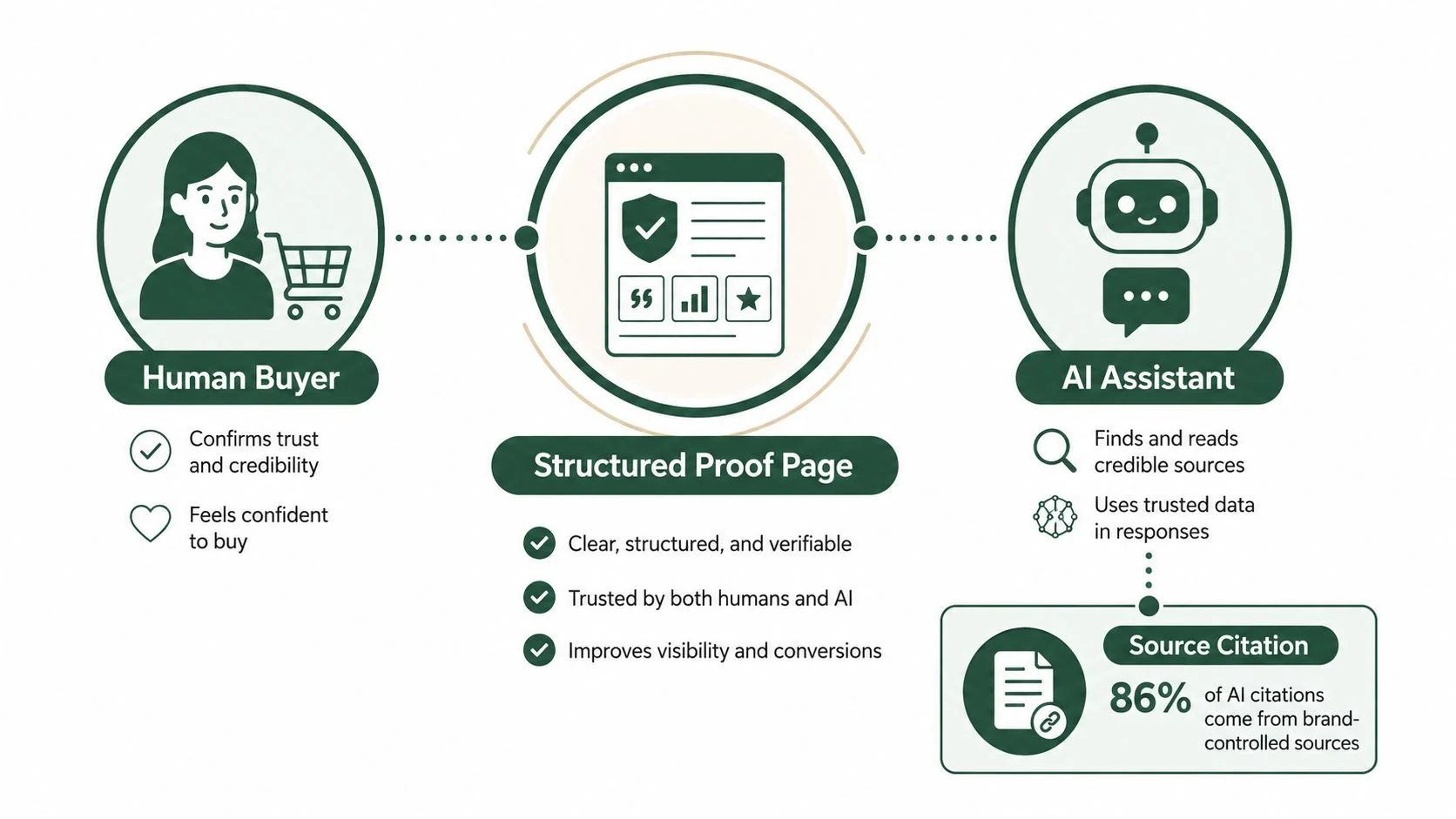
A proof page now has two audiences. The human buyer scans it for relevance and risk reduction. An AI assistant needs clear entities, consistent facts, and accessible source material before it can cite the agency in an answer.
Yext’s 2025 research found that 86% of AI citations came from sources brands already control, including websites and listings, according to its AI citation research. That makes a structured proof page a visibility asset as well as a conversion component. Your agency should publish the evidence it wants buyers and AI systems to find, rather than leaving the market to infer capability from scattered mentions.
Build pages that can be checked
A useful proof page gives each customer story a stable URL and a consistent structure:
- Customer identity: Use the approved company name, industry, geography, and relevant business context.
- Project facts: Explain the service, technical environment, delivery scope, and stakeholder problem.
- Outcome evidence: State the result in plain language and identify how the customer measured it.
- Verification paths: Connect to a customer quote, review profile, announcement, or reference process where permission exists.
- Entity consistency: Keep the agency name, service names, customer names, and niche terms consistent across pages and listings.
Third-party exposure still matters. Ahrefs reported correlations between AI visibility and both YouTube mentions, at about 0.737, and branded web mentions, at roughly 0.66 to 0.71, across ChatGPT, AI Mode, and AI Overviews in its AI brand visibility analysis. The practical implication: publish authoritative on-site evidence, then earn credible mentions outside the site.
The Starr Conspiracy’s 2025 AEO Benchmarks Report found that only 14% of B2B SaaS brands earned a ChatGPT citation for their top 25 commercial queries, while the top quintile reached 47% citation share. The benchmark is about B2B SaaS rather than development agencies, but it shows the competitive difference between being present in AI answers and being absent from them, as detailed in the AEO Benchmarks Report.
Buyers also verify authority across sites. Independent social-proof data reports that 36% check at least two review sites, and many treat reviews older than 3 months as irrelevant, according to Embryo’s social proof research. Keep profiles current, align naming across platforms, and connect every claim to evidence. Our guide to an AI funnel builder for dev agencies is one reference point for connecting recognition, proof, and demand capture.
Implementation Templates and A/B Test Framework
Proof should enter the page as copy, not as a design afterthought. The team needs a repeatable structure that connects the customer evidence to the claim being made.
Homepage hero template
Use this formula:
Outcome + Proof + CTA
Example structure:
Help [specific buyer] achieve [specific outcome] with [specific technical capability]. Trusted by [relevant customer category]. [CTA]
Keep the proof adjacent to the claim. A logo strip can sit below the hero, but it should identify the category it represents, such as “Selected healthcare software clients,” rather than display unrelated company marks.
Niche landing page template
A niche page should follow this sequence:
| Page block | Required content | Failure to avoid |
|---|---|---|
| Problem | A specific operational or technical problem | Repeating a broad industry slogan |
| Solution proof | A named project or relevant delivery example | Claiming experience without evidence |
| Specific offer | A defined engagement or next step | Asking for a generic contact |
| Secondary proof | Review, reference, certification, or second case | Reusing the same quote everywhere |
| CTA | A low-friction action linked to the buyer’s job | Hiding proof below the form |
Write case studies in challenge, approach, results format. Add the customer stakeholder’s name and role when approved. If the customer can’t disclose a result, disclose the constraint instead. A named technical problem with a verifiable delivery scope is stronger than an invented performance number.
Outbound follow-up template
Use three emails with distinct jobs:
- Proof email: Present one relevant customer example and the problem it addressed.
- Case study email: Share the deeper challenge, delivery approach, and customer evidence.
- Value proposition email: Explain why the agency’s niche capability fits the recipient’s current context.
Don’t send the same homepage link in every message. Match each email to the recognition gap. If the recipient doesn’t know your agency, lead with category relevance. If they’ve engaged with a case study, follow with a reference or technical detail.
Test the evidence, not only the button
Use a hypothesis format that names the uncertainty:
- Named versus anonymous testimonial: “If the testimonial identifies the stakeholder and project context, technical buyers will engage with the CTA more often because they can assess relevance.”
- Video versus text case study: “If the customer explains the delivery problem on video, visitors will progress further because the evidence feels easier to verify.”
- One deep case study versus several short proofs: “If the page presents one detailed example, qualified visitors will request a meeting more often because it supports supplier validation.”
Track qualified conversions, not just clicks. A practical guide on how to turn visitors into customers can complement the testing plan, but your CRM must remain the source of truth for pipeline impact.
Metrics That Prove Proof Is Working
Page views don’t show whether proof helped a buyer choose your agency. Bounce rate doesn’t tell you whether a CFO found the commercial evidence needed to continue. Measure the movement from recognition to qualified conversation, then connect that movement to CRM outcomes.
Build the dashboard around buyer friction
Track each metric against traffic source, niche page, proof format, and opportunity status.
| Metric | What it tells you | How to attribute it |
|---|---|---|
| Conversion rate by traffic source | Whether proof performs differently for search, direct, referral, or outbound visitors | Use UTMs and landing-page reporting |
| Time to conversion | Whether visitors act after reviewing evidence | Record first visit, proof interaction, and conversion timestamps |
| Sales cycle length | Whether late-stage proof reduces validation delays | Compare opportunities that viewed proof assets with similar sourced deals |
| Win rate on sourced deals | Whether proof contributes to commercial outcomes | Connect page engagement to opportunity and closed-won records |
| AI citation frequency | Whether proof is discoverable beyond your website | Run a fixed set of commercial prompts and log citations monthly |
Use event tracking for proof interactions. Record clicks on case studies, review profiles, reference requests, security pages, and customer logos that open detail. Add heatmaps only as diagnostic evidence. A heatmap can show that visitors ignore a proof block, but it can’t prove that the block influenced a later sales conversation.
The useful unit of analysis is whether qualified opportunities with relevant proof moved through supplier selection and validation more efficiently. Connect website analytics to the CRM, preserve the original source and campaign data, and ask sales to log which proof asset appeared in the buying process.
The benchmark-style content on social proof reports different effects by format, including approximately 8% conversion lift for generic logo strips, 14% for a single text testimonial, and 22% for a named-customer claim, while five reviews lifted purchase likelihood by 270% versus zero reviews, as reported by Foundry CRO. Treat those figures as directional benchmark content, not a forecast for your agency. Your audience, offer, page intent, and proof quality determine the result.
Start with one niche, one landing page, and one defined conversion event. Compare sourced pipeline before and after the proof change, then review the sales notes for objections that disappeared or remained.
A software agency owns a niche when buyers recognize its relevance before a salesperson explains it. Proof for websites creates that recognition through named customers, verifiable delivery evidence, current third-party validation, and pages structured for both human evaluation and AI citation. Audit your homepage and highest-value niche page this week, identify the missing evidence for supplier selection and validation, then publish one customer-specific proof asset with a tracked CTA and a CRM field for attribution.