AI Funnel Builder for Dev Agencies: Pipeline, Not Just Pages
How an AI funnel builder fits into a dev agency's demand-gen stack. Covers conversion benchmarks, integration requirements, and pilot workflows.
The benchmark for an AI funnel builder is whether the system helps a dev agency get to a booked call faster without degrading lead quality. Timing carries real weight: buyers who wait 30 minutes instead of 5 minutes are 100x less likely to be contacted (CartFlows sales funnel statistics, 2026). For agencies selling complex services, the tool matters only if it improves routing, qualification, and follow-up. Drag-and-drop output alone doesn’t count.
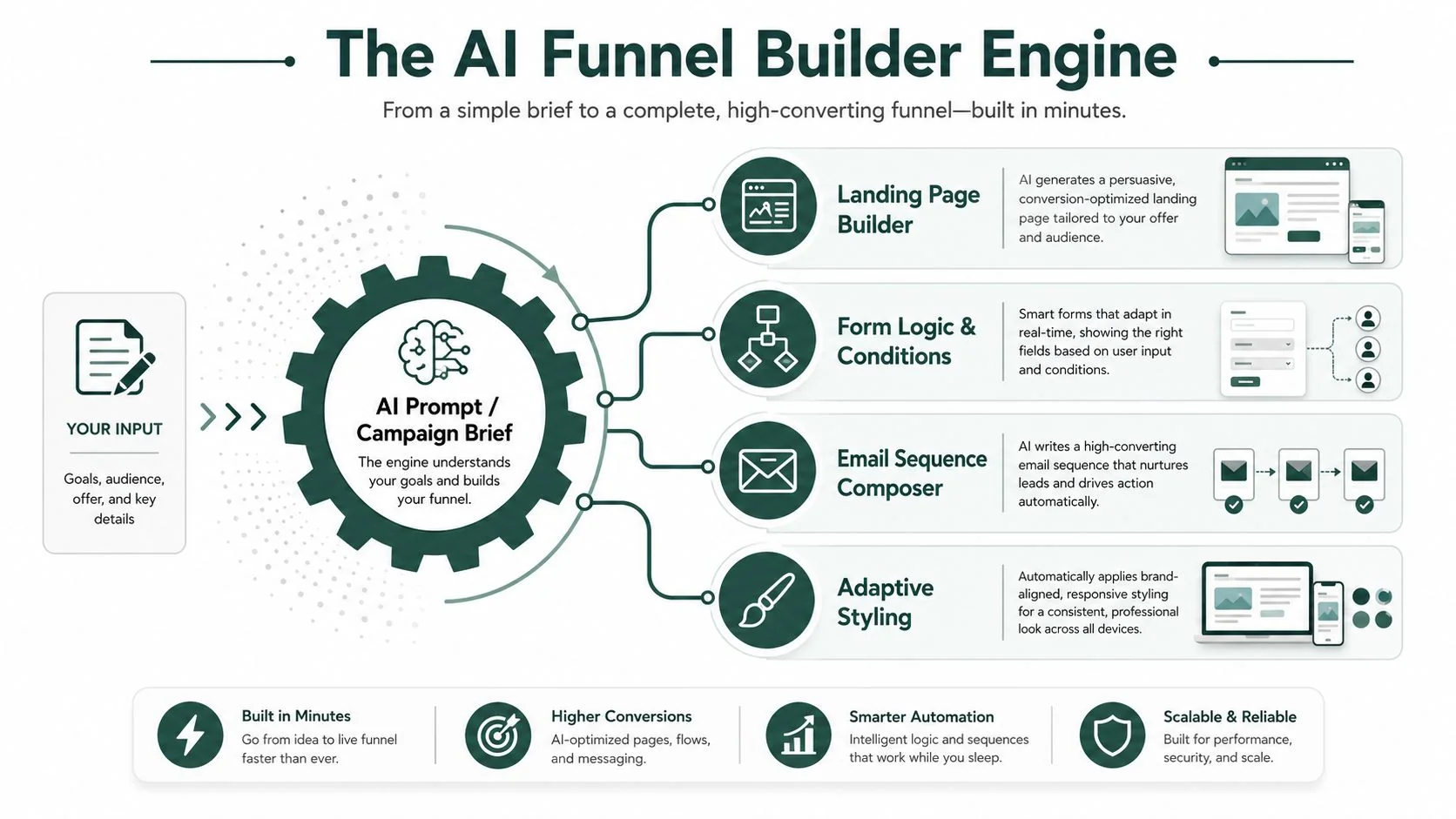
An AI funnel builder is software that takes a prompt or brief and turns it into a connected funnel, landing page, form logic, conditional branching, follow-up, and attribution. The category exists because buyers now expect near-immediate response, and because static funnels leave too much conversion value on the table after the page is published (Agentive AIQ, 2025-2026).
For a practical companion on orchestration, the content creation automation guide covers the same underlying problem, turning a brief into a repeatable production system.
What an AI Funnel Builder Does
A useful definition starts with what the tool produces. A real AI funnel builder turns a campaign brief into a working funnel schema, landing page, form fields, step logic, and conditional branching, so a team is not assembling every part by hand (LeadCapture, AI Funnel Builder). That matters to a software development agency because the bottleneck is rarely the page shell. It is the sequence after the click, where the wrong form path or slow response kills the lead.
Orchestration across the funnel
A generic page generator can publish a landing page. A useful funnel builder has to carry the offer through checkout, follow-up, retry logic, attribution, and lead routing so the outcome ties back to a named audience segment and a specific promise (Tagada, AI Funnel Builder). That is the difference between producing assets and producing pipeline. If the system cannot connect the page to the CRM and preserve what happened at each step, it is mostly a content tool with a sales label.
Practical rule: If a tool creates copy but cannot prove where the lead came from and what happened next, it will not help a dev agency own a niche.
For agencies already mapping their stack, the main checklist starts with the integrations documentation. Use that as a sanity test, not a buying decision by itself.
A 2026 benchmark reports an average website conversion rate of 5.13% across 13 industries, median landing page conversion at 6.6% from 41,000+ pages and 57 million conversions, and AI referral traffic at 5.8%, which sat above paid search and well above paid social at 2.11% (CartFlows sales funnel statistics, 2026). That doesn’t make AI a sure winner, but it does mean AI-assisted discovery already sends measurable traffic, so the funnel has to optimize for relevance and response speed, not only layout. For teams evaluating where to sharpen their offer, the 100Signals demand generation method is useful because it frames funnel work around pipeline quality instead of page output.
Generation Versus Optimization Capabilities
Some AI funnel builders only shorten production. Others improve what the funnel does after traffic starts arriving. For a dev agency, that distinction decides whether the system helps prove a niche or just helps ship pages faster.
Capability tiers that matter
| Capability | Generation Only | Generation + Optimization | Pipeline Impact |
|---|---|---|---|
| Funnel layout from prompt | Yes | Yes | Launches faster, but does not improve conversion by itself |
| Copywriting for headlines and emails | Yes | Yes | Speeds production, limited impact without traffic feedback |
| Form logic and branching | Sometimes | Yes | Filters leads and improves qualification |
| Intent-based routing | No | Yes | Sends better leads to the right path |
| Personalized outcome text | No | Yes | Improves message match after the click |
| A/B testing and dynamic text replacement | No | Yes | Refines conversion after launch |
| Smart lead scoring | No | Yes | Improves handoff quality to sales |
| Real-time CRM sync | Rare | Common in stronger systems | Keeps the funnel tied to revenue data |
One industry comparison frames meaningful AI funnel building as layout generation, AI copywriting, traffic routing, conversational iteration, and personalized outcome text. Another frames the category around auto A/B testing, smart lead scoring, and dynamic text replacement (LinkedIn comparison of AI funnel builders, 2026). That split matters because generation gets you to launch, but optimization decides whether the funnel earns its keep.
The optimization layer matters most for a dev agency trying to build niche authority. If the tool only saves design time, it may help the ops team, but it does not create a repeatable demand engine. If it changes routing, scoring, and text based on behavior, it ties each booked call back to the message and source that produced it. That connection is what turns a niche claim into measurable pipeline.
For teams shaping offer strategy, the 100Signals demand generation method is worth reading alongside vendor demos, because demand gen still sets the ceiling. A fast funnel cannot rescue weak positioning.
The integrations documentation is also a useful check here. Optimization features matter only if the system can carry lead data into the rest of the stack.
Bottom line: Generation helps you ship. Optimization helps you learn which niche deserves more spend.
Technical and Integration Requirements
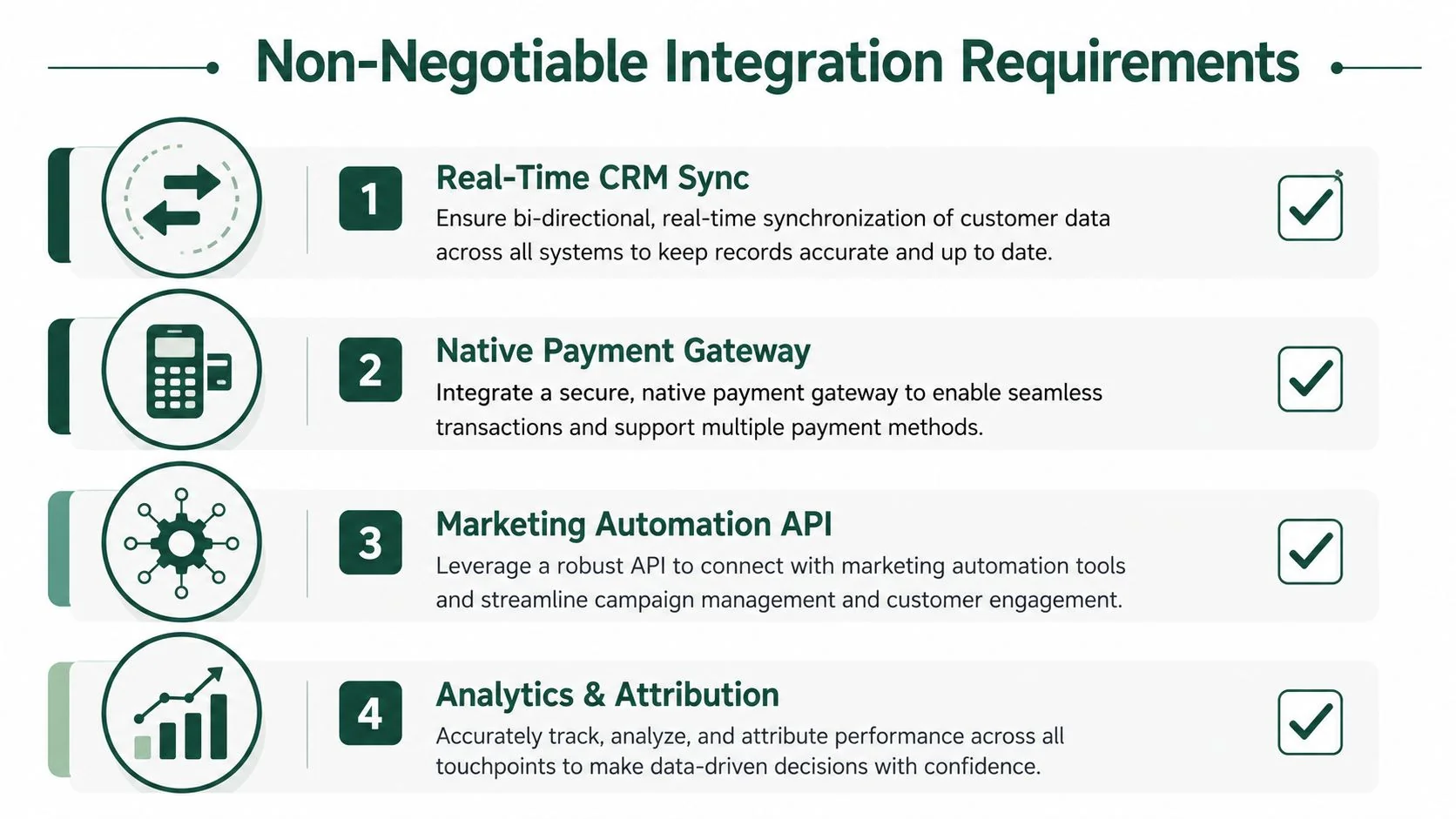
An AI funnel builder is only useful if it stays connected to the rest of the stack. The main technical risks are broken tracking, stale personalization, and half-synced lead data. Page rendering is rarely the problem. That’s where agency buyers get fooled: the demo looks clean while the revenue pipeline inherits the mess.
What has to work before you buy
For agencies running HubSpot, Salesforce, ActiveCampaign, Pipedrive, or custom workflows, the first priority is real-time CRM sync. The system should write conversations, form fills, and qualification outcomes back to the CRM without manual export-import cycles, otherwise sales works from stale context. That’s especially important when personalization depends on earlier interactions, because inaccurate records create bad routing and bad follow-up.
The second requirement is tracking preservation across the funnel lifecycle. A tool can publish a page and still lose attribution between the landing page, form, booking step, and handoff. That breaks the line a revenue team depends on, from offer to pipeline. If attribution fails, you can’t tell whether the new funnel improved lead quality or just created more noise.
What to test in a pilot
- Two-way CRM handoff. Submit test leads, then confirm the CRM shows the source, stage, and sequence outcome.
- Branching fidelity. Trigger different paths with different answers and verify each route lands where it should.
- Domain and publish workflow. Make sure the funnel moves from draft to live without breaking links or tags.
- Sequence triggering. Confirm the correct email or SMS sequence starts after the right behavior, not after a manual override.
Vendor docs often claim the platform can handle this in one flow, but the pilot has to prove it. If lead scoring, webhook routing, or sequence triggers fail once, the tool may still be useful for content, but it’s not ready for serious pipeline work.
The technical standard is simple. If the funnel can’t keep data intact through the entire buyer journey, it’s a page tool with integrations bolted on.
Agency Use Cases and Sample Workflows
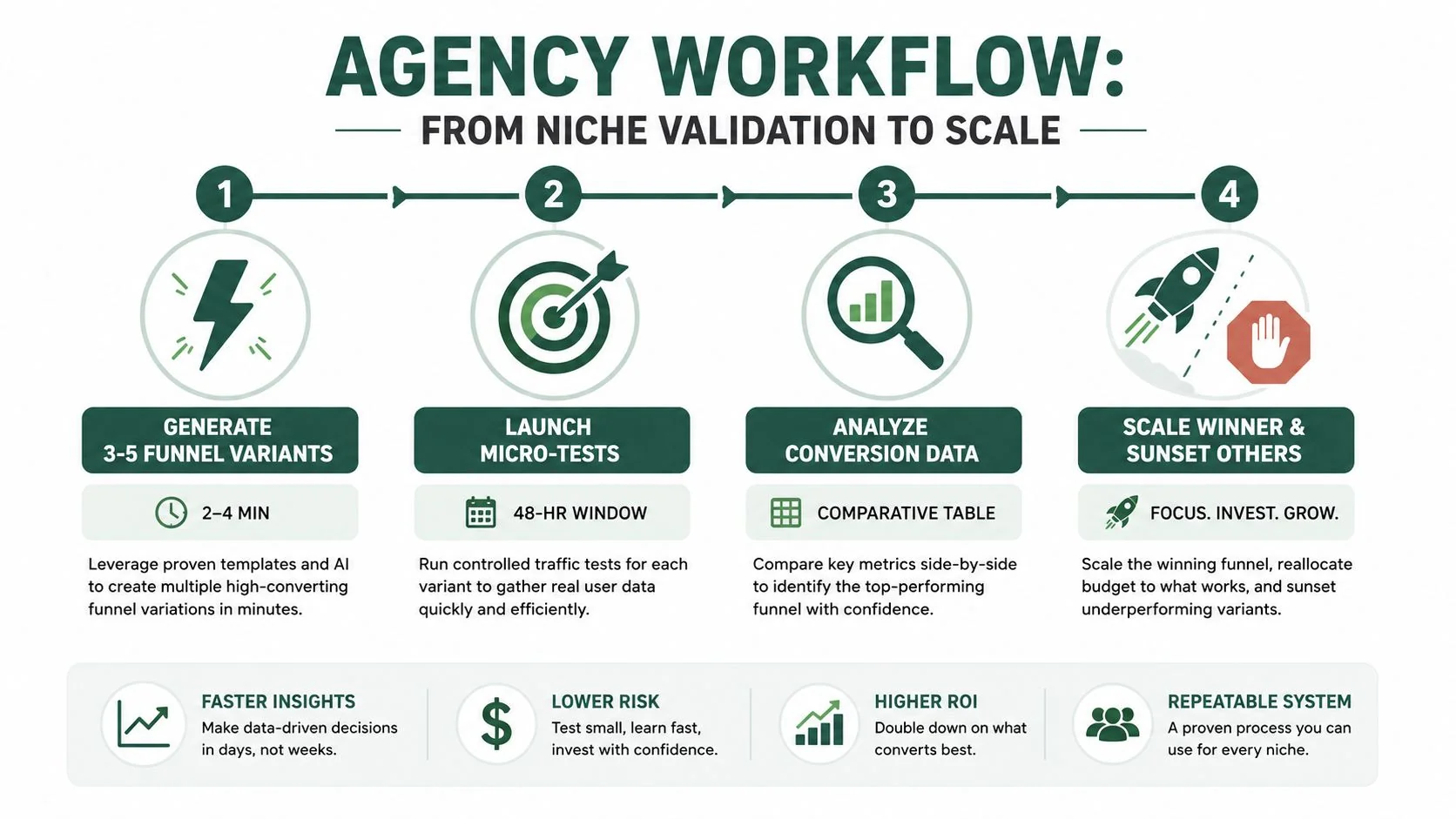
For software development agencies, the strongest use case for an AI funnel builder is niche validation tied to pipeline quality. A team can spin up multiple funnel variants in 2 to 4 minutes each, then test whether a vertical message attracts the right buyers before investing in content, outbound, and sales enablement (DoubleMyLeads, AI Funnel Builder). That speed does not prove the offer is strong, but it does shorten the gap between a positioning hypothesis and real buyer response.
Niche validation workflow
Start with a prompt that names the offer, audience, proof, and goal. For example, “Build a landing page for compliance software dev services aimed at healthcare SaaS founders, with a short form, case-study proof, and a demo-booking CTA.” The output should be a landing page, form logic, and a follow-up path that match the niche, not a generic agency template. If the page speaks to the wrong pain point, the traffic may still convert, but it will convert into weak pipeline.
If the first traffic test pulls weak relevance or muddy inquiries, kill the vertical or rewrite the positioning. If response quality is high, keep going and add more proof. For a software dev agency, the goal is better-fit conversations that justify sales time, not more visits.
Lead capture and qualification workflow
Interactive AI quizzes and conditional form logic matter when an agency wants more signal before a sales call. A prompt like “Create a discovery funnel for companies needing custom software modernization, with role-based branching and qualification fields for budget, timeline, and current stack” should produce a multi-step intake that filters for ICP fit before sales gets involved. The point is better sorting, not a longer form.
Good qualification adds friction only for the wrong buyer.
That matters because a software dev agency usually wins by narrowing scope, industry, and urgency before the first call. If the form captures the wrong context, the team still ends up with a calendar slot, but the slot belongs to a lead that will not move.
Sequence generation workflow
A more advanced prompt should ask the builder to generate the full schema, landing page, form fields, step logic, and branching for each answer path. That is the useful test because it shows whether the system can translate a campaign brief into a full operational journey, not just a prettier page. If the workflow stops at design, the team still has to stitch the pipeline together manually.
After launch, I’d judge the funnel on three tests.
| Test | Green Light | Yellow Light | Red Light |
|---|---|---|---|
| Message fit | Clear niche-specific replies | Mixed-fit replies | Generic responses |
| Lead quality | ICP-aligned, sales-ready | Some fit, some noise | Poor-fit volume |
| Operational handoff | CRM and sequences fire correctly | Manual cleanup needed | Data loss or broken routing |
The 100Signals software agency toolkit is relevant here because the workflow philosophy applies to the qualification step, not just the page build. Build the smallest version of the niche story, test it quickly, and scale only what real buyers respond to.
Common Pitfalls and How to Avoid Them
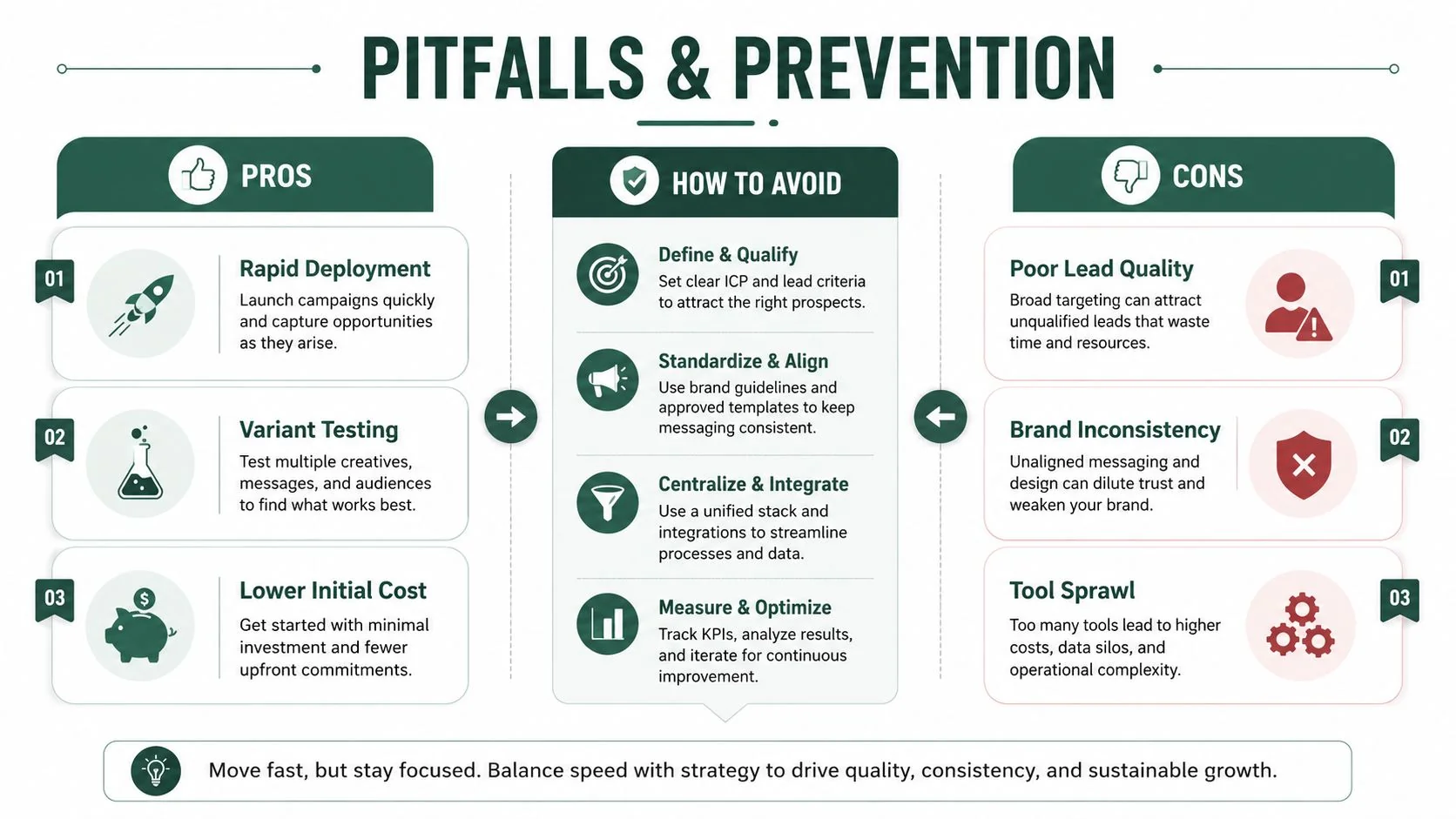
The biggest mistake is treating speed as strategy. A fast-built funnel that attracts poor-fit leads creates activity without pipeline, which is exactly how agencies end up with busy dashboards and thin revenue. Independent funnel guidance still puts ICP definition, lead capture, and prioritization of qualified leads at the center, which is the same problem most AI tools can’t solve by themselves (Pipedrive, AI sales funnel guidance).
The failure modes that show up first
The first failure is building automation before the core funnel converts. Teams wire in scoring, branching, and extra follow-ups before they’ve proven the base offer has traction. That usually means the team is optimizing the wrong thing, because no amount of automation can rescue weak positioning.
The second failure is using page generation as a substitute for ICP clarity. A prompt can’t tell you which segment has budget, pain, or urgency. It can only express the segment you already understand. When that understanding is fuzzy, the funnel will still run, but it will run toward the wrong people.
The third failure is ignoring multi-step drop-off. Every extra step creates a new place to lose the lead, especially if the routing isn’t tied to the buyer’s actual intent. If your form, quiz, and booking step don’t preserve context, the funnel leaks even if the landing page looks great.
The sequence that avoids the waste
- Build simple first. One offer, one audience, one path.
- Run real traffic. Don’t judge it from internal reviews.
- Inspect actual behavior. Watch where people abandon or stall.
- Confirm the core funnel converts.
- Add automation only where friction is proven.
That sequence is boring, and it works. It also matches how the 2026 CartFlows benchmark frames the market, because AI referral traffic already matters, but the conversion problem still lives in response speed, relevance, and lead handling (CartFlows sales funnel statistics, 2026).
A fast funnel helps you move into a niche faster, but only if it forces disciplined testing. If it just automates noise, it makes bad positioning easier to scale.
Metrics to Track and Pilot Framework
A funnel tool can generate pages quickly and still miss the point if it does not improve pipeline quality. The pilot should answer a harder question: does the system produce more qualified meetings for a specific niche, with cleaner routing and less manual cleanup? One vendor-adjacent benchmark claims a 20.5% lead-to-call conversion rate, compared with a commonly cited 5-10% range for traditional funnels, plus up to 5.46x ROAS and 3x more booked calls from intent-based triggers (Agentive AIQ, 2025-2026). Treat those figures as an upper bound, not a forecast.
The metrics that deserve a weekly review
| Metric | What it tells you | Why it matters |
|---|---|---|
| Lead-to-call conversion rate | Whether the funnel is creating meetings | Closest proxy for revenue motion quality |
| Time-to-first-response | Whether the system reacts fast enough | Speed is a conversion lever |
| Funnel drop-off by step | Where people leave | Shows whether friction is in the form, routing, or follow-up |
| Pipeline attribution per variant | Which niche or offer deserves scale | Prevents false wins |
Weekly review should focus on pipeline quality, not raw lead volume. A team needs to see which funnel version produced the call, which traffic source created it, and which segment accepted the conversation. A funnel that attracts the right buyer profile is more useful than one that fills the CRM.
A 30-day pilot that doesn’t waste time
Use one niche. Build three funnel variants. Run traffic for two weeks. Compare the variants on call rate, response speed, and lead quality, then cut the losers. If the tracking is muddy, fix attribution before you scale any variant.
I’d use this threshold. If the funnel creates response delays, weak qualification, or attribution gaps, stop and repair the process before adding more automation. If it produces cleaner meetings and a clearer niche signal, commit more budget to that segment and build the next campaign around the same audience.
Pilot rule: Scale the version that improves booked meetings and lead quality together. Ignore the one that only improves page velocity.
Response speed often determines whether a booked conversation turns into a real opportunity. Salesroads is a reference for call handling and follow-up timing.
An AI funnel builder earns its place when it helps a software development agency prove demand with less waste. If it only produces more pages, it adds little.