Optimizing Your Sales Organization Structure for 2026
Design a sales organization structure to scale your dev agency in 2026. Explore models, KPIs, and hiring roadmaps for growth-focused founders.
In April 2026, Tomasz Karwatka surveyed 119 dev agency owners. 41% had already lost deals or felt rate pressure from AI and client insourcing. 53% were burning budget trying to escape T&M. Most of them were also running a sales org built for a buying motion that no longer exists: founder-led at the top, generalists in the middle, account work scattered into delivery.
That’s a structural problem, not a sales-tactics problem. The decisions you make about how your sales org is shaped this year compound for the next three.
For a 60-to-300 person software development agency, sales org design is downstream of one bigger decision: which niche you actually own. Pick the niche and the structure follows. Skip the niche and no model fits.
Your Sales Organization Structure Is a Liability
Most dev agencies don’t choose a sales organization structure. They inherit one.
Founder closes the first ten deals. An SDR gets hired because pipeline feels thin. An account manager starts running upsells. Marketing throws in some campaigns. Now three people are touching the same account with no clean ownership and no shared definition of a qualified opportunity. The org chart looks harmless. The leakage shows up in missed follow-ups, weak discovery, and forecasts nobody believes.
Sales org structure belongs in the same category as architecture, staffing, and delivery design. It decides who owns pipeline creation, who converts interest into opportunities, who handles technical buying friction, and who protects retention and expansion.
Why founders should care
A founder focused on utilization and delivery can still get blindsided by GTM design failure. The pattern repeats:
| Failure point | What happens inside the agency | What the buyer experiences |
|---|---|---|
| Founder-led selling lasts too long | Closing depends on one person’s calendar and judgment | Slow response, inconsistent process |
| Generalists stay in place too long | Prospecting, discovery, proposal, and expansion compete for attention | Deals stall between steps |
| Roles overlap without ownership | SDR, AE, and delivery lead all contact the same account | Confusion and low trust |
| Structure gets too layered | Managers add process to fix noise instead of fixing design | Friction, slower decisions |
This is why “we need more leads” is the wrong diagnosis. You need fewer handoffs, tighter territories, or a split between net-new acquisition and account growth.
Practical rule: If your pipeline depends on heroic behavior from one founder or one seller, you have a temporary workaround, not a sales engine.
What a working structure does
A working sales organization structure does three things.
It clarifies ownership. One role owns first contact, another owns deal progression, another owns retention and expansion. No shared custody.
It matches buyer complexity. Simple transactional work tolerates generalists. Complex enterprise buying needs specialization and coordination.
It creates feedback loops. Objections, lost deals, and buying signals get routed back into positioning, offers, and targeting.
For a dev agency trying to own a niche, the third one is the point. If your sales design scrambles the evidence, you can’t tell which message is working, which segment is buying, or which positioning to double down on. Hearing the market is the job.
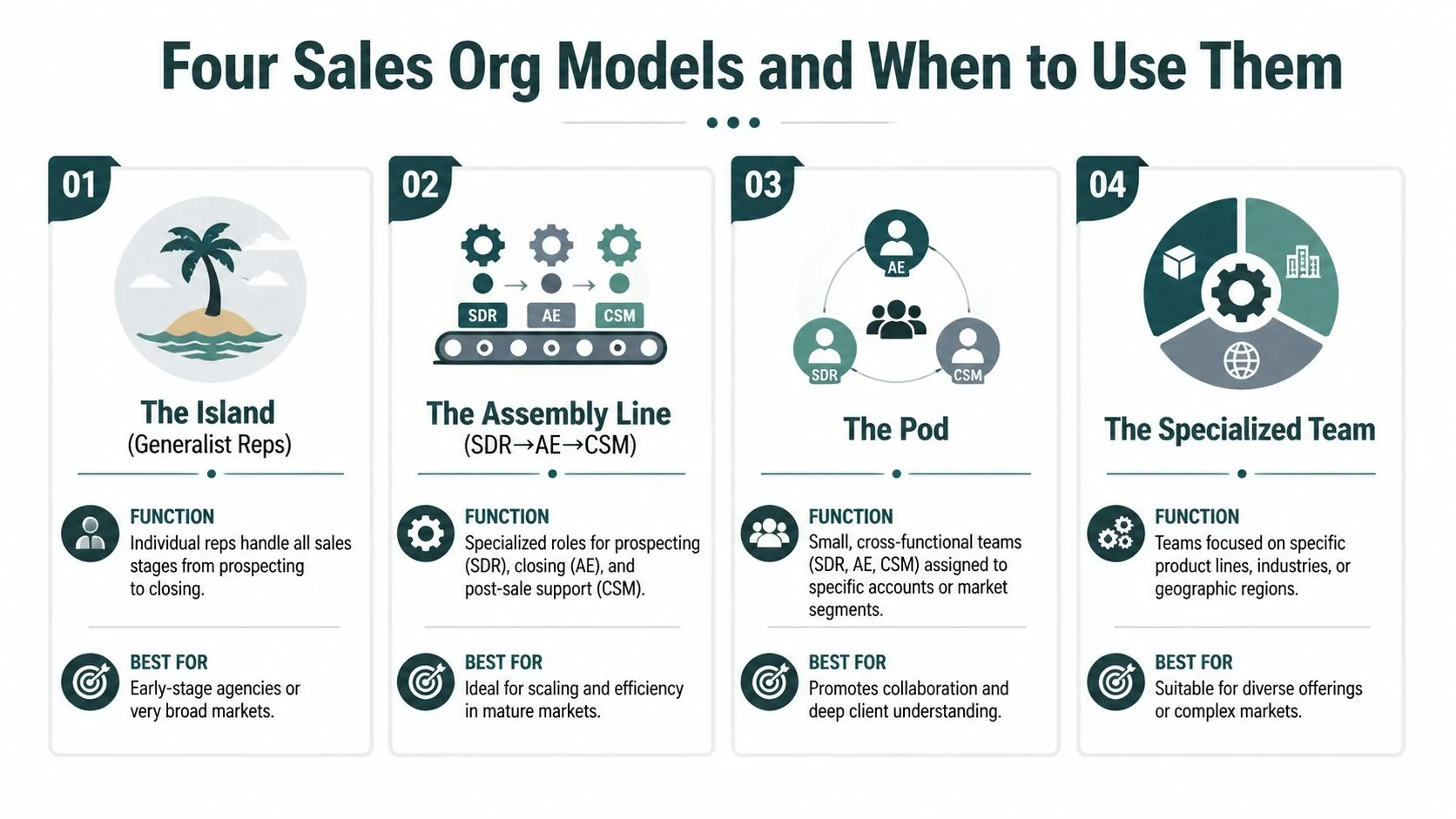
Four Sales Org Models and When to Use Them
A sales org model should change when buyer behavior changes. If intent signals concentrate in one niche, your structure tightens around that niche. If intent is weak and message-market fit is still shaky, keep the structure close to the founder and close to the buyer.
Trade-offs at a glance
| Model | Agency stage | Best for | Primary risk |
|---|---|---|---|
| Island | Founder-led, $5-10M ARR | Niche discovery, short cycles, direct buyer feedback | Rep overload and stalled follow-up |
| Assembly Line | $10-20M ARR with repeatable acquisition | Consistent outbound, higher pipeline volume, clear stage ownership | Poor handoffs and inflated top-of-funnel activity |
| Pod | Mid-market and enterprise pursuit by segment | Vertical specialization, strategic accounts, tighter collaboration | Team output hides weak individual performance |
| Hunter-Farmer | $15M+ ARR with material installed base | Separate net-new acquisition from expansion and retention | Account ownership disputes, messy incentives |
Island
The Island model gives one seller full control of the motion. Prospecting, discovery, proposal, negotiation, and close sit with the same person.
Use it when you’re still learning what buyers will pay for. This is the right model if your agency is testing a niche, refining its ICP, or hearing inconsistent objections. The founder gets raw signal fast because nothing is filtered through multiple roles.
It stops working once one seller is carrying too many contexts. A rep chasing cold outreach, running technical discovery, and pushing legal review in the same week becomes the constraint. In a dev agency selling modernization, platform engineering, or AI integration, that ceiling arrives early.
If one seller can’t keep response times under a business day and still run quality discovery, the Island model is too small for the opportunity in front of you.
Assembly Line
The Assembly Line splits ownership by stage. One role creates and qualifies pipeline. Another runs the deal. Another owns onboarding, retention, and expansion.
This model fits agencies that already know three things: who they sell to, what problem creates urgency, and what a qualified opportunity looks like. Once those are stable, specialization raises throughput. SDRs focus on list quality and conversion to meetings. AEs focus on multithreaded deals and commercial control. Account managers protect margin after the sale.
The failure mode is predictable. SDRs chase meeting count. AEs reject half the calendar. Delivery inherits poor-fit deals. That’s a design problem.
Move to Assembly Line when inbound intent is rising, outbound messaging is converting, and you need cleaner stage-by-stage accountability than founder-led selling can provide.
Pod
The Pod assigns a small cross-functional team to a segment, vertical, or named account group. For a dev agency, that means a dedicated combination of prospecting, closing, and growth roles around one market.
Pods make sense when domain context changes win rates. A generic rep sounds interchangeable in healthcare SaaS, fintech infrastructure, or logistics platforms. A pod that hears the same objections every week learns faster, sharpens messaging faster, and qualifies harder. Close rates go up. Time wasted on bad-fit accounts goes down.
This is also the cleanest response to intent data. If buying intent concentrates in one vertical, build a pod there. If intent spreads thin across five segments, don’t force pod specialization. You’ll create expensive focus theater.
Use pods when the segment is stable enough to justify dedicated coverage and valuable enough to produce repeat business.
Hunter-Farmer
The Hunter-Farmer model separates new logo acquisition from account growth. Hunters win the first deal. Farmers expand the relationship after delivery trust is in place.
This is the right call for agencies with a real installed base. If expansion revenue is material, stop asking net-new sellers to manage it between prospecting blocks. They will under-serve current accounts and miss new opportunities at the same time.
The split works in agencies with land-and-expand economics. Say a hunter closes a $60,000 entry project and a farmer turns it into a $250,000 annual account through roadmap work, team extension, or a second business unit. If nobody owns that expansion motion, it gets left to chance, and delivery staff end up doing unpaid account management.
A warning about management layers
Don’t try to fix a weak model by adding managers. Tall structures slow feedback, blur ownership, and hide mediocre selling behind approval chains. The OKR Hub on tall structures explains the trade-off clearly.
For a 60-to-300 person dev agency, the right structure has the fewest layers and the clearest accountability. Pick the model that matches your current buying signal. Change it when intent data shows your niche has matured to the next level.
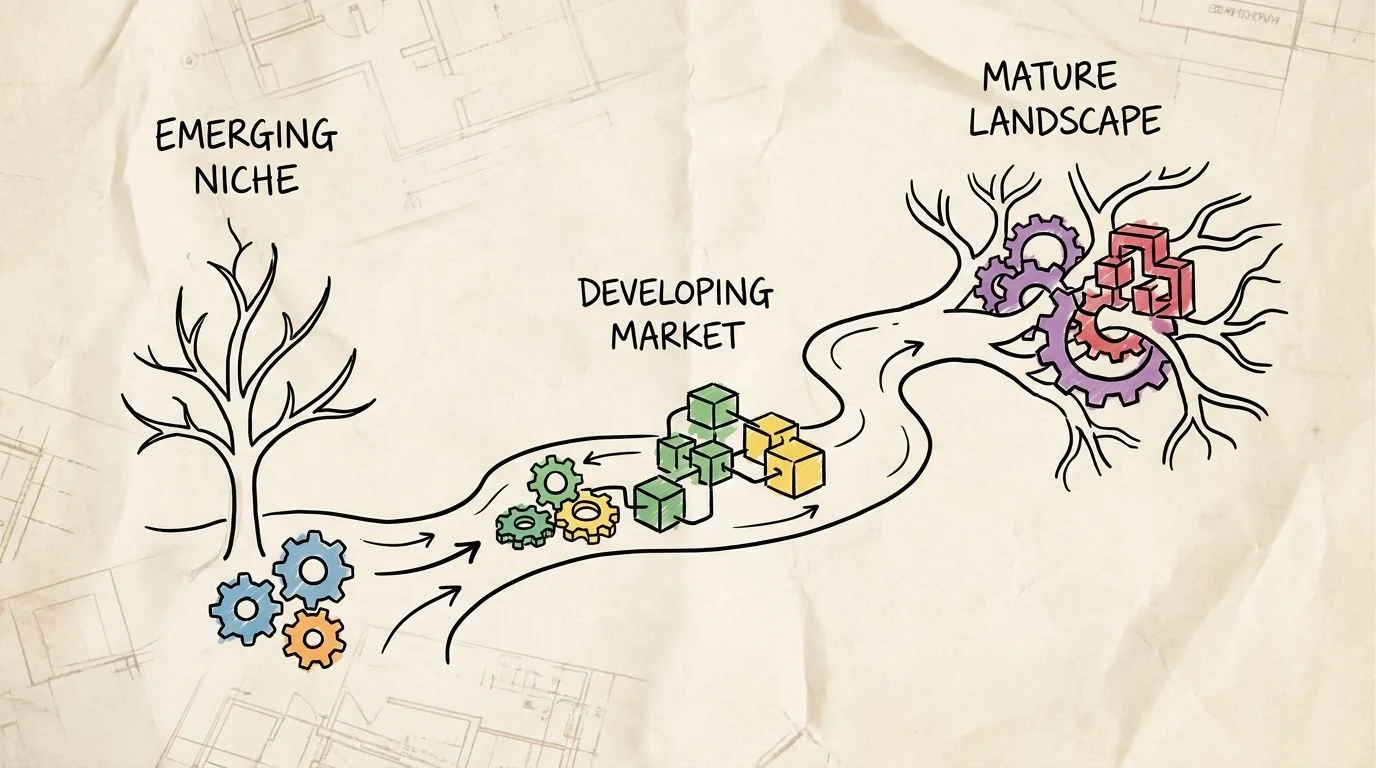
Choosing a Model Based on Niche Maturity
Teams that specialize too early create expensive noise. In agencies, that shows up as more meetings, more handoffs, and no improvement in close rate.
Headcount matters less than signal quality. A 70-person agency with a clear niche, repeatable objections, and visible buying triggers will outperform a 250-person agency that built roles around a vague ICP. If you structure for volume before the niche is proven, you turn uncertainty into payroll.
Emerging niche
An emerging niche has weak pattern recognition. Your team still debates who buys, what event creates urgency, and which message gets a reply. That’s not the time to add SDRs, split territories, or invent fancy stage ownership.
Keep the structure close to the market. Use an Island model or a founder plus one strong generalist. The person hearing objections should also help refine positioning, pricing, and offer design. Insert too many handoffs at this stage and you corrupt the feedback loop. Activity gets confused with demand.
Intent data raises the discipline. If third-party topic surges, inbound themes, and first-party website behavior look inconsistent across accounts, your niche is still forming. If only a small slice of target accounts shows repeated research behavior, you don’t have a broad repeatable motion. You have a hypothesis.
Run a simple test. If your team can’t define who your ideal customer is, what triggered their search, and why they chose you over a freelancer, consultancy, or internal team, keep the sales model simple.
Validated niche
A validated niche looks different. Calls start sounding familiar. Buyers raise the same concerns. Trigger events repeat. Intent signals cluster around a narrow account type instead of showing up randomly.
That’s the point to move into an Assembly Line.
Now specialization pays for itself. SDRs target accounts that show category interest. AEs run a repeatable discovery process because the buyer problem is no longer vague. Account managers expand delivery into adjacent services because the use cases are already proven.
Earn this shift. If intent data shows consistent engagement from the same vertical, job titles, and problem set for two or three quarters, your niche has matured enough to support role specialization. If those patterns disappear the moment you widen the list, the niche is narrower than you think.
| Niche maturity | Best fit | What triggers the change |
|---|---|---|
| Emerging | Island | Weak message consistency, scattered intent, founder still refining the offer |
| Validated | Assembly Line | Repeated buying triggers, stable ICP, clear qualification pattern |
| Dominated, complex sales | Pod | Strong niche position, larger buying committees, multi-threaded deals |
| Mature install base | Hunter-Farmer | Predictable expansion revenue, account growth needs dedicated ownership |
Dominated niche, enterprise complexity
A dominated niche creates a different problem. The question shifts from “who buys this?” to “how do we win without losing control of a complex sale?”
Pods are the answer. Enterprise deals involve technical reviewers, procurement, finance, and delivery stakeholders earlier in the cycle. One rep can quarterback the deal but not alone. A pod covers commercial, technical, and relationship risk without forcing the buyer through disconnected conversations.
Intent data matters here too. When buying activity spreads across multiple contacts in the same account, and research shifts from broad problem exploration to vendor comparison or migration concerns, the niche is mature enough for pod coverage. That’s the signal to organize around coordinated account pursuit instead of linear stage handoffs.
A common failure pattern is easy to spot. The agency wins mid-market deals with a strong founder-led pitch, then stalls in enterprise because procurement asks for detail, technical teams ask for proof, and nobody owns the full account strategy. Good positioning doesn’t fix weak structure.
A niche can be mature and still punish the wrong org design. Enterprise buyers expose every sloppy handoff.
Keep the model clean
Don’t run three structures at once unless you enjoy confusion. A founder-led motion for one segment, SDR-to-AE for another, and hunter-farmer for a third creates reporting noise, role conflict, and missed follow-up.
Use one primary model. Add a second only when the revenue case is obvious.
For a 60-to-300 person dev agency, the rule is straightforward:
- If intent signals are weak and uneven, keep sales close to the founder or a generalist seller.
- If intent signals repeat across a narrow ICP, specialize by stage.
- If intent signals expand across multiple stakeholders in larger accounts, use pods.
- If existing clients show reliable expansion intent, split net-new acquisition from account growth.
Role Templates, KPIs, and Compensation
A sales organization structure fails at the role level before it fails at the org-chart level. If sellers don’t know exactly what they own, your pipeline turns into shared custody.
The Center for Sales Strategy reports that one in five people are in the wrong role. Their analysis also notes that high-performing organizations enforce stronger accountability and move faster on under-performance, as covered in their role-fit guidance. For dev agencies, this shows up when a good relationship manager gets pushed into hunting, or when a sharp prospector gets asked to run long commercial cycles.
Role scorecard
The SDR exists to create qualified conversations, not just activity. The AE owns conversion. The Account Manager owns continuity and expansion. The Pod Lead owns segment strategy.
| Role | Core responsibilities | Non-negotiable KPIs | Compensation logic |
|---|---|---|---|
| SDR | Target accounts, outbound messaging, qualification, meeting creation | Qualified meetings held, AE acceptance rate, progression to real pipeline | Higher base, variable tied to qualified meetings and pipeline acceptance |
| AE | Discovery, opportunity management, proposals, commercial close | Pipeline progression, closed-won revenue, sales cycle control, forecast accuracy | Balanced base and variable tied to closed revenue and stage conversion quality |
| Account Manager / CSM | Onboarding continuity, renewal, expansion, account health | Retention quality, expansion creation, cross-sell movement, client continuity | Base-heavy, variable tied to retention and expansion |
| Pod Lead | Segment strategy, role coordination, deal orchestration | Pod pipeline quality, conversion discipline, account penetration | Mix of leadership MBOs and team performance variable |
SDR
For a dev agency, an SDR owns three things.
Account selection. Work from a fixed list, not random pulls from Apollo, Clay, or HubSpot every week. The list is the strategy.
First-touch quality. Outreach reflects niche context, the likely trigger, and the buying role. No “saw you on LinkedIn” openers.
Qualification discipline. No dumping weak meetings into AE calendars to hit a number.
Pay for accepted quality, not raw output. If you pay only for meetings booked, SDRs book noise.
AE
AEs own conversion, not top-of-funnel volume. Their job is to turn qualified interest into a real buying process. In agency sales, that means sharper discovery, stronger problem framing, and cleaner commercial control than most teams manage.
Audit your AE’s last 10 calendar weeks. If more than 20% of their hours sit in list-building, sequence-writing, or unqualified discovery, your structure is broken, not the AE. A coaching plan won’t fix it. An SDR seat or a tighter qualification gate will, this quarter. Inside agencies in the $5-30M ARR band, this is the most common AE pattern and the most postponed fix.
A practical AE scorecard mixes leading and lagging indicators:
- Opportunity progression. Are deals moving with purpose or sitting idle?
- Proposal quality. Are scopes aligned to client urgency and buyer economics?
- Closed-won revenue. Obvious, but not enough on its own.
- Forecast integrity. If the AE’s commit number is fiction, leadership can’t allocate capacity.
Account Manager or CSM
For agencies, this role matters more than founders think. Expansion revenue often comes from trust built after delivery starts, not from the original close. If no one owns that path, growth gets left to chance.
The account role owns renewal visibility, expansion timing, relationship mapping, and continuity between sales promises and delivery reality. Don’t measure this person like an SDR or an AE. The job is durable commercial growth inside existing accounts.
The fastest way to poison expansion revenue is to put a pure hunter in charge of an account after close and expect nuance.
Pod Lead
In pod structures, someone needs real authority over coordination. Not ceremonial leadership. Actual responsibility for the segment, account strategy, and internal decision flow.
The Pod Lead sets account priorities, resolves handoff disputes, pressure-tests opportunity quality, coordinates with delivery on strategic fit, and stops the pod from fragmenting into individual quotas with shared excuses.
Pay this role on a mix of management-by-objective targets and team outcomes. If you pay only on personal production, the role collapses back into individual behavior.
Compensation principles that don’t create bad behavior
Compensation should map to role intent.
| Role type | Reward | Avoid |
|---|---|---|
| Pipeline creator | Qualified meetings and accepted opportunities | Raw send volume, meetings without quality gate |
| Closer | Closed revenue, disciplined stage movement | Pure bookings without fit standard |
| Growth owner | Retention and expansion | Forcing expansion before value is established |
| Team lead | Team performance, operating discipline | Personal heroics labeled as leadership |
If a role owns one thing, pay for that one thing. Most comp failures come from mixed signals. The SDR gets paid for quantity, the AE gets punished for rejecting junk, and the founder wonders why trust breaks down.
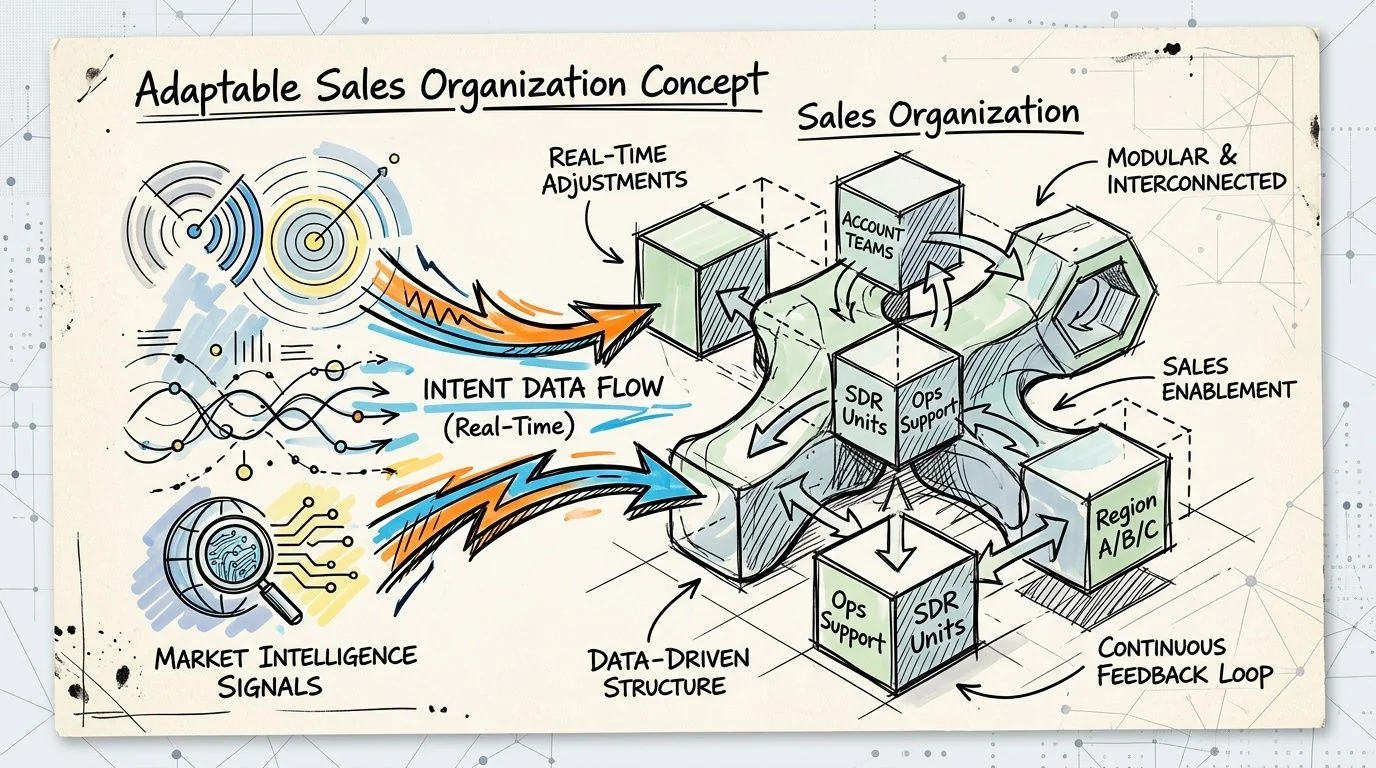
Using Intent Data to Trigger Structural Changes
A sales organization structure should react to market evidence, not internal politics.
Most agencies redesign sales after performance drops. That’s backward. Use intent data, search behavior, and account-level buying signals as an early warning system. If a cluster of accounts starts showing interest around a problem your agency already solves, structure should adapt before pipeline decays or a competitor gets there first.
What intent should trigger
Not every signal deserves a reorg. Some signals demand a change in coverage, role focus, or team shape immediately.
| Intent pattern | Structural response | Why it matters for a dev agency |
|---|---|---|
| Repeated demand around a single technical problem | Spin up a focused hunter motion | Captures urgency without disrupting core accounts |
| Rising activity inside one vertical | Create temporary vertical coverage or a mini-pod | Speeds learning, improves message consistency |
| Existing accounts showing adjacent need | Shift account growth ownership and expansion plays | Prevents net-new team from missing installed-base upside |
| Sales-accepted leads stalling after discovery | Rework qualification and AE ownership rules | Stops waste before it enters forecast |
A concrete example. Target accounts suddenly show buying interest around legacy platform migration, cloud cost control, or AI product integration. That can justify a temporary hunter team, a dedicated AE, or a pod aligned to that problem set.
If you don’t know which signals your accounts are throwing, run a free Scan. Ten minutes, a positioning read, and a recommended next step on which niche your structure should be tracking.
Intent is only useful if qualification is clean
Many firms collect account signals, then route them into the same cluttered system that already mishandles inbound and outbound. The dashboard looks busy. The pipeline doesn’t move.
Set a clear threshold for what becomes a real opportunity. If your team still argues about that, fix it first. A practical reference is this guide on what a sales qualified lead is. Without that discipline, intent data creates more meetings, not better pipeline.
Treat intent as a routing signal, not a vanity dashboard. Its job is to change who acts, when they act, and what coverage model they use.
A simple operating rhythm:
- Weekly signal review. Sales, RevOps, and marketing review account-level themes.
- Coverage decision. Keep in current motion, assign to focused hunter, or move into pod.
- Message adaptation. Update outreach and discovery based on what the signal suggests.
- Fast feedback. Confirm whether those accounts convert or just look active.
A video walks through how adaptive sales motions work in practice.
Treat structural changes as bounded tests
Don’t make permanent org changes off one hot signal cluster. Reassign a subset of accounts. Create a focused pursuit team. Monitor whether signal-rich accounts move faster or convert cleaner.
For a dev agency, this protects the core business while letting you exploit timing. That’s the value of intent data. It tells you when your current sales organization structure is no longer the best fit for the market you’re facing.
A Roadmap for Scaling Your Sales Org
Most agencies wait too long to redesign sales, then overcorrect. Founder-led for years, then a five-person team in a quarter. The result is role confusion masquerading as growth.
The better path is staged specialization.
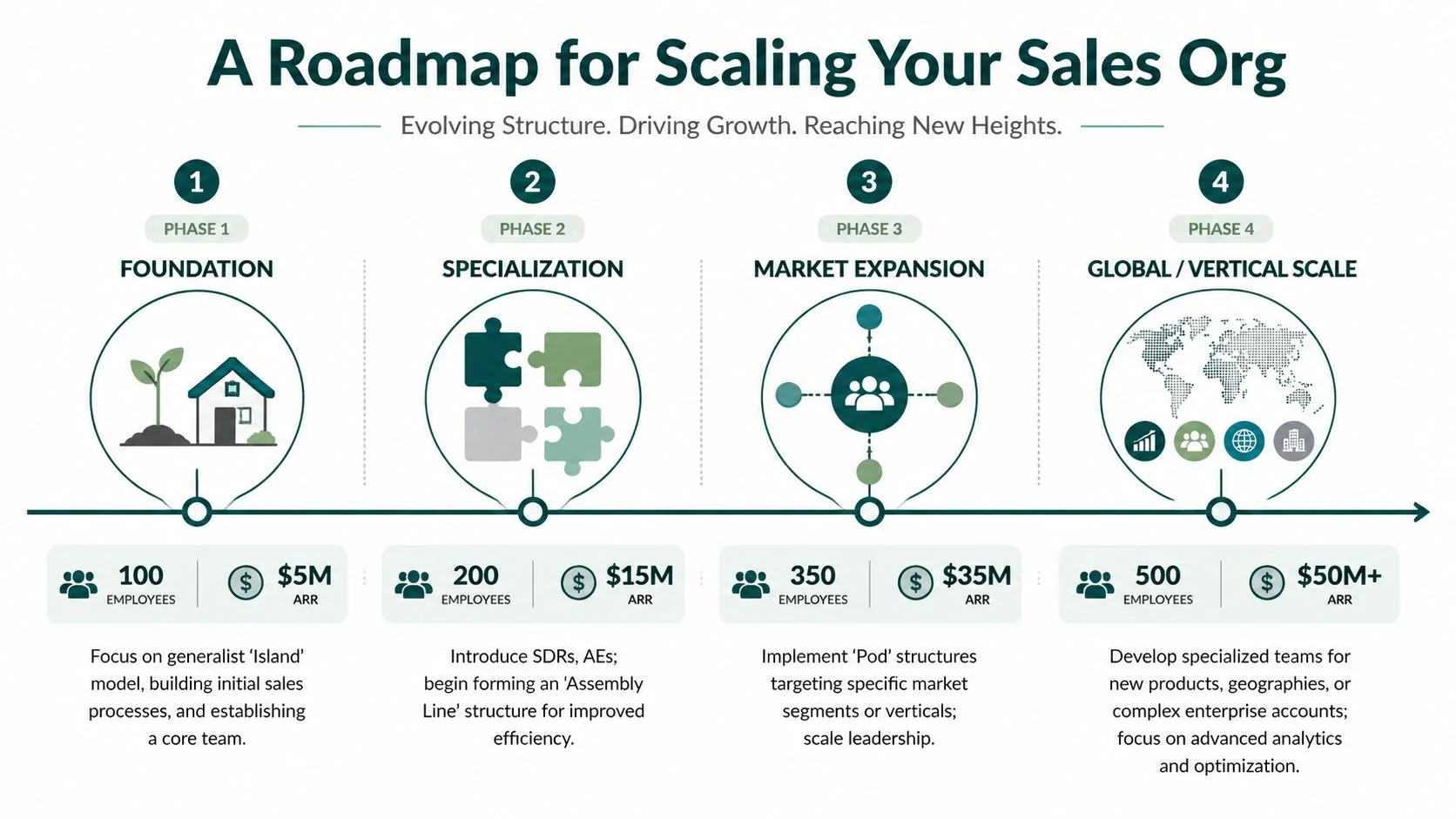
Phase one and phase two
The most important transition is the move from founder-led generalism to role specialization. In scaling from $3M to $10M ARR, the shift to an Assembly Line structure is the move that matters. Prospeo’s summary of RAIN Group research notes that elite sales organizations achieve 77% optimal account assignment rates compared with 36% in average performers, a 41-point gap.
For a 60-to-200 person dev agency, the sequence:
| Phase | Typical shape | What to install |
|---|---|---|
| Founder-led foundation | Founder plus one generalist seller | Basic CRM hygiene, target account rules, clear pipeline stages |
| Early specialization | SDR plus AE plus account owner | Qualified handoffs, discovery standards, account ownership map |
Hire SDR capacity before adding multiple closers. If AEs spend their time creating pipeline from scratch, you’ve relabeled generalists.
What a 100-person agency should look like
A 100-person agency needs simplicity with discipline, not a matrix.
A workable shape:
- Founder or sales leader owns market direction and strategic deals.
- One or two SDRs own target account outreach and qualification.
- One or two AEs own discovery, proposals, and closing.
- One account growth owner handles post-sale expansion and renewal risk.
- One RevOps or sales operations function cleans data, handoffs, and reporting.
The point is clear role boundaries.
A common mistake at this stage: hire a senior AE first and expect them to self-source, close, manage delivery alignment, and expand accounts. That person can be talented and still fail because the structure asks for four jobs.
Phase three and phase four
As the agency moves toward 200-to-300 employees, the structure should reflect segment complexity, not headline volume. Pods, vertical teams, and selected overlays earn their place.
A 250-person agency selling across well-defined niches might use:
- Vertical pods for core markets.
- A central RevOps layer for process, reporting, and account routing.
- Specialized account growth roles for major accounts.
- Selective overlays for technical pre-sales or regulated sectors.
That still needs restraint. Complexity outruns performance fast. If you’re considering a broader redesign that affects reporting lines and operating cadence, Synopsix’s organizational restructuring guide is a useful planning reference.
Use lead management maturity as the scaling gate
Headcount doesn’t justify complexity. Operating maturity does.
Before adding pods or overlays, confirm that your lead routing, qualification, and ownership rules are stable. If they aren’t, the extra structure hides confusion inside more boxes. This guide on managing sales leads is a practical checkpoint because it forces discipline around intake, handoff, and follow-up.
Add a new layer only when the current layer is constrained by market complexity, not when managers are frustrated.
What to avoid at every stage
| Scaling mistake | Why it hurts |
|---|---|
| Hiring closers before pipeline creation is stable | Expensive talent gets stuck prospecting |
| Keeping founders in every late-stage deal | Team never develops independent close discipline |
| Adding geography, vertical, and product splits at once | Reps lose focus, ownership gets muddy |
| Treating account management as admin | Expansion gets ignored until clients ask for help |
Sales org structure should get more precise as your niche sharpens and your account base deepens. It shouldn’t get more complicated because the org got bigger.
The Niche Decision Comes Before the Org Chart
Technical capability isn’t enough to win a dev agency market for long. Another firm can copy your service page, hire similar engineers, or claim the same stack expertise. What’s harder to copy is a sales organization structure that turns niche insight into repeatable pipeline.
A working structure does three things rivals fail at. It routes the right accounts to the right people. It keeps market feedback clean instead of distorted by role confusion. It converts niche authority into meetings, opportunities, and expansion with less waste.
This is market design.
The single biggest predictor of which model fits is which niche your agency owns. Run an Island in a clear niche and you’ll outperform an Assembly Line in a vague one. Skip the niche question and rearranging the org chart fixes nothing.
Most agencies we audit are running a sales org built for the agency they were three years ago, in a niche they never explicitly chose, against AI pressure that didn’t exist when the structure was set. The fix starts with deciding which market your team is for.
If you don’t know which niche to bet the next 12 months on, run the free Scan. Ten minutes, one positioning read, one recommended next step. That’s the decision that comes before the org chart, not after.
Frequently Asked Questions
What’s the right sales structure for a 50-person dev agency?
Stay close to founder-led with one strong generalist. Below 60 people, the cost of role specialization outruns the lift. Add an SDR seat when the founder can’t keep response times under a business day and still run quality discovery.
When does a dev agency need its first dedicated AE?
When the founder is the only person closing, has spent a quarter trying to step out, and pipeline has stalled because of it. The trigger is the founder becoming a single point of failure on commercial close.
Can we run an Assembly Line structure on a fuzzy ICP?
Not well. Assembly Line assumes you know who buys, what creates urgency, and what qualified looks like. With a fuzzy ICP, SDRs chase noise, AEs reject the calendar, and delivery inherits poor-fit deals. Tighten the niche before you tighten the structure.
Should AI change how we structure a sales team in 2026?
It changes who you sell to and how fast they evaluate, more than it changes the org chart. AI tooling on the buyer side compresses cycles and raises expectations on first touch. Hire and pay for first-touch quality. Don’t replace SDRs with sequencers and call it specialization.
Hunter-Farmer or Pod for a $20M ARR dev agency in a single vertical?
Pod, if buying committees are large and account complexity is high. Hunter-Farmer, if the install base is producing predictable expansion and net-new sellers are losing focus on it. Some agencies run both, with hunters seeded inside vertical pods.
How long should we run a structural change before judging it?
A full sales cycle plus 30 days. For dev agency engagements, that’s usually 90 to 150 days. Anything shorter is judging on noise.