What Is a Sales Qualified Lead? Dev Agency Guide 2026
What is a sales qualified lead for a dev agency? A prospect vetted by sales for fit & intent. Learn criteria, scoring, & processes to turn leads into pipeline.
A Sales Qualified Lead (SQL) is a prospect your sales team has personally vetted and confirmed has a specific, solvable problem, the budget to fix it, and the authority to sign a check within a reasonable timeframe. For a dev agency, focusing on SQLs means your team stops wasting time on the 70-80% of “leads” who will never buy. Without a qualification process, that’s most agencies.
Most agencies still treat SQL as a CRM status update. That’s lazy thinking. An SQL is a resource allocation decision. If your account executives, founders, or senior solution consultants spend time with people who can’t buy, won’t buy, or shouldn’t buy, they’re subsidizing confusion instead of building pipeline.
The classic SQL definition was simple. Marketing generated interest, then sales checked budget, authority, need, and timeline. That still matters, but it’s incomplete for software development agencies. In practice, the best SQLs now start qualifying themselves before they ever fill a form. They read your niche pages, compare you against alternatives, see your team on LinkedIn, and increasingly encounter your brand in AI assistants and search before replying to outreach. By the time sales talks to them, they have already done much of the vetting themselves.
That changes the standard. For an agency selling high-trust, high-ticket services, someone who booked a call is not an SQL yet. A real SQL is a prospect whose company fits your niche, whose buying problem is live, and whose prior exposure to your authority makes the first conversation commercially serious instead of educational.
The Real Definition of a Sales Qualified Lead for an Agency
A Sales Qualified Lead is not a lead marketing likes. It’s a prospect sales independently vets as ready for direct engagement across fit, intent, and timing, with confirmation of budget, authority, need, and timeline. Salesforce states that this standard produces a 3-5x higher conversion probability to opportunities than unvetted MQLs, while helping teams avoid the 40-60% of rep time lost on non-viable leads in Salesforce’s explanation of sales qualified leads.
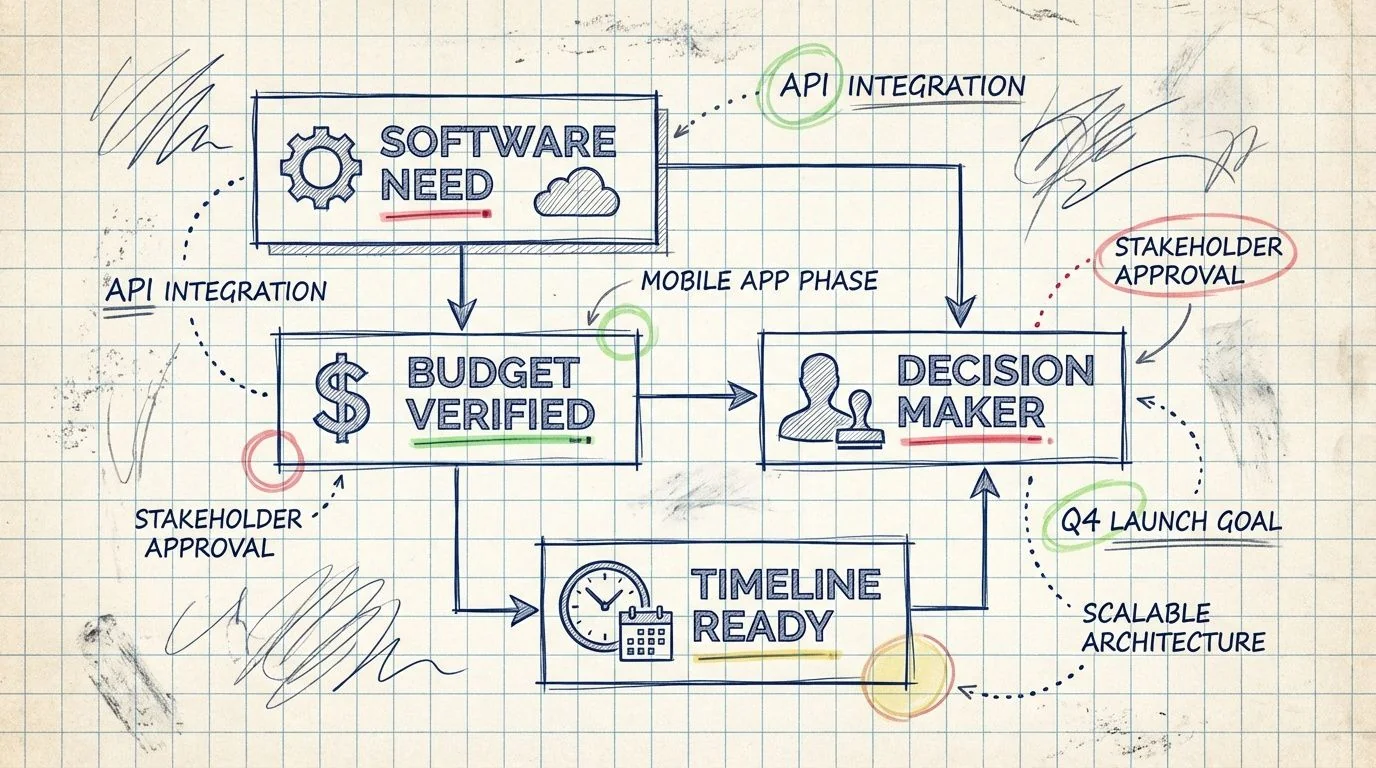
That definition matters more in an agency than in product-led SaaS. Your sales capacity is expensive. The people qualifying and closing work are usually some combination of founder, VP Sales, senior AE, architect, or delivery lead. Every wasted discovery call pulls scarce technical and commercial judgment away from deals that could close.
Why agency founders should care
Most agencies get this wrong in one of two ways:
| Agency mistake | What it looks like | What it causes |
|---|---|---|
| Calling interest “qualification” | Someone downloads a guide, attends a webinar, or replies “sounds interesting” | Sales chases noise |
| Calling meetings “pipeline” | Calendars fill with exploratory calls that have no buying process behind them | Forecasts become fiction |
If your sales team hasn’t verified commercial reality, you do not have an SQL. You have activity.
So the cleanest way to think about SQLs in an agency is as a gate on senior time. If the lead passes, deeper discovery makes sense. If it doesn’t, push it back into nurture or drop it.
Practical rule: If a prospect can’t articulate the problem, the internal owner, and a realistic buying path, they aren’t sales qualified yet.
The standard textbook definition is too narrow
BANT still works, but agencies shouldn’t stop there. If you want a useful companion framework for the basics, Embers has a straightforward breakdown of how to define and qualify sales leads that’s worth sharing with SDRs and AEs before they start inventing their own rules.
The agency-specific upgrade is recognition. When a prospect already knows your niche, has seen your work in search, and recognizes your firm before outreach lands, the SQL conversation starts from trust instead of cold skepticism. Recognition sharpens qualification without replacing it. Sales can spend less time explaining who you are and more time verifying whether the deal is real.
So the definition for an agency is harsher than the generic one. An SQL is a prospect sales has validated as commercially active, operationally fit, and worth senior attention. Anything less is pipeline theater.
Lead vs MQL vs SQL vs Opportunity Why the Labels Matter
Most agency teams say the labels don’t matter. They do. If you blur lead, MQL, SQL, and opportunity into one mushy category called “pipeline,” nobody owns quality and everyone blames everyone else.
The biggest clue is conversion. The average MQL-to-SQL conversion rate is 12-18%, which means most leads marketing passes are still not ready for direct sales engagement, according to SalesMotion on lead qualification. If your sales team treats every MQL like a real buying conversation, you’re choosing inefficiency on purpose.
Lead stage comparison for a software development agency
| Stage | Definition | Owner | Example for a Dev Agency |
|---|---|---|---|
| Lead | A contact or account that entered your system but hasn’t been qualified | Marketing or outbound prospecting | A VP Engineering downloads a guide on legacy modernization |
| MQL | A lead that has shown enough interest for marketing to flag it for review | Marketing | A director attends a webinar, visits service pages, and engages with follow-up emails |
| SQL | A prospect sales has vetted for fit, intent, and buying readiness | Sales | A platform lead asks whether you can integrate with their legacy ERP and discusses active project plans |
| Opportunity | A qualified deal being actively worked through a buying process | Sales | Multiple stakeholders join discovery, scope is discussed, and commercial steps are underway |
Why agencies keep mixing these up
The confusion usually starts with incentives.
Marketing wants volume because volume is visible. Sales wants meetings because meetings make the dashboard look alive. Founders want reassurance, so teams report “pipeline” long before there’s any proof of budget, ownership, or urgency. The result is predictable. CRM stages become optimism labels.
A clean lifecycle fixes that. If you need a good operational reference, MetricsWatch has a solid complete lead lifecycle guide that teams can use to align definitions before another quarterly review turns into finger-pointing.
Labels decide who acts next, what evidence is required, and whether the deal deserves senior time.
What each stage means in practice
An MQL is marketing saying “this account looks interesting.” An SQL is sales saying “I checked, this is real.” An opportunity is the team saying “we’re trying to win this.” Stop letting the first masquerade as the third. The labels exist so accountability has somewhere to land.
The operational consequence
The 12-18% MQL-to-SQL benchmark should make most agencies less proud of lead volume and more skeptical of it. The useful question isn’t “how many leads did marketing generate?” It’s “how many survived sales scrutiny?”
That distinction matters even more when you’re building niche authority. If your positioning is sharp, fewer contacts should make it through the top of the funnel, but more of the right ones should advance. That’s healthier than flooding sales with generic interest from companies you’ll never close.
SQL Qualification Criteria Your Sales Team Must Use
If your reps “qualify” by vibes, your forecast is fake. Use a checklist. For most agency deals, that checklist starts with BANT. Zendesk defines a sales qualified lead as a prospect showing clear purchase intent, with qualification requiring assessment of need, expressed interest, and budget availability, and notes that BANT has emerged as the industry-standard methodology in its guide to sales qualified lead criteria.
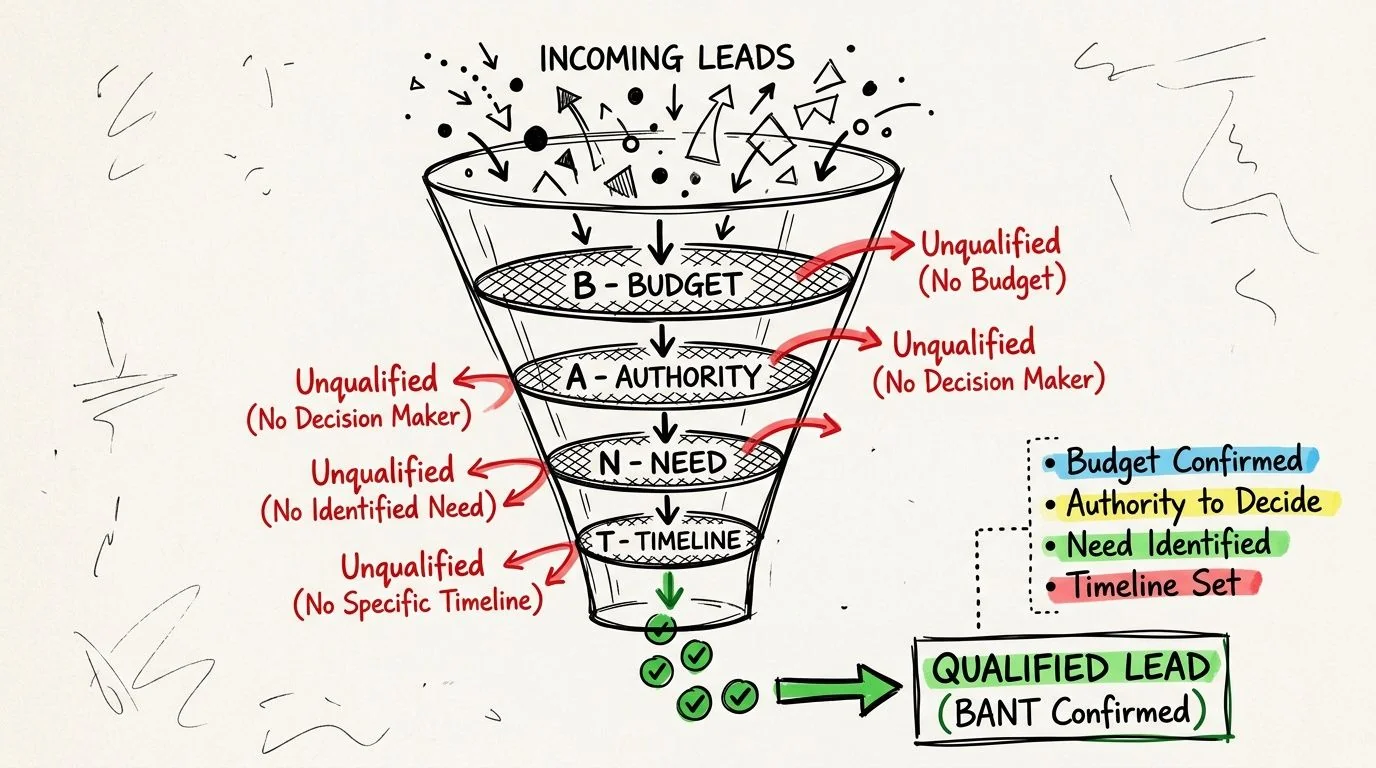
BANT is not profound. That’s why it works. It forces your team to stop mistaking pleasant conversations for commercial ones.
The BANT questions that matter in agency sales
| BANT factor | What sales must confirm | Useful agency question |
|---|---|---|
| Budget | There is money allocated or a credible path to allocation | “What budget has the team set aside for this initiative?” |
| Authority | You’re talking to a decision-maker or someone with direct influence | “Who besides you will sign off on vendor selection?” |
| Need | The problem is real, costly, and tied to your service | “What breaks if this doesn’t get fixed?” |
| Timeline | There is an actual implementation window | “When do you need a team in place or delivery started?” |
Don’t ask these like a script robot. Ask them like an operator trying to decide whether to commit resources.
The common agency failure is skipping budget because it feels awkward, skipping authority because the contact seems enthusiastic, and accepting vague timing because “we should keep it warm.” That’s how teams stuff the pipeline with deals that die slowly.
What good qualification sounds like
Good qualification gets specific fast.
A serious prospect can explain why the work matters now. They can tell you whether this is replacing an internal team, filling a capability gap, or supporting a launch, migration, or modernization effort. They can identify who owns the decision and whether procurement, engineering, product, or finance is involved.
Bad qualification sounds broad. “We’re exploring options.” “No fixed budget yet.” “Still figuring out timing.” Treat those as disqualifiers until someone proves otherwise.
Ask the uncomfortable question early. It’s cheaper to lose a weak deal in the first call than in month three.
When BANT isn’t enough
BANT is fine for straightforward service projects. It starts to break when the deal is larger, more political, or spread across multiple stakeholders. That’s where MEDDIC or MEDDPICC is better, because it forces your team to map decision criteria, decision process, economic buyer, and internal champion.
Force Management’s MEDDICC methodology is the cleanest reference here. Force Management says it’s the framework PTC used to grow from $300M to $1B in revenue, and it forces reps to map the economic buyer, decision criteria, decision process, and internal champion before forecasting anything. Internally, you also need a consistent review rhythm. Formalize the inspection around managing sales leads effectively, with reps required to show evidence for each qualification field before a deal moves forward.
Non-negotiables for a dev agency
Use these rules:
- Budget must be discussed: If nobody can describe a spending range or funding path, pause the deal.
- Authority must be mapped: If the only contact is an individual contributor with no access upward, keep nurturing, don’t forecast.
- Need must be specific: “We need more engineering capacity” is weak. “We need a partner who can ship this modernization work against our existing stack” is stronger.
- Timeline must attach to a business event: Launch date, migration deadline, internal hiring gap, or board pressure. Without that, urgency is often fictional.
An SQL in an agency context is a prospect that survives this interrogation without hand-waving. If your team can’t hold that line, your close rate will tell the truth later.
High-Intent Signals That Identify SQLs Before They Reach Out
The best SQLs usually don’t announce themselves with a form fill. They leave a trail. Smart agencies watch that trail before sales starts outreach.
MarketJoy’s intent data analysis shows prospects who hit pricing pages and request demos convert at 28%, versus 5% for passive engagers. Early sales validation filters out 65% of unfit leads before outreach starts and lifts pipeline velocity by 40%.
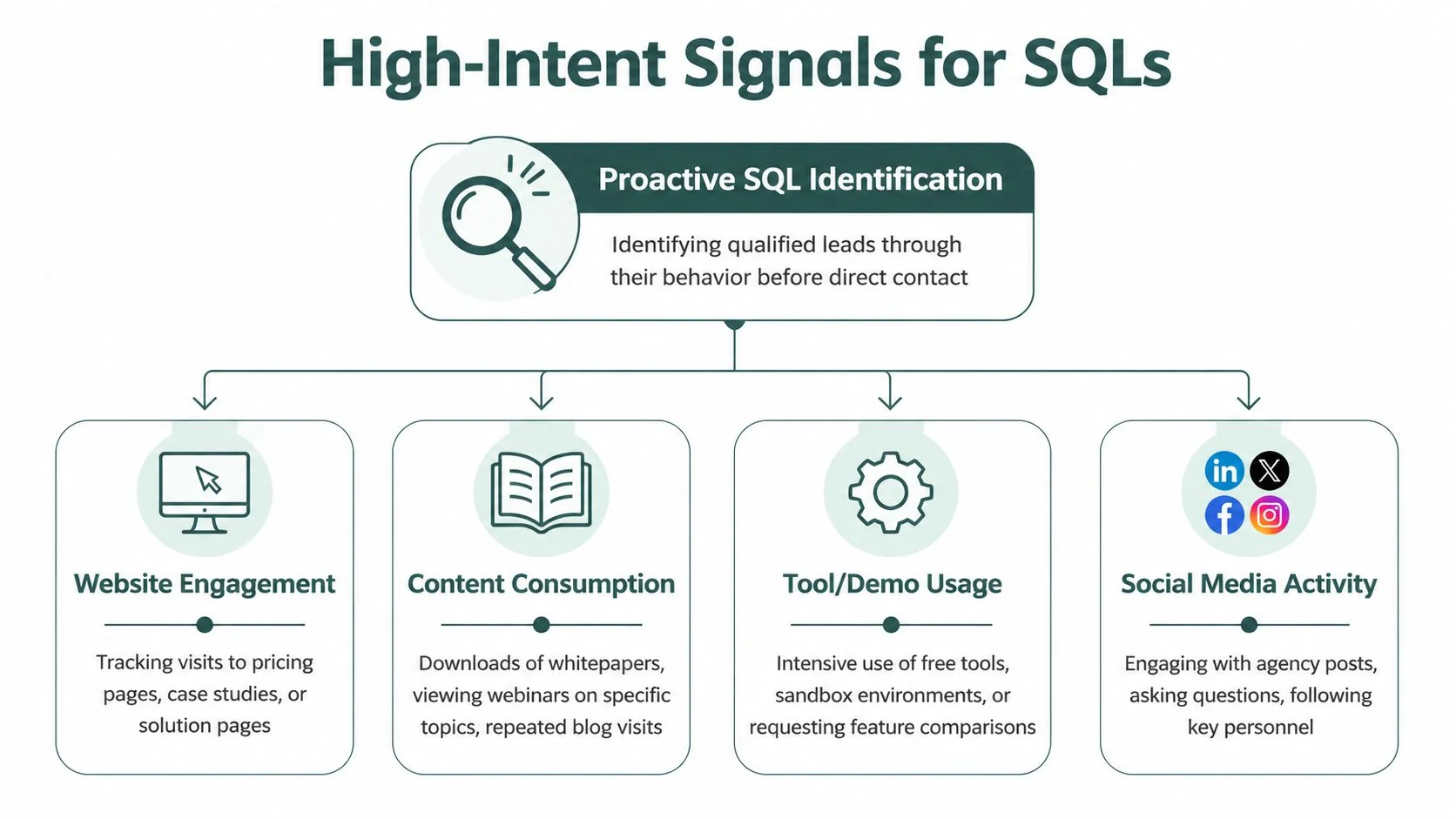
High-intent signals for SQLs
The usual digital body language still matters: pricing page visits, demo requests, and repeat visits to solution pages.
But agencies that stop there are behind. For software development services, intent often shows up earlier and across channels. A buyer reads a niche article, checks your case-study style content, compares service pages, interacts with your technical leaders on LinkedIn, and asks AI tools variations of “best agency for X” before ever replying to an email.
Signal hierarchy that sales should actually use
| Signal tier | What it tells you | Sales response |
|---|---|---|
| Passive interest | General awareness or light research | Keep in nurture |
| Problem exploration | The account is researching a relevant challenge | Start monitored outreach |
| Vendor evaluation | The buyer is comparing firms, capabilities, or approaches | Route to SDR or AE |
| Buying motion | The account engages with commercial or implementation-heavy content | Treat as priority SQL candidate |
This matters for niche authority because intent without recognition often stalls. A prospect can have a real problem and still ignore your outreach if they don’t know who you are. Recognition changes that. When your brand shows up repeatedly where technical buyers research, the same behavioral signal becomes far more actionable.
Why the obsolete SQL definition misses agency reality
The old definition waits for direct contact. That’s backward.
In a modern dev agency pipeline, some of the strongest SQL indicators happen before the first conversation. A company consuming specific content about your niche, revisiting delivery or solution pages, and engaging with your people publicly is giving you a stronger qualification signal than a random ebook download ever will.
Treat pre-conversation intent as part of qualification, not just prospecting input.
Sales shouldn’t chase every warm pixel. It should score intent in context. Pricing-page traffic from a company outside your ICP is noise. Repeated engagement from an account in your niche with a live transformation problem is signal.
The agencies that build this muscle stop depending on inbound luck. They identify likely SQLs before the prospect reaches out, then use outreach to confirm buying readiness instead of starting from zero.
The Sales Handoff Process That Prevents Dropped SQLs
Most dropped SQLs don’t disappear because the prospect lost interest. They disappear because your team built a sloppy handoff and called it process.
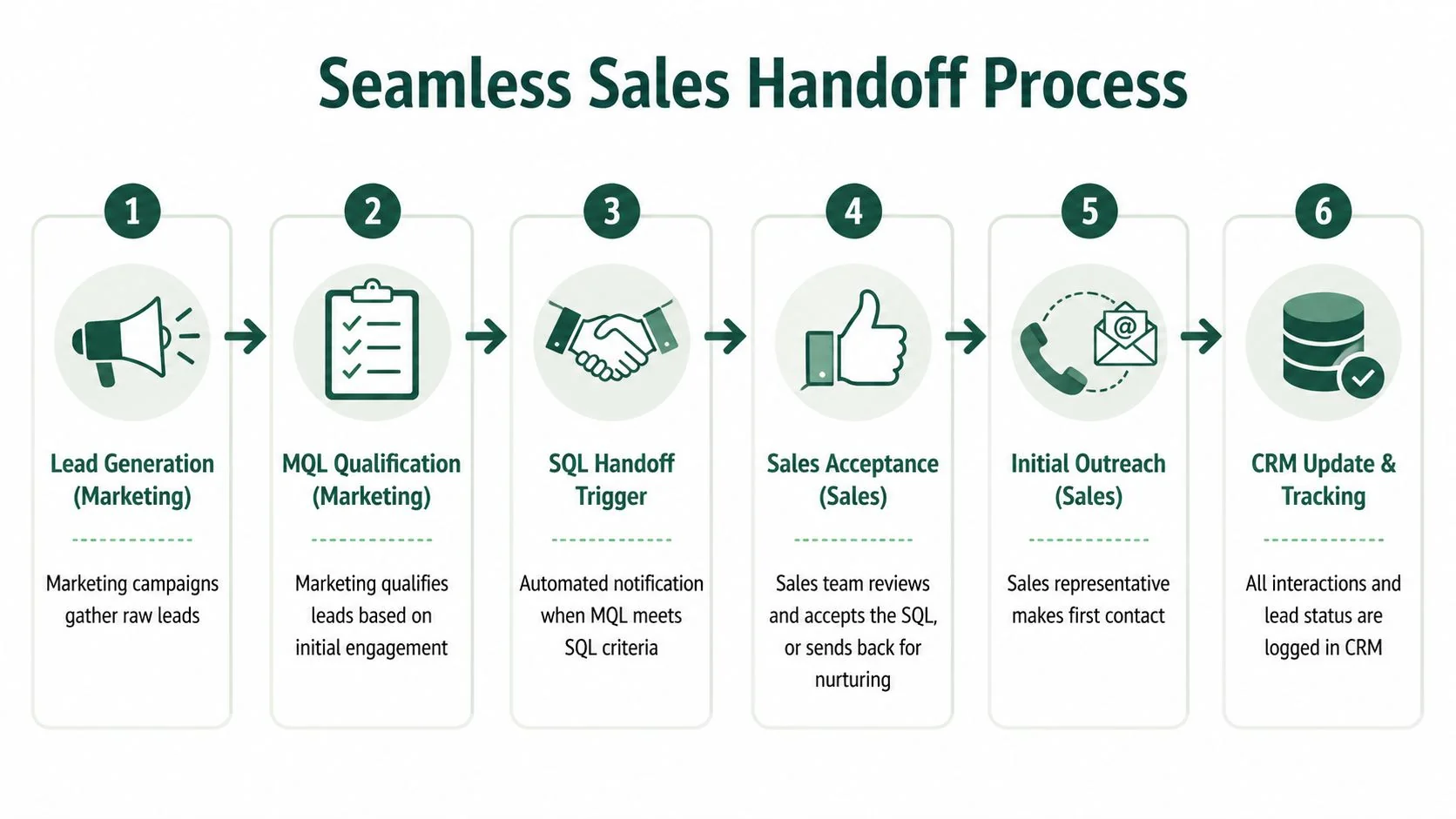
The handoff is where agency revenue leaks. Marketing thinks they passed a strong lead. Sales opens the CRM and sees thin notes, no buying context, missing contact history, and no clear reason this account deserves immediate attention. Then nobody moves quickly, and the prospect talks to someone else.
The SLA your team should enforce
A handoff only works if you define what must exist before sales accepts the SQL.
| Required handoff field | Why it matters |
|---|---|
| ICP fit notes | Confirms why this account belongs in your niche |
| Problem statement | Tells sales what pain the buyer is trying to solve |
| Source and intent signal | Shows why the lead was elevated |
| Stakeholder map | Identifies who’s involved or likely to be involved |
| Next action | Prevents “I’ll look at it later” drift |
Set a hard response rule. The original Harvard Business Review / MIT speed-to-lead study, revisited in 11x’s 2026 inbound analysis, found buyers are 100x more likely to connect when contacted within 5 minutes versus 30, and the average B2B company takes 47 hours. Four hours is table stakes. If someone has shown enough intent to be marked SQL, delay is incompetence.
What sales should be allowed to reject
Sales should not be forced to accept weak handoffs to keep internal peace.
A reject path is healthy if the reason is explicit. Missing authority. Weak need. Vague timing. Poor fit. Return the lead to nurture with notes, not drama. That makes qualification better over time.
A strong follow-up system matters here because accepted SQLs need immediate, context-rich outreach. Teams that struggle with this usually write generic “just checking in” emails that ignore the prior conversation. A better standard is to build follow-up around concrete next steps and buyer context, which you can model from follow-up email after meeting examples.
Handoff quality is visible in the CRM. If the record doesn’t explain why the account is sales-ready, it isn’t sales-ready.
The agencies that preserve SQL quality do one simple thing well. They make acceptance binary. Either the evidence exists and sales acts fast, or the lead goes back for more work, with no gray zone in between.
KPIs to Track SQL Performance and Pipeline Health
Most CEOs track the wrong numbers. Lead count is vanity. Meetings booked are only slightly better. If you want to know whether your SQL system works, track what happens after qualification.
Two numbers reframe the question. Maverrik’s 2026 outreach analysis finds that building recognition before outreach improves response rates by a factor of 3, because buyers triage their inbox by name they recognize. And 11x’s 2026 inbound research puts SDR time wasted on unqualified leads at up to 60%, with only 5% of salespeople rating their inbound leads as very high quality. That should change what you measure. The useful question is not “did outreach happen?” It’s “did recognition and qualification produce pipeline that moved?”
The KPI table that matters
| KPI | What it tells you | How to use it |
|---|---|---|
| SQL-to-opportunity rate | Whether qualification quality is strong | If this falls, your SQL bar is too low or discovery is weak |
| SQL velocity | How fast SQLs move into active deals | Slow movement usually means weak urgency or bad stakeholder access |
| SQL contribution to pipeline | How much new pipeline comes from true sales-ready leads | Low contribution means your team is still counting noise as pipeline |
| Cost per SQL | What it takes to create a real sales conversation | Rising cost without better downstream movement means targeting is off |
| Rep time on non-SQLs | How much effort is being burned on bad leads | If this is high, qualification discipline is failing |
SQL velocity is the operator metric
SQL velocity matters because it exposes fake urgency fast. If the lead stalls after qualification, one of two things is usually true. Either sales marked it too early, or the buyer never had a real project.
Track time from SQL creation to opportunity creation. Don’t overcomplicate it. Review by niche, source, and rep. If one niche moves faster, your positioning may be tighter there. If one source produces slow SQLs, stop feeding sales that channel until the criteria improve.
SQL contribution to pipeline tells you whether your GTM model is honest
Agencies often have “pipeline” that mostly consists of founder networks, referrals, and vague conversations with no repeatable acquisition engine behind them. SQL contribution strips away that story.
If true SQLs account for a small share of new pipeline, your qualification model is weak or your demand generation model isn’t attracting buyers with active intent. If SQL contribution is high and downstream conversion holds, you’re building a commercial system rather than depending on luck.
What good performance looks like in practice
You don’t need more dashboard noise. You need fewer, cleaner SQLs that progress.
Watch for these patterns:
- Recognition-backed outreach performs better. When prospects know your brand from search or AI visibility, reply quality improves, not just reply count.
- Intent-first routing saves sales time. Reps should spend more time with accounts showing active buying behavior and less time with generic engagement.
- Niche focus sharpens qualification. Teams get better when they repeatedly hear the same pains, buying triggers, and technical constraints from the same market segment.
If your team can’t explain why an SQL became pipeline, they can’t explain why pipeline exists.
For an agency CEO, this is a market position question, not a glossary question. The agencies that own a niche get recognized earlier, qualify harder, and move cleaner deals through the funnel. The point is better leads from the right market, already aware of who you are, not more of them.
If your agency is still treating SQLs as form fills and calendar events, you’re leaving pipeline quality to chance. The better model is recognition first, qualification second, outreach third, in that order.
Across 300+ campaigns we’ve run for software development agencies, the agencies that get recognized inside their niche before outreach starts qualify cleaner deals and waste less senior time on conversations that were never going anywhere.
100Signals builds that system. Search visibility, AI citations, and LinkedIn authority running before the first email goes out, so the prospects your team reaches already know who you are before sales picks up the phone.