Managing Sales Leads: A System for Dev Agencies
A practical lead management system for software development agencies. Capture intent, score for fit, route by niche, and nurture without the filler.
TL;DR: Managing sales leads is the operational layer that decides whether your pipeline is a system or a lottery. For a software development agency, a working system captures intent across every channel, scores accounts on fit, behavior, and external intent separately, routes by niche within minutes, and nurtures with material a buyer can forward to their CTO. Most agencies skip three of those four steps and then blame “marketing.”
At a glance:
- Most dev agencies only capture form fills. The signals that decide shortlist entry happen off-site and before any hand-raise.
- Effective lead scoring uses three separate dimensions: fit, behavior, and external intent. Collapsing them into one number produces junk pipeline.
- Response speed is a conversion control. Sub-5-minute routing to the right specialist is the standard, not a stretch goal.
- Nurture built around calendar cadence loses to nurture built around decision friction. Send what a buyer can forward to their CTO.
- Pipeline metrics should measure velocity and stage efficiency. MQL counts and email opens are not pipeline signals.
You run growth at a 120-person software agency. Pipeline is uneven. Referrals covered the gap last year. They are covering less of it now. Your reps are busy. Your CRM is full. And you still cannot tell your founder which accounts are actually close to a decision.
That is a lead management problem, not a traffic problem.
A custom software deal is high trust, multi-stakeholder, and rarely starts with a clean hand-raise. A buyer reads your technical content, sees your agency cited in an AI search result, compares you to a competitor, posts an engineering leadership role that signals a rebuild, and only later visits your site. If your CRM records only the form fill, you are missing the part of the journey that decided whether you made the shortlist.
Most agency lead models still over-weight firmographics and page visits. They miss the signals that actually predict near-term demand: AI assistant citations for problem-specific queries, competitor hiring patterns in a target segment, review-site comparisons, and repeat engagement from technical decision-makers inside one account.
Managing sales leads well answers three questions with precision: which accounts are in market, who should own them, and how fast the first response needs to happen to protect pipeline.
If your CRM only stores last-touch attribution and a rep queue, it is a record of missed context, not a lead management system.
What Lead Management Actually Is
Lead management for a dev agency is a four-part system: capture every buying signal (not just forms), score accounts across fit, behavior, and external intent separately, route to the right specialist within 5 minutes, and nurture with technical content a buyer can share internally. Agencies that run only one or two of these four steps blame marketing for the gaps the missing steps leave.
Lead management is the system that captures every meaningful signal of buying intent, scores accounts across fit, behavior, and external intent, routes them to the right owner inside an SLA, and nurtures with material that moves a decision forward.
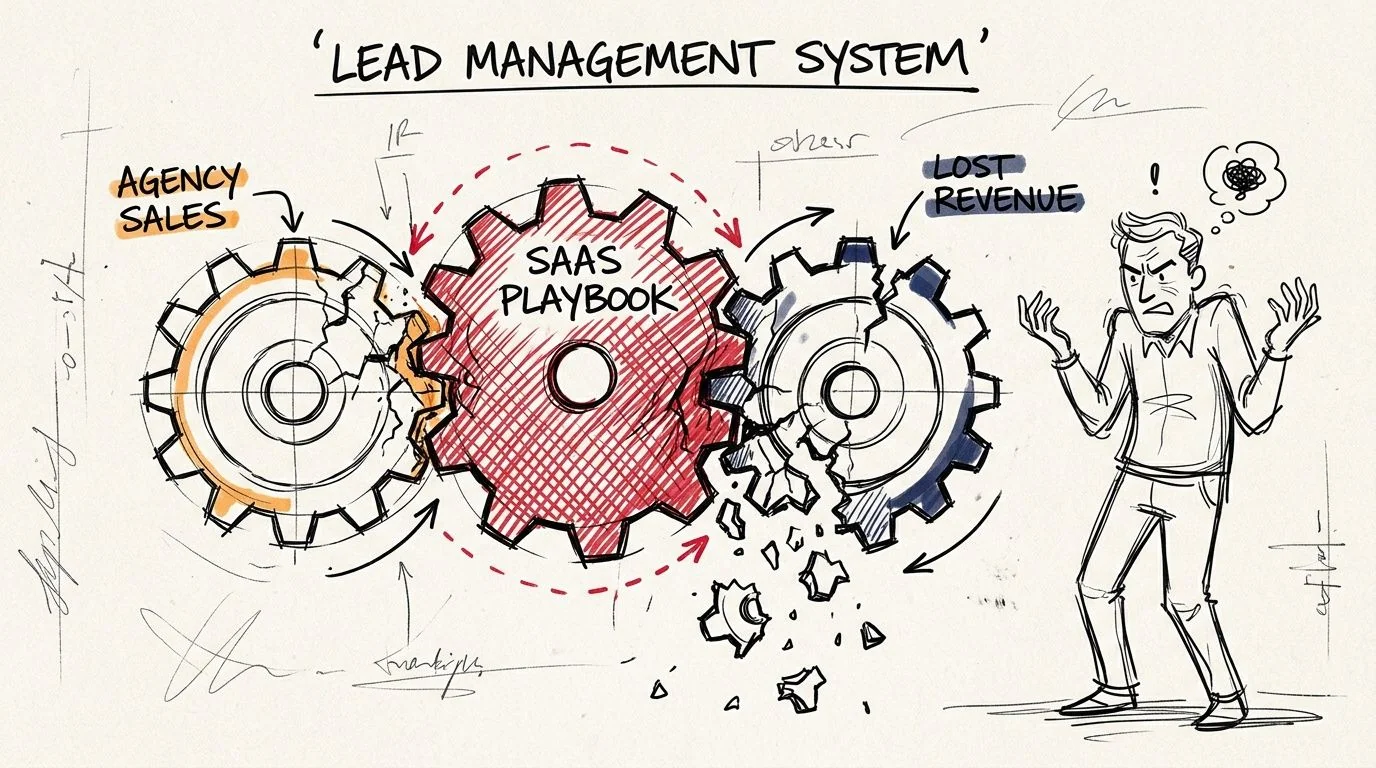
Most agencies run a lazy version of SaaS lead management. The website form goes into the CRM, an SDR gets a task, and a generic sequence starts. Sales complains about quality, marketing points to MQL volume, and pipeline stays uneven.
That model breaks because agency demand does not behave like product demand. Service buyers do not signal intent in one neat conversion event. They leave fragments across channels. The agency that collects and interprets those fragments wins first-meeting access.
Where agencies actually leak revenue
The failure points repeat across every 100-to-300-person agency I have worked with.
| Failure point | What teams do | What happens in pipeline |
|---|---|---|
| Form-first capture | Treat contact forms as the main source of truth | High-intent off-site signals never reach sales |
| Weak qualification | Pass leads based on title, company size, or one content touch | Reps spend time on accounts that will never buy |
| Manual routing | Route from inboxes, Slack pings, or spreadsheets | Fast leads go stale before first response |
| Bad nurture | Send “checking in” emails with no technical value | Buyers tune out before budget opens |
| Vanity reporting | Measure opens and MQL counts | Leadership cannot see which channels produce real opportunities |
Rule of thumb: If your sales team cannot tell you why a lead entered the pipeline, which signal triggered action, and who owns the next step inside 10 minutes, the system is broken.
The four jobs of a working system
For a dev agency, managing sales leads means four things, in order:
- Capture intent widely. Website visits matter. So do LinkedIn engagement, AI assistant mentions, niche community activity, and account-level changes that suggest buying motion.
- Score with context. Stop compressing fit, engagement, and external intent into one number. Separate them.
- Route instantly. The best specialist gets the best lead, not the nearest rep.
- Nurture with authority. Technical buyers reward signal, not persistence.
If your pipeline still depends on referrals and founder networks, that is not proof the market works, only proof your lead system doesn’t.
Capture Intent Beyond the Contact Form
Most dev agency CRMs record only forms, calls, and newsletter signups. The buying journey that decides shortlist entry happens before any of those events. A working capture layer assigns a standard event model to every signal: source, account, person, timestamp, signal type, confidence level. That discipline separates a real intake system from a CRM full of missed context.
Your best future clients often do not convert on your website first. They research, compare vendors indirectly, and validate your reputation before they ever identify themselves. If your CRM only ingests forms, booked calls, and newsletter signups, you are blind to the part of the buying journey that decides shortlist entry.
Build one intake layer for every signal
A useful lead capture system treats every meaningful interaction as an event, not a hand raise. Your CRM needs a standard event model: source, account, person, timestamp, signal type, confidence level.
The setup is simple in concept. The work is getting every source, off-site ones included, to write the same fields into the CRM.
| Signal source | Example event | Why it matters for a dev agency | Where to send it |
|---|---|---|---|
| Website | Case study view, pricing visit, architecture page return | Shows direct research into solution depth | CRM contact and account timeline |
| Founder profile views, post engagement from target accounts | Often the earliest visible buying curiosity | CRM activity or intent field | |
| AI assistants | Brand cited for niche problem queries | Indicates authority before direct site visit | Account-level intent tag |
| Market monitoring | Competitor hiring, stack changes, expansion signals | Suggests upcoming project demand | Account watchlist and routing queue |
| Community channels | Slack, events, podcasts, referrals | Captures dark-funnel awareness | Account notes and lead source taxonomy |
The unique gap today is AI visibility. Most capture systems record nothing when a target account asks ChatGPT or Perplexity “best fintech app modernization partner” and your brand appears in the answer. For a niche agency, that citation is not a vanity event. It means your agency was in front of the buyer before outbound ever started.
Use tooling that normalizes messy intent
What matters is a clean chain of custody for signals. A single platform is not required.
A practical stack looks like this:
- CRM as system of record. HubSpot or Salesforce. Ownership, stages, routing, and reporting have to live somewhere stable.
- Automation layer. Zapier or n8n handles the ugly middle. It moves events from forms, spreadsheets, enrichment tools, Slack alerts, and custom sources into the CRM without manual copying.
- Enrichment layer. Clay resolves companies, contacts, role data, and account context when an event arrives incomplete.
- Account monitoring. Tracked account lists and manual watchlists collect off-site signals that never appear in standard analytics.
Stop treating every capture the same
A buyer who downloads a broad guide is not the same as a VP Engineering from a target account who reads a fintech migration case study, views your engineering lead’s profile, and shows up in AI mention tracking. One enters nurture. The other triggers account review.
A weak capture model creates fake precision. It looks tidy because it only stores what forms can collect.
A noisier intake with stricter downstream scoring beats a clean CRM that misses the accounts most likely to buy.
What to standardize before you add volume
Before you scale campaigns, lock down the operating rules.
| Standard | Bad version | Better version |
|---|---|---|
| Lead source | ”Inbound” | Search, LinkedIn, AI mention, referral, event, outbound reply |
| Account matching | Manual rep judgment | Automated domain and company normalization |
| Ownership | First person to notice | Rule-based assignment by niche and geography |
| Signal naming | Random CRM notes | Controlled event taxonomy |
| Record quality | Optional enrichment | Required enrichment before scoring |
Without that discipline, your team argues about whether a lead “counts” instead of acting on it. Founders discover this too late, usually right when pipeline volume improves and attribution becomes politically useful.
Score Leads Across Three Dimensions
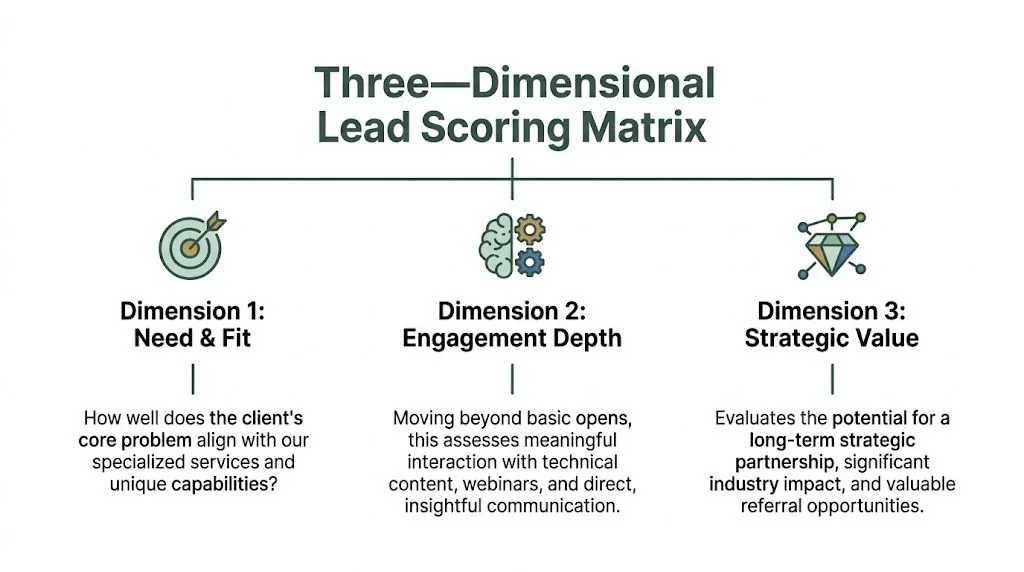
Traditional lead scoring compresses three different questions into one number and breaks all three. Keep fit, behavior, and external intent as separate dimensions. Score fit first as a gate. Score behavior by commercial relevance, not activity volume. Score intent from AI search citations, competitor hiring, and off-site category research. Action tiers built from this matrix give reps traceability that black-box scoring never provides.
Speed only helps if the right leads reach sales in the first place. A bad scoring model creates fake urgency, floods reps with low-probability accounts, and slows down the ones with real reason to buy.
Traditional lead scoring fails because it compresses three different questions into one number:
- Is this account a fit for what you sell?
- Has the account shown buying behavior?
- Is there external evidence that timing is real?
Keep those questions separate. Sales teams trust scoring when they can see why an account moved and what action each signal should trigger.
Score fit first
Fit answers whether the account belongs in your pipeline at all.
For a software agency, fit covers niche alignment, project type, budget range, region, delivery model, technical environment, and buying authority. Company size alone is weak. A 2,000-person company can still be a bad target if it only buys staff augmentation and your margin depends on scoped platform delivery.
Fit is the gate. If fit is low, behavior and intent can justify review. They should not auto-create pipeline.
Score behavior by buying relevance
Behavior should reflect progression toward a deal, not activity volume.
A contact who reads a migration case study, visits pricing, and replies with architecture questions deserves a higher score than someone who opens three newsletters and registers for a broad webinar. Commercial relevance is what matters. Reps need signals tied to active evaluation, not marketing noise.
Scoring usually fails here. Marketing systems count what is easy to measure. Revenue teams need to weight what correlates with qualified meetings.
Score intent from outside your owned channels
Intent is the dimension that separates modern lead management from the old MQL model.
Useful intent signals appear before a form fill and outside your website. If your agency shows up in AI-generated answers for “best fintech app modernization partner” and a target account is researching adjacent topics, that account has entered a higher-value state than website analytics can show. Competitor hiring data matters too. If a rival consultancy is hiring heavily for cloud migration architects in a niche you serve, demand is shifting. If a prospect starts hiring for a head of platform, staff engineers, or implementation roles tied to a transformation initiative, timing has changed.
Those signals should influence score and routing. They should not sit in a spreadsheet no one checks.
| Dimension | What to score | What to ignore | Owner |
|---|---|---|---|
| Fit | Vertical, use case, tech stack, budget reality, geography, decision-maker relevance | Vanity firmographics with no service alignment | RevOps with sales leadership |
| Behavior | Pricing visits, solution pages, technical replies, case study depth, repeat high-value sessions | Opens, accidental clicks, generic blog consumption | Marketing ops and SDR manager |
| Intent | AI search citations, competitor hiring shifts, category research, peer comparisons, internal hiring tied to transformation | Bulk third-party intent with no niche context | RevOps and market intelligence |
Build action tiers from the matrix
Keep the model simple enough that an AE can explain it in 30 seconds.
| Fit | Behavior | Intent | Action |
|---|---|---|---|
| High | High | High | Route to niche AE immediately |
| High | Low | High | SDR validates initiative, timeline, and stakeholder map |
| High | High | Low | Sales review for strategic accounts, otherwise short-term nurture |
| High | Low | Low | Long-term authority nurture |
| Low | High | High | RevOps manual review before assignment |
| Low | Low | High | Watchlist only |
| Low | High | Low | Hold or disqualify |
| Low | Low | Low | Ignore |
This gives reps something black-box scoring never does: traceability. They can see whether an account moved because the company matches your ICP, because the contact is consuming buyer-stage content, or because external intent changed.
Accurate scoring depends on complete account and contact records. Teams that skip enrichment usually misclassify strong accounts before sales ever sees them, which is why B2B data enrichment workflows should run before scoring, not after pipeline review.
Common scoring mistakes that create junk pipeline
- Job title shortcuts. A senior title does not guarantee ownership, budget, or project urgency.
- Overweighting low-friction activity. Opens, likes, and broad content views inflate scores without improving conversion.
- No exclusion logic. If you never define who should be blocked from SQL status, weak accounts drift upward.
- Ignoring external intent. Scoring only firmographics and on-site engagement misses the accounts already showing demand in AI search, hiring patterns, and competitor movement.
- No feedback loop from SDRs and AEs. Frontline teams see scoring failure weeks before dashboards do.
The goal is to spend sales capacity on accounts that can buy, are showing movement, and fit the work your agency wants to deliver.
Route Fast or Lose the Deal
Routing delay is the one conversion factor you fully control inside the first minute. High-fit, high-intent leads go to the niche specialist in under 5 minutes, not the nearest available rep. Round-robin is lazy for agencies where specialization is the product. Good routing rules are encoded, not implied: territory, niche, score combination, and current owner status all checked before assignment.
Fast routing is a conversion control. Once a lead crosses your qualification threshold, any delay is internal, avoidable, and expensive.
The Harvard Business Review study of 1.25M sales leads found that firms that contacted prospects within an hour of an inquiry were nearly seven times more likely to qualify the lead than those who contacted them even an hour later, and more than 60 times more likely than companies that waited 24 hours (HBR, “The Short Life of Online Sales Leads”). Lead response is not the only factor in conversion, but it is the only one you fully control inside the first minute.
Build routing around specialization
Round-robin works for transactional sales. It is lazy for niche dev agencies.
If the lead is about a fintech platform rebuild, route it to the person who can credibly discuss compliance constraints, migration risk, and delivery model. If it is a healthcare interoperability build, the same rule applies. Precision beats equality.
| Score combination | Automated action | Owner | SLA |
|---|---|---|---|
| High fit, high behavior, high intent | Create opportunity, alert owner, enroll in rapid follow-up task set | Niche practice lead or senior AE | Under 5 minutes |
| High fit, low behavior, high intent | Trigger validation outreach and account research task | SDR aligned to niche | Same business block |
| High fit, high behavior, low intent | Create sales review task or place in short-term nurture by account tier | AE or growth manager | Same day |
| High fit, low behavior, low intent | Add to authority nurture track | Marketing automation owner | Automated |
| Low fit, high intent | Flag for manual review before contact | RevOps | Same day |
| Low fit, low intent | Hold or suppress | No active owner | None |
Remove handoff ambiguity
Routing breaks when ownership rules are implied instead of encoded.
Use logic that checks account territory, niche specialization, score combination, and current owner status. If a record fails any required field, send it to a monitored exception queue, not a rep’s memory.
What the first response should trigger
The first response is a package, not one email.
- Assign owner instantly. One person owns the next move.
- Log rationale. The rep sees why this lead was routed and what signals caused urgency.
- Start sequence. Email, LinkedIn, and call tasks fire based on route type.
- Open service context. Attach niche case studies, prior account history, and fit notes.
If a rep has to ask “why did I get this lead?”, your routing logic is incomplete.
Handle edge cases explicitly
The dangerous leads are not the obvious ones but the partially qualified accounts that look promising but waste a week.
Examples: high-intent accounts outside your target geography, multi-brand enterprises with unclear ownership, contacts with strong engagement but no buying role. Those need manual review paths, not forced automation. Good RevOps teams protect sales capacity by being strict here.
When a founder says they want every lead contacted, they usually mean they do not trust the system to disqualify correctly. Fix the rules. Do not compensate with chaos.
Engineer Nurture That Builds Authority
Agency nurture built around calendar cadence fails because technical buyers do not convert on touch count. They convert when each touch removes a specific blocker. Map content to decision friction: problem clarity, vendor comparison, execution risk, internal buy-in. The standard for any nurture asset is simple: a prospect must be able to forward it to their CTO without adding an apology.
B2B buyers rarely convert because a sequence hit seven touches on schedule. They convert when each touch reduces uncertainty, proves expertise, and gives them something worth sharing internally.

Agency nurture fails because it is built around calendar cadence instead of buying evidence. A technical buyer comparing delivery partners wants proof your team understands architecture risk, delivery trade-offs, and the business trigger behind the project, not another “just checking in” email.
Build sequences around decision friction
Every nurture touch should remove one specific blocker to pipeline progression. Map content to the questions that stall deals:
| Buyer friction | What to send | Pipeline impact |
|---|---|---|
| ”I am not clear on the problem yet” | Short teardown of a common failure pattern in their niche | Improves problem urgency and reply rate |
| ”I am comparing approaches” | Brief analysis of implementation options and trade-offs | Increases consultative trust before a sales call |
| ”I am unsure your team can deliver” | Narrow case study with scope, constraints, and outcome | Reduces perceived execution risk |
| ”Timing is bad right now” | Relevant market signal tied to likely future demand | Keeps the account warm without forcing a meeting |
| ”I need internal buy-in” | Forwardable checklist, architecture note, or stakeholder brief | Helps your champion sell internally |
That last row matters more than most teams admit for large accounts: if your content cannot survive internal forwarding, it will not help them move.
Use intent signals to change the sequence, not just the score
Traditional nurture logic relies too heavily on opens, clicks, and form fills. Those signals are weak on their own. Senior buyers often read an email in preview, ignore the CTA, then visit your site later from a different device. A system that treats low click activity as low interest will misread the account.
Use modern intent signals to shift the content path:
- AI search citations. If your brand appears in AI-generated buying research tied to the account’s category, send proof-led content that helps the buyer evaluate vendors.
- Competitor hiring data. If a target account starts hiring for platform, product, or migration roles, send material tied to build-versus-buy trade-offs and likely execution bottlenecks.
- Review site comparison behavior. If the account is researching alternatives, move from educational content to delivery differentiation.
- Repeat visits to service or case study pages. Send narrow proof for that use case, not a generic agency overview.
- Leadership changes or funding events. Shift to content that addresses scale, time-to-value, and execution speed.
Most lead management programs stay stuck in 2018. They score intent, then keep the same generic sequence running. The better move is to let intent change message, asset, and call to action.
Replace follow-up language with operator language
Buyers notice when an agency writes like a sequencer. They also notice when an agency writes like a team that has shipped this work before.
| Weak nurture | Stronger nurture |
|---|---|
| ”Wanted to bump this” | Observation on a delivery risk common in their stack |
| ”Checking whether this is a priority” | Brief note on a market shift that makes delay more expensive |
| Generic case study | Case study narrowed by architecture, team model, or compliance constraint |
| Demo request | Offer to review implementation choices and likely failure points |
| ”Are you the right person?” | Stakeholder map hypothesis based on the account’s current initiative |
Strong nurture earns the next conversation by being useful before the meeting.
Design tracks by buying state, not by source
Source informs attribution. It should not dictate the full nurture path. Inbound, outbound, partner, and event leads often ask the same question: who can handle this without creating delivery risk?
A practical setup uses three tracks:
- Problem-aware, vendor-unclear. Category insight, architecture guidance, issue framing.
- Vendor-aware, timing-unclear. Delivery model comparisons, niche proof, risk-reduction content.
- High fit, delayed timing. Sparse but high-value touches tied to trigger events, not a weekly drip.
Generic nurture is easier to publish. It also produces softer pipeline and more recycled deals. Narrow nurture takes more work from subject-matter experts. It gives sales a warmer, better-educated account base.
Make every touch reusable inside the buying committee
The standard for quality is simple: send material a prospect can forward to a CTO, product lead, or CFO without adding an apology.
That usually means architecture reviews, migration checklists, technical memos, benchmark observations, implementation notes, and tightly scoped case studies. It does not mean filler copy dressed up as “staying top of mind.”
A simple multi-channel pattern works well:
| Touch type | What to send | Why it works |
|---|---|---|
| Insight tied to a current technical or market issue | Gives the buyer a reason to reply or forward | |
| Point of view from an engineering or delivery leader | Builds familiarity without inbox fatigue | |
| Resource | Teardown, niche report, or implementation checklist | Supports internal evaluation |
| Invitation | Small peer session or practical workshop | Builds trust through relevance |
| Direct note | Personalized observation based on account signals | Shows real research, not mail merge effort |
Nurture content should support conversations like this one:
Automate timing. Keep judgment in the content.
Automation should handle send timing, suppression rules, branch logic, and signal-based enrollment. The content still needs human judgment. If a sequence responds to competitor hiring with the same asset it sends after a webinar signup, the automation is working and the strategy is not.
No nurture asset goes live unless sales can explain which objection it resolves and which stage it helps advance. If nobody can answer that, the asset is content inventory, not pipeline infrastructure.
Audit nurture by outcomes, not activity
Bad nurture leaves operational fingerprints:
- Replies ask to opt out of personal outreach. The cadence feels automated and irrelevant.
- Sales revisits old accounts with no useful history. The sequence preserved activity, not context.
- Prospects consume content but never share it internally. The material informs one contact but does not help consensus.
- Deals jump from silence to proposal. The sequence failed to build trust before commercial discussion.
- Intent spikes do not change messaging. Your system is collecting signals it does not use.
Build enough authority that when budget opens, your agency is already on the shortlist and already trusted for the exact problem the buyer needs solved.
Measure Pipeline Velocity, Not Lead Volume
MQL counts and email opens measure activity that can rise while revenue quality falls. The metrics that matter are lead-to-opportunity rate, SQL-to-close rate, pipeline velocity, sales cycle length, and revenue by source. These five expose leakage. Review them together across capture, scoring, routing, and nurture. Optimize each in isolation and every team hits its local metric while the pipeline gets worse.
If your lead dashboard centers on MQL counts, email opens, and raw traffic, revenue quality can fall while every number on it rises. Heads of growth at dev agencies need a smaller set of metrics that answer two questions: is pipeline getting more efficient, and is the agency becoming the default name in a narrow market?
Track stage efficiency, not top-of-funnel theater
The most useful lead management dashboard is operational. It tells you where deals stall, where routing fails, and whether scoring logic is improving sales focus.
| Metric | What it tells you | What to do if it worsens |
|---|---|---|
| Lead to opportunity rate | Whether captured leads are truly pipeline-worthy | Tighten qualification and scoring rules |
| SQL to close rate | Whether sales is pursuing the right accounts and handling them well | Audit handoff quality and rep specialization |
| Pipeline velocity | How quickly value moves through the funnel | Check follow-up speed, stage friction, and deal hygiene |
| Sales cycle length | Whether trust and clarity are improving | Review content, discovery quality, and stakeholder alignment |
| Revenue by source | Which channels produce actual business, not just names | Reallocate effort away from noisy sources |
Keep the list short and make every metric expose leakage.
Add authority indicators to lead management
A niche agency should also watch leading indicators of market recognition. One of the strongest is branded search behavior. When buyers search for your agency by name, not just generic category terms, your market position is shifting.
Also monitor qualitative signals that standard CRMs miss unless RevOps records them deliberately: repeat mentions in deals of “already heard of you,” prospects referencing your content without direct attribution, and sellers reporting lower skepticism in first meetings. None of those need invented numbers to matter. They are practical evidence that authority is reducing friction.
Pipeline gets easier when recognition arrives before outreach.
Review the system as one machine
The right operating rhythm is not channel-by-channel. Review capture quality, score distribution, routing speed, nurture progression, and opportunity creation together. Separate them and each team optimizes its local metric while the pipeline gets worse.
Marketing can increase lead volume while crushing sales quality. Sales can speed first response while working low-fit accounts. RevOps can improve data cleanliness while still missing external intent. The dashboard should force cross-functional accountability.
Questions worth asking every month
- Are more leads entering with meaningful account context?
- Are high-fit accounts reaching the right specialist fast enough?
- Are nurture tracks creating better conversations, not just more touches?
- Is the agency showing up earlier in the buying journey?
Heads of growth who look only at closed revenue miss the warning signs until a quarter breaks. The point of managing sales leads well is earlier control, not better reporting: act on capture, scoring, routing, and nurture before closed revenue shows a problem.
Common Questions About Managing Sales Leads
What is lead management in B2B sales?
Lead management is the system that captures every meaningful buying signal from an account, scores that account across fit, behavior, and external intent, routes it to the right owner inside a defined SLA, and nurtures the relationship until the account is ready to buy. For agencies, the core deliverable is shortlist entry, not lead volume.
How fast should a sales team respond to a new lead?
Under 5 minutes for high-fit, high-intent leads. The Harvard Business Review study of 1.25M inquiries found firms that responded within an hour were seven times more likely to qualify the lead than those who waited even one hour longer. For niche dev agencies, speed only pays off when the lead also reaches a specialist.
What is the difference between lead scoring and lead routing?
Scoring decides whether a lead deserves sales attention. Routing decides which person gets it. Most agencies collapse the two and end up with fast handoffs of the wrong leads. Keep them separate and make each rule explicit.
Why do so many leads never convert?
Because most leads were never real buyers, or they were real buyers handled poorly: slow first response, generic nurture, wrong owner, no intent-aware sequencing. Lead management exists to stop both failure modes.
What tools do you need to manage leads well?
A CRM as system of record (HubSpot or Salesforce), an automation layer to move events cleanly (Zapier or n8n), an enrichment layer for missing context (Clay), and a monitoring layer for off-site signals (AI citations, competitor hiring, account news). Tools are cheaper than most agencies assume, and discipline is the expensive part.
From Leaky Funnel to Predictable Pipeline
Managing sales leads well changes how a software development agency competes. The direct benefit is cleaner pipeline. The bigger benefit is market position.
When you capture intent beyond forms, score for fit plus behavior plus external signals, route instantly, and nurture with actual technical value, you stop behaving like a replaceable vendor. You start behaving like the specialist buyers were already looking for, and you show up earlier in their journey. That shift is why lead management belongs in strategy, not admin.
If you want a read on whether buyers can find your agency before your SDRs can: run a free 100Signals scan and see how your niche visibility looks across AI search, organic, and account-level intent. That is where most lead management conversations should start, not where they end.
This is what separates agencies with occasional wins from agencies that own a category. The first has leads. The second has a system that decides which accounts get attention, who owns them, and what they receive.
More from 100Signals
Lead Generation for Software Development Companies How dev agencies build a consistent inbound pipeline through niche authority, not spray-and-pray outbound.
ABM for Software Development Companies Account-based marketing built for complex, multi-stakeholder software deals where relationships close revenue.
Demand Generation for Software Development Companies How software agencies create sustained category demand before buyers start a vendor search.
Lead Generation for IT Companies The lead generation model that works for IT firms selling long-cycle, high-trust engagements.
Demand Generation for IT Companies (and IT Consultancies) The MSP playbook plus where it diverges for IT consultancies and systems integrators selling six- and seven-figure engagements.