Listen Notes Podcast: A Playbook for Dev Agency Outreach
Use the Listen Notes podcast database to find shows, pull contact data via the API, and book guest spots that move dev agency pipeline in 2026.
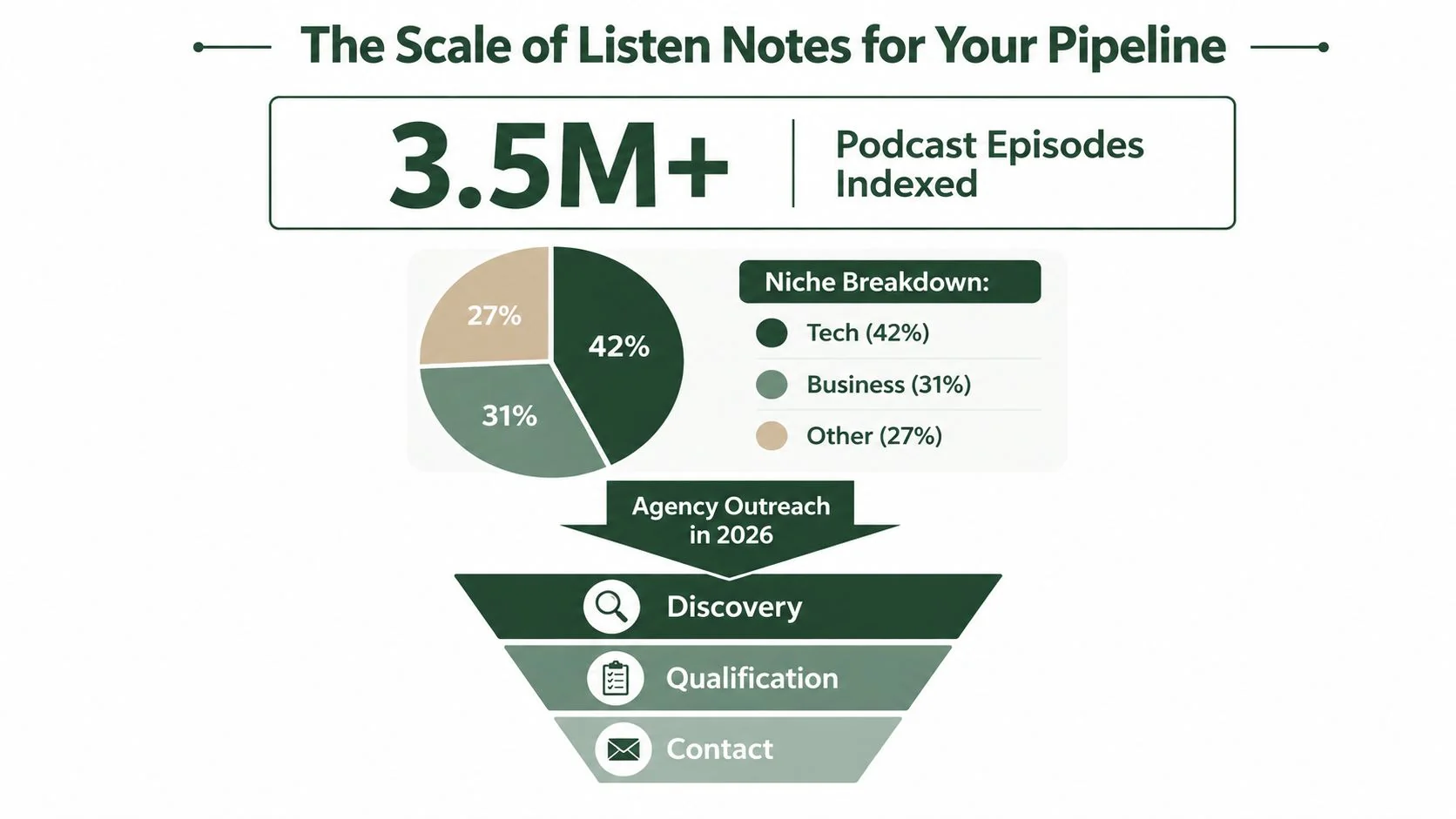
Listen Notes tracks at least 3,797,071 podcasts and 191,867,812 episodes, so the hard part is qualifying shows fast enough to feed outbound, not finding them. For a dev agency, the bottleneck is turning a massive public podcast graph into a short list your BDRs can work.
Listen Notes matters because it sits closer to B2B intelligence than a simple podcast directory. Its own stats page shows nearly 3.8 million RSS-based public podcasts and close to 192 million episodes worldwide, while its business-facing API snapshot is only slightly lower at 3,796,804 podcasts and 191,827,763 episodes Listen Notes podcast stats. For a team prospecting around niche authority, a live index is more useful than a static media list.
Most agencies treat podcast outreach like a PR task. It’s a pipeline task, so the owner should be the head of growth, a founder, or a content lead who already owns demand creation. The channel only works when someone is accountable for reply quality, meeting rate, and downstream opportunities. For a model of structured prospecting, the modern B2B sales prospecting guide is a useful backdrop for how it differs from random outreach.
Listen Notes also reports usage. Its datasets page shows 38,653,682 searches and 463,097,743 listens, which suggests people use it as both a discovery engine and a data source Listen Notes podcast datasets. That combination is why it’s useful for agencies that need to find shows, qualify them, and then run an outbound motion without wasting BDR cycles on hobbyist lists. If you’re already building niche authority assets, the 100Signals resource library has agency-specific material on turning that authority into market focus.
Practical rule: if a podcast list can’t be filtered into a pitchable shortlist in minutes, it’s not a pipeline asset.
By the end, you should have a repeatable Listen Notes workflow that turns guest appearances into a measurable pipeline channel.
Why Listen Notes Matters for Dev Agency Pipeline
A software development agency needs a faster way to separate shows that can move pipeline from shows that only look relevant on paper. Listen Notes is built for that job because it indexes almost the entire public RSS-based podcast graph, not just a closed app catalog, and its own materials frame it as a search engine and database rather than a player or host Listen Notes stats, Buzzsprout review of Listen Notes.
That matters because generic podcast lists waste BDR time. If someone on your team spends an hour manually scanning “tech podcasts,” they’ll end up with a mix of dead shows, broad business interviews, and hosts who don’t care about the problems your agency solves. Listen Notes gives you a way to move from broad discovery to a qualifying layer, which is the part that belongs in a pipeline motion.
Who should own it
This should sit with one owner. The head of growth should run the workflow, the content lead should shape the angle, and the founder should approve the niche and the target audience. If everyone owns it, nobody owns the list quality.
Four KPIs make the program defensible:
- Qualified shows added to the outreach list each week.
- Reply rate from podcast hosts after first and second touches.
- Booked appearances that match the chosen niche.
- Downstream opportunities created from those appearances.
If you only track raw show volume, you’ll end up rewarding the wrong behavior. If you track booked appearances tied to a narrow niche, the work becomes accountable.
The strategic value is that podcast outreach becomes a recognition channel. A dev agency that shows up repeatedly on the right shows in a single niche starts to look like the obvious specialist, not another generic vendor. That’s the difference between random publicity and a pipeline asset.
The Search Workflow That Surfaces Real Shows
Listen Notes search works when you stop thinking in broad topics and start thinking in buyer pain, current episode themes, and host intent. A keyword like “FinTech” is too loose. A keyword plus episode-level signals like “fraud,” “cloud cost,” or “compliance automation” gives you a list the sales team can use.
Start with the show, then verify the episode
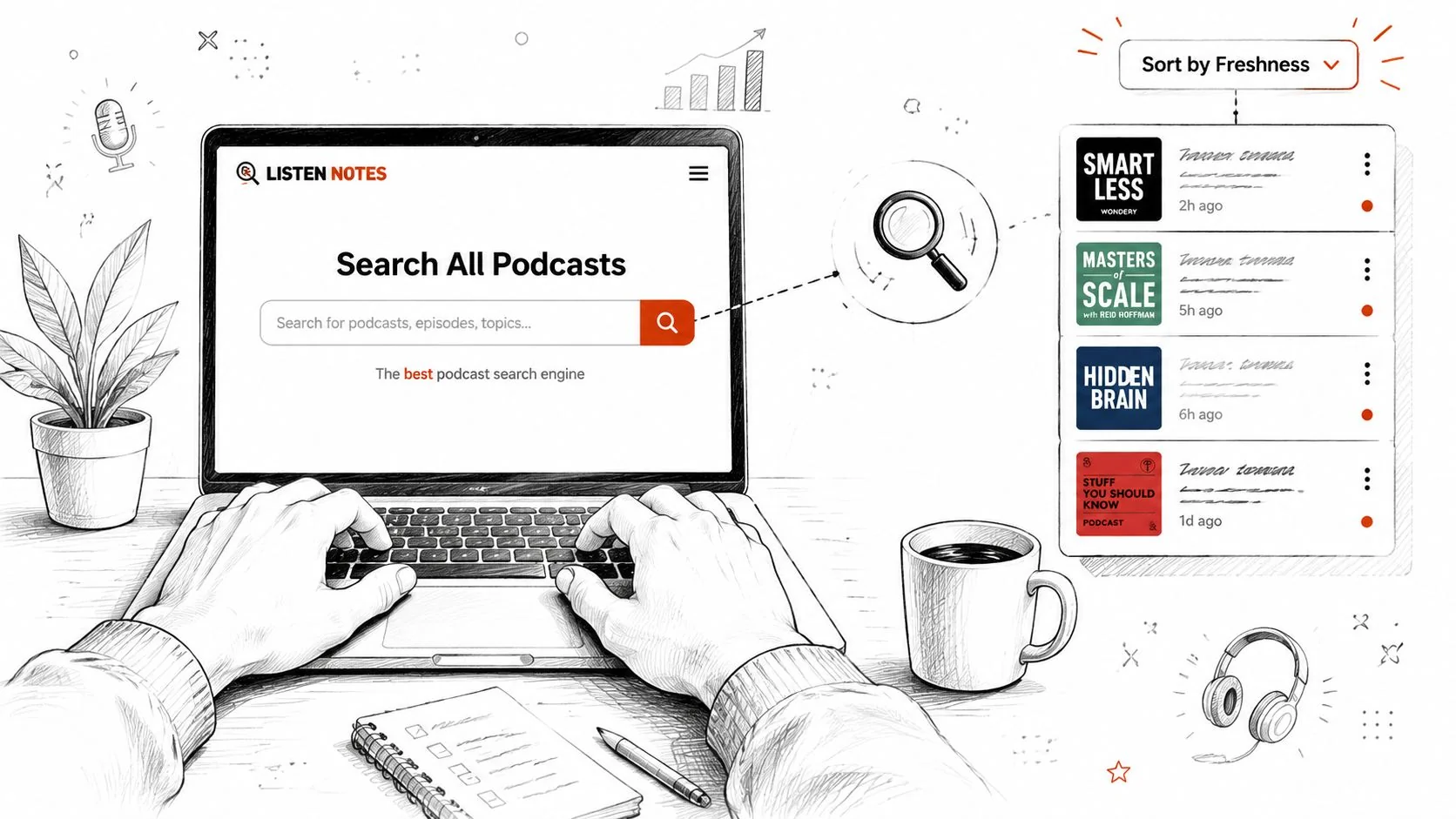
Use the search UI first when you are building a shortlist. Search the niche, then sort by relevance to see whether the show’s description matches your market. Switch to freshness when you need hosts who are actively publishing, because an active show is easier to pitch and easier to turn into a timely angle.
For a U.S. FinTech CTO target list, search combinations like FinTech, payments, banking infrastructure, and cloud architecture, then filter by region where possible. Exclude broad entrepreneur shows unless recent episodes show technical depth. The show description is usually marketing copy. Recent episodes show what the host cares about right now.
Practical rule: episode-level search is the strongest filter because it shows current host intent, not stale positioning.
Your qualification score should be strict. Before a show gets onto the pitch list, score it on four things: audience fit, episode freshness, guest quality, and whether the host has recently covered a problem your agency solves. If two of those are weak, move on.
A general “startup” podcast is usually a waste unless one of the latest episodes is clearly technical and the guest roster shows access to decision makers. A dev agency targeting US FinTech CTOs should prioritize shows that recently discussed architecture, compliance, platform reliability, or AI in regulated workflows.
Host fit matters more than show title, which is why the discipline in guest on podcasts with Fame is worth copying: it screens for fit, so your list stays tied to replies and booked appearances, not vanity discovery.
API vs Datasets vs Search UI
Listen Notes gives you three access layers, and if you pick the wrong one, you’ll slow your team down. The search website is for hands-on prospecting, the Podcast API is for workflows that need repeatability, and the bulk datasets are for offline analysis or custom ranking models Listen Notes tech stack notes, Listen Notes podcast datasets.
| Access Mode | Best For | Key Endpoints or Outputs | Watch Out For |
|---|---|---|---|
| Search UI | One-off prospecting under 50 shows | Manual search, show pages, episode discovery | Too slow for recurring CRM enrichment |
| Podcast API | Recurring workflows, CRM sync, enrichment pipelines | Search, metadata, charts, curated lists, genres, recommendations, autocomplete, audience demographics, authenticated with X-ListenAPI-Key | Must show Powered by Listen Notes on at least one screen, and you can’t pre-fetch, cache, index, or store content server-side |
| Bulk Datasets | Offline analysis, niche sizing, custom ranking models | CSV or SQLite exports | Overkill for simple outreach lists, only useful when you need local analysis |
The API is the right choice if your agency wants to run this as a repeatable process. If a marketer manually builds a list once a month, the UI is enough. If you want the data to feed a CRM, an internal tool, or enrichment logic, use the API and stop pretending a spreadsheet will scale. For bulk analysis, the datasets are the right answer only when you need to study market structure, compare niche density, or build your own scoring model.
A lot of teams get tempted by the dataset because it feels powerful. It is powerful, but power without a workflow just creates another file nobody opens. Use bulk exports only if you already know what you’re going to do with the data.
The strict usage policy is the other thing agencies ignore at their own risk. Listen Notes requires a Powered by Listen Notes logo where the data appears, and its API terms prohibit server-side pre-fetching, caching, indexing, or storage Listen Notes API pricing and terms. That means the API is fine for live workflows, but it’s not something you should mirror into your own database and forget.
Extracting Contacts and Verifying Show Credibility
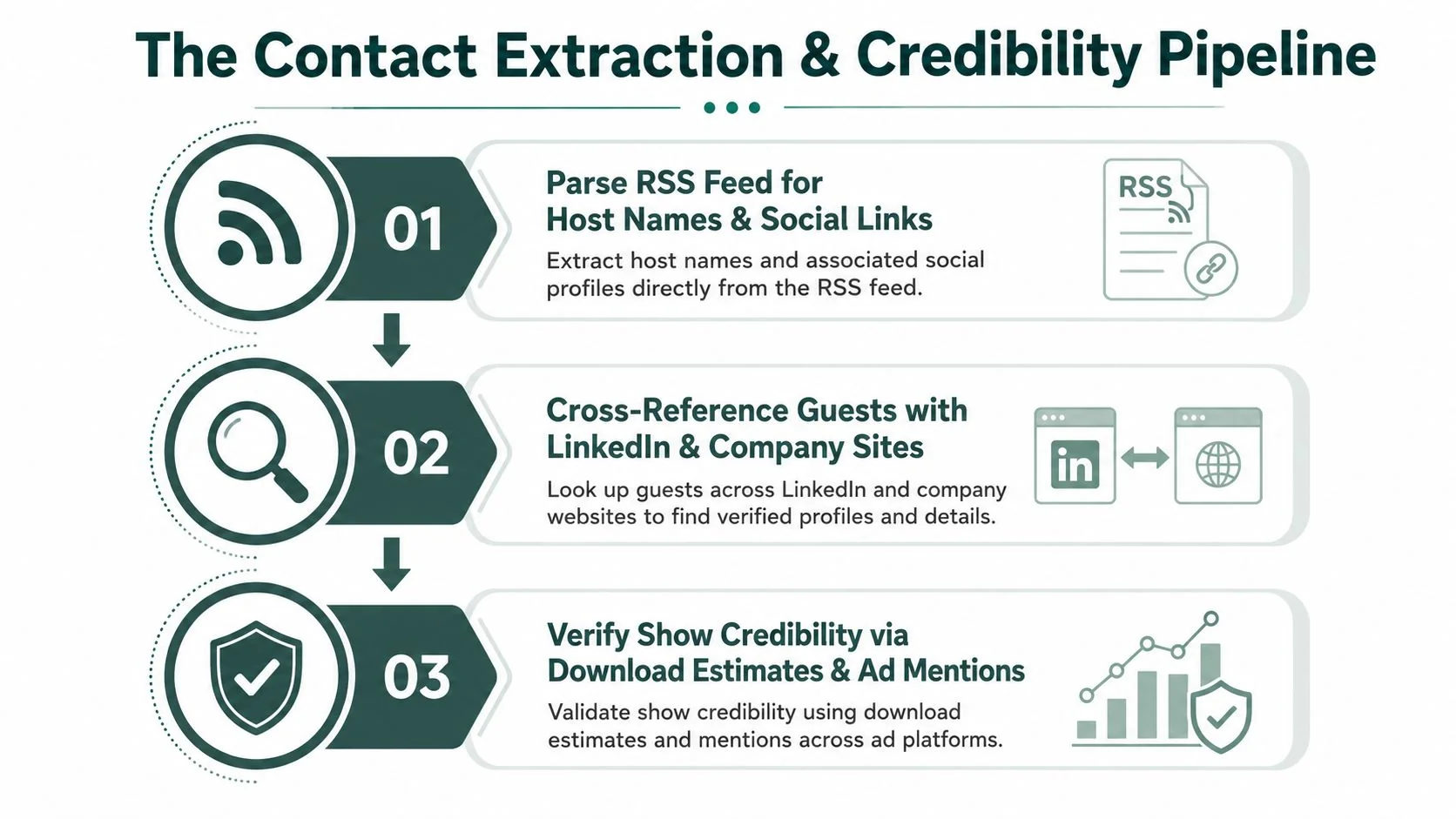
A Listen Notes show page is the start of a prospect record. The job is to turn that page into a verified host contact, a topical fit signal, and a credibility check that tells you whether the show deserves a pitch.
Build the record in three passes
First, parse the RSS feed or show metadata for host names, social links, and any obvious contact path. Second, cross-reference the most recent guests on LinkedIn and company sites to see whether the host interviews people like your buyers. Third, verify audience credibility by looking at the platform’s audience signals and chart presence instead of obsessing over vanity download numbers.
A show with a large but irrelevant audience is still a bad prospecting target. If the audience is full of other marketers, freelancers, or people fishing for exposure, your CTO pitch will fall flat no matter how polished the email is.
A fast check helps the BDR make the right call in under five minutes:
- Host Identity: Find the host’s name and one public contact path.
- Topical Pattern: Confirm the last few episodes are in your niche.
- Guest Quality: Look at whether the guests are buyers, operators, or only other media guests.
- Audience Fit: Check whether the show’s audience claim matches your buyer persona.
- Recency: Prioritize active shows over dormant ones.
If you need to extract contact details at scale, a tool like BillionVerify email extractor can support the enrichment step, but only after you’ve already decided the show is worth pursuing. Don’t use enrichment to rescue a bad list.
The common failure mode is chasing download counts alone. That creates a list of apparently popular shows that may have little access to decision makers. For agency pipeline, credibility means the host already talks to the people you want to reach.
Segmenting the List by Niche and Buying Committee
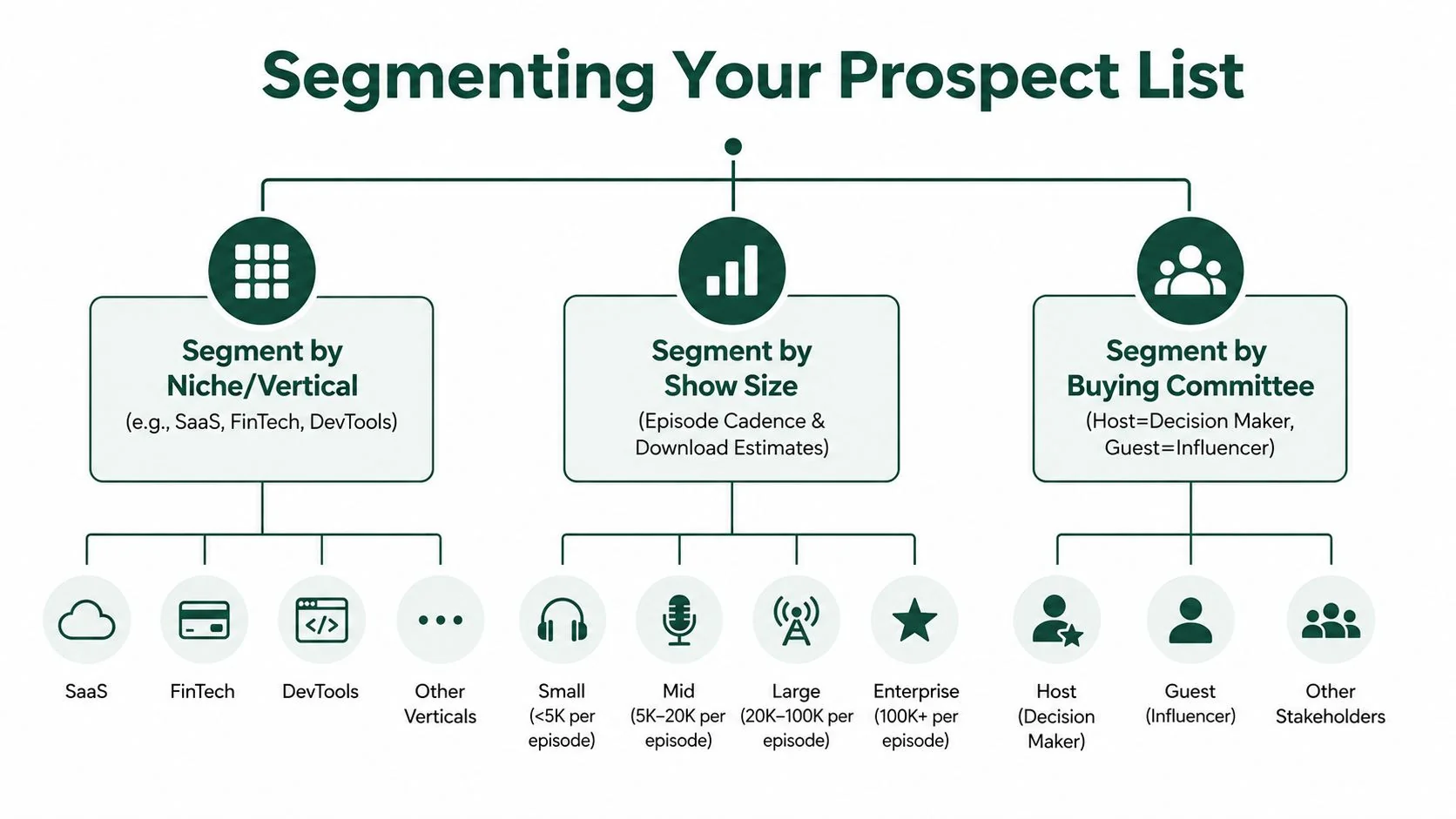
Raw show data becomes useful only after you segment it into a list that mirrors how your agency sells. The cleanest way to do that is by niche or vertical, show size and cadence, and recent guest overlap. Those three filters tell you whether a show belongs in a first-tier pitch list or in a recycle bin.
Weight the shows by buying committee access
A 200-person agency targeting US healthcare CTOs should care more about shows that regularly interview CIOs and VP Engineering than shows that mostly feature consultants or authors. The reason is access. If the host already brings on the people your sales team wants, the pitch has a better shot at landing and the downstream audience is closer to your market.
The second filter is show size, but use it intelligently. A big show is not automatically a better show. A smaller, highly relevant show with active publishing can outperform a broad show with weak topical alignment, because relevance drives the reply and the eventual mention.
The third filter is recent guest overlap. If a competing dev agency appeared two episodes ago, your pitch is probably dead on arrival. If the host just interviewed a technical operator from a target vertical, your angle is stronger because the show has already signaled interest in that problem space.
| Segment | Why It Matters | Fit Signal | Pitches per Quarter |
|---|---|---|---|
| Tier 1 niche buyer shows | Direct access to target decision makers | Recent guests include CTOs, CIOs, VP Eng, or operators in your niche | Highest priority |
| Tier 2 adjacent technical shows | Good for authority building and broader recognition | Host covers relevant technical themes, even if buyer titles are mixed | Moderate priority |
| Tier 3 broad business shows | Useful only if the audience overlaps with your niche | Strong topical fit, weak committee fit | Low priority |
A segment only deserves outreach if it can support both authority and pipeline. If it can’t do both, it’s not worth the friction.
A Reply-Optimized Outreach Sequence for Hosts
Podcast hosts aren’t standard cold prospects. They respond when you prove you listened, name a real episode, and make their job easier. Generic “we’d love to come on your show” outreach gets ignored because it looks like mass prospecting.
Four touches, each with a different job
The first email should anchor on a recent episode title and one clear reason your founder belongs there. The subject line should be simple, for example Idea after your episode on cloud cost or Loved your conversation with [guest name]. The body should reference the host by name, the recent episode title, and one topical angle tied to the host’s current interests.
The second touch should mention a specific clip, guest, or point from that episode so the host can see you listened. Don’t repeat the same ask. Add proof of relevance instead.
The third touch should offer a topic angle, not a slot request. You propose the exact theme your founder can cover, such as platform modernization for a regulated vertical or reducing delivery risk in a specific stack. A host can evaluate a topic faster than they can evaluate a vague partnership pitch.
The breakup email should make it easy for them to say no. That protects your sender reputation and keeps the sequence professional.
| Touch | Purpose | Personalization Fields |
|---|---|---|
| Email 1 | Open the conversation | Host name, recent episode title |
| Email 2 | Prove you listened | Recent clip, last guest name |
| Email 3 | Offer a useful angle | Show audience, target topic |
| Email 4 | Close cleanly | Host name, easy opt-out |
This works because recognition changes response behavior. Generic cold outreach to people who have never heard of you sits below 1%, while across 100Signals campaigns we see reply rates of 6 to 12% when target accounts already recognize the brand. That is an observation from our own work, not a promise. The lift comes from familiarity.
For the mechanics of agency outbound, the 100Signals outreach approach for agencies is the right reference if you want the same logic applied to broader sales email, not just podcast pitching.
Turning Appearances Into Niche Authority and Pipeline
Booked appearances only matter if they compound. Every guest spot should become a LinkedIn post, a niche landing page asset, a sales enablement clip, and a citation source that AI tools can surface later. If you don’t do that, the interview decays into a one-off link and the pipeline value disappears.
A 90-day cadence in one defended niche beats scattered appearances across ten topics because repetition builds recognition faster. Buyers remember the agency that keeps showing up in the same problem space. Search engines and AI assistants also have more consistent signals to connect your brand to that niche.
Use Listen Notes to find the right shows, qualify them hard, and pitch with precision. Each appearance then adds to your visibility in the niche, and the work stays tied to pipeline instead of vanity. It also helps the next outbound sequence reach the reply rates we see when accounts already recognize the brand (6 to 12% in our campaigns) instead of the under 1% typical of cold outreach.
This week, pick one niche, pull 25 shows from Listen Notes, score them aggressively, and send the first four-touch sequence only to the top tier. If you want that process turned into a repeatable outbound process, use 100Signals to map the niche, build the authority assets, and wire the outreach to pipeline instead of noise.