AI Auto Dialer for Dev Agency Pipeline: What Works
AI auto dialer setup for software development agencies: TCPA rules, consent workflows, vendor selection, and pipeline metrics that actually move meetings.
An AI auto dialer can report a 100% answer rate that says little about qualified conversations, so raw call volume isn’t the answer. The right system starts with consent, contact data, and recognition, then uses dialing to activate that foundation.
Most advice about an AI auto dialer starts with productivity. That framing is wrong for a software development agency. Since the FCC’s February 2024 ruling, AI-generated human voices fall under the Telephone Consumer Protection Act’s restrictions on artificial or prerecorded voice messages. The system is therefore a regulated communications architecture, not an automated SDR shortcut.
For founders and CEOs of 100 to 500-person agencies, the commercial question is whether the agency can prove that each call was authorized, identify the caller, honor an opt-out immediately, and reach a buyer who already has a reason to listen, not how many calls a platform can place. The dialer is the activation layer. Niche authority and verified contact data determine whether activation creates pipeline or complaints.
The Uncomfortable Truth About AI Auto Dialers
The popular advice says that an AI auto dialer solves an agency’s pipeline problem by increasing dials. That advice ignores the legal and data systems underneath the call. The United States enacted the Telephone Consumer Protection Act in 1991, and the Federal Communications Commission adopted implementing rules in 1992. The statute defines an automatic telephone dialing system through its capacity to store or produce phone numbers using a random or sequential number generator and dial those numbers. The Congressional Research Service’s TCPA overview traces that lineage and explains why automation remains central to the analysis.
The FCC later determined in 2003 that predictive dialers could fall within the autodialer category, even when they used preselected lists. Rules became stricter in 2012, when telemarketers were generally required to obtain prior express written consent for marketing robocalls and provide an opt-out mechanism during each call. List-based calling doesn’t automatically escape scrutiny because a vendor labels the workflow “B2B” or “AI-assisted.”
The FCC changed the voice question
In February 2024, the FCC clarified that calls using AI-generated human voices are covered by the TCPA’s restrictions on artificial or prerecorded voices. The ruling treats voice cloning and voice synthesis under the same consent framework as conventional prerecorded robocalls. The FCC declaratory ruling on AI-generated voices makes the operational point clear: natural-sounding speech doesn’t create permission to call.
That matters for an agency selling a narrow technical service. A campaign may combine automated number selection, synthetic speech, qualification, and routing, but personalization doesn’t establish consent. The architecture must keep consent records, suppression lists, caller identification, call purpose, opt-out events, and call logs connected.
Operating rule: Treat every AI calling campaign as a communications product with data lineage, access controls, and failure handling.
An agency that builds authority in a defined niche has a better starting position than one that buys more concurrency. A CTO who recognizes the agency from search results, an AI assistant citation, or a relevant LinkedIn post is more likely to understand the reason for the call. The dialer should deliver recognition into a conversation, not try to manufacture recognition through repetition.
What an AI Auto Dialer Actually Is
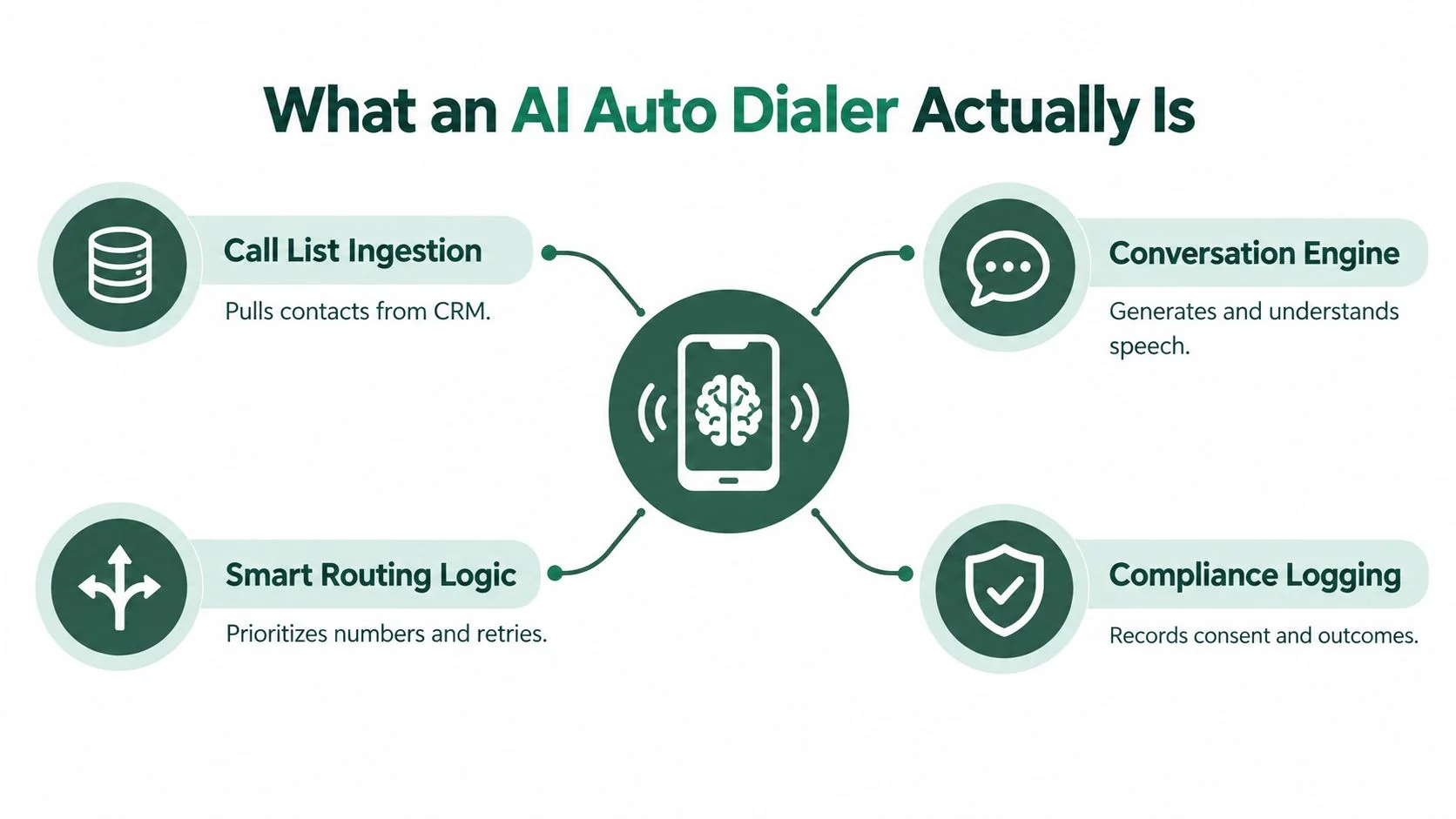
An AI auto dialer is a stack of four separate functions, not one feature, and each function changes the system’s operational and compliance scope.
-
Number selection decides which records enter the campaign. It may pull a fixed CRM list, select numbers sequentially, or use a random or sequential number generator. Under the TCPA definition, the system’s capacity matters, not just the campaign’s current settings.
-
Number presentation decides when and how records are called. A power dialer calls one record at a time. A predictive system calls ahead of agent availability. An AI-prioritized workflow may rank accounts by fit, engagement, or previous outcomes before handing them to a caller.
-
Voice generation produces the conversation. The voice may be a prerecorded clip, text-to-speech output, or a conversational language model with real-time speech. The FCC’s 2024 position places AI-generated human speech inside the artificial-voice framework.
-
Post-call action writes the outcome back to the operating system. That includes CRM disposition, transcript, recording, opt-out status, qualification, routing, and follow-up timing. If the opt-out lands only in the vendor dashboard, the agency has built a delay, not suppression.
Ask vendors four engineering questions
A vendor demonstration should begin with architecture, not voice quality. Ask which component the vendor owns, where each consent record lives, how quickly an opt-out propagates, and whether the audio is fully synthetic or hybrid.
The distinction between list ingestion and voice generation also matters. A system can create exposure through dialing logic even when a human conducts the conversation. Conversely, a voice agent can create artificial-voice obligations even when the list was manually uploaded. The Congressional Research Service’s later autodialer analysis reinforces the need to separate number generation, dialing behavior, and AI speech rather than treating “AI dialer” as a legal category.
For a niche agency, this decomposition prevents a costly procurement mistake. You may want preview calls for named enterprise accounts, human handoff for qualified buyers, and AI voice only for a separate, properly authorized segment. A vendor that sells one bundled mode makes that operating model harder to control.
Consent Architecture Before the First Dial
“We have consent” isn’t a sufficient answer. A defensible system must show who consented, when, for what purpose, through which source, under which jurisdiction, and whether that permission still applies.
The FCC says autodialed or artificial-voice calls to mobile phones generally require prior express consent. Telemarketing calls using prerecorded or artificial voices generally face written-consent requirements under applicable rules, and each telemarketing robocall must provide an immediate opt-out mechanism. The FCC’s telemarketing guidance should be treated as a system specification, not as a legal page someone reads after launch.
Seven controls belong in the pre-flight
| Control | What the system must preserve | Failure mode |
|---|---|---|
| Consent provenance | Source, timestamp, wording, scope, and expiration status | The agency can’t prove authorization |
| Campaign purpose | Marketing or nonmarketing classification | One consent record gets reused incorrectly |
| Suppression logic | Internal opt-outs and applicable Do-Not-Call records | Revoked contacts receive another call |
| Caller identification | Accurate identity and purpose at the start | The recipient can’t identify the caller |
| Jurisdiction mapping | Country, state, and market-specific rules | A US workflow is copied into the UK or EU |
| Immediate revocation | Real-time blocking across CRM, dialer, and enrichment | One system keeps calling after opt-out |
| Audit trail | Immutable call event, outcome, and retention records | Legal and RevOps teams see different histories |
The Eleventh Circuit vacated the FCC’s one-to-one consent rule in January 2025, which makes vendor shorthand especially dangerous. The ruling doesn’t turn consent into an informal checkbox. It makes the wording, evidence, scope, and suppression process more important to review.
Recording introduces a separate design question. Agencies operating across borders should document where participants are located, where audio is stored, and which consent standard applies. A practical reference on call recording compliance for expats can help teams build that analysis into call and data-retention design rather than bolting it on later.
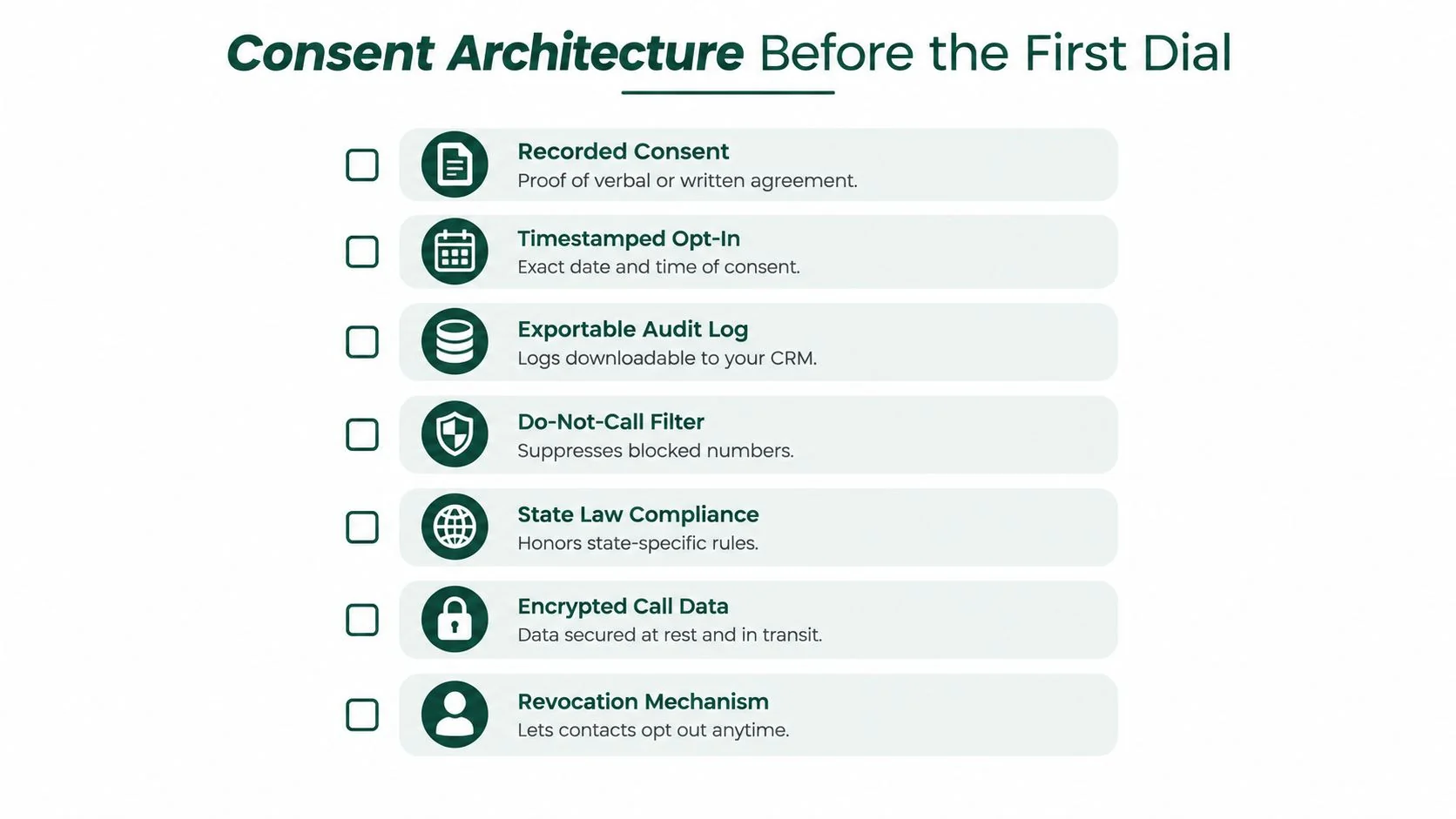
The right launch gate is simple: if the team can’t export the consent record, trace the source, identify the campaign purpose, and suppress the number across connected systems, the campaign isn’t ready. Compliance belongs in the data model and event pipeline, not in a vendor’s sales deck.
Dial Modes Compared for B2B Niche Outreach
A dev agency shouldn’t select a mode by asking which one produces the most dials. It should choose the mode that matches account value, data confidence, human qualification needs, and the team’s ability to monitor live-call outcomes.
| Mode | Typical connect driver | Compliance exposure | Best fit |
|---|---|---|---|
| Predictive | Multiple calls placed ahead of agent availability | High, because unanswered live calls can become abandoned calls | Large, controlled campaigns with enough live-agent capacity |
| Power | One record called after the prior record ends | Lower than predictive, but consent and purpose rules still apply | Smaller, straightforward lists |
| Preview | Agent reviews account and contact context before dialing | Lower pacing risk and stronger human control | Named enterprise accounts and high-value prospects |
| AI voice autonomous | Synthetic conversation handles qualification and routing | Artificial-voice consent, disclosure, suppression, and recording controls | Properly authorized, narrow use cases with clear escalation |
| Human-handoff hybrid | AI or automation qualifies, then transfers to a person | Exposure spans both automated voice and human handoff | Niche B2B outreach where qualification and technical judgment matter |
For UK-targeted campaigns, Ofcom sets a concrete engineering ceiling. The abandoned-call rate must be no more than 3% of live calls, calculated over a 24-hour period per campaign or call centre. Ofcom defines an abandoned call as one answered by a live person and then terminated by the caller, including a dialer disconnect caused by no available agent or a false answering-machine detection. Ofcom’s abandoned-call guidance provides the calculation and the control point.
The practical recommendation is preview plus AI-assisted research for named accounts, then human handoff for engaged prospects. Use predictive logic only where list quality, agent availability, and monitoring support it. For a niche agency, a caller who knows the prospect’s platform, market, and likely delivery constraint is worth more than an extra unattended connection.
Why Answer Rate Is the Wrong Metric
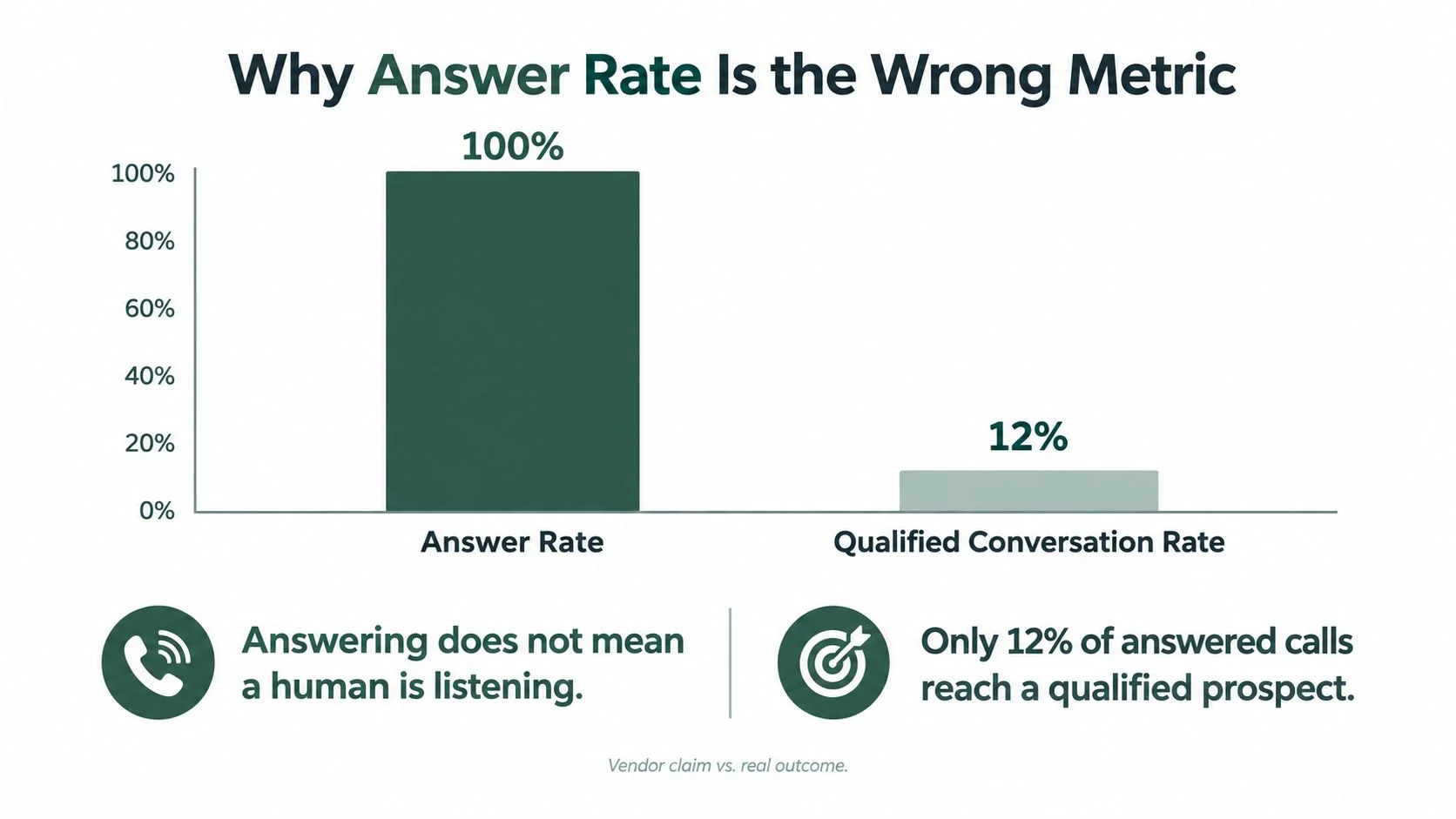
An available 2025 analysis claims 100% answer rate for AI voice agents, compared with an 8% industry average for human cold callers and 12% for human power dialing. Those figures come from a source reporting more than 850,000 outbound calls, but the comparison is weak without definitions for number type, geography, voicemail handling, filtering, contact quality, call duration, and the meaning of “answered.” The Rizzly outbound answer-rate analysis is useful precisely because it exposes how easily headline rates can mislead.
Cognism reports a 13.3% answered rate for SDRs using verified contact data and AI-assisted company research in 2025, compared with 14.4% for account executives calling warm opportunities. Cognism’s 2025 outbound calling data shows why the relevant comparison is data quality, buyer recognition, timing, and conversation quality, not “AI versus human.”
Measure the funnel that creates revenue
Track the following by campaign, account segment, and source:
- Verified-contact rate: Whether the number belongs to the intended buyer.
- Connect rate: Whether a call reaches a live person.
- Meaningful-conversation rate: Whether the person is the relevant buyer and engages beyond a greeting.
- Qualified-meeting rate: Whether the conversation creates a meeting that matches the agency’s niche and delivery criteria.
- Opt-out and complaint rate: Whether the campaign damages future reach.
- Pipeline per 1,000 dials: Whether activity creates commercial value.
A recognition-first sequence can produce fewer total connections and better commercial outcomes. The buyer may have seen the agency’s niche page, a search result, an AI citation, or a peer-relevant point of view before the call. That context changes the opening conversation in a way that dialer concurrency can’t create.
Use a connected measurement model to measure pipeline with AI across search, social, enrichment, and calling. The dialer should receive account context from those channels, not operate as an isolated activity counter.
How to Choose an AI Dialer Vendor
Give vendors six pass-or-fail tests. Don’t accept a roadmap answer when the campaign will handle real contacts.
| Criterion | Pass test | Fail signal |
|---|---|---|
| Consent-log provenance | Export includes source, timestamp, wording, scope, and status for CRM storage | Consent exists only in a vendor interface |
| Jurisdiction support | Vendor documents updates for US states, UK, EU, and Canada | One global workflow with no market controls |
| Call-mode control | Team can switch among preview, human handoff, and AI voice | Procurement locks the agency into one mode |
| CRM integration | Write-back covers account hierarchy, custom fields, transcript, outcome, and opt-out | Manual CSV exports or partial contact updates |
| Retention and access | Legal can receive transcript and audio records promptly | Vendor can’t explain storage, deletion, or export |
| Commercial model | Pricing reflects connected conversations or qualified meetings | Seat pricing rewards user count instead of outcomes |
A vendor that can’t answer the consent-log question in five minutes is a liability. Ask the representative to show a real export, a suppression event, and the audit trail after a contact revokes permission.
Reject these claims immediately
Reject any vendor that says AI voice is exempt from TCPA restrictions. The FCC’s July 2024 proposal describes an AI-generated call as an outbound call using computational technology, machine learning, predictive algorithms, or large language models to generate voice or text content and communicate with the called party. The FCC document on AI-generated calls reinforces that “AI” covers more than a conversational agent.
Reject vendors that can’t demonstrate a working Do-Not-Call and internal suppression sync. Reject vendors whose AI voice doesn’t identify itself when your campaign and jurisdiction require disclosure. Treat transcript quality as secondary to provenance, routing, and stop controls.
Teams evaluating the broader outbound stack can also find AI-powered lead gen solutions for SaaS, but don’t let a broader tool list replace a technical vendor review. For a dev agency, integration depth and evidence matter more than the length of a feature page.
A 30-Day Dialing Playbook for a Niche Dev Agency
A dialer belongs in the third week, not the first. The sequence below assumes a defined vertical, a named buyer, and a contact dataset that has been validated before outreach.
Week one builds recognition
Publish or refine the niche landing page. Create content that answers the technical and commercial questions buyers search before selecting a development partner. Run an AI-citation pass so the agency’s positioning appears consistently in the systems buyers use for research.
Pull intent data once across 200 to 500 target accounts, then remove records that don’t fit the agency’s delivery capability or geography. The point is an account universe where each call has a defensible reason, not the largest list.
Week two gives the account context
Engage with named buyers on LinkedIn. Publish a short founder-authored post that names the niche and the problem the agency solves. Use a peer-cited case study or technical argument that makes the agency recognizable before a contact sees an outbound number.
Week three activates preview dialing
Call 200 verified contacts in preview mode. Give the seller an AI-assisted pre-call brief with account context, likely technology constraints, and a reason for the conversation. Cap outreach at two touches per contact per week, and propagate opt-outs across email and the dialer within minutes.

Week four escalates selectively
Use human-handoff calls on engaged accounts. Use AI voice only on an unworked segment where consent, disclosure, suppression, and escalation have been tested. Stop calling accounts that generate complaints or show no fit. Record the reason for each outcome so the next campaign improves targeting instead of merely increasing activity.
The campaign fails when weeks one and two are skipped. Founders can browse 100Signals resources for additional agency-specific planning material, but the operating principle remains simple: authority first, recognition second, dialing third.
Dialing Compounds Recognition, Not Replaces It
An AI auto dialer is a communications system operating under the TCPA, applicable state rules, UK Ofcom requirements, and European electronic-privacy frameworks. Its legal position depends on consent, jurisdiction, disclosure, caller identification, suppression, and retention. The brand name on the software doesn’t change those obligations.
Its commercial position depends on the same discipline. An agency that has established a recognizable point of view in a narrow market gives every caller a better opening. An agency that hasn’t established recognition asks an automated voice to create trust at the exact moment an unknown number appears.
Instrument qualified conversations, meetings, opt-outs, complaints, and pipeline created per 1,000 dials. Keep the consent record with the account and contact, not in a disconnected vendor log. Refuse any platform that can’t show how a revoked number is blocked across CRM, enrichment, and dialer systems.
Teams extending their operating stack can review a practical developer’s guide to white label tools, but tooling doesn’t substitute for positioning. Niche ownership comes first, verified data comes next, and the dialer compounds that work. Build the recognition layer, prove the consent path, then use calls to convert existing relevance into qualified pipeline.
If your agency is competing in a defined vertical, start with a consent and data audit before buying more dialing capacity. 100Signals can map the niche, build the recognition layer across search, AI assistants, and LinkedIn, and activate outbound only after the account and contact foundation is ready. Request a positioning scan at 100Signals and make the next call arrive after the buyer has a reason to recognize your name.