What Is Share of Voice in Marketing: 2026 Strategy Guide
Discover what is share of voice in marketing and how it impacts pipeline growth. Go beyond vanity metrics to boost conversion rates for your dev agency in 2026.
Share of Voice is the percentage of the market conversation your brand owns. For a dev agency, it matters because a 10% increase in Excess Share of Voice is associated with a 0.5% gain in Share of Market.
Most agency leaders treat SOV as a soft brand metric because they learned it from social dashboards. That’s the wrong frame. If you sell complex software services, SOV is an upstream measure of whether buyers will recognize your firm before sales starts doing work. Recognition changes response rates, deal velocity, and who gets invited into the shortlist.
The old version of SOV measured media spend against category spend. The current version measures visibility across the places buyers build vendor memory: search, social, media coverage, and now AI-generated discovery.
What Is Share of Voice
Share of Voice is a sales signal before it is a marketing metric. For a software development agency, it measures the percentage of category visibility your firm controls across the places buyers discover, compare, and remember vendors. The formula is simple: (Your brand’s visibility in a channel ÷ Total category visibility in that channel) × 100.
The concept started in media planning. A brand that spent $5,000,000 on e-reader advertising in a category with $100,000,000 in total spend held 5% SOV, using the standard definition outlined in the Wikipedia entry on Share of Voice. Digital channels changed the inputs, not the logic. Agencies now calculate SOV from search visibility, category mentions, social reach, referral coverage, and presence in AI-generated answers because those are the surfaces that shape shortlist formation.
For agency CEOs, that shift matters because visibility affects revenue earlier than closed-won reporting does. If your firm appears in 3 of the 10 vendor-comparison queries that matter in fintech app development, gets cited in AI answers for “best healthcare software development company,” and shows up repeatedly in LinkedIn discussions among CTOs, your commercial position is stronger before an SDR sends the first email.
The part most agencies miss
Binet and Field’s analysis of 171 campaigns from 1980 to 2010, cited in Talkwalker’s share of voice guide, found that every 10-point increase in Excess Share of Voice is associated with a 0.5-point gain in Share of Market. If an agency holds 20% share of market in a niche but only 12% share of voice, it is underweight in buyer attention relative to its commercial position. If it holds 30% share of voice, it has room to grow.
That relationship is why SOV belongs in the pipeline review, not only in a brand dashboard.
The agency-specific interpretation is more useful than the textbook one. Buyers of custom software services cannot inspect delivery quality at first touch, so they rely on market signals. Repeated exposure in search, trade content, founder posts, analyst lists, and AI search results lowers perceived risk. Lower perceived risk improves reply rates, increases direct traffic from branded searches, and raises the odds that procurement includes your firm in an RFP instead of screening you out early.
Practical rule: If your agency has low SOV in a niche, sales pays for that gap through lower outbound conversion and slower pipeline velocity.
What counts as voice now
For dev agencies, “voice” includes four measurable surfaces: commercial search rankings, citations or mentions in AI answers, social visibility among relevant operators, and editorial or partner coverage that buyers use for validation. A channel only counts if it influences vendor selection.
That is why raw impressions are a weak proxy on their own. Ten thousand impressions from broad “software development” content can produce less pipeline than 500 impressions from high-intent searches such as “Node.js agency for SaaS migration” or “HIPAA compliant app development partner.” Relevant SOV matters more than gross SOV.
If you want a sharper breakdown of how SOV differs from market share in modern search and AI environments, the Sight AI visibility platform study is a useful companion read because it separates visibility from revenue capture with examples tied to search and AI discovery.
Why SOV Is a Pipeline Metric
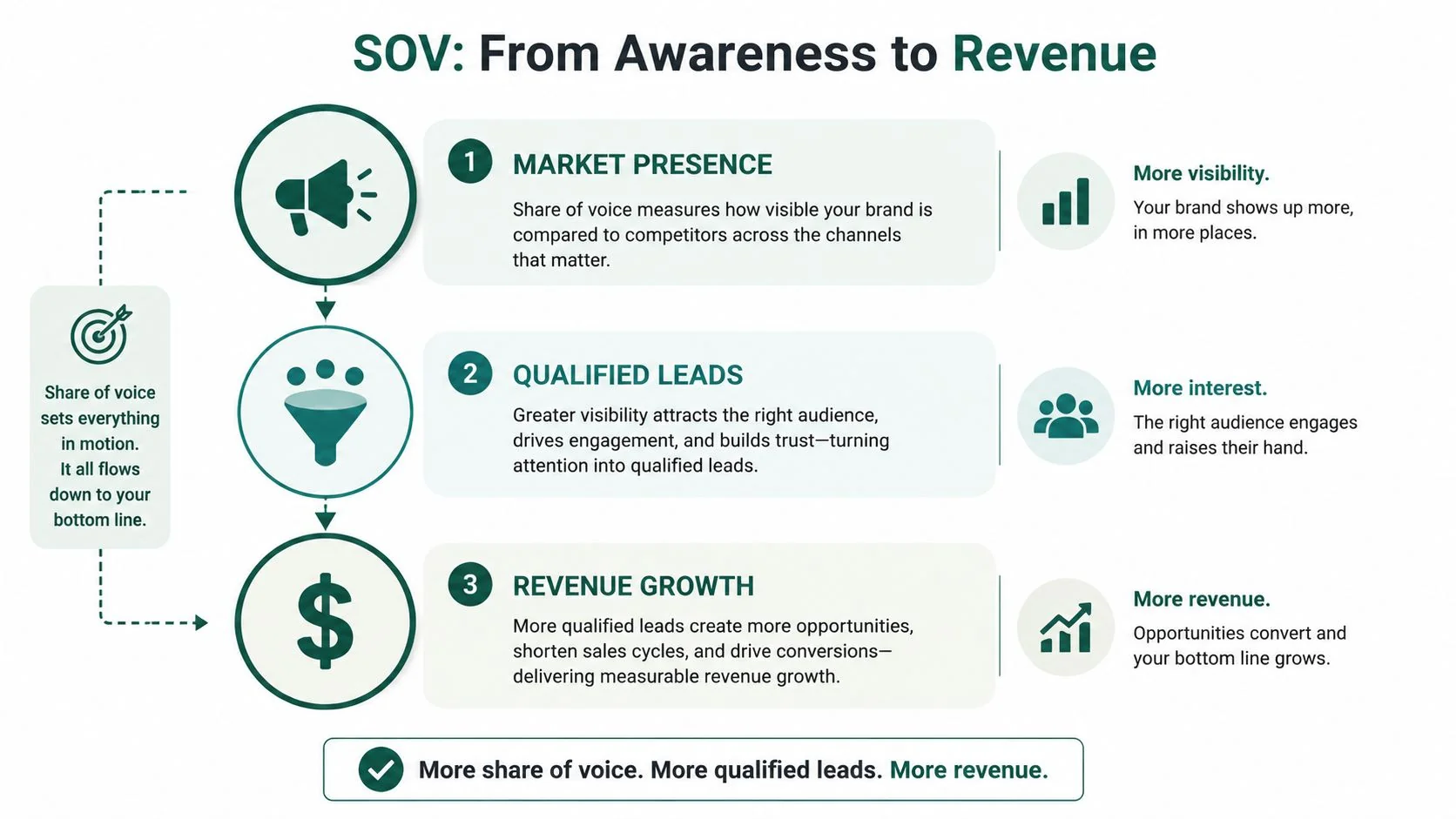
For a dev agency CEO, share of voice is an early sales signal. It tells you whether the market is making your outbound, referrals, and shortlist inclusion easier before revenue data shows the effect.
Share of market records revenue already won. Share of voice tracks how often your agency appears across the buyer surfaces that shape vendor selection. Binet and Field’s campaign data, cited above, ties excess share of voice to future share growth. In services, the mechanism is straightforward. More relevant visibility lowers perceived risk, and lower perceived risk improves conversion at multiple points in the funnel.
Why the pipeline effect is stronger for agencies
A SaaS buyer can start with a free trial. A software development buyer cannot trial a six month delivery relationship. That pushes buyers toward indirect evidence before the first call. They check who ranks for the category terms they search, which firms appear in AI-generated answers, which founders show up repeatedly in their feed, and which agencies get cited by credible third parties.
Those signals create awareness and compress the trust gap.
That has direct commercial consequences. A prospect who has seen your agency in a comparison query, a founder post, and an AI answer is more likely to open your email, less likely to treat your outreach as random, and more likely to accept a meeting framed around a specific problem. The same visibility also helps in later-stage deals because procurement teams and technical evaluators can validate you faster.
Where SOV shows up in the sales math
For agencies, SOV changes pipeline velocity before it changes closed revenue, and many leadership teams miss that.
If your firm owns a larger share of relevant category visibility, sales gets three advantages:
| Pipeline effect | What higher relevant SOV changes | Business impact |
|---|---|---|
| Outbound conversion | Prospects recognize your name or expertise before the first touch | Higher reply rates and more meetings per rep |
| Inbound quality | More buyers arrive with a defined use case and category fit | Better SQL rates and fewer low-fit discovery calls |
| Deal speed | Buyers need less proof that your firm is credible | Shorter validation cycles and fewer stalled opportunities |
The distinction between relevant SOV and broad visibility matters here. An agency can generate a large volume of impressions around generic software content and still see little pipeline movement. By contrast, consistent visibility around terms tied to budget and urgency, such as legacy modernization, HIPAA app development, or Node.js migration, can influence shortlist formation with far less traffic.
Why CEOs should watch SOV before pipeline softens
Pipeline usually weakens after visibility drops, not at the same time. If your agency stops appearing where buyers compare options, outbound starts colder, branded search interest fades, and referral conversations carry less built-in credibility. Revenue reports show the damage later.
This is why SOV belongs on the same dashboard as SQL rate, win rate, and sales cycle length. It is not a substitute for those metrics. It is an upstream variable that helps explain why they are moving.
| Metric | What it measures | What it tells a dev agency CEO |
|---|---|---|
| Share of Market | Revenue captured in the category | Historical performance |
| Share of Voice | Visibility across buyer-relevant channels and queries | Whether future pipeline creation is getting easier or harder |
The practical test is simple. If rising SOV does not increase qualified traffic, improve outbound response quality, or help your firm enter more competitive evaluations, it is the wrong SOV measure. If it does, it belongs in revenue planning.
If you need a broader KPI framework for deciding where SOV belongs in your dashboard stack, Orbit AI’s guide to marketing KPIs is useful because it helps separate leading indicators from outcome metrics.
How to Calculate Share of Voice The Correct Formulas
The formula doesn’t change by channel. The input does.
Share of Voice = (Your Brand Metric ÷ Total Market Metric) × 100
That’s the entire model. The only technical challenge is defining the numerator and denominator correctly for each channel your buyers use. For a dev agency, that usually means search, social, paid, PR, and AI discovery.
Share of Voice formulas by channel
| Channel | Brand Metric (Numerator) | Total Market Metric (Denominator) | Example Calculation |
|---|---|---|---|
| Organic search | Your agency’s visibility, impressions, or rankings for a defined keyword set | Total visibility, impressions, or rankings across your tracked competitors for the same keyword set | Your organic visibility divided by total niche visibility, multiplied by 100 |
| Social media | Your brand mentions or engagement in a niche conversation | Total mentions or engagement for all tracked competitors in that same conversation | If your brand has 500 Instagram mentions and the market has 10,000 total, SOV is 5% |
| Paid search | Your impression share or paid impressions in a defined auction set | Total eligible impressions or total paid visibility across the tracked category | Your paid impression share divided against total market opportunity, multiplied by 100 |
| PR and media | Your mentions or placements in target publications | Total mentions or placements across your competitor set in those publications | Your weighted media presence divided by total category media presence |
| AI search | Your citations, mentions, or recommendations in AI-generated answers for target prompts | Total tracked citations or mentions across competitors for the same prompt set | Your AI citations divided by total citations in the tracked market set |
Two rules prevent bad SOV math
First, keep the market set fixed. If you compare yourself against a different competitor list every month, trend lines become noise. A niche agency should usually track direct alternatives, not global consultancies that sell everything to everyone.
Second, keep the query or topic set fixed for each report cycle. If one month you measure “healthtech software development” and the next month you add broad software outsourcing phrases, your SOV didn’t change. Your denominator did.
Engineering mindset: SOV is only as reliable as the system boundary. Define the category loosely and the metric becomes useless.
The distinction that saves you from false confidence
A high SOV in the wrong topic cluster can still produce weak pipeline. If your agency dominates general “software development” chatter but buyers hire you for a narrow compliance-heavy niche, your reported SOV will look healthy while your actual commercial position remains weak.
That’s why the best SOV model is always scoped around a niche, buyer problem, or commercial keyword set. For agencies, category-wide visibility is often less useful than owning a smaller buying conversation where budget and urgency are real.
A Practical Guide to Measuring SOV for Dev Agencies
SOV measurement should run like revenue operations. For a dev agency CEO, the useful output is an early warning system: whether your firm is entering the buyer’s consideration set before sales starts outbound or before an RFP appears.

What to measure by channel
Track each channel separately because each one affects pipeline in a different way.
For organic search, Ahrefs or SEMrush can estimate visibility across a fixed keyword set and competitor group. Build the list around commercial searches such as niche, platform, compliance, migration, or integration terms. A firm ranking for “healthtech app development HIPAA” matters more than broad visibility for “software development company” if the first query is where budgeted buyers compare vendors.
For social and earned media, use a monitoring tool such as Brand24 to track branded mentions, executive mentions, and topic-level discussion across a named competitor set. LinkedIn usually matters more than X or Instagram for agency sales because buyers check founder credibility, proof of work, and peer validation there before responding to outreach or booking a call.
For paid media, use Google Ads impression share and lost impression share due to budget or rank. Those metrics show whether paid visibility is constrained by spend, weak creative, or poor auction competitiveness. Keep paid SOV separate from organic SOV so leadership can see whether growth came from authority, ad spend, or both.
To optimize for AI discovery, develop a prompt set centered on buying questions. Track whether your agency is cited, recommended, or referenced in answers across the same prompt set each month. AI search is starting to influence shortlist formation before a buyer ever visits your site.
A workable operating cadence
Run a weekly check for operators and a monthly review for leadership. Weekly reporting catches execution problems early, such as a content push that fails to gain rankings or a PR campaign that generates mentions outside the target niche. Monthly review is the right interval for strategic decisions because SOV shifts more slowly than lead volume.
A useful dashboard includes four layers:
- Competitor set: 5 to 10 direct agencies a buyer would compare against
- Channel view: organic, social, earned media, paid, and AI discovery tracked separately
- Topic clusters: niche-specific themes such as fintech modernization, healthcare interoperability, or ecommerce replatforming
- Revenue overlay: branded search growth, demo requests, SQLs, outbound connect rates, and opportunities created by niche
That last layer is where agencies usually fail. They measure visibility without tying it to commercial movement. If your SOV rises in “legacy app modernization” while meetings booked in that niche stay flat, either the query set is too informational or the offer is weak. If SOV rises and branded search, direct traffic, and reply quality rise one reporting cycle later, marketing is improving sales efficiency, not just awareness.
How to keep the data usable
Limit the system before you automate it. A narrow, stable measurement model beats a broad one that changes every month.
Use only direct competitors. A 40-person Laravel shop should not benchmark itself against Accenture. Use only commercially relevant topics. A content library can drive plenty of traffic while contributing little to pipeline if it ranks for educational terms with no buying intent. Standardize naming, query sets, and reporting dates so month-over-month changes reflect market movement rather than reporting noise.
If you need a faster way to map which agencies dominate a service category or region, an advanced agency search platform can help define the initial competitor set before tracking starts.
A good SOV dashboard is boring by design. The inputs stay fixed, the trend is easy to trust, and the output helps sales decide where credibility is rising fast enough to support pipeline.
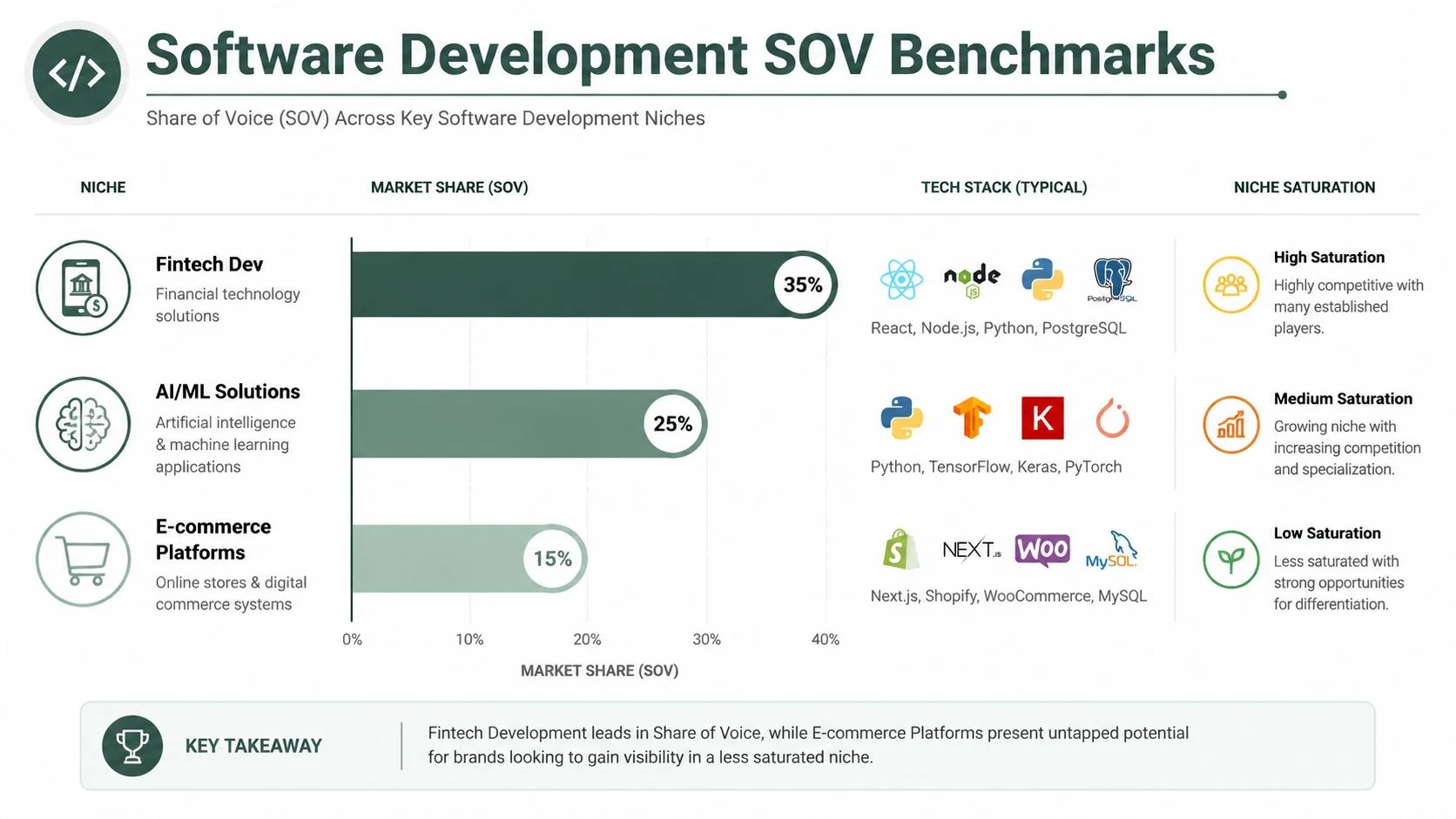
SOV Benchmarks for Software Development Niches
A dev agency doesn’t need the highest visibility in its category, only enough share of voice in a defined buying niche to shorten sales cycles and raise conversion rates on outbound. That is the benchmark that matters.
Broad benchmarks hide the actual commercial picture. An agency can rank well for “software development company” and still lose pipeline in “legacy app modernization for insurers” if buyers do not see it repeatedly in the research surfaces they trust. Strong SOV in a niche increases the odds that outbound emails get recognized, referral checks confirm the same positioning, and shortlist conversations start with less skepticism.
Benchmarks should map to revenue potential, not category size
There is no universal “good” SOV number for agencies because competitive density changes by niche. Ten credible competitors in a regional healthcare software segment create a very different benchmark from 200 firms publishing into generic AI development terms. The practical question is narrower: what share of the relevant buying conversation do you control inside the segment your sales team is targeting?
For a 40-person agency, 12% SOV in “React development” may produce little because the term is crowded, price-sensitive, and often too early-stage. A smaller share in “SOC 2-ready fintech product development” can be worth more if that topic appears in shortlist research, procurement checks, and AI search summaries used by decision-makers.
A useful benchmark model for agencies
Use operational bands tied to buyer behavior and pipeline outcomes.
| Position in a niche | What it usually looks like | Pipeline implication |
|---|---|---|
| Emerging | Your agency appears inconsistently across Google, LinkedIn, AI search results, and third-party mentions for a tightly defined service niche | SDRs and founders must create credibility manually in first-touch outreach |
| Competitive | Your agency shows up often enough to be recognized during vendor research, but competitors still set much of the narrative | Outbound reply rates and shortlist rates improve, but deals still depend heavily on proof in sales calls |
| Dominant | Your agency is repeatedly visible across search, social proof, expert mentions, and AI-generated recommendations for the same problem set | Buyers enter meetings with preloaded trust, which usually improves meeting acceptance and sales velocity |
Those bands are more useful than a single industry average because they connect visibility to what a CEO cares about: pipeline quality. If your firm wants to win target accounts in one vertical, align SOV reviews with your target account management strategy instead of using generic category benchmarks.
Channel mix changes the benchmark
Raw share is a weak benchmark if it sits in the wrong channels. A niche agency with moderate overall SOV can outperform a louder rival when its visibility is concentrated in buyer-relevant surfaces such as high-intent search queries, founder LinkedIn posts, analyst or community mentions, and AI search citations.
That matters more in software services than in many consumer categories because the buying process is multi-threaded. A CTO might discover an agency through search, validate it on LinkedIn, ask peers for confirmation, then run the firm through an AI assistant to compare options. If your agency is absent from one or two of those steps, your apparent SOV can look healthy while your actual shortlist rate stays weak.
Software development agencies also lack a reliable public benchmark that converts SOV directly into market share across channels. Treat that as a measurement constraint and keep tracking SOV anyway. The better approach is to benchmark by channel and weight each channel by its role in deal creation.
What a sane benchmark review looks like
Review SOV in three layers:
- Commercial niche. Measure visibility for the exact service, industry, and geography your team sells, such as “Python modernization partner for logistics firms in the US”
- Buyer-relevant channel. Separate search, LinkedIn, media mentions, review platforms, and AI search citations instead of blending them into one number
- Sales effect. Compare SOV changes against outbound response rates, meeting-to-opportunity rate, and time from first conversation to proposal
One warning matters here. High mention volume in generalist conversations often produces weak pipeline. If 30% of your visibility comes from educational content for junior developers or broad commentary on AI trends, that exposure may inflate reporting while doing little for revenue. The benchmark worth defending is relevant SOV among accounts with budget, urgency, and a matching problem.
An Action Plan to Increase Relevant Share of Voice
For a dev agency, share of voice only matters if it changes who replies, who books, and how fast deals move. More top-of-funnel visibility does not help if prospects still ask for proof, compare three larger firms, or stall after the first call. The operating goal is narrower. Increase visibility in the exact commercial conversations that shape shortlist formation.

Build relevant SOV where buyers verify risk. For software development agencies, that usually means three surfaces working together: high-intent search queries, AI-generated answers for commercial research, and LinkedIn credibility signals tied to named operators.
Pick the niche before you pick the channel
Agencies that start with a publishing plan usually spread effort too thin. Agencies that start with a category definition can concentrate proof, repeat the same positioning across channels, and become easier to remember during vendor selection.
A workable sequence looks like this:
-
Define one revenue-grade niche
Choose a service, buyer type, and business problem with enough specificity to guide both content and sales. “App development” is too broad. “Legacy claims platform modernization for regional insurers” gives marketing and sales a usable category. -
Map the queries that appear before a buying conversation
Include terms around migration risk, integration complexity, compliance requirements, vendor comparisons, cost of delay, and replacement timelines. These are the phrases that signal active evaluation, not casual interest. -
Publish assets that lower perceived delivery risk
Case studies with architecture detail, migration checklists, comparison pages, and founder-led commentary outperform generic educational content because they answer commercial objections directly.
Build presence across validation channels
Buyers do not evaluate agencies in one tab. They search for a solution, check whether an expert looks credible in public, and increasingly test the market through AI tools that summarize options. If your firm is absent from one of those steps, you lose conversion efficiency even if rankings look strong in another.
| Channel | What to publish or improve | Pipeline effect |
|---|---|---|
| Search | Niche service pages, competitor comparison pages, implementation guides | Improves discovery on commercial queries and raises conversion from research to first call |
| AI discovery | Clear expert-authored pages, concise definitions, structured case evidence, FAQ sections | Increases the chance your agency is cited or summarized in AI-assisted vendor research |
| Posts from founders, delivery leads, and solution architects tied to real projects | Reduces credibility friction during shortlist review and outbound follow-up |
A useful test is whether the same core message appears in all three places. If search says “healthcare interoperability specialists,” AI tools summarize you as a general software shop, and LinkedIn mostly discusses hiring or culture, your SOV is fragmented. Fragmented visibility slows pipeline because prospects have to reconcile conflicting signals.
Tie SOV to account selection
Relevant SOV rises faster when the target account list and the content plan describe the same market. If sales is chasing fintech scale-ups while marketing publishes for enterprise healthcare buyers, visibility will grow in one segment and pipeline in another. That disconnect hides the underlying performance problem.
A better approach is to pair your visibility plan with target account management for agency growth. Use the same vertical definition, company size band, and buying triggers in your outbound list, landing pages, LinkedIn narratives, and AI-visible content. That alignment makes SOV measurable against reply rates, meetings booked, and proposal volume by account segment.
What to stop doing
Stop publishing broad thought leadership that attracts peers, junior developers, or general business readers with no buying intent.
Stop rotating between five different positioning statements each quarter.
Stop treating social reach as evidence of market penetration if it does not improve shortlist rate or outbound conversion in the accounts you want.
Useful SOV comes from repeated exposure around one commercial problem, for one defined buyer, across the places that influence vendor selection. For a dev agency CEO, that is the real payoff. Stronger SOV increases awareness, reduces skepticism, improves outbound efficiency, and shortens the path from first touch to qualified opportunity.
Pitfalls and Advanced SOV Concepts for 2026
Bad SOV models push agencies into bad sales decisions. If your dashboard counts every mention equally, you will overinvest in visibility that looks good in reporting and does little for meetings, shortlist rate, or proposal volume.
The failure point is usually model design. A founder sees more LinkedIn mentions, more branded impressions, and more citations in AI answers, then assumes pipeline should rise at the same pace. It rarely works that cleanly. Different channels influence different parts of the buying cycle, and the same mention can carry very different commercial value depending on query intent, audience, and context.
Weighted SOV is the model agencies actually need
An agency named in a generic “top software companies” list should not get the same credit as an agency recommended in an AI answer for “best fintech app development agency” or ranking on a comparison page for a high-intent service query. One reaches broad attention. The others sit much closer to vendor selection.
A useful weighted model scores visibility across at least three factors:
-
Intent quality
Did the mention appear on a buying-stage query, a category query, or a low-intent informational topic? -
Audience fit
Was the likely reader a CTO, product lead, and founder in your target niche, or a general audience with no budget authority? -
Trust transfer
Did the placement increase confidence through comparison content, expert commentary, analyst-style coverage, or AI-generated recommendations?
This changes the operating decision. A dev agency with 8 percent raw SOV in a niche can outperform a rival with 15 percent raw SOV if its visibility is concentrated in bottom-funnel searches, AI summaries for commercial queries, and third-party comparisons that buyers use before outreach. That is why raw SOV often fails as a management metric. Weighted SOV tracks sales influence more accurately.
Channel overlap matters more in 2026
The old model treated search, social, PR, and analyst mentions as separate lines on a report. Buyers do not behave that way. A prospect might first see your agency in an AI answer, check your LinkedIn credibility, read two comparison pages, then reply to an outbound message because your name already feels familiar.
That sequence has pipeline value even if no single touchpoint looks dominant on its own.
For agency leaders, this means SOV should be measured across assisted influence, not just isolated channel share. If AI search visibility rises and outbound reply quality improves in the same segment, that points to pre-sales trust building before the SDR or founder reached out.
Don’t confuse share of attention with share of voice
Presence is not the same as engagement from real buyers. An agency can dominate discussion among peers, recruiters, and junior developers and still lose enterprise deals because the visibility sits in the wrong places.
Use a second layer beside SOV:
- Branded search trend by niche
- Return visitor rate on service pages
- Named-account engagement from target companies
- Outbound reply rate where prospects mention prior familiarity
- Shortlist rate after first qualified conversation
If SOV rises but those numbers stay flat, the issue is usually poor weighting, weak buyer fit, or content mapped to topics that attract the wrong audience.
Competitor sets need constant correction
Many agency teams distort SOV by tracking the wrong competitors. They include global consultancies, tiny freelancers, or firms that sell into different budgets and geographies. That inflates the denominator and makes the metric less useful for decisions.
Track the competitors that appear in real deals, category searches, AI recommendations, and shortlist conversations. Review that set quarterly. A practical way to do this is to combine SOV reporting with competitive intelligence for agency positioning, then compare visibility shifts against proposal losses, win-loss notes, and outbound conversion by segment.
For agencies in 2026, SOV is an early sales signal. If your relevant, weighted SOV is increasing in the channels buyers trust before they speak to sales, pipeline velocity usually improves before closed revenue does. If it is not, your market presence may be getting louder while your sales motion stays just as hard.
Frequently Asked Questions
| Question | Direct Answer |
|---|---|
| What is share of voice in marketing in one sentence? | It’s the percentage of the relevant market conversation your brand owns across a defined set of competitors and channels. |
| Is SOV the same as market share? | No. SOV measures visibility or conversation presence. Market share measures actual sales share. One is upstream. The other is an outcome. |
| Which channels should a dev agency track first? | Start with the channels buyers use to discover and validate agencies in your niche. For most firms, that means organic search, LinkedIn, earned mentions, and AI discovery. Add paid only if it materially contributes to pipeline. |
| How many competitors should we include? | Include direct alternatives a buyer would realistically compare against you. Don’t inflate the category with giant firms outside your true niche. |
| Should we report one blended SOV number? | Usually no. A blended number hides channel quality. Report SOV by niche and by channel, then map those trends to meetings, reply quality, and opportunities. |
| How quickly does SOV affect pipeline? | It affects different parts of pipeline at different speeds. Recognition tends to change outbound response and shortlist quality before it shows up in closed revenue. |
| Can small agencies use SOV, or is it only for big brands? | Small agencies can use it well because niche markets are measurable. In many cases, a focused agency gets more value from niche SOV tracking than a broad firm tracking a giant category. |
| What’s the biggest implementation mistake? | Measuring broad visibility instead of niche-specific visibility. That creates a comforting metric that doesn’t explain sales performance. |
For a software development agency, SOV is a way to measure whether your firm is becoming easier to buy. When your agency owns more of the right niche conversation across search, AI discovery, and buyer-validation channels, outbound stops feeling cold and shortlists get easier to enter.
If you want to turn niche visibility into pipeline instead of just reporting on it, 100Signals helps software development agencies build recognition in one defensible market before outbound begins. That matters because when prospects have already seen your agency in search, AI assistants, and LinkedIn, response rates and sales conversations change.