Target Account Management for Dev Agencies: A Playbook
A practical target account management playbook for software dev agencies. Learn to build dynamic lists, use intent data, and align teams to fill your pipeline.
Most agencies waste target account management on list hygiene. That’s backwards. The point of target account management is knowing which accounts are worth pursuing, when they’re active, and how to move before a slower competitor does. That matters because Salesmotion reports that 82% of B2B companies run active target account management programs, and focused playbooks can push win rates up to 50% versus 20% for non-targeted opportunities. The strategy is mainstream. The edge now comes from execution.
For a software development agency, target account management means working a live list of named accounts. You identify the narrow slice of companies that fit your niche, tier them by value, track buying signals, and route the right play to the right account fast. If you’re still treating your target account list like a quarterly spreadsheet exercise, you’re maintaining a directory, not running TAM.
Your TAM Playbook Is Only As Good As Your Data
Target account management is a disciplined way to focus sales and marketing effort on the accounts most likely to buy your agency’s services. For dev agencies, that usually means narrowing a broad market down to a manageable set of named companies instead of hoping random inbound leads line up with your delivery strengths.
The mistake I see most often is simple. Agencies build a target account list once, export it to a spreadsheet, and call that strategy. But the list gets stale, buying committees change, priorities shift, and your team keeps working accounts that aren’t moving.
The useful unit in target account management is the account record, with the signals attached to it. If your system can’t tell you which accounts fit your niche, which contacts matter, and which companies are showing active movement, your TAM playbook will underperform no matter how polished the outbound copy looks.
What good data actually means
Good data for TAM isn’t just accurate company names and titles. It means your account view includes firmographic fit, technographic relevance, buying context, and fresh engagement inputs. If your agency is trying to win React modernization work for B2B SaaS platforms, a clean list of generic CTOs won’t help much. You need to know who’s running the stack you care about, who’s likely carrying the migration pain, and who’s showing signs of interest.
A lot of founders also separate authority-building from target account management. That’s another mistake. If buyers are already seeing your brand in search, LinkedIn, and AI-generated answers, your outreach lands differently. This is why work on optimizing for Google AI Overviews belongs upstream of account activation, not beside it.
Practical rule: If sales can’t look at one account and immediately see fit, recent signal activity, and the next recommended action, your TAM data model is incomplete.
Your enrichment layer matters here. Agencies that want cleaner account selection and contact mapping should tighten how they handle B2B data enrichment. The quality of every downstream decision depends on it.
Build Your Micro-Niche ICP First
A vague ICP kills target account management before it starts. Neither “Mid-market SaaS” nor “Healthcare tech” is an ICP. Both are lazy category labels that push your team toward generic messaging, weak qualification, and bloated account lists.

A real ICP for a dev agency has to be narrow enough that your commercial team can reject most opportunities quickly. That sounds restrictive, but it is efficient. The narrower the ICP, the easier it is to build authority, write credible content, and run outreach that sounds like you understand the buyer’s world instead of trying to impress them with technical buzzwords.
What a usable ICP includes
You need three layers.
| ICP layer | What to define | Why it matters for a dev agency |
|---|---|---|
| Firmographic fit | Company type, size band, product model, internal team structure | Filters out companies that can’t buy or don’t match your delivery model |
| Technographic fit | Stack choices, infrastructure clues, legacy platform signals, product architecture hints | Connects your agency’s actual technical strength to likely need |
| Problem context | Trigger events, visible friction, team gaps, product constraints | Turns “fit” into a reason to contact the account now |
If you only use the first row, you’ll end up with broad account lists full of companies that look right on paper and go nowhere in pipeline.
Build around painful specificity
Micro-niche ICPs work because they combine constraints. A better ICP sounds more like this: product-led B2B SaaS companies with a growing engineering org, visible platform complexity, a technical leadership change, and evidence that performance or delivery speed is hurting them. That gives your team something to screen for and something to say.
This is also where competitive framing matters. If you’re trying to own a narrow category, you need to know which firms already occupy mindshare in it, what language they use, and where your angle is stronger. That’s why I like using competitive intelligence methods for AI search visibility alongside standard account research. The buyers you’re targeting don’t separate vendor discovery channels. Neither should you.
The best ICPs read like disqualification tools, not aspiration statements.
Founders usually resist this because they don’t want to “shrink the market.” But a narrow ICP is how you decide where your agency can become the obvious choice.
A useful way to pressure-test the ICP is to compare it against your strongest historical clients and your strongest future positioning. If those don’t line up, the ICP is too broad or too generic. The account list will drift fast.
For teams that need a sharper method, start with competitive intelligence for B2B positioning and map where your agency can credibly dominate, not merely participate.
This walkthrough covers the difference between category-level targeting and actual niche definition:
A founder test that works
Ask one blunt question. If you had to bet your next phase of growth on one narrowly defined segment, could you name the exact operational traits, stack clues, and business triggers that make an account a fit?
If you can’t, stop building lists. Your TAM motion will only amplify vagueness.
Construct a Tiered and Actionable Account List
A flat list is operationally useless. If you hand sales 400 accounts with no prioritization, you’ll get random follow-up patterns, uneven personalization, and internal arguments about where to spend time. Tiering fixes that because it turns the list into a resource allocation model.
The underlying data model should include more than company size and industry. Operatix notes that target account selection depends on integrating technographic data, B2B research data, and behavioral insights, and for software development agencies this can turn a broad market into 200 to 500 mapped accounts with 1,000 to 5,000 contacts. That’s the right scale for many agencies because it’s narrow enough to manage and broad enough to create pipeline coverage.
Start with source quality, not source volume
Over-collection and under-validation are common pitfalls. What helps is a clear view of what each source is good for.
| Data Source | Primary Use Case | Signal Quality | Cost | Weakness |
|---|---|---|---|---|
| LinkedIn Sales Navigator | Finding accounts, validating org structure, identifying likely stakeholders | Strong for role and company context | Paid | Limited technographic depth |
| Clutch and G2 | Finding agencies’ likely-fit buyers by category, reviews, and market positioning | Useful for category fit and visible pain themes | Mixed | Coverage is uneven and often surface-level |
| Apollo or ZoomInfo | Building contact lists and basic account coverage | Useful for speed and scale | Paid | Contact accuracy can drift |
| Company websites and job pages | Confirming stack clues, hiring signals, delivery gaps, product priorities | High when manually verified | Low direct cost, high time cost | Hard to scale without a process |
| CRM history | Checking prior engagement, disqualified accounts, referral paths, timing clues | High if maintained well | Existing sunk cost | Usually incomplete or messy |
A founder should care about this because source selection drives list quality, and list quality drives whether your team spends the next quarter on real opportunities or noise.
Use a three-tier model and make the tiers behave differently
Most agencies copy tier labels and then run the same outreach motion across all of them. That defeats the point.
| Tier | Account profile | How to work it | What not to do |
|---|---|---|---|
| Tier 1 | Strategic, high-fit, high-value accounts | Deep research, custom messaging, multi-threaded outreach, leadership involvement | Don’t automate the first touch |
| Tier 2 | Strong-fit accounts with good upside | Semi-personalized plays by role, sub-vertical, or pain pattern | Don’t over-invest manual research too early |
| Tier 3 | Good-fit but lower-priority accounts | Programmatic nurture, broad relevance, signal monitoring | Don’t let these absorb SDR time meant for Tier 1 |
The practical point is simple. Tiering should change labor allocation, content depth, and speed of response. If it doesn’t, you have labels, not a tier model.
How to build the list without stalling
I prefer a working list built in passes instead of a “perfect” list built in one shot.
- Pull a gross list from your primary databases using hard ICP filters.
- Remove obvious non-fits fast. Wrong model, wrong geography, wrong complexity, wrong budget pattern.
- Add validation signals from websites, hiring pages, leadership changes, and known stack clues.
- Map initial contacts across technical, operational, and economic roles.
- Assign provisional tiers based on fit and strategic value.
- Push the list live and let engagement data refine it.
That last step matters most. A list becomes useful when your team starts interacting with the market and learning from response patterns.
If your team is still “finalizing the list” after weeks of internal debate, you’ve already lost time you can’t get back.
What an actionable account record should include
At minimum, each account should answer these questions:
- Why this company: The fit logic tied to your micro-niche
- Why now: A visible trigger, problem pattern, or research signal
- Who matters: The likely buying group, not just one decision-maker
- What to say: A concise hypothesis about the problem you solve there
- What tier: The service level and effort model assigned to the account
That structure keeps the list from becoming another dead artifact in RevOps.
Activate Your List With Intent Signals
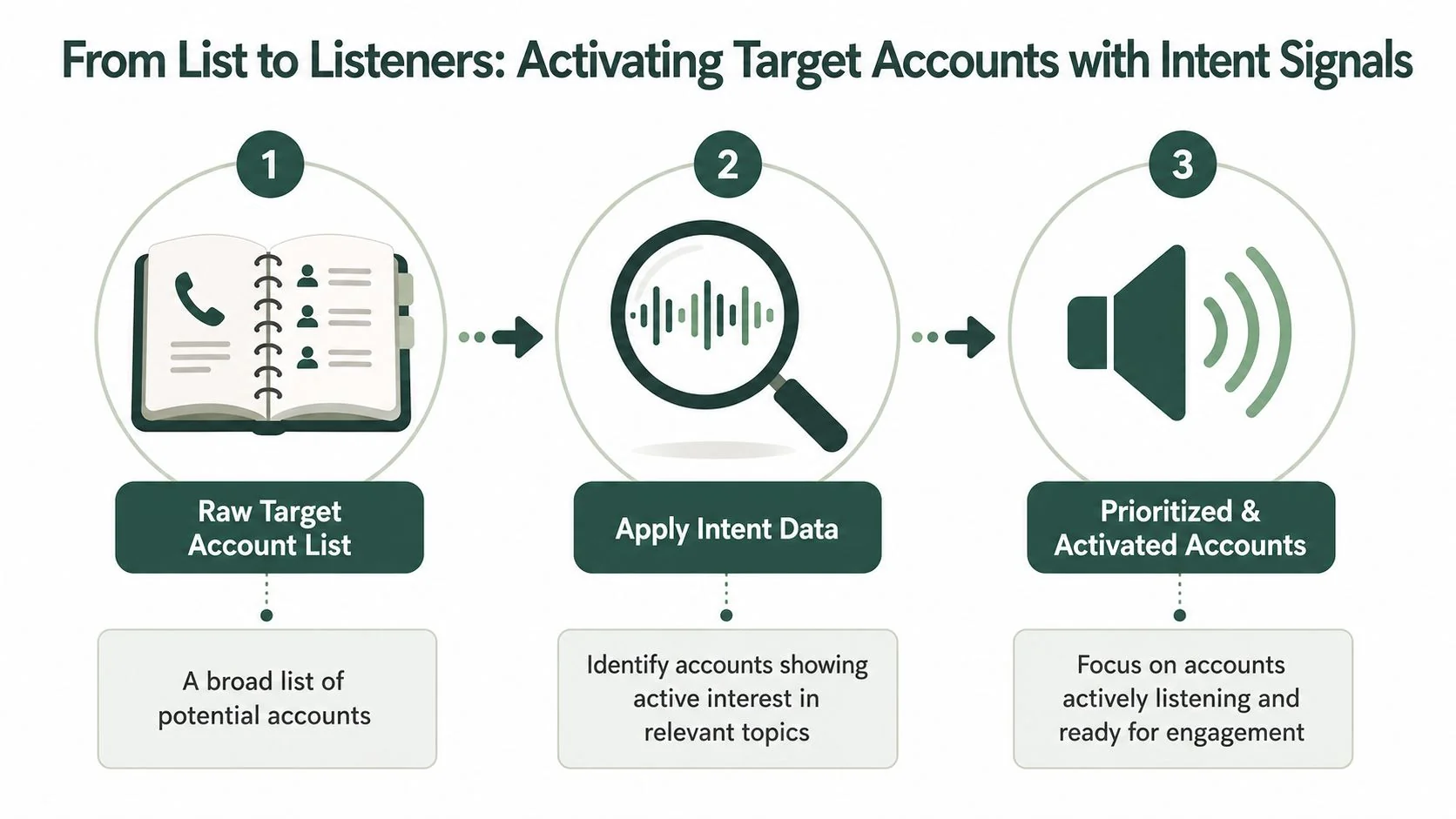
A target account list without intent data is a phonebook. It tells you who exists but not who is paying attention.
The agencies that create pipeline from target account management do one thing differently. They use signals to decide when to act. That includes first-party signals from their own properties and third-party signals that show topic-level research behavior across the market. The point is to stop treating all named accounts as equally urgent, not to predict the future.
First-party signals deserve the fastest response
Your strongest signals usually come from activity you can observe directly. Repeated visits from the same company, multiple contacts engaging with the same topic, technical content consumption, or return visits to service pages all mean more than vanity metrics like opens.
For a dev agency, the useful question is whether this account showed coordinated curiosity around a problem you solve. If the answer is yes, route it.
| Signal type | Example | What it should trigger |
|---|---|---|
| Website behavior | Multiple visits from one account to service, case study, or technical pages | Sales review and account reprioritization |
| Content engagement | Technical guide downloads, webinar attendance, repeat consumption by several contacts | Role-based follow-up with relevant proof |
| Email engagement | Replies or meaningful click behavior from mapped stakeholders | Fast human follow-up |
| Third-party topic interest | External research around migration, performance, cloud cost, or modernization topics | Targeted outreach tied to the researched problem |
Speed beats list perfection
Most agency teams often find themselves stuck seeking perfection. They want better data, better enrichment, better contact coverage, better copy, and one more review pass before launch. Meanwhile, the buying window opens and someone else gets there first.
Relationship One makes the tradeoff plain: for agencies running 90-day campaigns, guidance is needed on balancing speed and accuracy, and 80% accuracy plus fast execution might outperform 98% accuracy after a six-week delay. That is the right operating principle for most dev agencies. If your brand already has some authority in the niche, waiting for list perfection is usually a pipeline leak.
A list with minor contamination and fast signal response will beat a pristine list that nobody acts on.
Put escalation rules in writing
Intent only matters if your team knows what happens next. Most TAM programs fail here because signal review lives in a Slack thread and no one owns the response window.
Use simple rules.
| If this happens | Then do this |
|---|---|
| A Tier 1 account shows repeated research behavior | Move it to active pursuit and assign an owner immediately |
| Multiple stakeholders from the same account engage | Expand contact map and switch from single-threaded to multi-threaded outreach |
| A Tier 2 account spikes in relevance | Promote it temporarily and deploy a tighter play |
| A Tier 3 account stays quiet | Keep it in nurture and stop forcing outbound touches |
This is the operational core of modern target account management. The list is static input. Signals are what keep it current.
Orchestrate Sales and Marketing Plays
Once accounts are tiered and signal-scored, the next question is execution. In practice, most agencies run sales and marketing as parallel workstreams and lose the account. Marketing publishes content. Sales sends outbound. Neither side knows what the other is doing, so the buyer gets disconnected touches that feel random.
That approach kills account penetration. Salesmotion notes that enterprise ABM programs reach a 20% to 30% penetration benchmark, and win rates rise when teams engage four or more stakeholders in a high-value account, with a minimum target of 3 to 4 engaged contacts per account. For a dev agency selling into complex buying groups, single-threaded outreach is a self-inflicted constraint.
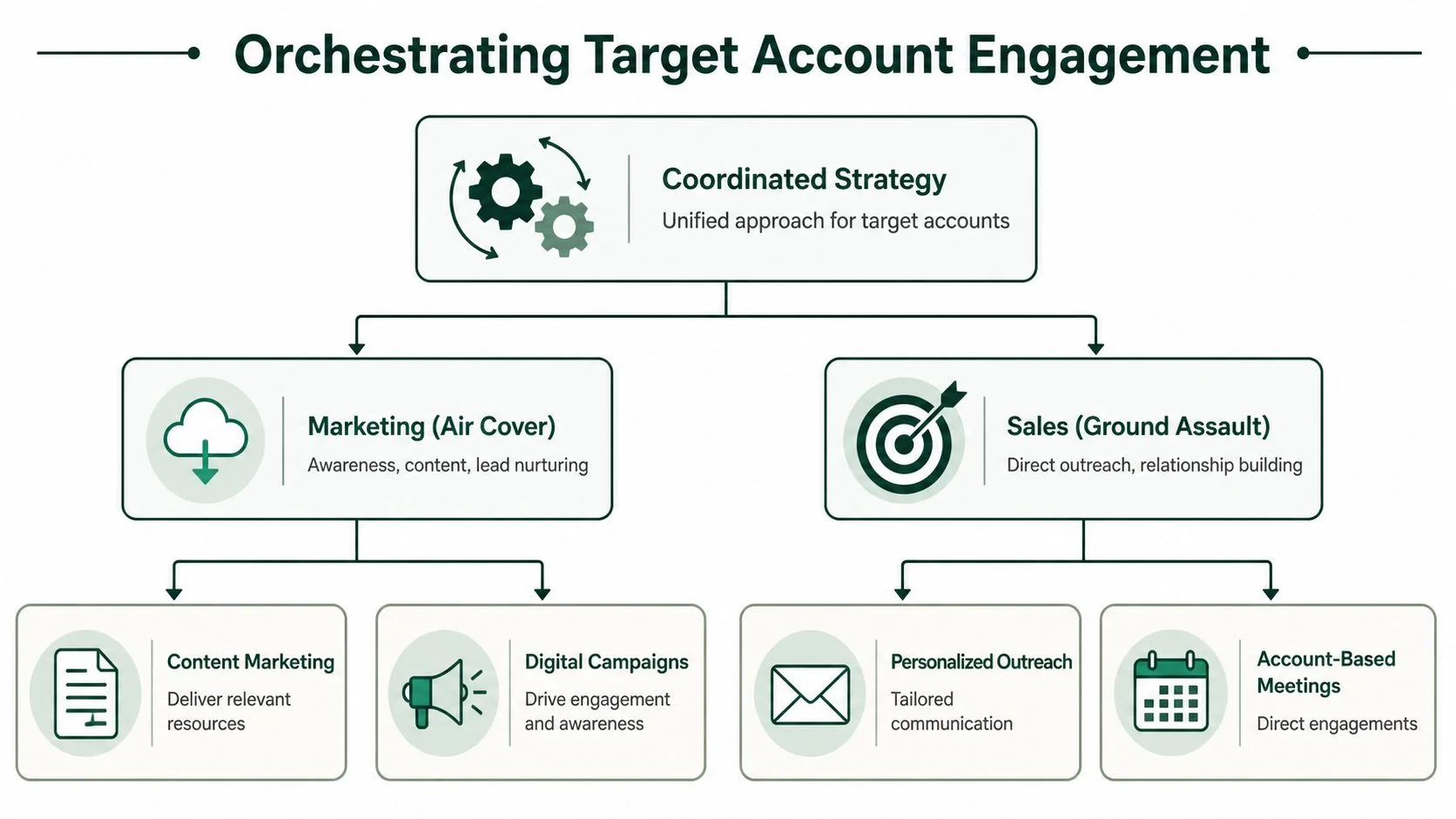
Treat marketing as air cover and sales as precision follow-up
This works best when each function has a clear job.
| Function | Job inside target account management | Failure mode |
|---|---|---|
| Marketing | Build recognition, frame the problem, warm the buying group with relevant proof | Producing generic content that doesn’t support named accounts |
| Sales | Convert active interest into conversations, map stakeholders, advance the account | Sending disconnected messages with no awareness of prior engagement |
| RevOps | Keep data, routing, and account ownership clean | Letting signals die in systems no one checks |
A Tier 1 play should feel coordinated even if the buyer never sees the machinery behind it. If a target account has been engaging with content on platform modernization, sales shouldn’t show up with a generic intro asking if they’re the right person.
A workable sequence for a priority account
I prefer orchestrated plays that layer touches without overcomplicating the stack.
- Marketing runs account-aware air cover. That could be LinkedIn promotion of a technical teardown, founder-led posts on a niche pain point, or case-study distribution aligned to the target account’s context.
- The content matches the account hypothesis. If the account likely has migration friction, don’t promote generic software outsourcing content.
- Signals trigger the handoff. Once engagement appears, sales gets a specific reason to act.
- Sales reaches out with context. Mention the problem pattern, not the activity log.
- The team expands the thread. Map adjacent stakeholders and tailor the follow-up to each role.
Operator note: One real conversation with the right stakeholder is more valuable than a dashboard full of low-quality engagement.
Multi-threading is not optional
Dev agency deals often involve technical, operational, and financial concerns at the same time. If you’re only talking to engineering leadership, you may miss procurement pressure, internal resourcing constraints, or platform risk concerns that sit elsewhere in the account.
That means account plans need role variation. A CTO may care about modernization risk and team velocity. A product leader may care about release bottlenecks. An operations or finance stakeholder may care about execution confidence and delivery waste. One message won’t cover all of that.
A practical account map should include:
- Technical stakeholders: CTO, VP Engineering, Engineering Director, Platform Lead
- Product-side stakeholders: VP Product, Group PM, Product Operations lead
- Commercial or operational stakeholders: COO, finance owner, procurement contact where relevant
The point of target account management is to raise the odds that your agency becomes legible inside a complex buying group, not to blast more people.
Build The Right Tech Stack For The Job
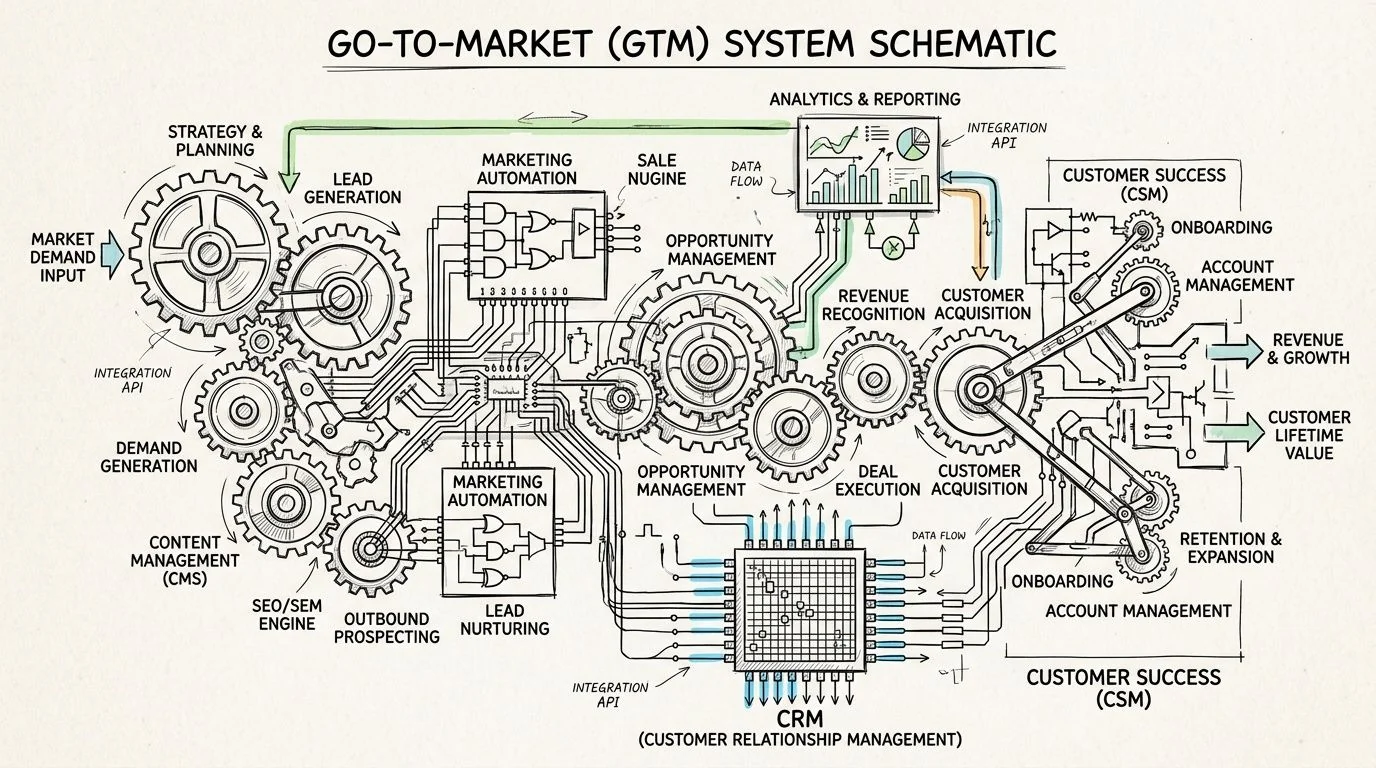
Spreadsheets are fine at the start. They are not fine once your team needs to react to live buying signals, coordinate outreach, and preserve account context across functions. That’s the line founders need to understand.
The real issue is missed opportunity cost, not tooling maturity. The Insight Collective points out that most target account management advice treats target account lists as one-time exercises, while the actual gap is moving from static spreadsheet lists to dynamic, CRM-integrated systems, and agency leaders need a decision framework for when static lists become a revenue leak. That’s the right frame.
Know when the spreadsheet has become the bottleneck
Skip the giant martech stack. What you need is enough system design to keep signal, context, and action connected.
These are the usual warning signs:
| Symptom | What it means |
|---|---|
| Sales asks who owns an account | Ownership isn’t operationalized |
| Contacts live in multiple sheets | Data integrity is already slipping |
| Intent or engagement data gets reviewed manually once a week | Response speed is too slow |
| Marketing can’t see which accounts sales is pursuing | Orchestration is broken |
| Closed-lost reasons never make it back into targeting logic | The system doesn’t learn |
If two or more of these show up, the spreadsheet has stopped being a cheap tool and started charging a hidden tax.
Keep the stack simple and integrated
For most agencies in the 100 to 500 employee range, the core stack can stay lean.
| Stack layer | What it does | Common options |
|---|---|---|
| CRM | Source of truth for accounts, contacts, ownership, and stages | HubSpot, Salesforce |
| Outreach layer | Executes sequences, tasking, and rep workflow | Outreach, Salesloft |
| Data layer | Supplies account enrichment, contact coverage, and intent inputs | Clearbit, 6sense, 100Signals |
The specific vendors matter less than the workflow. A useful system does one thing well: it moves a signal into a visible action attached to the right account and contact.
If you’re evaluating broader process modernization, this perspective on modernizing GTM with AI software is useful because it treats tooling as workflow infrastructure, not software shopping.
Make the switch based on operational pain
Founders often ask when they should invest in a proper TAM stack. Move when missed timing starts costing meetings, when account ownership gets fuzzy, or when your team can’t preserve what it learns from one campaign to the next.
One option in this category is 100Signals, which supports coordinated outbound and pipeline targeting for named account sets while tying authority-building and activation together. That’s useful if your motion depends on niche visibility before outreach. Whichever vendor you pick, you need a CRM-native, signal-aware system.
Buy tools when they remove response lag and preserve account intelligence. Don’t buy them because a platform demo made your RevOps lead optimistic.
Turning the List Into a System
The agencies that win with target account management don’t obsess over whether the list was perfect on launch day. They care whether the system notices movement fast, routes the right play, and helps the team build relevance inside a buying group before competitors do.
That’s why this matters for founders. A working TAM system reduces your dependence on founder-led selling, random referrals, and broad-market positioning. It gives the business a narrower commercial focus and a cleaner way to turn that focus into pipeline. You work a defined slice of demand instead of waiting to be discovered as a generalist agency.
This is also how niche authority compounds. When your ICP is narrow, your content gets sharper. When your content gets sharper, your outreach lands better. When your outreach is timed against real signals, conversations start earlier and with more context. That combination is what moves an agency from “one of many capable vendors” to “the firm buyers already expected to hear from.”
Target account management is worth doing when it becomes a system for niche ownership and predictable pipeline.