Live Data Technologies for Dev Agencies: A Practical Guide
Master live data technologies with actionable strategies for agencies. Compare Kafka, CDC, WebSockets, and build scalable real-time systems.
The global data streaming market was USD 12.45 billion in 2022 and is projected to reach USD 115.4 billion by 2030. Live data technologies are enterprise infrastructure, not an experimental feature reserved for large engineering departments.
Live data means information delivered in real time or near real time as it’s generated, rather than collected into a batch, processed later, and archived. Infosys defines live data as the opposite of batch or historical processing, with data exchanged through human-to-machine or machine-to-machine interfaces. For a software development agency, that distinction changes both delivery architecture and market positioning. Clients increasingly need systems that react to events, while agencies still have to carry the cost of keeping those reactions accurate, observable, and commercially useful.
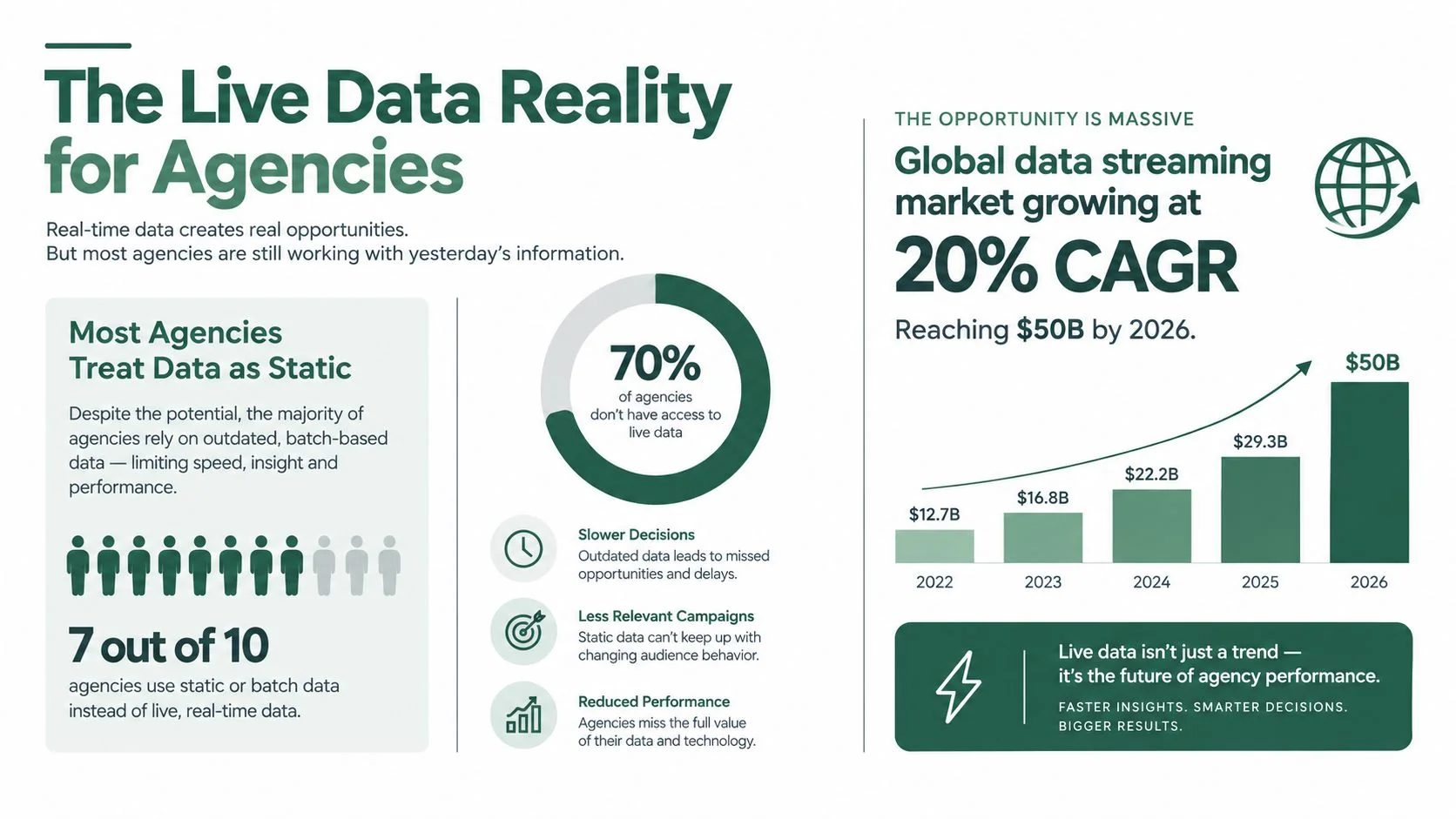
The Live Data Reality for Agencies
The global data streaming market reached USD 12.45 billion in 2022 and is projected to reach USD 115.4 billion by 2030, according to Gitnux’s 2026 industry summary. Other forecasts place the data streaming platforms market at USD 13.6 billion in 2026, rising to USD 68.9 billion by 2034, while a separate estimate puts the data streaming and event processing market at USD 1.73 billion in 2025, growing to USD 6.11 billion by 2032. These forecasts use different market definitions, so adding them would produce a misleading total. Their practical implication is clearer: continuous processing is becoming standard enterprise infrastructure.
Agencies should sell a defined business action, not “real time” as a generic feature. A payment event may update risk scoring, a database change may synchronize a customer record, and a hiring signal may trigger account research. Each workflow sets a different tolerance for delay, source-system impact, operational overhead, and stale data. The architecture decision is therefore a cost and reliability decision, not an ingestion-speed comparison.
Why batch thinking loses strategic ground
Enterprise adoption now extends beyond specialist infrastructure teams. The Gitnux summary reports that 54% of enterprises used real-time streaming for customer analytics in 2023, 68% of cloud users implemented streaming pipelines in 2024, and 72% of Fortune 500 companies had adopted Kafka-based streaming by 2023. Those figures do not establish that every client needs Kafka. They indicate that agency buyers increasingly encounter competitors able to design systems around continuously updated state.
Batch remains appropriate for financial close, historical reporting, and low-change reference data. It becomes a liability when a business decision depends on a new event. A scheduled pipeline may eventually produce a correct customer record, yet deliver it after the window in which that record could influence the decision.
Practical rule: Sell the business action that depends on freshness, then design only the minimum live path required to support it.
The commercial case follows from that constraint. An agency specializing in CDC-based synchronization for regulated SaaS platforms can explain its value more precisely than one promoting general cloud development. Niche authority comes from connecting a technical pattern to a recurring buyer problem, then accounting for freshness, monitoring, failure recovery, and source-system risk.
Architecture of Real-Time Systems
A production-grade live system has four layers: ingestion, transport, processing, and serving. Artie’s architecture guide describes this separation and connects failures at any layer with latency, data loss, or operational work. For an agency, the architecture should follow the client’s required action, then specify which layer owns freshness, recovery, and correctness.
Ingestion captures the event
Ingestion reads changes from an application event, SaaS API, message queue, or relational database. For database synchronization, Artie explains that change data capture reads row-level changes from the transaction log. This avoids repeatedly scanning complete tables and connects an existing transactional system directly to a streaming design.
The source contract must define what qualifies as an event and which system remains authoritative after capture. Dropped connections, incomplete records, unsupported source types, and connectors that cannot keep pace with change volume can all corrupt freshness before transport begins. Monitoring therefore needs to expose connector health and capture lag, not only downstream query performance.
Transport moves events without losing control
Transport carries events from producers to consumers. Kafka fits architectures where several downstream systems need the same stream, because its operating model includes partitions, retention, replay, consumer lag, and access control. Those capabilities also create work for the delivery team. A point-to-point integration can reduce that burden when one consumer is sufficient and historical replay is unnecessary.
Metabase architecture explained is relevant when the client needs an analytics-serving layer. Metabase can present analytical state, but it does not govern the upstream event path. Serving remains the final layer, so transport still requires controls for delivery, retention, and access.
Processing and serving determine actionability
Processing validates, enriches, joins, filters, and transforms events. Serving exposes the resulting state to an application, dashboard, warehouse, or decision engine. ClickHouse’s comparison of real-time analytics platforms separates ingestion latency, query latency, and data freshness. An event can arrive quickly while a cache or partially updated view continues to show stale state.
| Layer | Primary responsibility | Main failure mode | Agency design question |
|---|---|---|---|
| Ingestion | Capture source events or row changes | Missing, incomplete, or duplicated input | What event is authoritative? |
| Transport | Move and retain events | Backlog, loss, or consumer lag | Must multiple systems consume and replay the stream? |
| Processing | Validate and transform state | Schema errors, late joins, or bad enrichment | Which transformations belong before serving? |
| Serving | Deliver usable state | Stale cache or partial view | What action depends on the freshest committed state? |
This model sets a defensible agency scope. A periodically refreshed dashboard may not justify the cost of full streaming. An immediate action based on a source change does. In that case, the proposal must cover every layer, including monitoring, failure recovery, replay policy, and the source system’s authority.
Comparing Core Technologies
Technology selection should follow the event source, required response, and cost of keeping the result trustworthy. Airbyte’s streaming guide places practical latency from milliseconds to minutes, depending on the workload. Application workflows may require milliseconds, while reporting, analytics, and some AI pipelines can tolerate seconds or minutes.
An agency should define whether its target is ingestion latency, query response, or data freshness before committing to a service level. Fairview’s review of real-time synchronization tools reports near-real-time tools in the 1–5 minute range, modern CDC pipelines sustaining under 100 milliseconds, and well-tuned Kafka deployments achieving under 10 milliseconds end to end. It also cites a bank-scale Confluent deployment sustaining sub-5 millisecond p99 latency at 1.6 million messages per second. These are reported deployment results, not baseline guarantees. For an agency pipeline, each figure must be weighed against connector ownership, replay requirements, source load, and incident response effort.
| Technology | Latency | Operational complexity | Source impact | Best for |
|---|---|---|---|---|
| Kafka and event streaming | Well-tuned deployments can reach under 10 milliseconds end to end, with the cited bank-scale Confluent deployment sustaining sub-5 millisecond p99 at 1.6 million messages per second | High. Teams manage partitions, retention, replay, serialization, consumer lag, and monitoring | Usually low after publication, but producers must emit correctly designed events | High-throughput distribution, replayable histories, and multiple consumers |
| Change data capture | Modern CDC pipelines can sustain under 100 milliseconds, while other tools operate in the 1–5 minute range | Medium. Connector behavior, transaction logs, schema evolution, and reconciliation require active ownership | Lower than polling when configured correctly | Replicating relational inserts, updates, and deletes without full-table polling |
| WebSockets | Application latency can be very low, but performance depends on connection management and server design | Medium to high. Teams handle connection lifecycle, fanout, authentication, and recovery | Low at the database layer, but application services must publish the correct state | Bidirectional updates for collaborative interfaces or live operational screens |
CDC is a source synchronization pattern
Qlik describes CDC as turning a database into a live stream. Devart contrasts CDC with event streaming and polling, describing polling as higher latency with greater source load, while CDC supplies near-real-time updates with lower source impact. That trade-off makes CDC appropriate for agencies modernizing an existing relational estate. It avoids full-table polling without requiring every application team to redesign around domain events. The remaining work is operational: connector health, transaction-log retention, schema compatibility, and reconciliation still need clear ownership.
WebSockets solve a different problem
WebSockets maintain a bidirectional application connection. They can deliver changed state to a browser or service, but they do not provide a durable event backbone, replay mechanism, or database replication strategy. Use them when the requirement is interactive delivery. A connected screen may need rapid updates, while downstream systems still require durable events or replicated state.
The agency qualification question is direct: Does the client need to distribute events, replicate database state, or update a connected application? Kafka, CDC, and WebSockets address different failure modes and delivery contracts. The decision matrix should therefore price not only latency, but also replay, source impact, connector maintenance, connection recovery, and the evidence required to verify freshness. Treating one technology as a universal live-data layer creates avoidable operational debt.
The Hidden Cost of Live Reliability
Speed is visible in a demo. Reliability appears six months later, when a source team changes a field type, an event arrives out of order, or a duplicate updates a customer record twice. IBM’s analysis of real-time data identifies schema changes, incomplete records, data drift, low-latency bottlenecks, and higher operational overhead as risks in real-time environments.
Live data isn’t automatically better data. A fast incorrect record can trigger a faster incorrect decision. Batch systems often provide a natural interval for validation, reconciliation, and human review. Streaming systems remove that delay, so the agency must replace it with explicit controls.

Reliability requires more than a latency dashboard
A production service needs to show whether an event was received, accepted, transformed, served, and acted on. Latency alone can’t reveal a silent schema mismatch or a record that passed through the pipeline with a missing business key.
| Reliability concern | What breaks | Control the agency should implement |
|---|---|---|
| Schema drift | Consumers reject events or interpret fields incorrectly | Versioned schemas and compatibility checks |
| Late-arriving events | Aggregates and dashboards show incomplete state | Event-time handling, watermarks, and correction logic |
| Duplicates | Counts, balances, or actions execute more than once | Idempotency keys and deduplication |
| Incomplete records | Downstream decisions use partial context | Required-field validation and quarantine paths |
| Consumer lag | Freshness degrades while ingestion appears healthy | Lag alerts tied to business SLAs |
| Debugging gaps | Teams can’t reconstruct what happened | Correlation IDs, replayable events, and audit logs |
IBM’s cited market context says access to real-time data became the number-one challenge in 2025, while projections in the same discussion state that nearly 30% of generated data may be consumed in real time by 2025 and 80% of worldwide data is expected to be unstructured. These are projections and contextual claims from the source, not universal operating conditions for every client.
Engineering position: If the agency can’t explain how a bad event is detected, quarantined, corrected, and replayed, it hasn’t delivered a real-time system. It has delivered a fast dependency chain.
That distinction affects pipeline positioning. Clients with high-consequence data problems need an agency that can own observability and recovery, not merely configure a broker. Reliability becomes a niche authority signal because it is harder to demonstrate in a sales deck and harder for generalist competitors to deliver consistently.
Agency Pipeline Use Cases
Live data creates commercial value when it shortens the distance between a market event and an agency action. The strongest use cases start with a trigger that identifies a company, person, or account worth researching now, not with a platform.
A workforce-intelligence vendor reports tracking about 160 million professionals, detecting roughly 449,000 job changes per week, and re-verifying profiles every 10–14 days. It also publicly claims more than 300 million employment verifications every month and more than 1 million monthly job changes through Live Data Technologies. These vendor-reported figures illustrate the operating model: employment and title signals are continuously refreshed and delivered through APIs, flat files, or data warehouses.
Prospect mapping from employment signals
An agency specializing in a technology stack can monitor role changes, hiring activity, and company movement, then route qualified accounts into research and outreach. The architecture may combine an external workforce-data API, a warehouse, enrichment, and a CRM trigger. The value comes from a niche team identifying which changes matter for its service offer, not from knowing every job change.
The signal should lead to verification, not automatic outreach. A new engineering leader may indicate a strategic initiative, but the agency still needs to confirm company fit, existing vendors, geography, and the likely project scope.
Intent aggregation
Intent systems combine multiple changing signals, such as website activity, search behavior, and social activity, into account prioritization. The design problem is freshness alignment. A signal that updates quickly may be less useful than a slower signal with clearer relevance, so teams should record signal timestamps, source confidence, and the action each signal permits.
For data-definition considerations, 100Signals on B2B data enrichment provides a practical reference point. An agency building its own pipeline should define fields, provenance, refresh behavior, and suppression rules before it connects intent data to sales automation.
Proposal and capacity decisions
Dynamic pricing can use current delivery capacity, market demand, and competitor activity to inform proposals, but the system shouldn’t turn volatile external signals into automatic pricing without review. A more defensible design recommends a pricing band, flags unusual conditions, and preserves the evidence behind the recommendation.
| Pipeline use case | Trigger | Suitable latency | Required control | Authority advantage |
|---|---|---|---|---|
| Prospect mapping | Employment, title, or company change | Near real time to daily | Verify account fit before outreach | Own a narrow buyer signal tied to one service |
| Intent aggregation | Multiple account activity signals | Seconds to minutes for routing, slower for analysis | Score source confidence and freshness | Explain why an account enters priority review |
| Proposal intelligence | Demand, capacity, or competitor movement | Minutes to daily | Human approval and audit trail | Price from documented conditions instead of intuition |
Live data becomes a pipeline asset only when a signal has a defined owner, a permitted action, and a recovery path when the signal is wrong.
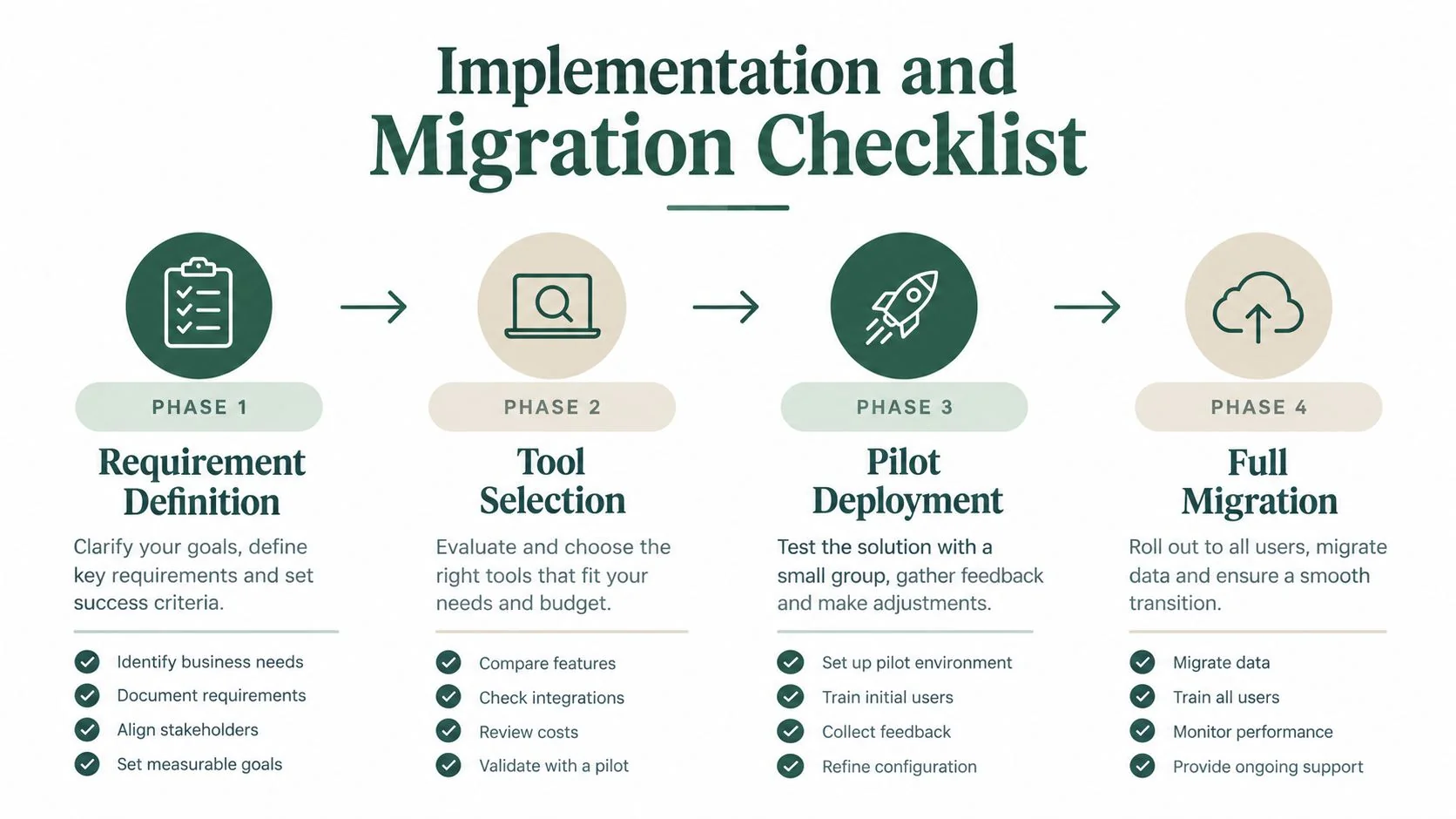
Implementation and Migration Checklist
Agencies shouldn’t migrate every client from batch processing to streaming. They should isolate the workflow where freshness changes the commercial result, then prove the operating model before expanding it.
Phase one defines the requirement
Start with the action, not the technology. Record the source event, the consumer, the maximum acceptable delay, the acceptable level of duplicate or missing data, and the fallback when the stream stops.
Use three separate measures:
| Measure | Definition | Why it matters |
|---|---|---|
| Ingestion latency | Time from event creation to capture | Shows source and connector performance |
| Query latency | Time required to read the current state | Shows whether users or services can act quickly |
| Data freshness | Age of the newest committed state available to the consumer | Shows whether the result is actually current |
This separation follows the performance model in ClickHouse’s real-time analytics comparison. A team that reports only “end-to-end latency” can hide stale caches, delayed commits, or partial views.
Phase two selects the smallest viable pattern
Choose CDC when the source of truth is a relational database and the requirement is to move inserts, updates, and deletes with limited source disruption. Choose Kafka when several consumers need a durable, replayable event stream. Choose WebSockets when the requirement is bidirectional delivery to connected application clients.
Managed services such as Confluent Cloud can reduce infrastructure administration. Self-hosted Kafka can provide more control but makes capacity, upgrades, security, and incident response the agency’s responsibility. Neither choice removes the need for schema governance or consumer monitoring.
Reported production benchmarks provide reference targets, not contractual promises. Fairview reports under-100-millisecond latency for modern CDC pipelines and under-10-millisecond end-to-end latency for well-tuned Kafka deployments. An agency should load-test its own source, payload, partitioning, serialization, and consumer behavior before committing to an SLA.
Phase three pilots failure behavior
The pilot should include bad records, duplicate events, schema changes, connector restarts, consumer pauses, late arrivals, and replay. Teams often test the healthy path and discover recovery problems only after a client incident.
| Pilot test | Pass condition |
|---|---|
| Schema change | Consumers reject or accept the change according to a documented compatibility rule |
| Duplicate event | The downstream state remains correct |
| Late event | The system corrects or quarantines the affected result |
| Consumer outage | Events remain available for recovery or the loss is explicit |
| Invalid record | The record enters a visible quarantine path |
| Freshness breach | The owner receives an actionable alert |
Phase four expands only after ownership is clear
Assign an owner for source contracts, schema versions, alert response, replay, reconciliation, and client communication. Connect technical alerts to business impact. A consumer lag alert matters because it may delay lead routing, inventory action, fraud review, or customer communication.
Don’t hide the live path inside a one-off project. Package the operating model into architecture decisions, runbooks, dashboards, tests, and a named support boundary. That turns an implementation detail into a repeatable agency capability.
Migration rule: Keep batch processing for workloads that don’t benefit from freshness. Streaming earns its place only when faster action offsets its monitoring and recovery cost.
Strategic Positioning for Growth
With live data now standard infrastructure, the differentiator is the cost of keeping speed trustworthy. Schema governance, replay design, freshness SLAs, and failure response determine whether a fast pipeline produces dependable client outcomes.
That projected market growth, noted earlier by Gitnux, signals adoption, not a reason to standardize every workload. Batch remains the better choice where freshness does not change action.
Choose one buyer problem, such as CDC modernization for SaaS operations or event-driven analytics for logistics platforms. Build the architecture, failure tests, observability model, and commercial proof around it. Publish decisions generalist competitors avoid, including the conditions that justify batch.
This focus gives prospects a clear reason to recognize the agency’s expertise before a sales call. It also creates a repeatable delivery model through reusable connectors, schemas, dashboards, recovery procedures, and qualification criteria.
To turn that specificity into pipeline, request a free positioning scan from 100Signals. It can clarify the niche, problem to own, and authority assets needed before outbound begins.