How to Get Software Development Contracts in 2026
How software development agencies win contracts in 2026: pick a niche, build verifiable authority, sequence outreach on intent, and write proposals that close.
Software development agencies win contracts by becoming the recognized choice before they reach out. Sending more outreach doesn’t get them there. According to Pitchsite’s 2026 agency benchmark data (aggregating Loopio, GigRadar, and Upwork), cold outbound wins 8 to 15% of deals for web and software development agencies. Warm and inbound leads convert at 30 to 50%. That is a 2 to 3x gap. Buyers trust an agency they already know over one that just appeared in their inbox.
This article is for founders and CEOs of software development agencies, IT consultancies, and software houses. If you are an individual contractor looking for employment, the playbook below is not for you. The individual-contractor and agency-owner journeys diverge at the very first step. For agencies, the job is reducing perceived delivery risk before the first sales conversation. That means picking a niche where your expertise is verifiable, building proof buyers can inspect, sequencing outreach based on intent, and writing proposals that remove ambiguity. Skip that order and you end up in crowded RFPs, rate pressure, and long sales cycles.
Recognition does not require months of waiting before you start outreach. Niche authority, intent-sequenced outreach, and search and AI validation run together and reinforce each other. Recognition leads, but outreach doesn’t wait for it.
Niche Agencies Compete on Fit
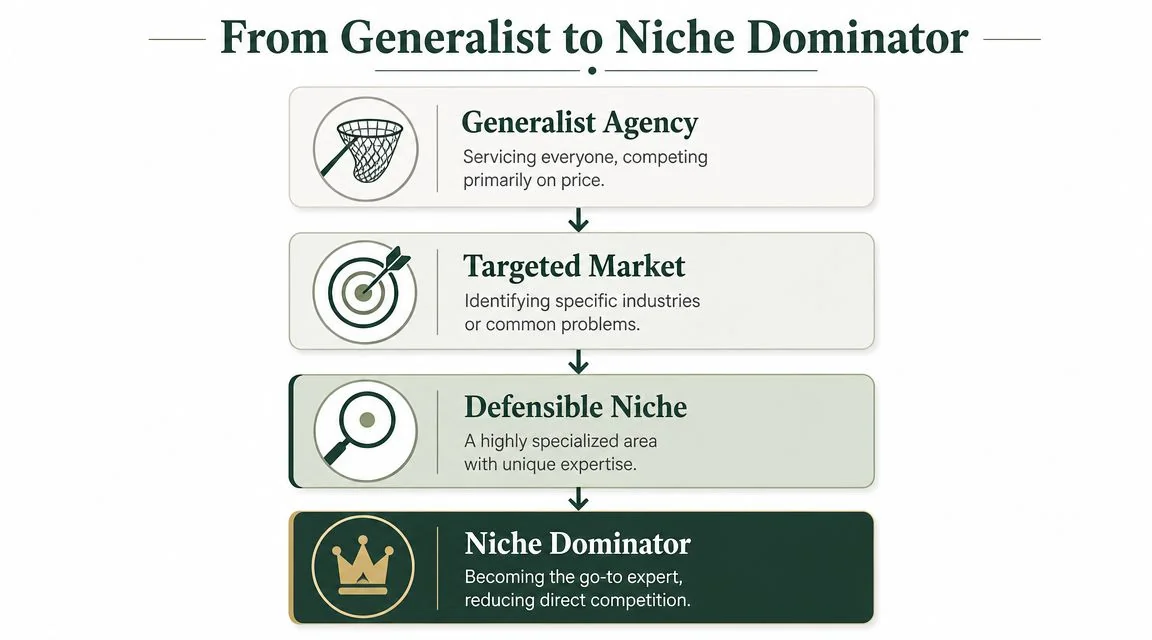
A generalist agency is easy to compare. A niche agency is harder to replace.
Buyers compare broad vendors on rate, team size, geography, and logo slides. They compare niche vendors on fit. Fit wins better deals because it shifts the buying criteria from “Who can build this?” to “Who already understands the constraints?”
Why specialization changes pricing power
Software development is a tiered market with visible pricing bands. Fullstack’s pricing guide shows smaller firms often bill $90 to $160 per hour on projects around $20,000 to $500,000, mid-sized firms often charge $120 to $250 per hour on projects around $75,000 to $2 million, and enterprise-class firms may charge $400+ per hour, with some reaching $900 per hour on projects from $750,000 to over $100 million. The same guide lists offshore rates at $27 to $55 per hour and nearshore rates at $44 to $82 per hour in its software development price guide.
Those bands tell you something more useful than “rates vary.” They show buyers already expect to pay very different prices for apparently similar work. The gap is explained by risk, specialization, and perceived consequences of failure.
Positioning as “full-service custom software development” puts your agency in the comparables that procurement already has on a spreadsheet. Positioning as the agency that builds, migrates, and supports complex platforms for one buyer type with known constraints moves you into a different comparison set.
The Teneo 2026 B2B Software Vendor Survey found 73% of vendors now cite low-cost and AI-native entrants as the biggest competitive threat. Only 14% name traditional incumbents. Generic positioning is the problem: it puts a 50 to 200 person agency on the same shelf as offshore shops and AI-native tools, where the only differentiator left is price.
Practical rule: Niche selection is rate defense.
What a real niche looks like
A niche is not “healthcare” or “fintech.” Those are sectors. Still too broad for authority.
A useful niche has three properties:
| Filter | What good looks like | What weak looks like |
|---|---|---|
| Problem specificity | One repeatable build, migration, integration, or compliance-heavy workflow | ”We build custom apps” |
| Buyer clarity | One economic buyer, one technical evaluator, one recurring trigger | Mixed buyers with unrelated use cases |
| Proof portability | One case study, architecture pattern, or delivery process helps sell the next deal | Every proposal starts from zero |
Niche choice for a software development agency should come from delivery economics. The strongest niches sit where buyers face high implementation risk, vendor switching costs are real, and internal teams cannot staff quickly enough. Pattern recognition beats broad capability claims in those conversations. For more on scoring niche authority, see the Agency Niche Authority Index.
How to choose a niche without guessing
Three tests before you commit:
- Check recurring demand: Start with segments where software spending is persistent, not experimental.
- Check authority saturation: Search for the exact problems buyers research. If every result is a giant consultancy or generic listicle, there is room for a specialist with sharper proof.
- Check sales efficiency: Ask whether one domain page, one demo, and one proposal structure can support multiple deals in that segment.
Agencies that avoid narrowing because they fear losing opportunities lose authority instead. Saying yes to every category tells buyers you have solved none of them thoroughly.
A defensible niche also changes who you compete against. Instead of every offshore shop and regional dev vendor, you compete with a smaller group of agencies that understand the domain. That makes the comparison survivable.
Build Verifiable Authority Where Buyers Look
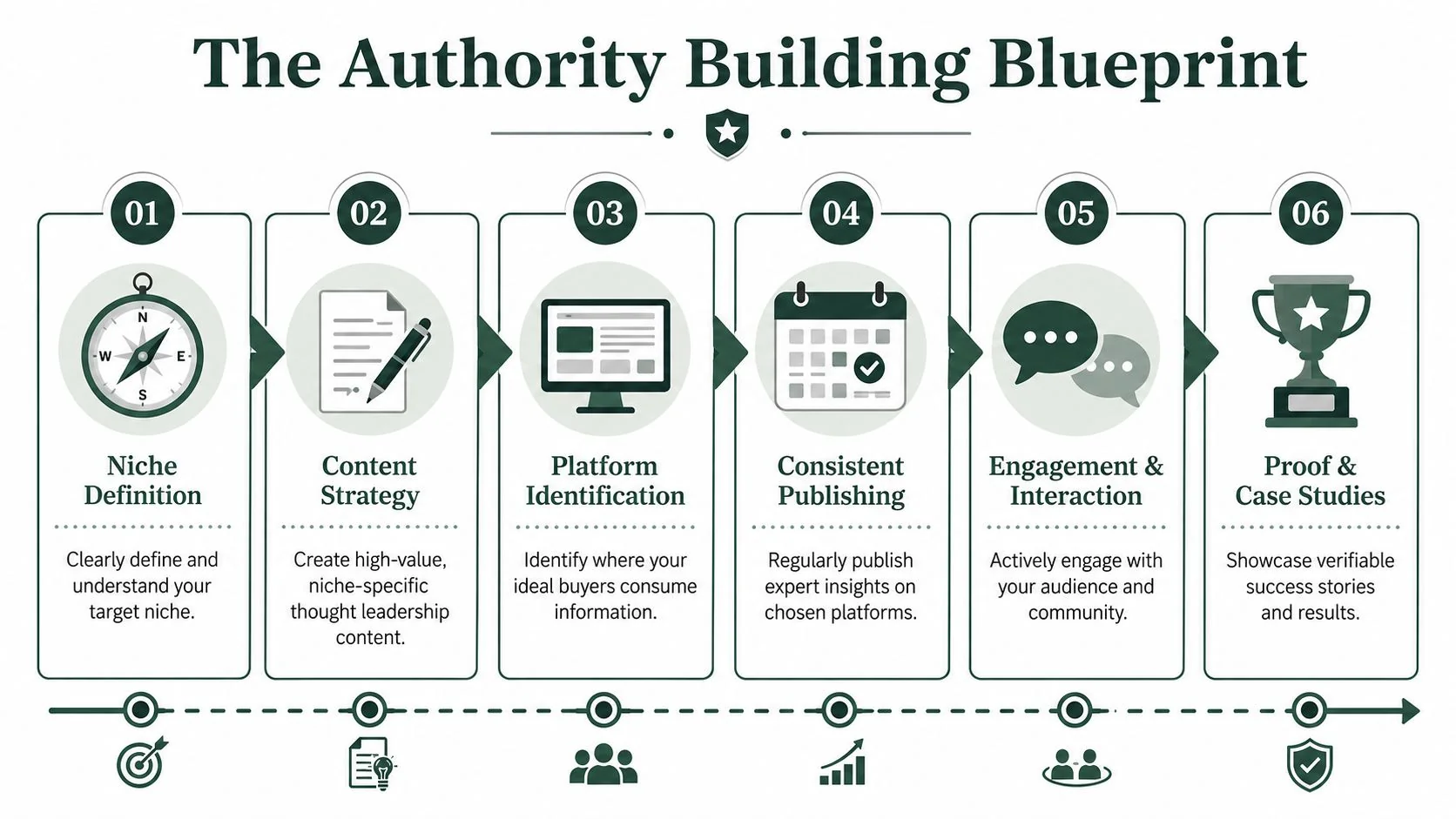
Authority is evidence a buyer can inspect before they talk to sales.
Generic trust signals do not carry enough weight for an agency without massive brand recognition. Portfolio pages, broad “services” copy, and cold outreach alone do not answer the buyer’s real question: why should we trust this team with a delivery-critical project?
Build assets that lower buyer risk
The frame that works for an agency CEO is risk-reduction assets: milestone templates, delivery process pages, and domain-specific proof. This discussion on contract-winning trust signals points the same way. Most advice still says “build a portfolio, network, and cold email,” but that does not explain which signals reduce buyer risk enough to win a first contract.
The job of content is to reduce buyer uncertainty, not to add volume.
A useful authority stack usually includes:
| Asset | Why buyers care | What weak agencies publish instead |
|---|---|---|
| Delivery process page | Shows how requirements, milestones, change requests, and acceptance work | Vague “our agile approach” copy |
| Domain proof page | Connects your expertise to a niche problem with concrete examples | A mixed portfolio with no pattern |
| Technical deep dive | Shows your architects understand edge cases and trade-offs | Surface-level trend posts |
| Proposal preview content | Helps buyers understand how you scope and control risk | ”Contact us” with no commercial clarity |
Publish where discovery actually happens
If your buyers use Google, ChatGPT, Claude, Perplexity, LinkedIn, private Slack groups, and referrals to shortlist vendors, your content has to be citable and specific. Named authors help. Narrow topics help. Pages that answer one high-stakes buyer question in detail are more useful than broad pillar pages stuffed with service keywords.
A page on “legacy claims platform modernization for regional insurers” is stronger than “software modernization services.” It names the domain, the system type, and the buyer problem. That page supports search discovery, AI citations, sales follow-up, and proposal context.
Buyers trust specificity because it implies repetition. Repetition implies fewer surprises.
Turn authority into a sales asset
Build a small library of reusable authority assets and make them part of every sales path. That includes domain pages, technical explainers, process documents, and niche-focused thought leadership. A detailed example of that approach appears in thought leadership for software development companies, which shows how agencies turn expertise into discoverable commercial proof.
The test is simple. If a page cannot help a buyer justify your selection internally, it’s content inventory, not authority.
For a broader look at recognition-first lead generation for software agencies, see software development leads.
Recognition First: Three Motions, Run Together
Outreach activates authority but can’t replace it.
The agencies that consistently win contracts are not running a strict sequence of “build authority, then start outreach, then do proposals.” They run three motions simultaneously against the same target accounts: they build niche authority that buyers can verify, they run intent-sequenced outreach that meets buyers where they are, and they make sure the agency shows up everywhere a buyer might look, including search and AI answer engines. Each motion feeds the others.
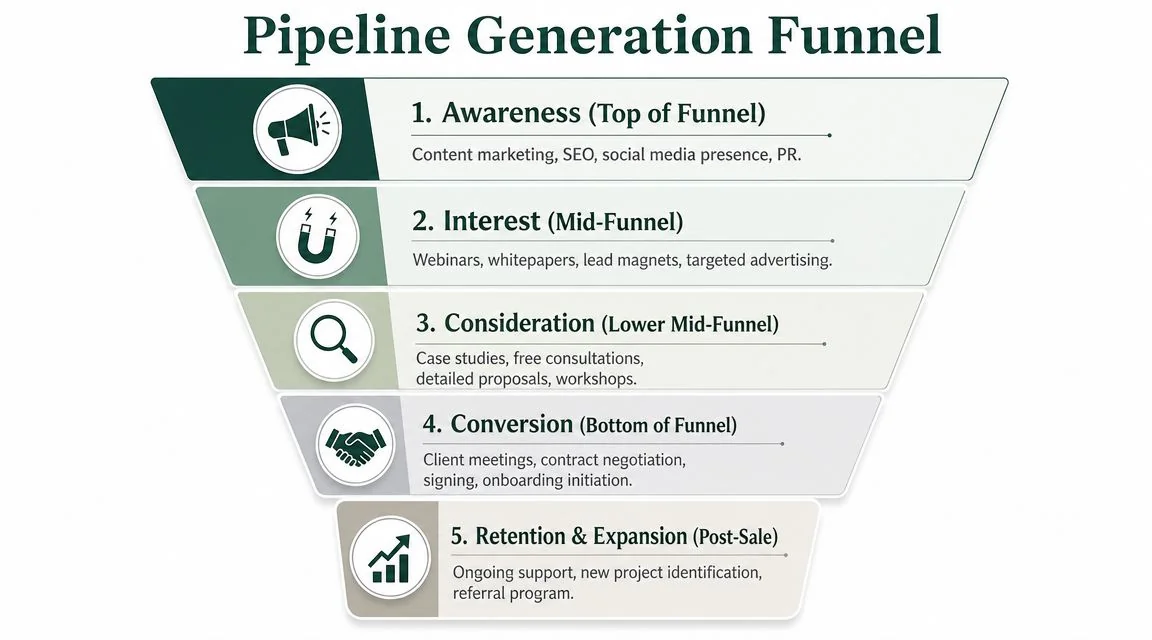
Agencies that ask “where do we find contracts?” usually have the wrong operating model. The harder question is how to build a pipeline that survives downtime, uneven project timing, and the gaps between large engagements. Contract acquisition is a pipeline design problem, not a lead source problem.
Run three parallel motion types
Treat all outreach as one of three motions, each with different triggers and expectations.
| Motion | Trigger | Goal | Offer type |
|---|---|---|---|
| Intent-based | Buyer visited pricing, case studies, niche pages, or replied to a warm touch | Start a live commercial conversation | Audit, workshop, scoped discussion |
| Warm outbound | Buyer engaged with LinkedIn posts, newsletter, webinar, or referral intro | Convert awareness into qualification | Relevant point of view plus proof asset |
| Cold outbound | Account fits ICP but shows no visible engagement | Create recognition and test problem fit | Short note tied to niche problem and proof |
Sending the same message across all three breaks the model. Cold outreach should never ask for a full sales call on first touch. Warm outreach should not ignore prior engagement. Intent-based outreach should not sound like prospecting. If a buyer already consumed your material, the next message should move the conversation forward, not restart from zero.
What sequencing looks like in practice
Let your niche authority carry the message.
If a VP of Engineering from a target account reads your migration guide and then visits your pricing or process page, send the one asset that removes the next decision barrier: a sample delivery plan, a discovery workshop structure, or a page showing how you handle milestone acceptance.
Later in the cycle, this video makes the case for a full-funnel process over isolated tactics.
A practical team setup:
- Marketing owns authority signals: niche pages, technical articles, LinkedIn distribution, retargeting audiences, and engaged-account lists.
- Sales owns sequence logic: who gets intent follow-up, who gets warm outbound, who stays in low-frequency cold nurture.
- RevOps owns routing: page visits, content engagement, CRM stages, and account-level suppression so no one gets conflicting touches.
An example of this coordinated model appears in inbounding and outbounding for software agencies. Build recognition first, then use outbound where it has context.
What breaks sequencing
Three things break it fast.
SDRs targeting broad account lists with broad service language generate generic replies or none at all. Marketing handing sales content that is not tied to a niche buying problem means a “top software trends” article cannot start a contract conversation. Measuring channel vanity instead of pipeline movement produces more campaigns, not cleaner handoffs between awareness, engagement, and qualification.
Design a Proposal That Closes Itself
Most proposals lose the deal by forcing the buyer to imagine how delivery will work.
A proposal should function as the final risk-control document before signature. If it reads like a capabilities deck with pricing attached, the buyer has to do the hard part alone.
Guidance from Altigee’s article on software development contracts and templates gets the commercial point right. The strongest technical signal is a risk-controlled commercial structure: fixed cost, time and materials, or dedicated team based on scope certainty, with clear ownership of code, billing schedule, and liability. That is sales enablement.
Pitchsite’s 2026 benchmarks show that requiring a discovery call before sending a proposal lifts win rate by 38%. Proposals sent within 24 hours of a call close at significantly higher rates; win rates decline sharply after 72 hours. Tiered (Good/Better/Best) pricing wins 18% more often and averages 22% higher contract value than single-price proposals.
Match contract model to scope certainty
The wrong model creates conflict even if the project gets signed.
| Model | Best For | Client Risk | Agency Risk |
|---|---|---|---|
| Fixed Cost | Well-defined scopes with stable requirements and clear acceptance criteria | Pays for precision up front, but may overpay for contingency | Scope creep, underestimated complexity, margin compression |
| Time and Materials | Iterative work where requirements will evolve | Budget can expand if governance is weak | Less delivery risk, but more scrutiny on velocity and prioritization |
| Dedicated Team | Long-running programs, product extensions, or embedded delivery | Commitment without perfectly fixed outputs | Utilization and team continuity risk |
What the proposal must answer
A buyer evaluating multiple vendors wants clarity on five issues quickly.
- What exactly are we buying: deliverables, milestones, and non-goals.
- How does change work: who approves, what happens to timeline and cost.
- What counts as accepted: milestone-level acceptance and final acceptance.
- Who owns the output: code ownership, IP treatment, access rights.
- What happens if things go wrong: liability boundaries, support expectations, escalation path.
If those answers are buried in legal language or omitted until procurement, you have increased buyer anxiety right when they need confidence.
Structure the document like an operating plan
Start with the client’s business objective in plain language. Then show your understanding of the current state and constraints. Define the recommended delivery model and explain why it matches the level of scope certainty. Only then present timeline logic, pricing logic, governance, assumptions, and legal-commercial terms.
Operator view: Buyers accept premium pricing more often when the proposal shows you have controlled the failure modes.
Good proposals also make trade-offs visible. If the scope is underdefined, say that fixed cost will either require a narrower phase or a larger contingency. If the buyer wants speed, show what that means for access, decision latency, and change requests. Explicit constraints earn respect rather than penalties.
The Teneo survey found 80% of buyers now demand higher ROI quantification than they did in 2024. A proposal that explains the commercial logic of your delivery model, not just the features, directly addresses that demand.
Onboarding Sets Up the Next Contract
The first month after signature decides whether you won one contract or opened an account.
Most agencies treat onboarding as admin: kickoff call, Slack invite, repo access, sprint zero. The better approach is to use onboarding to confirm the buyer made the right choice and to create the operating rhythm that makes expansion feel low risk.
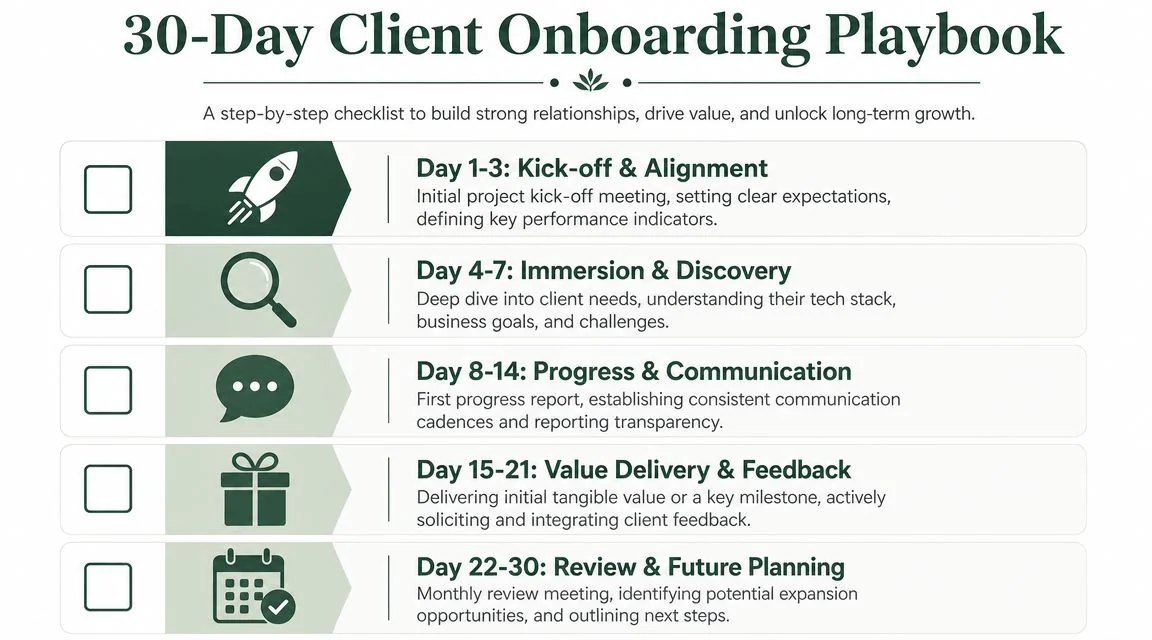
Days 1 to 7
Lock the shared operating model, not just the delivery backlog.
Document the project purpose, the decision-makers, communication cadence, escalation path, artifact owners, and acceptance workflow. Write a short “definition of success” document in the client’s language. If the client says success means stable releases, fewer manual steps, faster onboarding of internal users, or cleaner integrations, mirror that language in every update.
Days 8 to 21
Show visible progress early, even if the largest milestone is still ahead.
That does not mean rushing code. It means producing evidence that the project is under control: architecture decisions, risk register, validated requirements, environment readiness, dependency map, and a first milestone plan. Buyers relax when they can see the work moving.
| Review item | What the client needs to see |
|---|---|
| Progress against plan | Work is moving and blockers are explicit |
| Open decisions | Their input is required in specific places |
| Risks and dependencies | Problems are surfaced early, not hidden |
| Acceptance path | They know what “done” means for the next milestone |
Days 22 to 30
Expansion opportunities usually appear here. Look for adjacent needs that became visible during discovery and early execution: integration cleanup, analytics instrumentation, QA automation, support workflows, internal tooling, documentation debt. Frame them as implications of the goals the client already approved.
If onboarding proves control, the next statement of work feels like a continuation, not a new purchase.
Formalize reporting here too. What shipped, what changed, what needs input, what risks remain, what comes next. If executives can scan that in minutes, your account team becomes easier to trust.
Frequently Asked Questions
How do software development agencies get new contracts?
Agencies win contracts by reducing perceived delivery risk before the first conversation. The mechanics are: narrow to a niche buyers can verify, publish proof assets that answer due-diligence questions, run outreach calibrated to buyer intent, and send proposals that control risk rather than showcase capability. Warm and inbound leads convert at 2 to 3 times the rate of cold outbound, per Pitchsite’s 2026 benchmarks.
Why is niching down better than staying a generalist agency?
Buyers compare generalist agencies on rate and team size. They compare niche agencies on fit. Fit changes the buying criteria from “who can build this?” to “who already understands our constraints?” That shift means shorter sales cycles, fewer competitive RFPs, and higher close rates. The Teneo 2026 B2B Software Vendor Survey found 73% of vendors cite low-cost and AI-native entrants as their biggest competitive threat. Without a niche, a generalist agency competes on price against exactly those entrants.
What is a good win rate for a software development agency?
According to Loopio’s 2025 RFP Trends Report, the average RFP win rate across industries is 45%, up from 43% in 2024, with top performers reaching 60% or more. For web and software development agencies specifically, Pitchsite’s 2026 data puts cold outbound win rates at 8 to 15% and warm or inbound win rates at 30 to 50%. If you are losing below 45%, the most common cause is a value-communication problem, not a price problem: agencies above a 45% win rate lose on price less than 30% of the time.
How long is the B2B software development sales cycle?
Inventive.ai’s May 2026 analysis of B2B win rate data puts the professional services average sales cycle at 51 days. Enterprise deals and large contracts take considerably longer: contracts over $200K average 13 decision-makers. For software development agencies, the Settle RFP analysis of 7,569 RFPs (October 2025 to February 2026) found IT Services and Software have the tightest median turnaround windows, at 21 to 22 days from RFP release to submission deadline.
Which contract model should an agency use: fixed cost, time and materials, or dedicated team?
Match the model to scope certainty. Fixed cost works when requirements are stable and acceptance criteria are clear. Time and materials suits iterative work where scope will evolve. A dedicated team model fits long-running programs or embedded delivery where the client needs consistent capacity. The wrong model creates disputes even on successful projects: if scope is ambiguous and you price fixed, margin compression is nearly guaranteed.
How fast should an agency send a proposal after a sales call?
As fast as possible, ideally within 24 hours. Pitchsite’s 2026 benchmarks show that proposals sent within 24 hours of a discovery call close at significantly higher rates. Win rates decline sharply after 72 hours. The same data shows that requiring a discovery call before sending any proposal lifts win rate by 38%. A proposal sent quickly after a structured call signals delivery discipline, which is exactly what buyers are evaluating.
If you want to know how to get software development contracts reliably, treat contract acquisition as a positioning and proof problem first, a sequencing problem second, and a proposal and onboarding problem after that. Agencies that own a niche, publish verifiable authority, and operationalize risk reduction become easier to shortlist, easier to buy from, and harder to replace, which steadies the pipeline.