How to Find Bookkeeping Clients That Pay and Stay
Learn how to find bookkeeping clients with a proven playbook for referrals, local SEO, LinkedIn and outreach that fills pipeline fast.
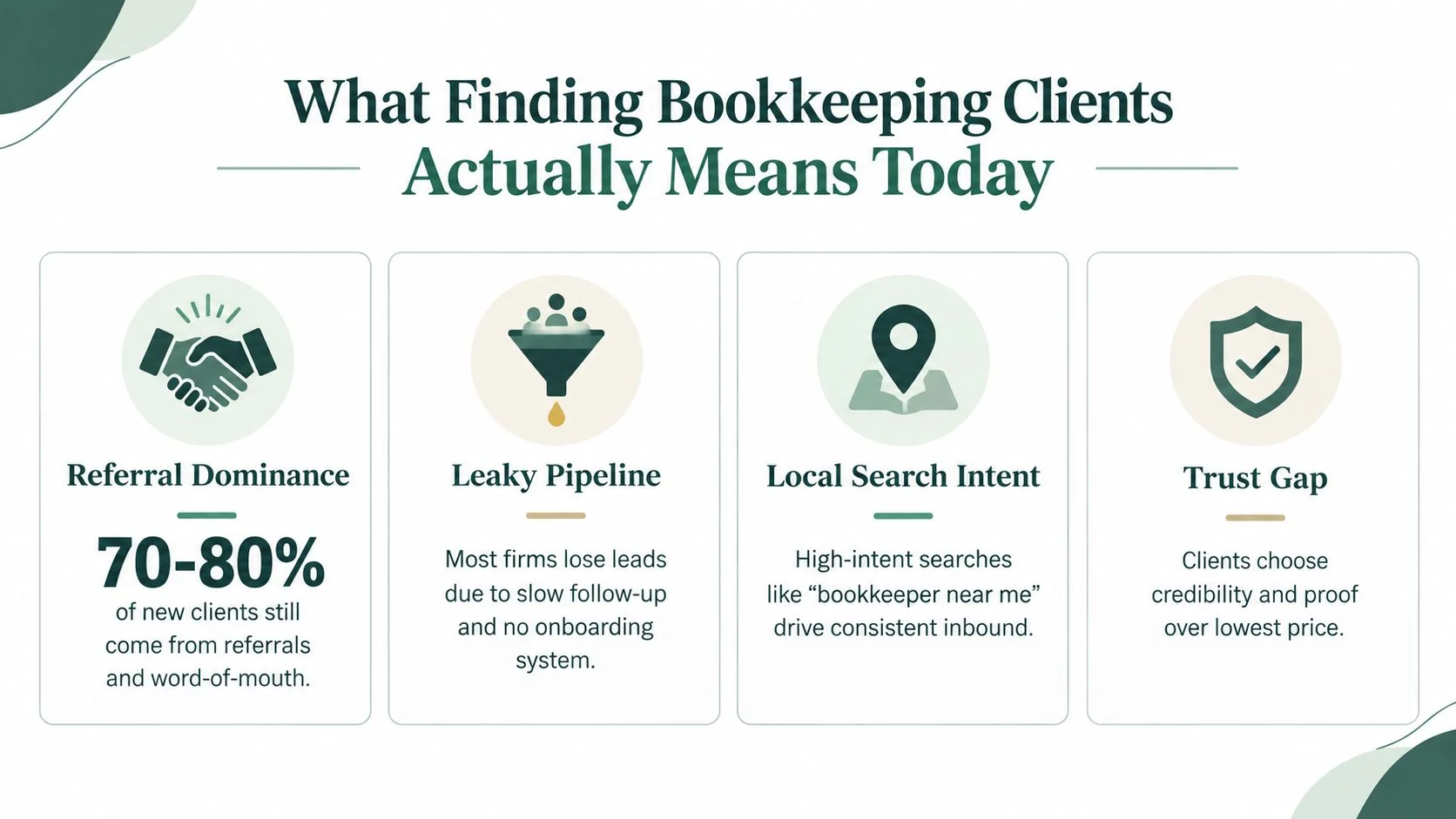
70% of small and midsize businesses found their current accountant through referrals or word of mouth, while 46% of businesses still looking for an accountant would use search engines. Yet more than 90% of accounting firms still rely on word of mouth as their main acquisition channel, and only 38% explicitly ask most clients for referrals. The result is a leaky pipeline: buyers trust referrals and search, but firms often leave both channels to chance. (Accountants Daily, 2025)
For a software development agency, the lesson is broader than bookkeeping. “How to find bookkeeping clients” is a niche pipeline problem. You need a defined buyer, a credible offer, a channel sequence, qualification rules, and measurement tied to profitable accounts. Generic lead lists fail because they ignore the signals that make a bookkeeping prospect urgent, reachable, and likely to stay.
What Finding Bookkeeping Clients Actually Means Today
Bookkeeping acquisition is a referral-led market, but referral activity is rarely engineered. A 2025 survey found that 58% of businesses still seeking an accountant would turn to referrals, compared with 46% using search engines. Only 6% of accounting firms ask every client for referrals. (Accountants Daily, 2025) The opportunity is operational: capture the buying paths prospects already trust, then measure each path by qualified meetings, closed accounts, and retention.
Search and referrals carry different information. A prospect searching for a bookkeeper in a specific location has stated a problem and is likely comparing providers. A referred prospect arrives with borrowed trust from an existing relationship. Treating both as interchangeable leads hides differences in urgency, credibility, and follow-up requirements.
Why generic prospecting underperforms
A broad list of small businesses supplies names, not buying context. It rarely shows whether a company has just formed, outgrown an owner-managed process, changed software, hired staff, or entered more complex reporting and compliance work. Those signals determine whether outreach addresses a live problem or becomes unwanted noise.
Timing also changes the economics. A 2026 market article focused on Poland reported 500 to 700 new sole proprietorship entries daily, with most new sole proprietors choosing an accountant within the first 30 days. After 60 days, selling becomes harder because the owner has usually formed a relationship or chosen to manage bookkeeping independently. (SmartFirm, 2026)
For a dev agency, the operating model is similar to selling into a narrow software vertical. Identify a defined buyer, a recurring problem, and the trigger that makes action likely. Then make relevant proof visible before outreach begins. This is niche pipeline engineering, not generic lead generation.
Practical rule: Keep each acquisition source in its own pipeline until qualification, conversion, and retention economics show that combining them is sensible.
The sequence that makes the system work
Define the niche first, then build positioning and proof around its recurring problems. Systematize referrals and partnerships before buying broad leads. Use local search and targeted social outreach to capture existing intent. Add content, marketplaces, cold email, or paid acquisition only after intake, qualification, and follow-up operate consistently.
Weak targeting, poor list quality, and activity without qualification are recurring prospecting mistakes that drain pipeline. More names cannot repair a process that fails to distinguish a high-intent business from a poor-fit one. The right sequence turns referrals into a measurable channel, search into an intent capture system, and outreach into a controlled experiment.
How to Define Your Ideal Bookkeeping Client and Niche
The right niche is the segment where urgency, service complexity, referral access, and searchable language overlap, not the industry with the largest addressable market. A bookkeeping firm should be able to finish this sentence without using “small businesses” as the answer: “We help [specific business type] that has [specific trigger] and needs [specific recurring outcome].”
Newly formed businesses deserve special attention because bookkeeping decisions often happen early. A 2026 guide on new-business prospecting says the strongest target window is the first 30 to 60 days and estimates that the United States has about 5.5 million new businesses registering annually. (SMB Sales Boost, 2026) Not every new company is valuable, but formation timing is a practical filter that generic lists usually omit.
Use four filters:
- Business age: New firms may need setup, chart-of-accounts design, payroll coordination, and recurring close support.
- Complexity: Inventory, multiple entities, project costing, sales tax, or expanding payroll creates more recurring work than a simple cash ledger.
- Trigger: Funding, rapid hiring, a new location, a tax deadline, or a failed close process creates a reason to act.
- Service bundle: Compliance-only work attracts a different buyer from monthly bookkeeping combined with cash-flow reporting and advisory.
Comparing niche choices
| Niche Option | Buying Urgency | Channel Fit | Pipeline Implication |
|---|---|---|---|
| Newly formed service businesses | High during setup and early compliance decisions | Registration data, local search, referrals from attorneys and formation advisers | Prioritize speed and onboarding clarity |
| Established local professional firms | Moderate, often relationship-led | Referrals, Google Business Profile, local partnerships | Build review density and partner recall |
| E-commerce businesses | High when reconciliation and reporting become complex | Software communities, specialist content, partner referrals | Sell operational expertise, not commodity data entry |
| Inventory-heavy businesses | High when books fail to explain margins or stock movement | Industry partners, targeted outbound, educational content | Qualify for workflow complexity before quoting |
| Fast-growing agencies and consultancies | High when founders lose visibility into cash flow and utilization | LinkedIn, founder communities, referrals | Position bookkeeping with management reporting |
The 100Signals ICP for software agencies offers a useful way to formalize the profile. Record the industry, stage, trigger, systems, service need, geography, referral sources, and disqualifiers. A niche is defensible only when those fields change your targeting and message.
Choose a niche you can prove
A niche statement without proof is just a slogan. Review your strongest existing accounts and identify the work they repeatedly value, the problems they refer, and the partners who introduced them. If you can’t produce relevant examples, sample reports, or a clear process for that segment, choose a narrower promise you can substantiate rather than a broad claim you can’t.
The best ICP reduces waste in every downstream activity. It determines which landing page to build, which partners to contact, which search terms to target, and which prospects deserve a personal message. For founders, that makes niche selection a pipeline-control decision, not a branding exercise.
Building Positioning That Earns Trust Before Outreach
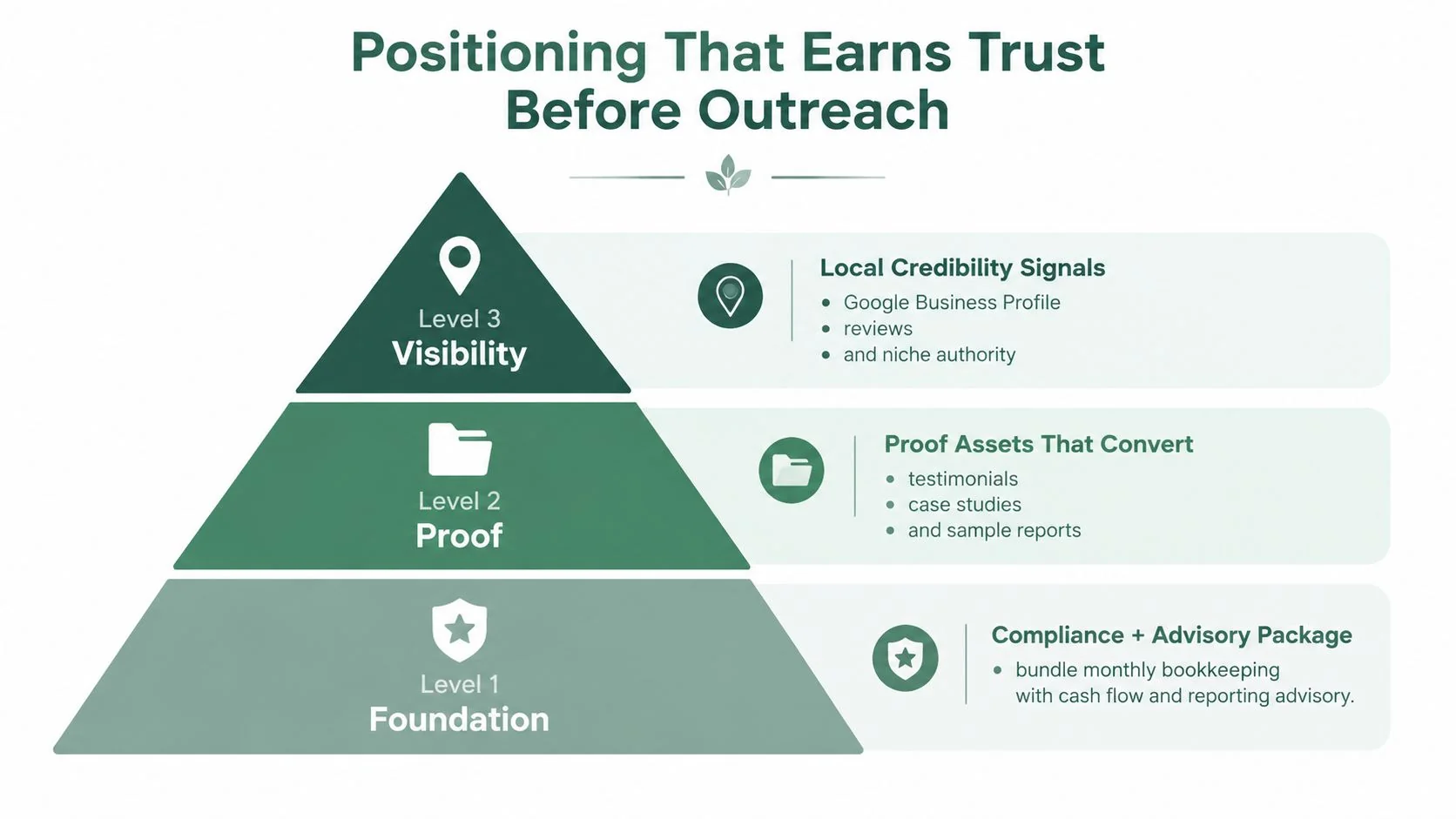
A bookkeeping firm should answer three buyer questions before paying for attention: what does it handle, who is it built for, and what will the client understand or control afterward? The website, profile, proposal, and outreach message need the same answers. Inconsistent positioning makes every channel work harder.
Positioning comes before outreach because outreach sends prospects to assets they can inspect. A referral creates an introduction, but the prospect still checks the website and profile. A search visitor compares the offer, proof, reviews, and response process. A cold-email recipient may inspect the sender before replying. The acquisition system should therefore establish trust before it increases traffic.
Package the outcome, not the task
Transaction entry and reconciliations make a bookkeeping offer easy to compare. A stronger package connects compliance work to operating visibility through monthly close, management reporting, cash-flow review, cleanup, and a defined escalation process.
Make the package concrete. State the accounts included, close cadence, reporting format, client responsibilities, response times, and out-of-scope work. Replace “strategic insight” with the actual report, meeting, or decision the client receives.
Industry reporting supports an advisory angle. Xero reported that 73% of US accountants and bookkeepers said their practices saw increased profits in the prior year, while a UK industry report found that 82% said Making Tax Digital for Income Tax would help attract new business. (Xero, 2025) Compliance change can open an advisory conversation, but only when the service addresses a specific buyer problem.
Build proof that survives inspection
A niche landing page should include:
- A precise promise: Name the business type and operational problem.
- A sample deliverable: Show a redacted monthly report, close checklist, or cash-flow view.
- Relevant evidence: Use testimonials and examples from comparable businesses when available.
- A qualification path: Explain what information the prospect should bring and what happens after the first call.
- Local signals: Display the service area, business details, and review profile consistently.
Xero’s 2026 SEO guidance recommends completing a Google Business Profile with the firm’s name, address, phone number, hours, services, and a detailed description containing target keywords. (Xero, 2026) Keep these details aligned across the site and profile so prospects do not encounter conflicting information.
LinkedIn can reinforce recognition before outreach. Specify the target industry in the profile and publish answers to recurring operational questions. A LinkedIn content creation tool can support a consistent publishing workflow, but it cannot substitute for evidence or a differentiated offer. Build the proof layer first, then systematize visibility around it.
Channel by Channel Playbook for Finding Bookkeeping Clients
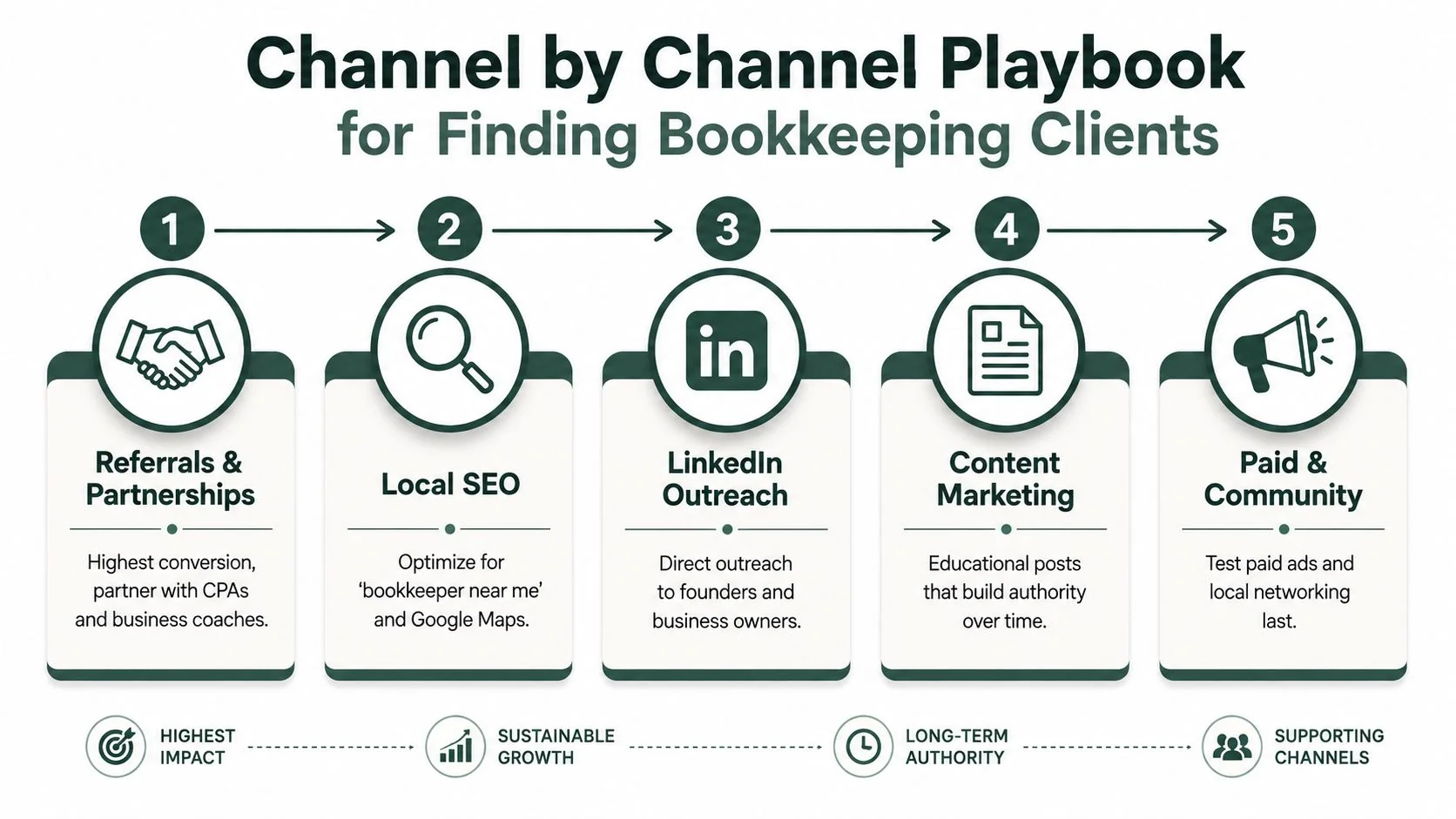
Screened bookkeeping referrals convert at 35% to 50%, compared with 3% to 8% for shared marketplace leads and 6% to 12% for paid-search leads. (Upcision) That gap should determine channel order. Build the pipeline around trust and qualification first, then add channels that require more spend or follow-up.
Start with referrals and partners
Put a referral trigger inside delivery. Ask after a successful cleanup, a clear monthly close, or a useful advisory review. Give clients a short description of the account types you want, so “send anyone you know” becomes a specific request that is easy to recognize and repeat.
Partners extend reach while transferring some initial trust. Build relationships with CPAs, attorneys, payroll specialists, business coaches, lenders, and formation advisers who encounter bookkeeping problems before a buyer searches. Define the client profile, handoff process, response standard, and boundaries before sending referrals. A referral channel becomes a pipeline only when ownership and follow-up are explicit.
As noted earlier, word of mouth is a major acquisition source for accounting firms, while referral requests are not consistently built into client interactions. Add the request to the CRM and onboarding workflow instead of relying on memory.
Capture local search intent
Claim and complete the Google Business Profile. Use the service language buyers search, including “bookkeeper near me” and “bookkeeper in [city]”. Make the landing page match the profile promise, then keep services, hours, contact details, service area, and reviews consistent.
Reviews support both search credibility and referral confidence. Ask at a defined point in the client lifecycle, respond professionally, and route negative feedback into service recovery. The operating goal is a reliable proof signal for prospects already comparing providers, not a larger review count by itself.
Use LinkedIn and targeted outbound
LinkedIn works when the ICP is visible and the message names a business trigger. Contact founders after a relevant change, such as expansion, hiring, a new entity, or an operational transition. A generic “we provide bookkeeping services” note gives the recipient no reason to respond.
Cold email is a precision channel. A 2026 guide for accounting firms says firms should expect 2% to 4% positive reply rates once ICP and messaging are dialed in, usually after the first 30 to 45 days. (Modern Inbound, 2026) Use a tight list, one problem, one credible observation, and one low-friction question. Mailadept’s Cold Email That Gets Replies offers a practical structure for that message.
100Signals is one option for agencies that need mapped target accounts, outreach, and coordinated LinkedIn activity. It fits a recognition-first sequence: establish niche authority, then activate outbound against accounts that match the profile. The 100Signals lead generation method reinforces the same operating principle.
Add content, marketplaces, and paid channels last
Content compounds authority, but it will not repair unclear positioning. Publish answers for the selected niche, reuse strong topics in LinkedIn posts, and connect each article to a service page and qualification path. This creates an owned demand layer that can support referrals and outbound rather than competing with them.
Use marketplaces only after intake is standardized, because shared leads often carry weaker intent. Paid search belongs after the firm can track source, qualification, close rate, and first-year value. Until those measures are visible, buying traffic hides channel economics instead of improving them.
Outreach Templates Pricing and Onboarding That Close and Retain
A bookkeeping pipeline loses efficiency at the handoff. If the buyer, trigger, scope, and decision process remain unclear, a qualified inquiry turns into unpaid proposal work. Use a short intake path to test urgency, complexity, fit, and authority before preparing a detailed proposal.

Use messages that expose the trigger
Referral request:
Referral prompt: “We’ve just finished resolving [specific issue]. Who in your network is dealing with a similar bookkeeping problem?”
Partner outreach:
Partner message: “You work with [client type] when [trigger] occurs. We handle [specific bookkeeping and reporting scope]. Would it be useful to define the situations where a referral makes sense?”
Cold email:
Subject: [Specific trigger] at [company]
“I noticed [relevant business signal]. Firms at that stage often need [specific operational outcome], not just transaction processing. We help [niche] with [defined scope]. Is improving [problem] on your current priority list?”
Each message names a business situation rather than a broad service category. Personalization should change the business hypothesis, not merely insert the company name.
Price around complexity and retention
Build scope from transaction volume, accounts, entities, payroll, inventory, cleanup requirements, reporting cadence, and advisory access. Separate setup or cleanup from recurring work. State client responsibilities, exclusions, response times, and deliverables before quoting the recurring package.
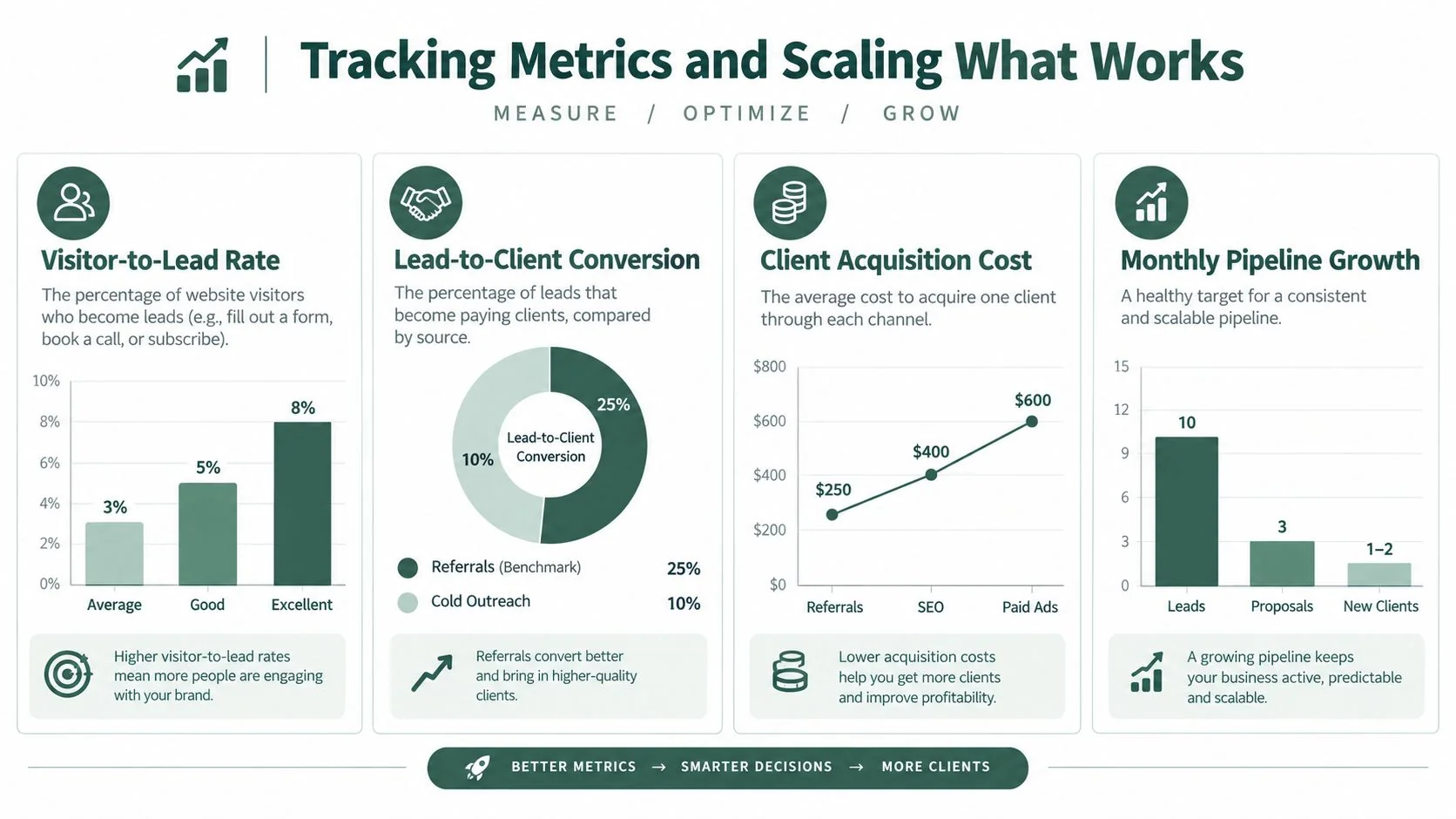
Accounting-firm benchmark data reports website visitor-to-lead conversion at 1% to 3%, niche-optimized conversion at 3% to 5%, and lead-to-client conversion at 5% to 20%. It also identifies a healthy LTV:CAC benchmark of 3:1 or better. (Get X Media) These figures make channel quality more important than lead volume. A low acquisition cost can still produce a poor account if delivery consumes margin or the client churns quickly.
Make the first 60 days operationally boring
Onboarding should collect access, historical records, chart-of-accounts decisions, reporting expectations, deadlines, and escalation contacts. Set the first close date and show the client exactly what they will receive.
Use a kickoff checklist, shared document request, issue log, and recurring review. The first experience must demonstrate control and communication. A predictable onboarding process also improves referral potential, because the client can describe a visible result rather than only a pleasant interaction.
Tracking Metrics and Scaling What Actually Works
A bookkeeping firm can waste a large budget on leads and still build a weak pipeline. Acquisition needs an operating scorecard that follows each source from first touch through qualification, proposal, signed engagement, completed onboarding, retention, and referral. A lead creates value only when its expected revenue exceeds the cost and delivery effort required to win and serve the account.
Use a channel scorecard
| Metric | What it tells you | Scaling decision |
|---|---|---|
| Source-to-qualified rate | Whether the channel reaches the defined ICP | Fix targeting before increasing volume |
| Qualified-to-client rate | Whether trust, offer, and sales process work | Improve qualification or positioning |
| CAC by source | What each signed client costs to acquire | Cut channels that buy low-quality demand |
| First-year revenue by source | Whether the channel produces valuable accounts | Favor profitable segments over cheap leads |
| Payback period | How quickly acquisition spend returns | Delay expansion when cash recovery is too slow |
| Retention and referral rate | Whether delivery creates durable growth | Repair onboarding and service quality |
Compare CAC with first-year revenue, gross margin, retention, and payback time. Accounting-firm benchmark data places CAC between $1,000 and $8,000, with acceptable payback periods varying by engagement complexity. Treat those figures as decision guardrails, not pricing rules. A channel deserves more capital only when it produces retained, profitable niche accounts.
Read conversion economics in context
A referral-led funnel can support lower volume because screened referrals convert at 35% to 50%. Marketplace and paid-search leads require tighter qualification because their conversion ranges are lower. Compare channels by signed clients and retained revenue, not by form fills or raw lead counts.
An accounting attribution analysis reported that 57% of clients arrived by referral, 3% by advertising, and referrals converted at 25.56% from prospect to client. (Webtonic, 2026) This is one analysis and results vary by firm, but the operating implication holds: systematize referral capture before paying to manufacture more demand.
Turn measurement into niche ownership
A niche becomes defensible when the firm owns the buyer’s language, partner network, proof, and response workflow. Search visibility captures existing intent. Reviews and referrals reduce trust friction. Outbound can then reach accounts with a reason to recognize the firm.
For dev agency founders, the transferable model is pipeline engineering. Choose one segment, instrument each conversion step, and rank channels by retained revenue per acquisition dollar. Concentrate proof where the economics work instead of adding channels indefinitely.
Start with the scorecard. Audit recent signed clients by source, fit, margin, retention, and referral potential. Then commit the next acquisition investment to the channel that produces the strongest retained accounts.
If your agency is trying to own a narrow software vertical, request a free 100Signals positioning scan to identify the gap between current visibility and the accounts you want in pipeline.