What Is an Ideal Customer Profile: A Dev Agency Playbook
What is an ideal customer profile for a software development agency. Build a data-driven ICP from firmographics, technographics, and intent signals, and avoid the four traps that derail most agencies before outreach even starts.
According to 6sense’s 2024 Buyer Experience Report, which surveyed 2,509 B2B buyers, 81% of buyers have already picked a vendor before they speak to a sales rep. Seventy percent of the purchase process is over before a seller is engaged. For a software development agency, that number rewrites what an ideal customer profile needs to do. An ICP is a targeting model that determines which accounts should already know your name before the first outreach lands, which ones deserve focused pipeline activity, and which ones are not worth your time at any stage of the cycle.
Most agencies get this wrong in specific, predictable ways. This guide covers the definition, the three data layers, the four-step build process, and four traps that quietly wreck agency ICP work before a single email is sent.
TL;DR
- An ideal customer profile is an account-level targeting model, not a persona for individuals
- Build it from three data layers: firmographics (fit), technographics (compatibility), intent signals (timing)
- 81% of buyers pick a vendor before first contact, according to 6sense research with 2,509 buyers. Your ICP determines whether you show up during that pre-contact window
- Most dev agencies fail ICP work for four specific reasons: the persona trap, the TAM fear, wishful thinking, and FOMO-driven switching
- Treat ICP as a living model. Review quarterly, not once at a strategy off-site
What Is an Ideal Customer Profile
An ideal customer profile is a data-backed description of the company type that produces repeatable revenue, healthy margins, and faster close times. For a software development agency, the model has to go beyond industry label and headcount. It needs firmographic fit (does the company’s structure match your delivery model), technographic compatibility (does their stack match your expertise), and live buying signals (is there evidence they are moving toward a purchase now).
The standard template, “B2B SaaS, 50 to 500 employees, North America,” is not an ICP. It describes a pool of companies. An ICP tells you which companies inside that pool are worth pursuing this quarter, and why.
For a dev agency, the model needs to answer four questions:
| Question | What the ICP must tell you |
|---|---|
| Which accounts deserve focus | Companies that match your delivery strengths, deal economics, and niche position |
| Why they buy | The business problem, technical constraint, and trigger creating urgency now |
| When to engage | Live signals indicating active evaluation, not just passive profile fit |
| How your agency wins | The angle you own based on stack expertise, proof, and timing |
An ICP that answers all four drives meetings. One that answers none is documentation.
The Four Ways Dev Agencies Fail at ICP Work
After 300+ marketing campaigns for software development agencies, the failure patterns are consistent. The failure is rarely a knowledge gap. Agencies fall into one of four traps before the model is built, and they never correct course.
Trap 1: The Persona Fixation
Some teams spend weeks building buyer personas before they have a working account model. “CTO Carlos, 38, pragmatic, skeptical of vendors, prefers async communication.”
Knowing that your target buyer is a pragmatic CTO does not tell you which companies belong on your list. It does not help your team decide whether a 120-person fintech firm actively hiring platform engineers is a better target than a 300-person logistics startup that just raised a Series B.
Persona work belongs after ICP work. Define which companies fit first. Then map the decision-makers inside those companies. A persona built before the account model is built on assumptions. Assumptions are expensive.
The related mistake: demographic profiles with no predictive power. The buyer’s age or educational background does not predict deal velocity. Their organizational context, authority level, buying trigger, and involvement in previous evaluations do.
Build the account model first. The persona follows.
Trap 2: The TAM Fear
The most common objection to a precise ICP: “If we get too specific, we will lose deals.”
The data says otherwise. EBSTA’s 1H 2025 research found that ICP-fit accounts produce a sales process eight times more efficient and deal values nearly five times higher, compared to non-ICP accounts. Companies with tightly defined ICPs report win rates of 40 to 50 percent on qualified opportunities. Companies with broad targeting report 20 to 25 percent, according to a 2025 analysis by Rathvane.
A narrower ICP removes the low-probability accounts you were working, and improves conversion rate and deal quality on the accounts you keep. You lose the activity of chasing wrong-fit accounts. You do not lose the revenue.
The Marketing Juice, reviewing dozens of software development firms, put it directly: “The fear that specialisation will limit your pipeline is almost always unfounded in practice. Specificity in messaging tends to increase pipeline quality and volume simultaneously.”
89% of software development agencies in the 100Signals database position across three or more verticals. Niche agencies report margins two to three times higher than generalists, and specialists earn 40 to 60 percent more per person. A narrow ICP is the starting point for a market position that compounds.
Trap 3: The Wishful Thinking ICP
An agency reviews its past client list, identifies the most impressive logos, and reverse-engineers an ICP from them. The problem: the most impressive logos are often not the most profitable accounts.
A solid ICP audit means looking at closed-won accounts against one standard. Not which clients you enjoyed and not which logos look good on the website. The question is which accounts had fast sales cycles, healthy margins, clean delivery, expansion potential, and referral value inside the niche you want to own.
That audit almost always produces a different list than the one founders had in mind. Some of the best-fit clients were small and unglamorous. Some of the prestigious clients were delivery nightmares with compressed margins and no referral upside.
Wishful thinking in ICP work produces a targeting model built around who the agency wants to be, not what it already does well. The practical result: outbound hitting accounts that can buy, but will not buy at the price or under the conditions the agency needs, because the real delivery strength is not relevant to those accounts.
Build the ICP from what your closed-won data says, not from what your aspirations suggest.
Trap 4: The FOMO Switch
Every few months, a new category gets loud: AI tools, agentic development, a vertical a competitor just claimed. Agencies see the signal and conclude their ICP is wrong. They pivot. Three months later, they pivot again.
A niche takes 6 to 18 months to produce compounding visibility. An article that ranks, an AI citation that sticks, a LinkedIn reputation that registers, an outbound sequence that returns warm replies: none of these happen in the first 90 days. They require enough time for the market to recognize the pattern.
Agencies that switch ICP every quarter never accumulate that signal. They are always at the beginning of a new curve, never in the middle of one compounding. The trend they are chasing was claimed by the agency that stayed put two quarters ago.
Add new signals to the watchlist. Evaluate them against current niche data at the next quarterly review. A trend post is not evidence of a market shift.
ICP vs Buyer Persona vs Target Market
These three terms get used interchangeably, and they are not the same. The ICP drives account selection. The persona guides messaging inside accounts. The target market sets strategic scope. Mixing them up produces marketing that builds content for broad categories and sales lists built from wrong accounts.
The functional difference comes down to unit of analysis:
| Concept | Unit of Analysis | Primary Function | Example |
|---|---|---|---|
| ICP | Company or account | Decide which businesses to target | US-based B2B SaaS firms, 50 to 200 engineers, modern cloud stack, actively hiring platform roles |
| Buyer Persona | Individual stakeholder | Shape messaging for a person inside the account | VP Engineering concerned about delivery speed, team capacity, and architecture review pressure |
| Target Market | Market segment | Set strategic scope | North American healthcare software companies |
The ICP is the operating layer. It determines which companies belong on the list. The persona matters once you have decided a company belongs. The target market matters earlier, as the boundary-setting decision.
Where the sequence breaks down
Persona work often produces fiction when it is built before the ICP is validated. Someone in marketing writes a detailed stakeholder profile. The sales team ignores it because it does not improve list quality. A persona built without a validated account model is built on assumptions about who the buyer is, with no data confirming which companies that buyer works at.
The correct sequence:
| Order | What to define | Why it comes first |
|---|---|---|
| 1 | Target market | Sets broad category boundaries |
| 2 | ICP | Filters to accounts worth pursuing |
| 3 | Buyer personas | Adapts messaging to decision-makers inside those accounts |
For a dev agency: do not start with psychographics. Start with search intent and discovery behavior. What are companies in your target segment researching before they reply to outreach? That behavior tells you which accounts are in-market and which content they will engage with before a first call.
Personas matter, but only after you know which accounts deserve your time.
The Three Data Layers of a Defensible ICP
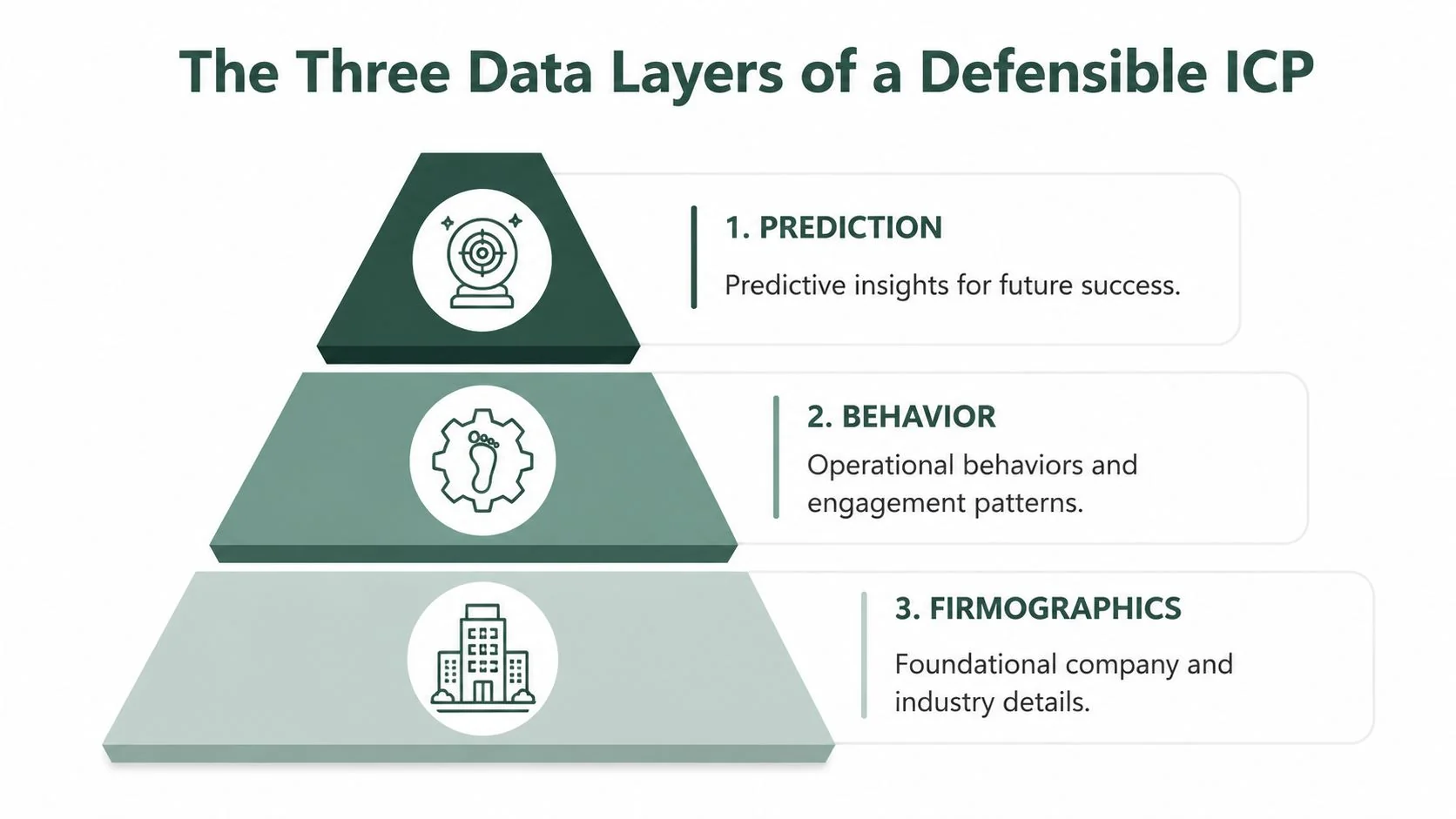
A defensible ICP for a software development agency has three layers. Firmographics tell you whether the company fits your delivery model. Technographics tell you whether the stack matches your expertise. Intent signals tell you whether the account is likely to move now. All three together make the model predictive. Missing any one of them keeps it blunt.
Firmographics: the floor
Firmographic fit is the entry screen. For dev agencies, that means industry, company size, geography, operating model, funding stage, regulatory environment, and business maturity.
Bad firmographic fit creates expensive pipeline. You can book meetings with the wrong companies. They often want the wrong engagement model, have no internal ownership of the decision, or operate on timelines that do not match your economics.
Three questions firmographics should answer:
- Industry fit: Are they in a segment where your delivery experience creates a credibility advantage?
- Scale fit: Do they have enough complexity and budget for your engagement type?
- Operating context: Are they in a regulated, integration-heavy, or migration-heavy environment where your agency creates disproportionate value?
Firmographics are a screen, not the model.
Technographics: service compatibility
Technographics are where the model gets specific enough to be useful. Cloud provider, application stack, data tooling, CI/CD infrastructure, security tooling, and patterns visible in engineering job postings all indicate whether your delivery model fits their environment.
For a dev agency, technographics often predict delivery compatibility better than industry labels alone. A Series B healthtech company migrating off a legacy EMR stack, publishing roadmap notes about HIPAA-compliant data pipelines, and actively hiring platform engineers is a different account from a similar-size healthtech company with flat headcount, no product roadmap activity, and no visible compliance pressure. The firmographic profile looks similar. The technographic and behavioral profile tells a different story.
Organizations using technographic data in targeting achieve 28% higher conversion rates and are 50% more likely to exceed revenue goals versus teams relying on firmographic data alone, according to Autobound’s 2025 analysis of B2B targeting data.
Intent signals: timing
This layer separates a watchlist from active pipeline. You need accounts that are moving, not just accounts that could buy.
For dev agencies, useful intent signals include:
- Hiring patterns tied to platform engineering, data infrastructure, compliance, or specific technology roles
- Content behavior around migration, modernization, audit readiness, or architecture decisions
- Search activity around the problems you solve
- Change events: funding rounds, product expansions, geographic rollouts, leadership changes, compliance deadlines
The account that fits your niche but shows no buying motion is a watchlist entry. The account that fits your niche and shows multiple intent signals is pipeline.
Combining the layers
This data sits in fragments. Firmographics live in the CRM. Technographics come from enrichment tools. Behavioral signals show up in ad platforms, LinkedIn activity, and outbound response data. The job is to combine them into one scoring model.
A working scoring model uses three dimensions:
| Dimension | Example question |
|---|---|
| Fit | Does this company match our best-customer pattern structurally? |
| Compatibility | Does their stack and delivery environment match our expertise? |
| Timing | Is there evidence they are moving toward a purchase event? |
Score each dimension, weight the variables that consistently appear in your closed-won accounts, and use the combined score to prioritize list-building, outreach sequencing, and content targeting.
Descriptive before predictive
A common mistake: jumping straight to scoring before the descriptive layer is solid. Review your closed-won and closed-lost accounts first. Which clients expanded? Which churned? Which bought fast because your authority already matched the category? Which demanded custom work that destroyed margin?
That pattern is the foundation. Scoring without it is guesswork dressed up as precision.
A defensible ICP should let your team say something this specific:
“We target mid-sized B2B software firms in regulated niches, running modern cloud infrastructure, with visible signs of platform investment and recent engineering hiring tied to compliance or product expansion.”
Broad enough to support growth. Specific enough to drive account selection, content targeting, and outbound prioritization from the same model.
If your current ICP cannot do that, rebuild from the three layers instead of rewriting a persona document.
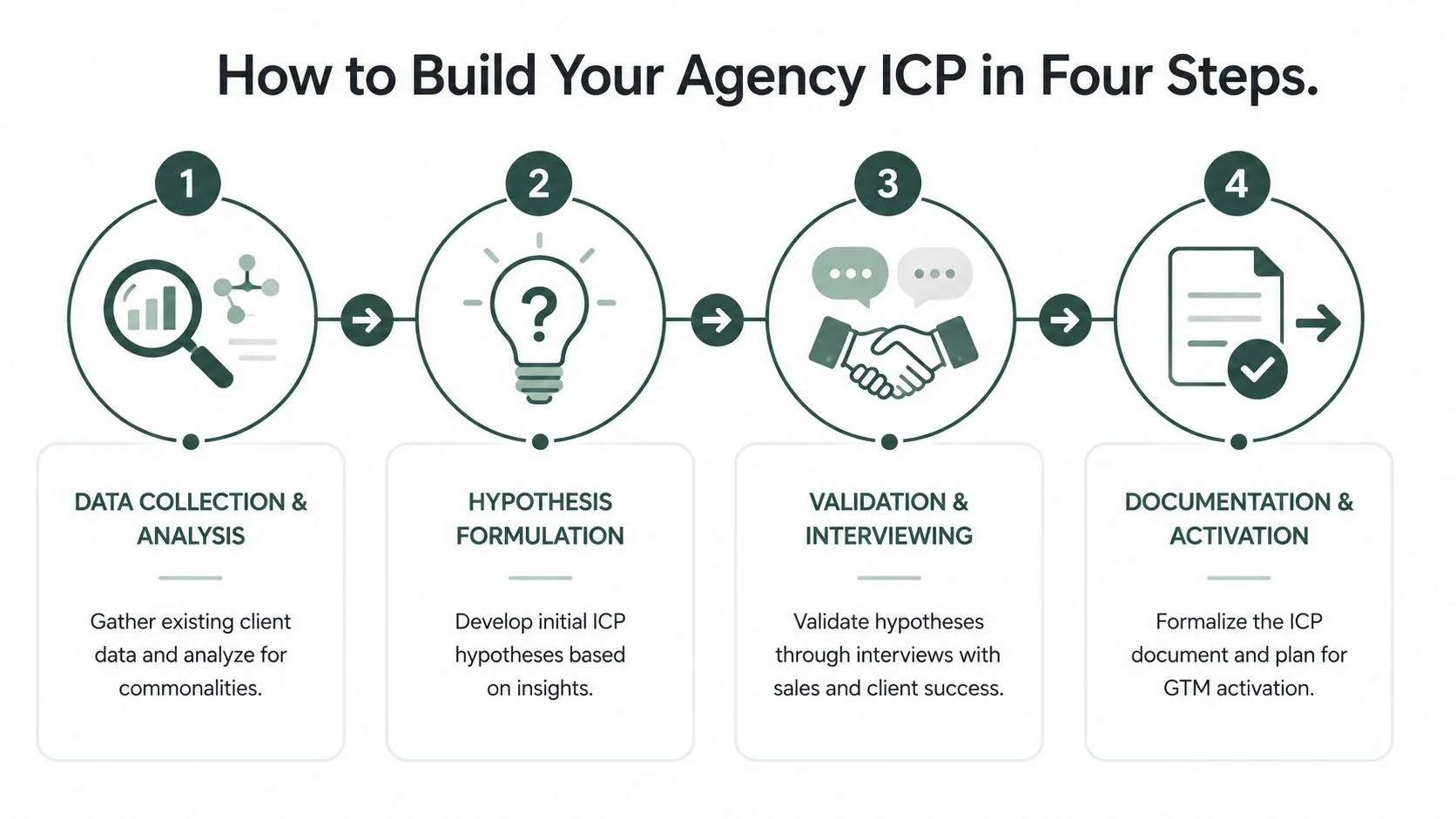
How to Build Your Agency ICP in Four Steps
Skip the strategy document. Build from revenue data.
Step 1: Audit your best and worst accounts
Pull your closed revenue and run it through delivery reality. List your strongest accounts and your weakest ones. Compare them on: company type, project shape, buying speed, gross margin, expansion potential, stakeholder quality, and delivery friction.
Do not ask which clients you enjoyed. Ask which ones produced good economics and repeatable demand.
| Account group | What to inspect |
|---|---|
| Best-fit clients | Fast sales cycle, clear need, healthy margins, expansion path |
| Bad-fit clients | Long cycles, procurement drag, vague ownership, poor margin |
| Lost deals | Similarity patterns, timing gaps, weak authority, stack mismatch |
Many agencies find an uncomfortable pattern here. The loudest logo on the website is not the most profitable account.
Step 2: Interview the right people
The data tells you what happened. Interviews tell you why.
Talk to three groups: sales, delivery, and clients. Sales explains buying triggers and objections. Delivery explains project fit and operational friction. Clients explain what made them trust you enough to buy.
Run specific questions, not satisfaction calls:
- Buying trigger: What changed internally before they started looking for a partner?
- Selection logic: Why did they shortlist your agency over alternatives?
- Risk concerns: What almost stopped the deal?
- Outcome test: What result made the engagement feel successful to them?
Step 3: Build a weighted scoring model
Turn your findings into a model the team can actually use. Three buckets, not twenty fields.
| Score bucket | Example indicators |
|---|---|
| Strong fit | Vertical match, delivery match, stakeholder maturity, active buying signals |
| Medium fit | Partial niche overlap, some stack alignment, unclear or weak trigger |
| Weak fit | Wrong engagement size, weak internal ownership, poor historical pattern |
Weight the variables that consistently appear in successful deals. If your best clients repeatedly share a specific operating model, technology environment, or regulatory context, score those heavily. If certain patterns consistently precede stalled deals, treat those as penalties.
One rule: if your sales team will not use this in list-building and pipeline reviews, it is too complicated.
Step 4: Validate the market before operationalizing
A narrow ICP with no reachable account pool solves nothing.
Use LinkedIn Sales Navigator, your CRM, account intelligence platforms, and search data to confirm the ICP describes a market you can reach. You want a segment narrow enough to dominate and broad enough to support sustained outbound, content production, and relationship building over 12 to 18 months.
If the ICP produces fewer than 200 addressable accounts, it may be too narrow for a full GTM motion. If it produces 5,000 or more accounts, it is probably still too broad.
What the finished output looks like
One page. Five questions answered clearly:
- Which companies fit
- Which companies do not fit
- Which signals move an account from watchlist to active pursuit
- Which channels matter for recognition before outreach begins
- Which proof points and offers belong in outreach for this account type
If it sprawls into a long internal document, it is overbuilt. A working ICP fits on one page and is used every week by sales, marketing, and leadership. Founders need an ICP sales can act on Monday morning, not a prettier document.
How to Activate Your ICP to Build Pipeline
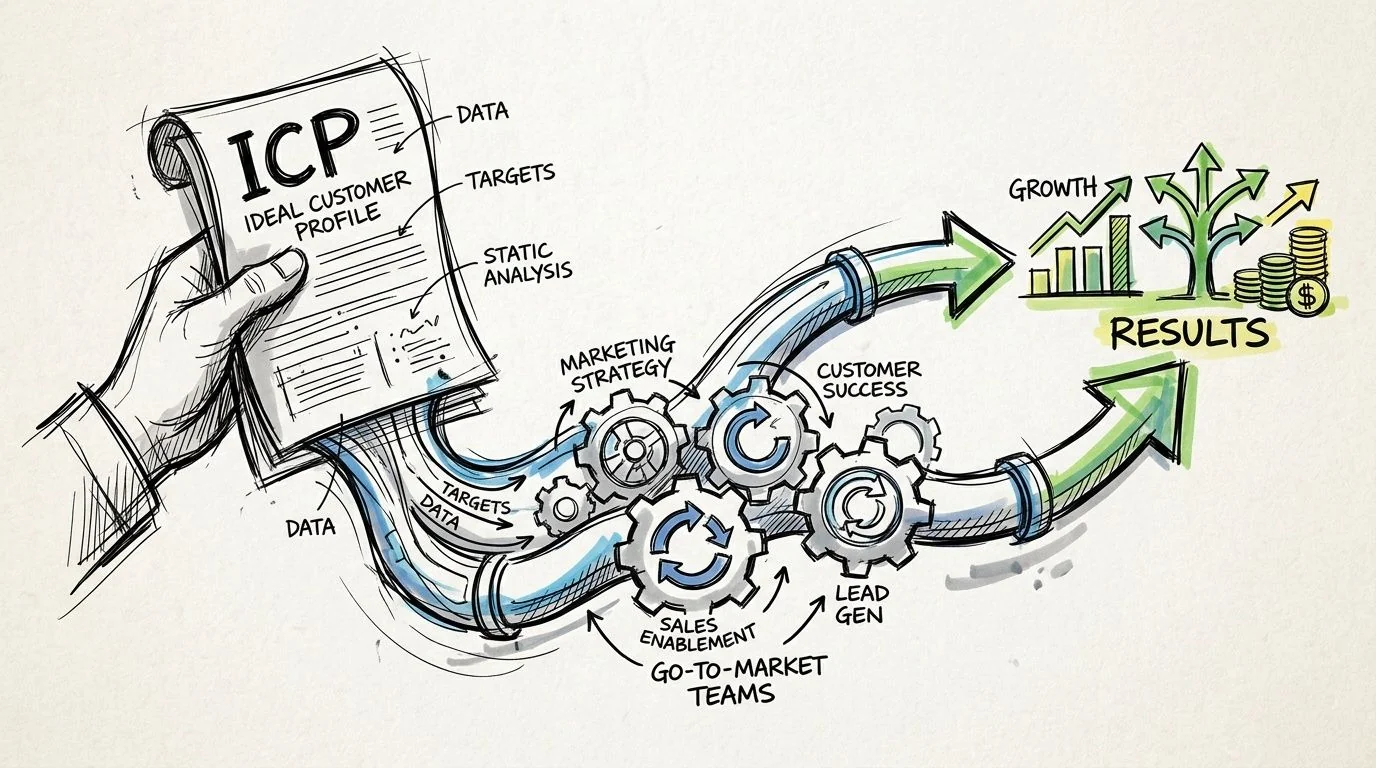
An ICP sitting in a deck does nothing. It only matters when it controls where you build authority, what your team says, and which accounts get attention first.
Use ICP to narrow positioning
Positioning is the first activation layer. If your ICP says you win with a specific category of software company under specific conditions, your homepage, landing pages, search content, LinkedIn content, and case studies should all reflect that. “We build custom software for ambitious companies” makes no claim. It is not a market position.
Narrow positioning is how recognition compounds. The narrower the ICP, the more precisely your content, outbound, and referrals point at the same account pattern.
Use ICP to focus outbound
Outbound should begin with account segmentation, not copywriting. Split your list into priority tiers based on fit score and active intent signals. Tier A accounts get personalized, high-context outreach. Lower tiers stay in lighter sequences until signals improve.
For dev agencies, ICP-aligned outbound changes reply quality materially. A sequence that references the specific stack, vertical context, and compliance pressure your prospect operates under is informed outreach. Buyers notice the difference.
Use ICP to shape content and search coverage
Your content strategy should come from the ICP, not from a generic keyword backlog. If your ideal accounts care about migration risk, compliance complexity, integration debt, or platform modernization, those themes should dominate your content calendar: blog posts, comparison pages, implementation guides, LinkedIn content.
| GTM area | What the ICP should control |
|---|---|
| Positioning | Niche claim, category language, proof points |
| Content | Topics, keyword themes, AI-visible authority assets |
| Outbound | Account selection, sequencing, personalization depth |
| Sales process | Qualification rules, objections, proposal framing |
Build authority where your best accounts already look. Then use outbound to convert recognition into meetings.
Use ICP to align marketing and sales
Most agencies leave revenue on the table when marketing chases traffic, sales chases meetings, and delivery cleans up the mismatch. A working ICP fixes this because everyone operates from the same account logic. Marketing knows which problems to publish around. Sales knows which companies belong on the list. Leadership knows which niche deserves investment.
The result is cleaner pipeline: better-fit accounts, better conversations, better close rates, and better use of founder attention.
Measuring ICP Fit and When to Refine It
An ICP that stays unchanged goes stale. Markets shift. Tech stacks change. Leadership changes. AI search changes which agencies get shortlisted before a buyer ever fills out a form.

Watch leading indicators first
Leading indicators show ICP decay before revenue reports do. If positive reply quality softens, qualified meeting rates slip, or target accounts stop engaging with your content, the targeting model needs scrutiny before the pipeline numbers make it obvious.
| Indicator type | What to watch |
|---|---|
| Outbound quality | Reply quality, positive reply rate, meeting acceptance |
| Funnel movement | Qualified meeting rate, SQL progression, proposal conversion |
| Market response | Branded search, direct visits from target accounts, content engagement from named firms |
For dev agencies, recognition breaks before pipeline does. Buyers stop seeing your firm as a category expert before they stop filling the calendar. That lag is where ICP drift hides.
Validate with lagging indicators
Lagging indicators confirm whether top-of-funnel fit produces profitable work. Watch win rate, ACV, expansion behavior, margin quality, and churn together.
A segment can book meetings and still destroy margin in delivery. That is expensive misclassification, not ICP fit. A strong ICP improves both conversion quality and account economics. If one rises while the other falls, the model is incomplete.
Set a quarterly review cadence
Review the ICP every quarter. That cadence is frequent enough to catch market shifts and disciplined enough to prevent reactive changes after one weak campaign.
Refine when you see patterns like these:
- Declining conversion quality from segments that previously performed
- Repeated wins in an adjacent niche you were not targeting deliberately
- New technology patterns across recent closed-won accounts
- Discovery changes where buyers mention AI search, communities, or referral paths you do not yet track
What refinement should actually change
Refinement should be specific and evidence-backed. Adjust exclusion criteria based on delivery pattern data. Reweight technographic signals when new stack patterns appear in closed-won accounts. Add hiring or funding events as timing triggers when they show up repeatedly in fast-moving deals. Narrow the niche claim if broad positioning is attracting low-fit demand.
Small corrections restore precision faster than a full rewrite. Keep sharpening the ICP you have rather than writing a new one every quarter.
An ideal customer profile for a software development agency is a living targeting model that combines firmographic fit, technographic compatibility, and live intent signals. It tells your team which accounts to pursue, which to ignore, and where niche authority compounds into demand. Agencies that treat it as a static persona sheet get noisy pipeline and weak positioning. Agencies that build it from real data, activate it across positioning and outbound, and sharpen it quarterly build a market footprint that buyers recognize, trust, and buy from more readily.
Frequently Asked Questions
What is the difference between an ICP and a buyer persona?
An ideal customer profile defines which companies to target. A buyer persona defines the individuals within those companies and how to message them. The ICP is an account-level model built from firmographics, technographics, and behavioral data. A persona is a stakeholder-level model built from role responsibilities, decision-making patterns, and buying context. Build the ICP first. Let it define which companies belong on your list. Build personas from the decision-makers inside those companies.
How narrow should a dev agency’s ICP actually be?
Narrow enough to direct account selection, content, and outbound at the same pattern. As a working rule: if your ICP does not help your sales team decide whether a specific company belongs on this week’s outreach list, it is too broad. As a market sizing check: if the ICP describes fewer than 200 reachable accounts, it may be too narrow for a sustained GTM motion. Between 200 and 800 well-matched accounts is a workable range for most 60 to 300 person agencies.
How often should you update your ICP?
Quarterly. That cadence is frequent enough to capture market shifts and disciplined enough to prevent reactive changes after a single bad campaign. Watch leading indicators (reply quality, meeting acceptance rates, content engagement from named accounts) monthly. Run a formal review every 90 days. A full rewrite should be rare. Most refinements are adjustments to weighting, exclusion criteria, or timing signals based on closed-won and closed-lost patterns.
What data do you need to build an ICP for a dev agency?
Start with what you already have: CRM data on closed-won accounts (industry, company size, deal size, sales cycle length), delivery notes on margin quality and project complexity, and patterns from lost deals. Add technographic data from enrichment tools (stack, cloud provider, compliance environment) and intent signals (hiring patterns, content behavior, change events). The CRM audit is the foundation. Enrichment and intent layers come after.
Why do dev agencies avoid narrowing their ICP?
The most common reason is fear of losing deals. The data does not support the fear. EBSTA’s 1H 2025 research found ICP-fit accounts produce a sales process eight times more efficient, with deal values nearly five times higher. Companies with tightly defined ICPs report win rates of 40 to 50 percent versus 20 to 25 percent for broad-targeting approaches. The accounts you lose by narrowing are almost always the accounts that cost the most to service and produce the least referral value.
What makes an ICP go stale?
Four signals: declining reply quality from segments that previously performed, repeated wins from accounts outside your stated ICP, new stack patterns appearing in your closed-won accounts, and buyers describing discovery paths you are not tracking. Any one of these warrants a targeted adjustment. All four at once means a more substantial review is overdue.