Customer Health Scores to Protect Pipeline
Build customer health scores that protect agency pipeline. Learn the exact signals, weighting models, and CRM integrations dev agencies need to stop churn.
Customer health scores are supposed to predict retention, but traditional models predicted churn correctly only 40% of the time, while 71% of customer success leaders now consider their model broken or stale, according to Coommit’s 2026 coverage of customer health scoring. For a software development agency, the failure is easy to explain: a client can keep approving code, paying invoices, and answering project emails while the executive sponsor shifts budget to an internal team.
A useful score is a composite retention metric that combines delivery, support, relationship, commercial, and tenure signals to estimate whether an account will renew, expand, contract, or leave. The practical question for a 100 to 500-person agency is whether the score gives leadership enough lead time to defend revenue and create the proof of expertise that fills the next niche pipeline.
The Reality of Customer Health Scores in Dev Agencies
A customer health score should expose renewal risk before revenue reports do. It combines product usage, support patterns, relationship quality, and financial signals into one indicator, often using a 0–100 scale or red, yellow, and green bands. Gainsight’s customer health score guide recommends Healthy at 71–100, At Risk at 31–70, and Critical at 0–30, while advising teams to weight signals by importance.
That structure fits subscription software more naturally than a custom development engagement. A SaaS provider can observe logins, feature adoption, and usage frequency. An agency must assess architecture decisions, shipped code, incident response, stakeholder confidence, and commercial outcomes. The client does not consume the service through a product interface. Renewal depends on whether decision-makers still trust the team with the next business result.
Invoice payment is a weak health signal. It confirms that billing has continued, not that the buyer still values the relationship. NPS has a similar limitation. A survey can record sentiment after it changes, but it may miss a champion losing internal influence, procurement reviewing alternatives, or a CFO freezing discretionary delivery.
Practical rule: If a signal cannot trigger an owner, a deadline, or a specific account action, it should not be a primary score input.
Health scoring protects agency pipeline because retained accounts create references, extensions, and evidence within a target vertical. Leaders can pair the operating model with the customer retention cookbook, and teams responsible for demand generation can review these agency marketing resources.
The score has one job: identify which account needs intervention before relationship risk becomes visible in revenue reports. That requires weighting executive access and commercial confidence alongside delivery evidence, rather than treating continued payment as proof of account health.
Signal Families That Actually Predict Agency Churn
The strongest agency model starts with five signal families. A B2B framework from Onboard’s customer health score metrics guide groups these inputs into product usage, support activity, relationship engagement, commercial behavior, and tenure, a useful structure for forcing both behavioral and financial evidence into the account record.
For a development agency, “product usage” becomes delivery velocity and outcome adoption. The relevant evidence includes accepted milestones, reopened work, change-request patterns, escaped defects, and whether the client is using what the team shipped. Support activity needs interpretation too. A high ticket count can mean active reliance on the agency, while a sudden drop can mean the client has stopped bringing you into important work.
Relationship engagement deserves more weight than ticket volume in multi-stakeholder accounts. Track whether the champion responds, whether technical and commercial stakeholders attend reviews, whether executives grant access, and whether the agency gets invited into roadmap or budget conversations. A healthy delivery stream can’t compensate for disappearing executive sponsorship.
| Signal Category | Standard SaaS Metric | Dev Agency Equivalent |
|---|---|---|
| Product usage | Feature adoption and login frequency | Accepted milestones, production adoption, delivery velocity, and realized outcomes |
| Support activity | Ticket volume, severity, and resolution time | Incident severity, escalation quality, response friction, and unresolved delivery issues |
| Relationship engagement | Onboarding participation and lifecycle activity | Champion responsiveness, executive access, stakeholder coverage, and review attendance |
| Commercial behavior | Renewals, upgrades, downgrades, and billing activity | Extension discussions, scope changes, budget visibility, payment friction, and procurement behavior |
| Tenure | Time since subscription start | Length of engagement, dependency depth, accumulated domain knowledge, and renewal stage |
Tenure shouldn’t automatically increase a score. A long relationship can create switching costs, but it can also conceal dissatisfaction that has accumulated without a formal complaint. The useful question is whether tenure has produced stronger access, broader scope, and clearer business value.
This matters for niche authority because each signal tells you whether the account will become evidence for your positioning or a quiet gap in your pipeline. A client that grants executive access and expands work in the same vertical can support a credible specialization. A client that only sends maintenance tickets can’t carry that strategic weight, even if delivery remains profitable.
Building a Defensible Scoring Model
Build the score as a weighted composite on a 0–100 scale. Start with eight to twelve signals across delivery, engagement, support, commercial behavior, and relationship structure, then normalize each input to a common range. CDP’s customer health score glossary recommends setting weights from historical predictive power and testing them against 12+ months of churn and renewal history.
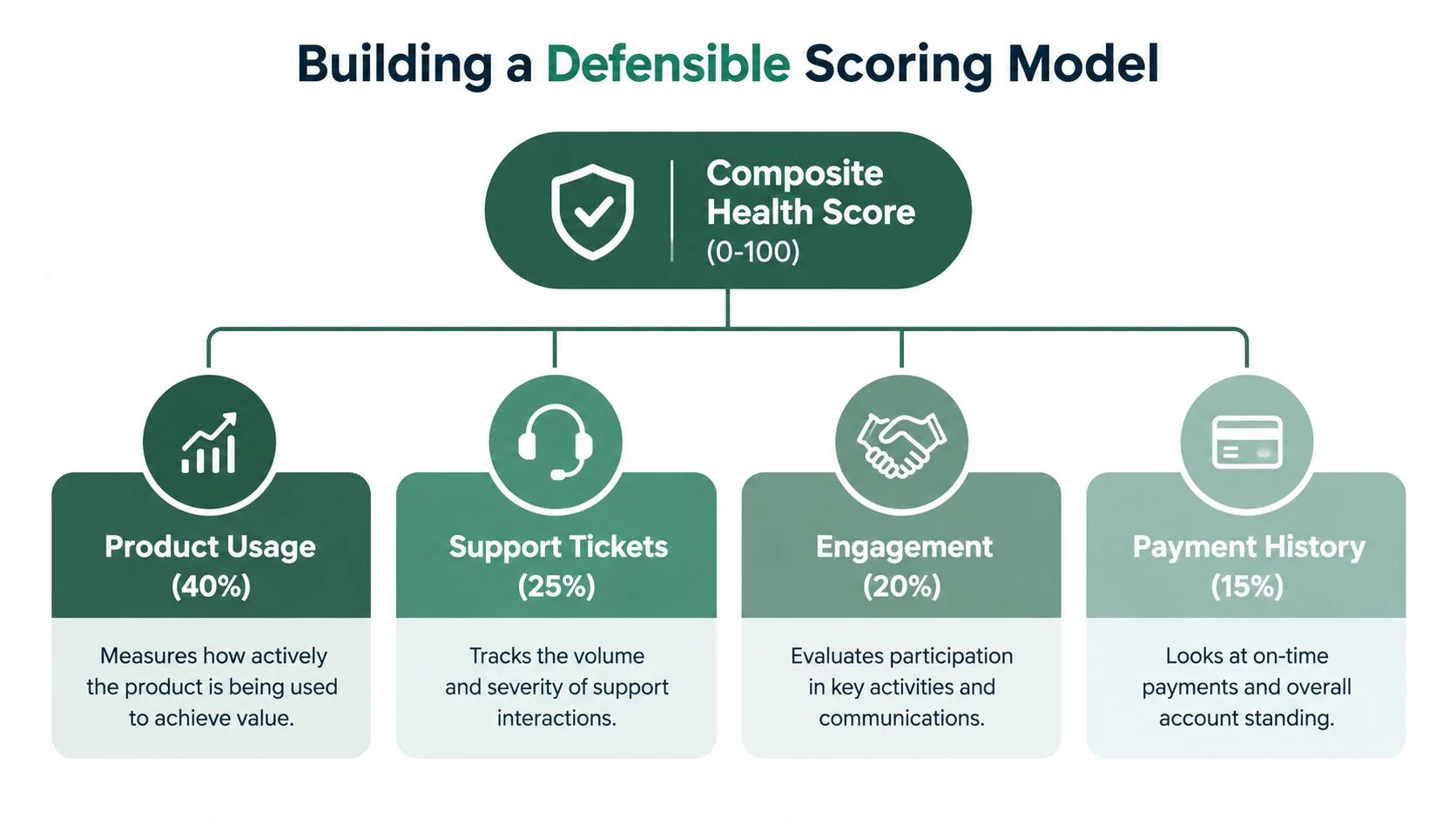
Do not copy SaaS weights into an agency CRM. If your account history is sufficient, compare each normalized signal with the outcome you need to predict, such as renewal, contraction, or expansion. Give more weight to signals that change before that outcome. A founder’s intuition can suggest a signal for testing, but it should not determine the final model.
A practical structure looks like this:
- Delivery outcome: Score milestone acceptance, delivery reliability, rework, and production impact as one family.
- Relationship depth: Score champion responsiveness, executive access, stakeholder coverage, and meeting quality.
- Commercial position: Score extension visibility, budget confirmation, scope stability, payment friction, and procurement movement.
- Service risk: Score incident severity, unresolved escalations, communication breakdowns, and repeated defects.
- Account context: Score tenure and strategic fit, while preventing longevity from masking a deteriorating relationship.
The formula is simple. Multiply each normalized family score by its tested weight, then add the results. If the evidence is weak, begin with equal provisional weights and label the result as an early model. Replace those assumptions after account history shows which signals precede renewal risk. The same discipline appears in resources such as Chatgrow’s guide to qualifying leads with Chatgrow, although agency health scoring must prioritize renewal outcomes over inquiry quality.
Treat thresholds as operating rules. Apply the bands defined earlier, then test whether they separate renewed accounts from churned or contracted ones. For a development agency, a score can remain acceptable while the executive sponsor disappears, the champion loses budget authority, or an extension stays unconfirmed. Those relationship and commercial signals should pull the score down even when delivery is stable. An account with strong milestones but no executive access needs a recovery owner, not a reassuring average.
Model discipline: A red score without an assigned recovery action is just a red spreadsheet cell.
Why Static Scores Fail and How to Recalibrate
A static score fails because the account changes faster than the model. A client can retain the same delivery volume while its decision structure changes underneath you. The executive sponsor may leave, the champion may lose budget authority, or procurement may begin consolidating vendors. Product and delivery signals can remain green while the commercial relationship turns red.
Remery’s analysis of predictive health scoring says predictive implementations are designed to flag risk 30–35 days before customers surface dissatisfaction in surveys. It also cites a benchmark with 84% median predictive accuracy when a health-score threshold below 60 identified future NPS detractors. Those figures describe predictive implementations, not a guaranteed agency result, but they show why lead time matters.
Override rules for relationship collapse
Your model needs explicit override conditions. Product health shouldn’t neutralize a sudden relationship failure. Treat the following events as immediate review triggers:
- Executive access disappears: Escalate when senior stakeholders stop attending or decline roadmap and budget conversations.
- Champion responsiveness collapses: Reassign relationship ownership when replies become inconsistent and the champion no longer advocates internally.
- Stakeholder coverage narrows: Flag an account when the agency depends on one contact and loses access to finance, operations, security, or product leadership.
- Commercial language changes: Review the score when the client avoids extension dates, delays budget confirmation, or introduces insourcing and vendor-consolidation language.
The override doesn’t need to replace the composite score permanently. It should force a human review, a documented risk reason, and an owner. Perspective’s coverage of health-score automation argues that next-generation models need telemetry, relationship structure, and conversational diagnostics together.
Recalibrate after every material renewal outcome, not only on a calendar. Rebuild scores at 30, 60, and 90 days before churn when historical data allows it, then check which signals moved early. If a signal’s relationship with renewal weakens, reduce its weight. If executive disengagement repeatedly precedes contraction, promote it from contextual note to override rule.
Integrating Scores into CRM and Pipeline Operations
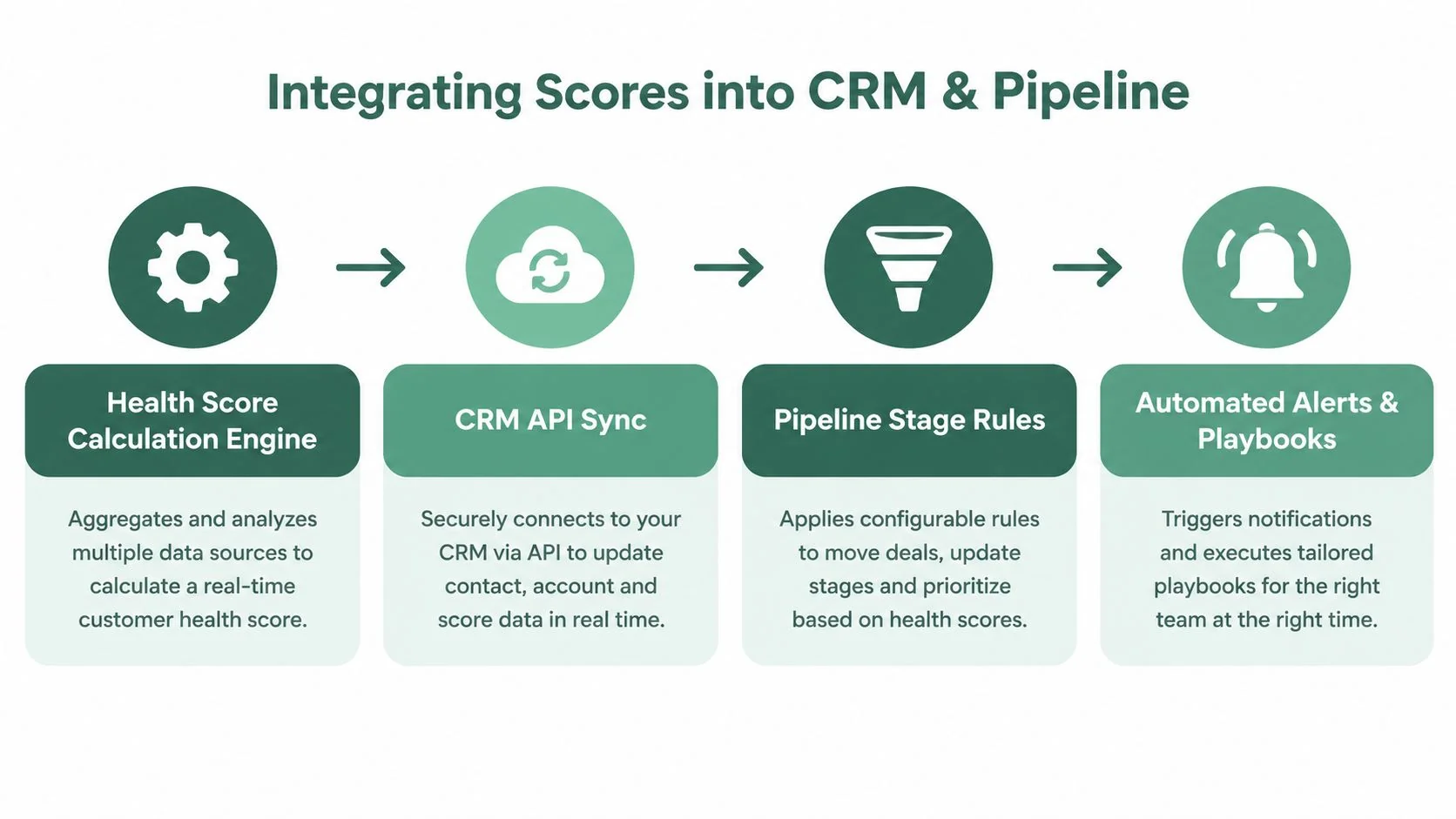
A health score protects revenue only when it changes account decisions. In a high-touch development engagement, the CRM must connect delivery status, support history, executive access, stakeholder coverage, billing, renewal timing, and expansion activity in one account record. Gainsight’s survey found that many companies record health scores in customer success systems, while others still use spreadsheets. The gap matters because recording a number is different from using it to guide churn and renewal decisions.
Start with an account-level data contract. Define the account ID, source system, update owner, refresh timing, normalization rule, and action attached to each field. Pull delivery status from the project platform, incidents from support, stakeholder activity from the CRM, commercial data from finance, and renewal dates from the contract record. The score should expose its components and timestamp, not just display a color. Relationship and commercial fields deserve equal visibility with delivery metrics because a technically successful project can still be at risk when executive access disappears or budget ownership becomes unclear.
Turn risk into pipeline exposure
Revenue-at-Risk converts account health into a financial priority. Glencoyne’s B2B customer health scoring guide defines it as Monthly Recurring Revenue multiplied by churn probability. For project-based agencies, use the recurring portion of a retainer or a documented renewal value. A one-off build should not be represented as recurring revenue.
Attach a specific workflow to each threshold:
- Yellow: Notify the account owner, require a written risk reason, and schedule a stakeholder conversation.
- Red: Alert the delivery leader and executive sponsor, create a recovery plan, and set a review date.
- Green with expansion signals: Create an expansion task only when commercial intent and stakeholder access support it.
- Missing data: Reduce forecast confidence and assign a data owner. An empty field is not a healthy signal.
A CRM workflow should create ownership, not a stream of unreviewed notifications. The account owner records the intervention, the client’s response, and the next observable signal. Leaders responsible for managing sales leads for agencies should use the same account taxonomy, so retention risk and new-business pipeline share consistent vertical, stakeholder, and commercial context. That consistency lets leadership compare renewal exposure with pipeline quality without forcing delivery teams to maintain a separate reporting system.
Defending Top Accounts and Securing Niche Authority
A rigorous health score changes the agency’s definition of account management. The team stops waiting for a cancellation notice and starts defending the relationships that carry the most commercial and market value. Revenue-at-Risk tells leadership where financial exposure sits, while relationship overrides reveal risks that delivery dashboards miss.
The strategic payoff extends beyond retention. A client that renews, expands, and gives the agency access to senior stakeholders can become a reference, a domain-specific case study, and a source of language for future positioning. That evidence helps a development agency own a niche because buyers see repeated competence in a defined problem, not a general claim to build software.
Rank accounts by more than revenue
Use three views in the leadership review:
| View | Leadership question | Result |
|---|---|---|
| Financial risk | Which account exposes the most renewal value? | Intervention priority |
| Relationship strength | Which accounts could leave despite healthy delivery? | Executive coverage plan |
| Market value | Which accounts can deepen authority in the target niche? | Reference and expansion strategy |
Don’t let the largest account automatically receive every resource. A smaller account with strong executive access, clear vertical fit, and expansion potential may create more defensible positioning than a large but anonymous delivery contract. That trade-off belongs in the operating review, not only in marketing planning.
Recalibrated health scores help agencies defend against insourcing, identify expansion before procurement opens a replacement search, and turn successful delivery into credible niche authority. For founders and CEOs, start here: audit your top accounts, map the five signal families, identify missing executive relationships, and put every yellow or red account into a named recovery playbook. If pipeline predictability depends on being recognized for a specific kind of software work, request a free positioning scan from 100Signals and use the findings to decide which accounts, references, and niche signals should shape your next growth push.