Authority Link Building for Dev Agencies: The Playbook
Stop chasing DA scores. Learn the data-backed authority link building system software development agencies actually need to fill their pipeline.
85.8% of surveyed SEO professionals say digital PR is the most effective way to build backlinks according to BuzzStream’s link building statistics roundup. That number should settle the usual agency debate about volume. For a 200-person software development agency, the constraint is visibility inside a narrow buying committee. If the right CTO, VP Engineering, or product lead never sees your name attached to a credible third-party source, your backlink count is irrelevant.
Authority link building for dev agencies means earning editorial references from relevant publications, industry sites, and cited resources that technical buyers already trust. The goal is to make an otherwise invisible vendor visible in the exact niche where six-figure projects are sourced, shortlisted, and discussed. Vanity DR inflation doesn’t do that.
Why Standard Link Building Fails Dev Agencies
Agency link building is commonly run like a batch job. Teams buy prospect lists, sort by DR, and send templated pitches at scale. The operating assumption is that more outreach produces more links. For a 200-person software development agency, that workflow creates activity without solving the visibility problem faced by an invisible vendor.
In an outreach dataset covering nearly 12 million emails, the average response rate was 8.5%, while personalized subject lines improved responses by roughly one-third, according to Reporter Outreach’s State of Link Building. Broad outreach has little tolerance for weak relevance. Poor targeting reduces replies first, then leaves the agency with placements that contribute little authority.
Dev agencies face a narrower buying path than generic B2B providers. A founder or engineering executive selecting a custom software partner is unlikely to spend the entire process browsing agency listicles. Buyers review trade coverage, vendor comparisons, implementation commentary, compliance updates, architecture analysis, and technical benchmarks. Links outside that information layer rarely change how the agency is evaluated.
Volume outreach solves the wrong problem
The core problem is not a missing backlink count. Buyers often fail to encounter the agency in credible third-party sources before a sales conversation begins. That is a distribution problem: the agency’s expertise exists, but it does not appear where technical buyers form shortlists and assess risk.
The useful campaign shape is a focused story that earns several editorial placements, not a larger spreadsheet of loosely related prospects. A narrowly defined subject can give journalists and editors a reason to cite the agency without turning the article into a rewritten service page.
Practical rule: Begin outreach only after developing a story that a journalist or editor could publish without rebuilding the agency’s positioning. Otherwise, the process is inbox spam with SEO vocabulary.
Why this matters for pipeline
A software agency can lose before the first call. The prospect may not know its name, cannot associate it with a specific domain, and has no external evidence that it understands the buyer’s technical constraints. This is the invisible vendor problem.
A generic “we build custom software” page gives publishers little to cite. A documented analysis of engineering bottlenecks in healthcare claims automation, developer hiring friction in industrial SaaS, or migration risk in fintech compliance gives them a concrete reference point. Authority link building starts working when the agency publishes material a market can reference instead of pitching the agency as the subject.
| Standard approach | What happens in practice | Why it fails a dev agency |
|---|---|---|
| Large prospect list | Low relevance reduces response rates | Buyers never see niche expertise |
| DR-first targeting | Teams pitch sites without topical fit | Links do not strengthen category authority |
| Service-page outreach | Editors ignore self-promotional assets | The page gives them no reason to cite it |
| Minimal personalization | Responses remain near the baseline or fall below it | Technical publications expect clear beat alignment |
The New Hierarchy of Link Quality
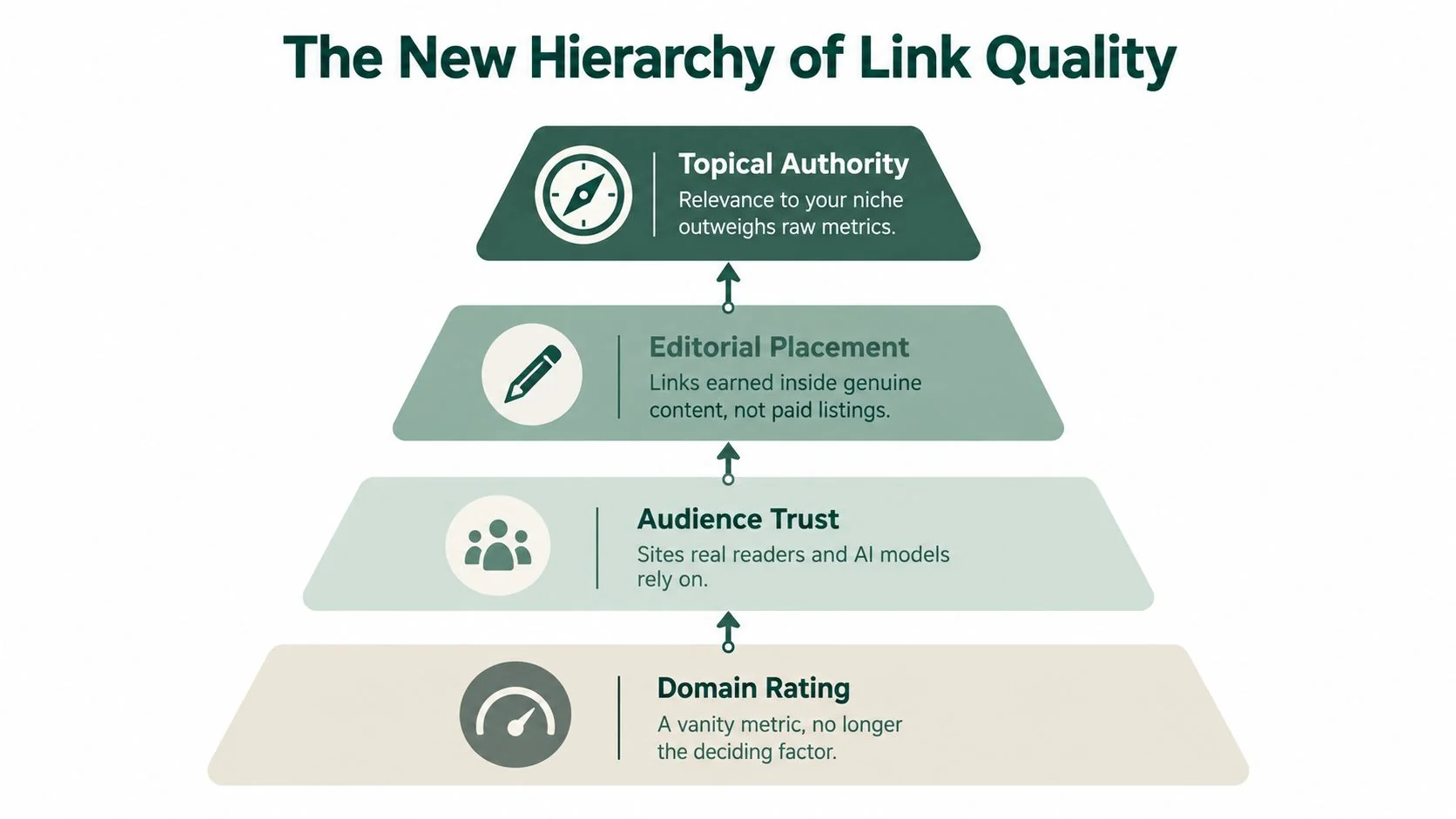
For a 200-person software development agency, link value follows a practical order: topical relevance, editorial context, audience trust, then raw authority metrics. This hierarchy addresses the agency’s invisible vendor problem. Buyers need repeated evidence that the company understands a specific technical market, while search systems need consistent signals connecting the brand to that market.
DR is a filter, not a strategy
The market has already assigned prices to placements. 76% of surveyed buyers pay at least $300 per link, 31% pay $500–$1,000, and the industry-wide acceptable price for a high-quality backlink is about $508.95, while average earned digital PR links are often cited around $750, according to Reporter Outreach. These figures describe purchasing behavior, not the value of every link. Price and placement value are separate variables.
For a dev agency, placement value comes from context. A mention within reporting on compliance engineering, platform modernization, or product delivery risk can support buyer confidence. A site with a higher DR but no connection to the agency’s niche may contribute little to that decision.
Relevance is the authority multiplier
Link evaluation works like code review prioritization. Start with the signal most likely to affect the target market, then use broader metrics to screen candidates.
| Signal | What to ask | Why it matters for a dev agency |
|---|---|---|
| Topical authority | Does this site cover the niche you want to own? | It teaches buyers and machines to associate your brand with that niche |
| Editorial placement | Is the mention inside real reporting, analysis, or resource content? | Context carries the argument, not just the hyperlink |
| Audience trust | Would a technical buyer read or cite this source? | Links influence perception when the audience trusts the publisher |
| Domain Rating | Is the site credible by third-party metrics? | Useful screening input, weak decision criterion on its own |
Backlink profile work should connect external reputation to a defined market. AISEOGrow explains how to improve your site’s reputation with backlinks. The operational requirement for an agency is narrower: pursue references that reinforce one technical category instead of collecting domain strength without a market association.
DR still matters as a screening input. It is not the unit that decides value.
Why this matters for niche ownership
A 200-person dev agency needs repeated coverage around a narrow class of business and engineering problems, not visibility across every software term. Each relevant reference strengthens that market identity for prospective buyers and machine-generated answers.
High-authority coverage is also uneven. Analysts at Ahrefs found that backlink authority is distributed across a broad range of referring domains, making top-tier placements scarce rather than a dependable output of larger outreach lists. The implication is direct: story quality and publication fit determine authority outcomes more reliably than outreach volume. A plan built on routine access to the highest-DR publications lacks a viable supply assumption.
Niche Validation and Asset Engineering
A 200-person software development agency rarely earns authoritative links from a broad claim such as “we build custom software.” The market cannot associate that message with a specific problem, and editors cannot turn it into a useful citation. Authority link building needs a defined buyer group, a question with editorial value, and an asset that functions as evidence or infrastructure rather than sales copy.

Pick a niche that creates a publishable question
“Compliance automation for mid-market healthcare providers” gives an editor a subject. “Migration debt in industrial field-service platforms” gives one a technical problem. “Data residency constraints in EU health products” gives one a market-specific question. “Custom software development” gives none.
The validation test is direct: can a publisher use the material to answer something its readers already ask? If the answer is no, narrow the category before producing the asset.
Use this workflow:
- Map repeatable buyer pain from closed-lost notes, discovery transcripts, proposal themes, and delivery retrospectives.
- Reduce it to a market claim. For example, mid-market health operators may overpay for manual audit workflows because integration work is fragmented.
- Check existing coverage. Articles, reports, and discussions about parts of the issue indicate an editorial surface and reveal gaps your agency can address.
- Package the gap as evidence through research, a benchmark, expert analysis, a teardown, or a practical tool.
This process addresses the invisible vendor problem. Buyers may recognize the problem but still have no reason to associate its solution with your agency. Repeated evidence around one technical category gives publishers, buyers, and AI systems a stable description of what the agency knows.
Build something worth citing
A service page rarely gives an editor a reason to link. Utilities, original evidence, and clearly documented analysis do.
| Asset type | What it looks like | Why publishers cite it |
|---|---|---|
| Original benchmark | Comparative data on delivery bottlenecks, tooling choices, or compliance gaps | It supplies evidence for trend stories |
| Expert analysis | A technical teardown tied to an industry change | It gives reporters quoted interpretation |
| Interactive tool | Cost estimator, migration readiness score, or checklist generator | It provides practical value beyond opinion |
| Structured resource | Glossary, implementation map, or standards guide | It becomes a reference asset |
The asset should contain information that another agency cannot reproduce by rewriting a generic service page. A useful operating model is to build authority with data. The objective is one defensible claim with enough evidence for a publisher to cite and an AI-generated answer to summarize accurately.
Editors do not owe an agency distribution. They need specificity their readers can use.
The mechanics that usually get skipped
Founders often approve the niche statement and move directly to outreach. The missing step is an asset designed for publication and machine extraction.
Use this build sequence:
- Method first. Define what was measured or analyzed before stating conclusions.
- One headline claim. Five weak angles create no clear citation target.
- Quotable components. Include short findings, labeled charts, and plain-English implications.
- Editorial framing. Write an executive summary that a journalist can accurately paraphrase.
- Commercial restraint. Keep services in the byline, author bio, or supporting context rather than dominating the evidence.
Niche visibility compounds through recognition. Once buyers and publishers connect the agency with one defined problem domain, the brand becomes easier to identify as a credible technical source.
Targeted Outreach Using Intent Signals
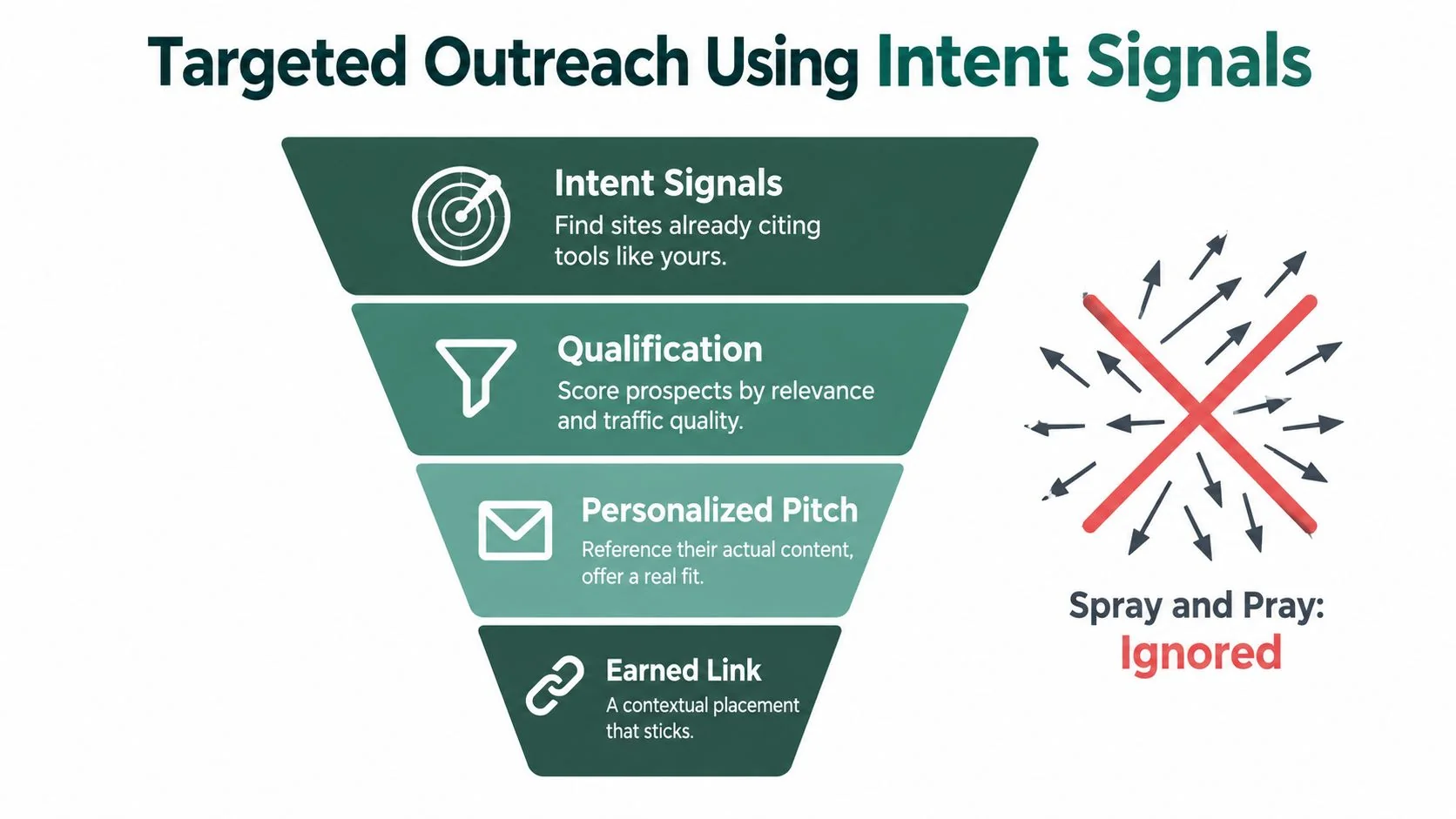
The prospect list now determines whether a strong asset earns attention. A default workflow, scrape a category, sort by authority, and send one pitch to everyone, produces mediocre results because it ignores editorial intent.
The response math from section one compounds here. A narrow list is what keeps placement rates near the 4–8% placement rate, or about one link for every 12–25 prospects contacted benchmark reported by Reporter Outreach’s dataset. The implication is operational. Relevance and personalization are required to keep authority link building from becoming low-yield outbound.
Compare the two outreach models
| Traditional agency approach | AI-first intent approach |
|---|---|
| Pull a large list of high-metric sites | Build a short list of sites already covering your micro-vertical |
| Pitch the asset as a generic “resource” | Pitch a specific angle matched to an editor’s beat |
| Use broad templates with token merge fields | Reference a recent article, theme, or recurring coverage gap |
| Treat follow-up as optional | Treat follow-up as part of the workflow |
| Measure sends and opens | Measure placements and downstream sales recognition |
For a 200-person software development agency, “intent signals” identify publications and writers already showing interest in the agency’s niche. Relevant signals include coverage of adjacent tools, compliance rules, engineering constraints, implementation failures, and category shifts. The agency is entering an existing editorial thread with stronger evidence, rather than trying to create demand from zero.
What a qualified list looks like
A qualified outreach list is small enough for every prospect to have a defensible reason to care. The placement benchmark is realistic only when the list is narrow and the asset fits the publication.
Use qualification criteria such as these:
- Coverage fit. The site already publishes on the problem addressed by the asset.
- Role fit. The message reaches the editor or writer responsible for that beat.
- Format fit. The publication links to sources, tools, or research.
- Audience fit. Its readers overlap with technical or executive buyers.
Qualification holds up best as a repeatable process:
Follow-up is part of the system
A single email rarely closes the loop. Editors miss messages, defer them, or need a sharper angle. Follow-up is useful when it adds context, introduces a new hook, or connects the asset more clearly to the publication’s beat.
Send fewer pitches. Make each one defensible.
A reliable sequence has three stages:
- The first email ties the asset to a specific article, topic cluster, or audience problem.
- The follow-up reframes the value by isolating one finding or practical implication.
- The final follow-up stays short and makes the decision easy to defer or decline.
Teams that need a repeatable system can use products such as BuzzStream and Respona for prospecting and personalization. Firms such as 100Signals package niche validation with outbound sequencing for dev shops. The vendor matters less than the decision rule: outreach begins only after niche fit and asset fit are clear.
Visibility Beyond Google in the AI Era
73.2% of experts believe inbound links influence AI-generated search results, while 80.9% believe unlinked brand mentions indirectly help rankings and 78.8% believe nofollow links can still matter, according to a 2025 study summarized in its analysis of links in the age of AI. For a 200-person dev agency, this changes the authority problem. The firm may deliver complex systems successfully yet remain an invisible vendor when buyers ask ChatGPT, Claude, Perplexity, or Google AI Overviews which specialists understand a narrow technical issue.
Classic rankings remain relevant, but they are only one distribution channel. AI systems assemble answers from sources that are topically consistent, clearly written, and easy to extract. A random guest post therefore contributes little, even if it carries a followed link.
What this changes for a dev agency
Authority assets must make the agency legible as a specialist, not merely visible as a service provider. The strongest formats answer specific buyer questions and expose evidence that an AI system can quote accurately.
| Weak asset | Strong asset for AI citation |
|---|---|
| Generic thought leadership | Structured research with clear findings |
| Promotional blog post | Niche guide with explicit answers |
| Broad service page | Market-specific page backed by evidence |
| Opinion without sourceable detail | Analysis with method and stable terminology |
Recent trend reporting summarized by Link.build identifies digital PR and original research as the most effective tactics, while non-passing link attributes accounted for roughly 25–35% of new backlinks in 2024–2025 in its AI-era link-building trends report. The implication is specific: a dev agency should build assets that attract editorial citations and provide machine-readable evidence, rather than optimize only for followed links.
How to structure for machine citation
AI systems cite information they can identify, separate, and verify. Use direct headings that mirror buyer questions. Put one claim in each paragraph, explain the source and method behind original analysis, and use the same term for the same concept throughout the page. Definitions, short summaries, and comparison tables also give retrieval systems clean excerpts.
A technical agency can reinforce this authority through AI-driven demand generation for dev shops, where intent data and content distribution connect narrow expertise with active demand. The objective is measurable at the source level: an AI assistant should be able to associate the firm with a defined technical problem and cite evidence supporting that association.
For an agency competing against larger consultancies, this is the difference between appearing in a vendor list and being named as a credible specialist. Links help create the supporting network, while precise assets give search systems and AI assistants material they can interpret.
Measuring ROI and Protecting Your Brand
The wrong KPI for authority link building is “how many links did we get.” The right question is whether market recognition improved enough to change pipeline behavior.
Measure the campaign in a stack:
| Layer | What to track | Why it matters |
|---|---|---|
| Authority output | Placements on relevant editorial sites | Confirms the campaign earned credible distribution |
| Sales signal | Reply quality and meeting quality | Shows whether recognition is affecting outbound |
| Market position | Whether prospects already know your niche claim | Indicates if you’re moving from vendor to category specialist |
If you’ve done the work correctly, outreach gets easier because the buyer has seen your firm before. In our campaigns at 100Signals, when target accounts already recognize the brand, we see reply rates of 6–12%, compared with under 1% for cold outreach to people who have never heard of you. That is what we observe, not a guarantee, and results vary by niche and list quality. The directional lesson holds: authority shortens the credibility gap before sales contact.
Separate earned from paid, or create risk
Google is explicit about link qualification. Its current guidance says paid placements, sponsorships, and other compensation-based links should use rel=“sponsored”; user-generated content should use rel=“ugc”; and rel=“nofollow” is the fallback when the site owner doesn’t want to associate the page with the linked URL, according to Google Search Central’s outbound link guidance. Google’s 2019 announcement introducing these attributes made the same distinction in plain terms, stating that sponsored is for advertisements, sponsorships, or compensation agreements, and ugc is for comments and forum posts in Google’s announcement.
That means the compliance rule is straightforward:
- Earned editorial links come from coverage, analysis, or resources where no payment controls the placement.
- Paid links must be disclosed with the appropriate attribute.
- Community links from forums, comments, or similar environments are not editorial endorsements.
If your agency or SEO partner blurs those categories, authority link building stops being a durable reputation asset and becomes policy risk.
For a dev agency, the business outcome is the real test. Authority link building works when your firm becomes easier to recognize and shortlist inside one narrow market.