Digital First AI for Software Dev Agencies
How digital first AI reshapes demand generation for software dev agencies. Covers AI assistants, search, LinkedIn, outbound, and pipeline measurement.
78% of organizations were already using AI in at least one business function in 2025, up from 55% in 2023. For software development agencies, digital first AI is now an operating layer for pipeline, not a content toy for the marketing team. The agencies that win with it build recognition where buyers already look rather than publishing more, then use that recognition to make outbound land.
What Digital First AI Actually Means for Dev Agencies
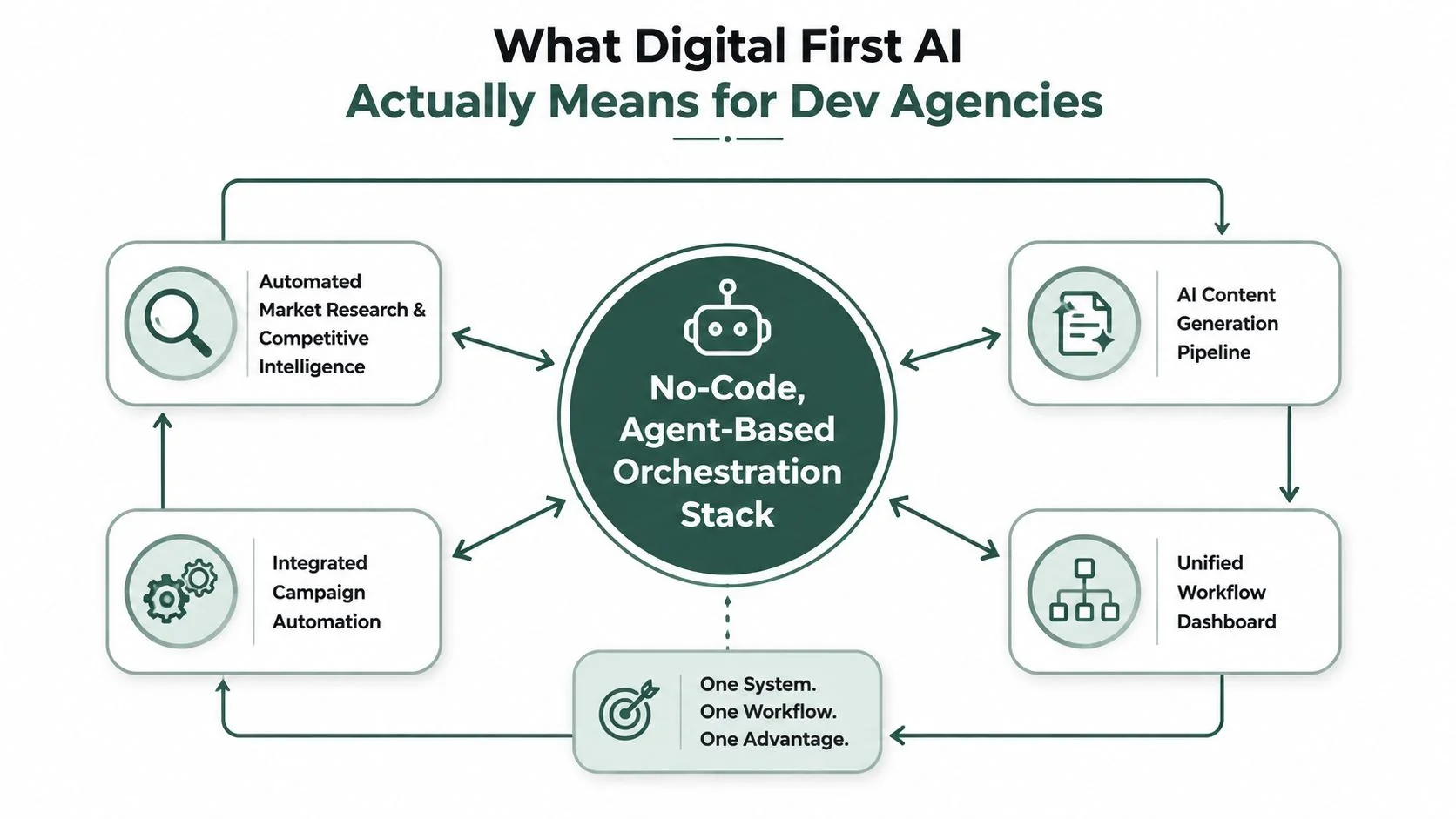
Digital first AI is a no-code, agent-based orchestration stack. It combines market research, social intelligence, content generation, strategic analysis, creative production, and web data extraction into one workflow layer instead of forcing your team through separate tools and handoffs, as described in Software Advice’s overview of Digital First AI. For a 100 to 500 person dev agency, that distinction matters because the old demand gen model was built for linear funnels, manual review, and disconnected campaigns.
The shift is visible in adoption. 71% of organizations were regularly using generative AI in business operations in 2025, compared with 33% in 2023 (Fullview 2025 AI statistics). That tells you the model has already moved from experiment to embedded workflow. If your agency still treats AI as a copywriter replacement, you’re behind the market and behind your buyers.
The real architectural change
Traditional marketing tooling asks humans to assemble the workflow. Digital first AI flips that. You define the inputs, the task boundaries, and the output format, then let agents move the work through research, writing, design, and distribution. That’s why the practical value is faster generation of niche-specific campaign variants that can support positioning.
Practical rule: if AI only touches the draft stage, it’s a content tool. If it touches research, positioning, asset creation, and campaign assembly, it’s a pipeline system.
That’s also why Algomizer’s AI visibility guide is worth your time if you care about being cited in AI answers. Visibility now depends on more than rankings. It depends on whether your expertise is structured enough for machines to recognize and reuse.
For agencies, digital first AI works when it helps you own a niche faster than competitors can copy your messaging. If your offer is sharp, the orchestration layer helps you produce evidence, publish it, and distribute it without waiting for five separate teams to coordinate.
I’d also point your team to the SEO resources for dev agencies if you want a practical baseline for the technical and content side of that stack. The agencies getting this right use AI to compress the path from niche selection to recognized authority.
AI Visibility as a Pipeline Variable
Most founders still treat AI citations and search visibility like vanity metrics. That’s the wrong frame. In TrustRadius’ 2024 B2B Buying Disconnect Report, 78% of buyers selected products they had heard of before starting research (TrustRadius report summary). For an agency, that means pre-search recognition is not soft awareness, it’s a measurable input into whether your outbound even has a chance.
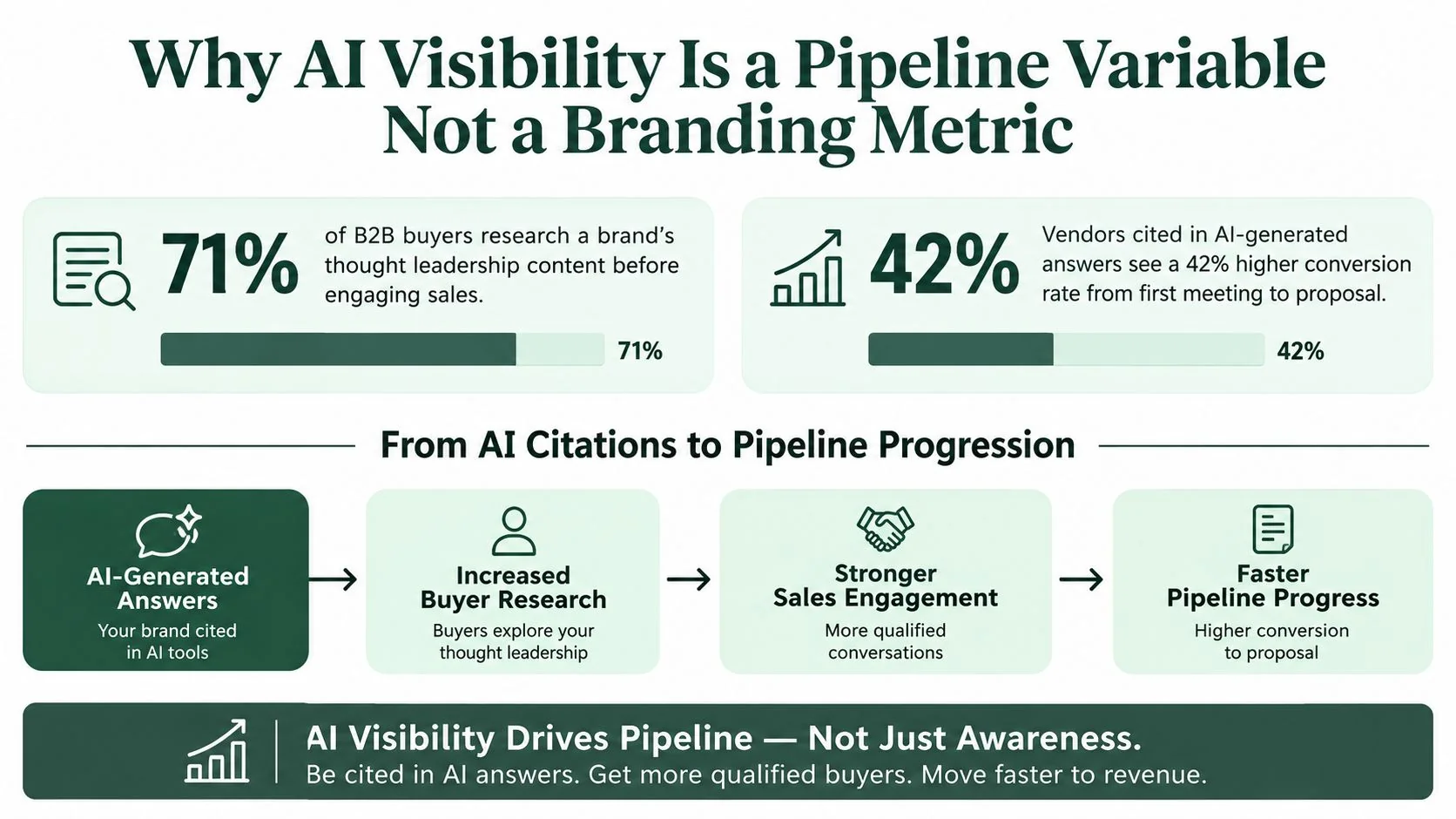
Buyers don’t move from ignorance to curiosity in a straight line. They search, ask AI assistants, check LinkedIn, and only then decide whether to respond. If your agency shows up in those moments, the outbound email doesn’t feel cold. It feels familiar.
Recognition changes reply behavior
This is why AI visibility belongs in the pipeline dashboard. If a prospect has seen your agency cited in search or in AI-generated answers before your rep reaches out, the outbound sequence isn’t introducing a stranger. It’s reinforcing a name they already know. That’s the difference between inbox ignored and inbox opened.
Visibility before outreach lowers resistance before the first email is sent. That makes it part of how outbound converts.
The content many agencies publish today still assumes the buyer is a blank slate. They aren’t. LinkedIn, AI assistants, and search have already done the first layer of filtering. Your job is to make sure those systems can find and repeat your niche position with enough consistency that your outbound feels like the obvious next move.
If you want a deeper tactical map of that layer, the 100Signals AI visibility method is the right reference point. It’s the kind of resource you use when you’re trying to be cited, not just indexed.
The pipeline implication is direct. Recognition creates warmer first touches, warmer first touches create better reply rates, and better reply rates create more qualified meetings. That’s why AI visibility has to be managed as a revenue input, not a quarterly branding update.
Where AI Intersects with Search and LinkedIn and Outbound
For dev agencies, discovery doesn’t happen in one channel. It happens across search, AI assistants, LinkedIn, and outbound, and those surfaces reinforce one another. LinkedIn matters because 89% of B2B decision-makers use LinkedIn during vendor research, and 83% do most of their research before contacting a vendor directly, based on LinkedIn’s 2024 buyer research of 500+ senior B2B buyers in the US, UK, and Western Europe (buyer research summary). That makes LinkedIn a research surface, not a brand channel.
The working model runs the channels as one system. Buyers see your point of view on LinkedIn, search for the problem, ask an AI assistant to synthesize options, and then receive outbound that either matches the recognition already formed or gets ignored.
Channel sequencing for recognition first pipeline
| Channel | Role in Engine | Measurement | Typical Timeline |
|---|---|---|---|
| Organic search | Surfaces your niche expertise when buyers look for the problem | Branded search, ranking presence, niche landing page visibility | Medium term |
| AI assistants | Repackages your expertise into answer formats buyers trust | Citation presence, mention frequency, topic coverage | Medium term |
| Builds pre-search familiarity and thought leadership recall | Target-account engagement, profile and post visibility, direct response quality | Short to medium term | |
| Outbound | Converts existing recognition into meetings and conversations | Reply quality, qualified meetings, pipeline created | Immediate once recognition exists |
The mistake is to run these as separate workstreams with separate owners. That wastes budget because each channel is feeding the next. A dev agency that publishes strong LinkedIn commentary but never translates it into searchable niche proof is leaving recognition stranded. A team that ranks for the niche but never shows up on LinkedIn is invisible where buyers spend time.
If you’re benchmarking tooling for that workflow, compare LinkedIn AI tools by whether they help you keep one narrative consistent across feed, search, AI citations, and outbound, not by their feature lists.
The strongest agencies use LinkedIn to seed familiarity, search to validate expertise, AI citations to reinforce authority, and outbound to convert the whole stack into meetings. That sequence is what turns recognition into pipeline.
Building a Spec First AI Workflow in 90 Days
The fastest way to fail with digital first AI is to install it as a generic content engine. The right way is to treat each workflow stage like a production system with a spec, inputs, outputs, and acceptance criteria. That matters because Digital First AI 2.0 is workflow-centric, with a Data Room for first-party inputs, a Web Searcher for trend tracking, Canvases for offer, ICP, and proof points, and Flows for multi-step campaigns, all built around discrete campaign stages (Digital First AI 2.0 workflow model).
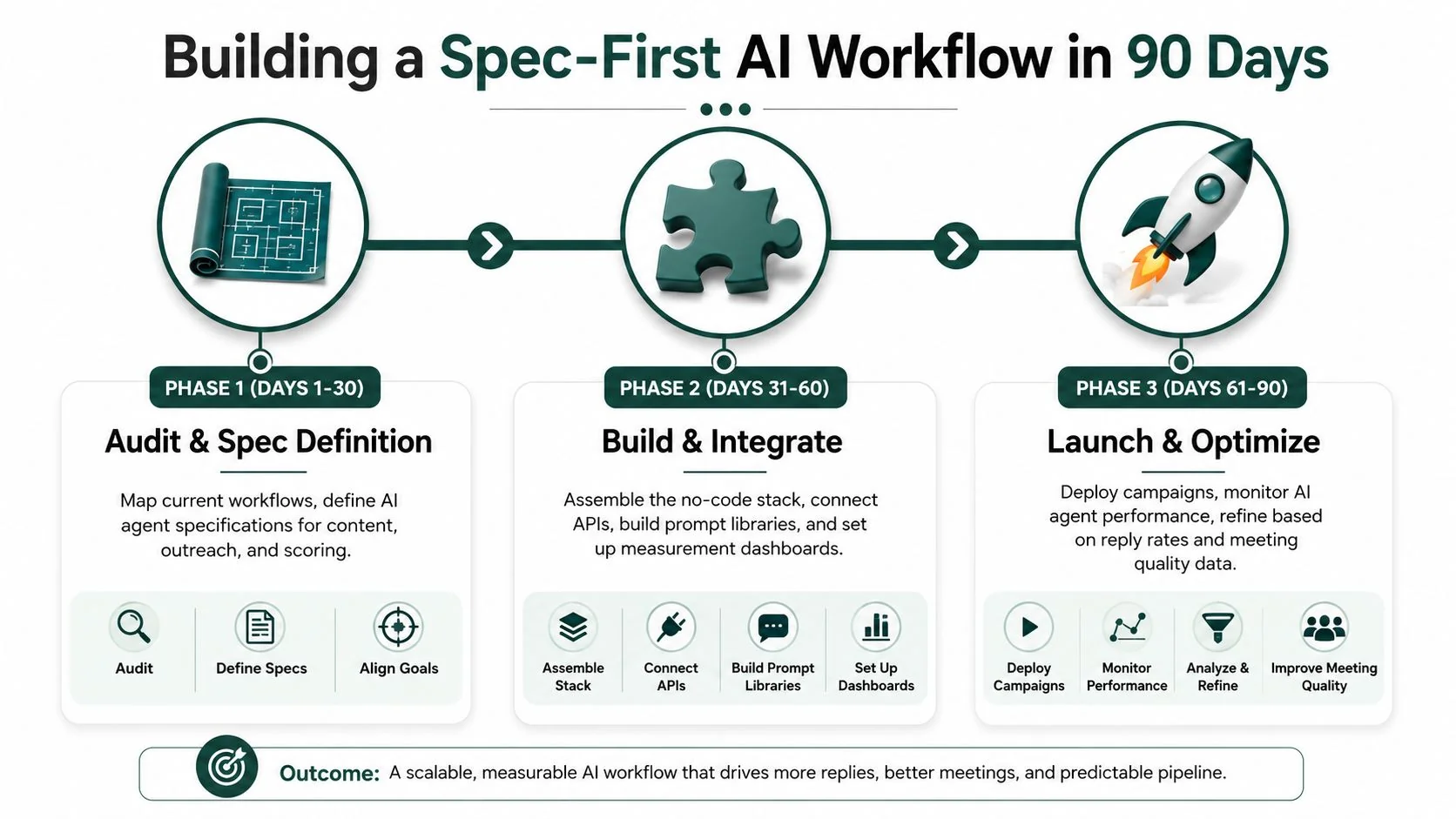
Days 1 to 30, validate the niche with data, not opinion
Start with the segment, not the content. Pull first-party inputs into the Data Room, review the segments you already sell into, and define the niche where you can win. Then write the task spec for each artifact you want AI to produce, including what good looks like and what gets rejected.
The point is to stop vague positioning from contaminating the workflow. If the input is sloppy, the outputs will be generic. If the niche is sharp, the AI stack can generate research, angle, and proof assets that sound like a specialist, not a generalist.
Operational rule: no AI workflow should go live until the team can state the input, the output schema, and the rejection criteria in plain English.
Days 31 to 60, build visibility where buyers already look
Use the Web Searcher for trend tracking, then turn the insights into Canvases that define the offer, ICP, and proof points. Search, AI assistants, and LinkedIn need to say the same thing. If those surfaces disagree, the market won’t trust you.
Your success metric here is consistency. A buyer should be able to read your LinkedIn post, find your niche page, and ask an AI assistant a related question without getting three different versions of your firm.
Days 61 to 90, activate outbound with constraints
Use Flows to assemble multi-step campaigns for cold, warm, and intent-based outreach. Keep the list quality tight and the message anchored to the niche language you’ve already made visible elsewhere. Then measure response quality, not just reply count.
The agencies that fail at this stage usually make one of two mistakes. They let the AI draft too freely, or they don’t set a review loop for hallucinations and weak positioning. Either problem turns a clean workflow into noisy output.
If your outbound doesn’t match the authority you’ve already published, you’re burning the recognition you paid to build.
The spec-first approach is what makes the stack scale. Each stage gets its own contract, each contract makes evaluation easier, and each evaluation makes cross-market expansion safer.
Two Niche Examples of Recognition First Engines
A software agency targeting fintech compliance platforms built its engine around one rule: every asset had to reinforce the same niche. The team used AI to draft market research, LinkedIn commentary, and outbound angles, but every output passed through a human review focused on niche accuracy. The first problem they hit was content quality degradation at scale, not strategy. Once volume rose, the language started to drift toward generic “digital transformation” wording, which cut trust fast.
They fixed it by narrowing the prompt inputs and forcing the workflow to pull from a locked set of proof points. The result was cleaner positioning and better-qualified conversations, because the team stopped asking AI to invent the niche and started asking it to express the niche they had already defined.
A second agency focused on healthcare software modernization made a different mistake. They treated AI like a content accelerator and ignored the full funnel. Their posts got attention, but the LinkedIn engagement never translated into outbound movement because the messaging changed between channels. Then the algorithm shifted, their reach softened, and they realized they’d built visibility without transfer into pipeline.
The fix was to connect the surfaces. They used search to anchor the topic, LinkedIn to create recognition, and outbound to reference both. Once the sequence matched, conversations became easier to start because the prospects had already seen the agency’s point of view in more than one place.
| Agency Pattern | What They Measured | What Broke | What They Fixed |
|---|---|---|---|
| Niche-first engine | Reply quality, qualified meetings, consistency of positioning | Generic language at scale | Locked inputs and tighter review |
| Content-first engine | Engagement, impressions, surface-level awareness | Channel drift and weak handoff to outbound | Unified message across search, LinkedIn, and outbound |
Generic positioning produces generic outputs. AI assistants can’t cite what isn’t specific, and buyers won’t trust an agency that sounds interchangeable with every other dev shop in the market.
Connecting Digital First AI to Niche Ownership and Pipeline
Digital first AI matters because it turns niche ownership into a repeatable operating system. If your agency is cited in AI answers, visible in search, and present on LinkedIn for the same niche, competitors can copy the format but they can’t easily copy the accumulated recognition. That’s what creates defensible positioning.
The measurement model should be split in two. Track recognition signals like AI citations, branded search demand, and LinkedIn engagement from target accounts. Then track pipeline signals like reply rates, qualified meetings, and deal velocity. If recognition rises and pipeline doesn’t, your message is weak. If pipeline rises without recognition, you’re probably buying short-term response and calling it strategy.
The founders who win in 2026 will be the ones who used digital first AI to position first, build authority second, and reach out third, not the ones who asked whether AI could write faster. That sequence turns a software agency from another vendor into the obvious choice in a niche that buys.