What Is Pipeline Generation: Strategies for Dev Agencies
Learn what is pipeline generation. Dev agencies can build targeted, measurable revenue streams using proven strategies & a 90-day plan for 2026. Boost growth
Pipeline generation is the process of creating and qualifying revenue opportunities. For software development agencies, the definition is narrower: it’s the part of go-to-market that turns niche authority into qualified deals. Measure it by segment, channel, and owner, and judge it on forecast quality, not raw lead volume. Outreach.ai recommends segment-level measurement for a reason: company-wide totals hide whether one niche is producing real opportunities while another drags the forecast down. Outreach.ai on segment-level pipeline measurement
Introduction
A pipeline that cannot be measured by segment, channel, and owner is only activity, not evidence of revenue progress. For software agencies, niche positioning should change deal quality, not just the number of contacts.
Pipeline generation starts with selecting the right accounts, engaging the right buyers, qualifying real intent, and moving those opportunities toward closed-won. Gong describes it as the full path from identifying leads to closing the sale, with sales and marketing both involved in the nurture process. Gong on pipeline generation
For agencies selling specialized services, that definition sets the standard. If your authority does not reach the deal stage, it may build awareness, but it does not prove pipeline.
Understanding Pipeline Generation
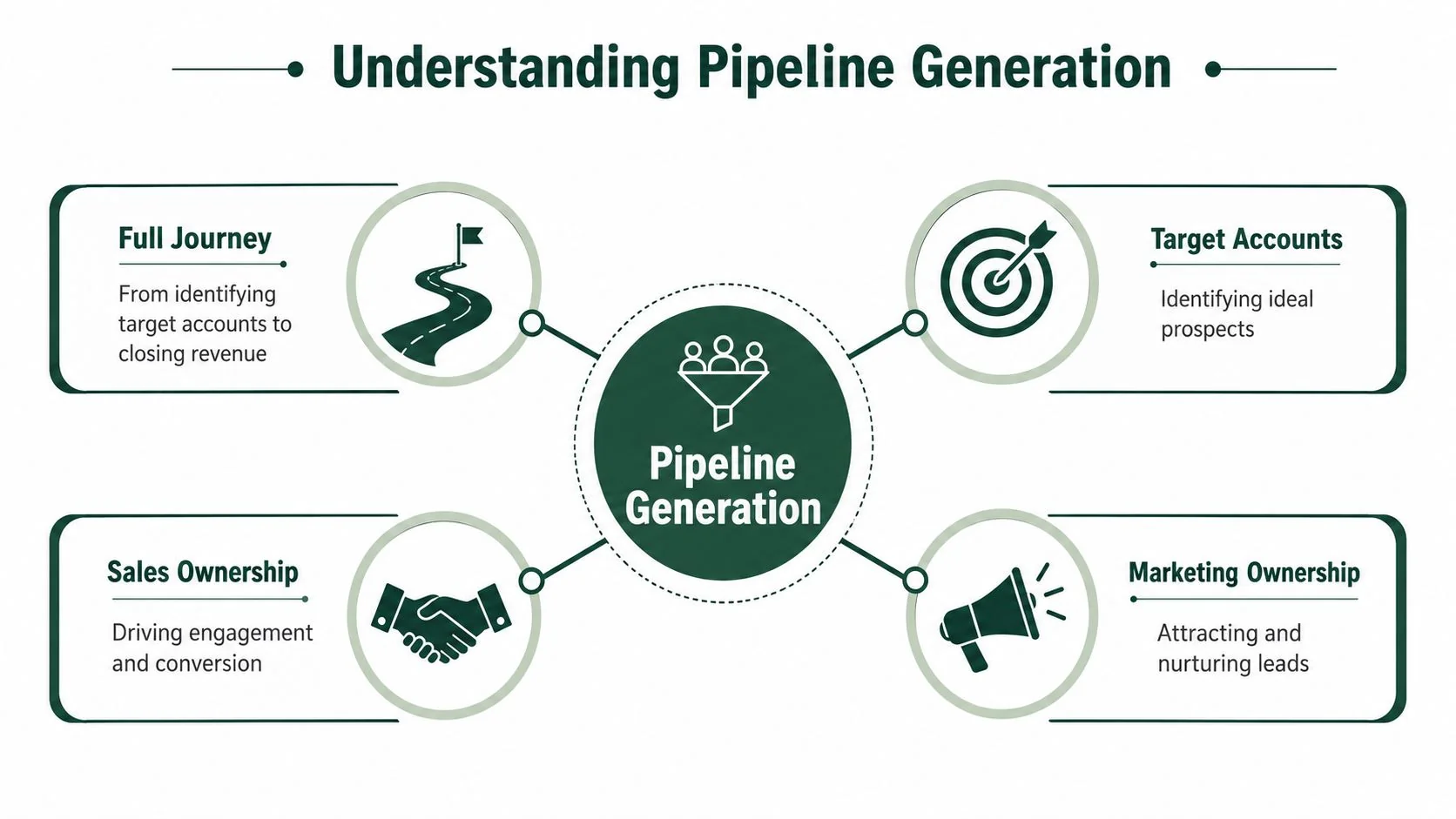
It covers the whole revenue path
Pipeline generation is the process of identifying, qualifying, and creating opportunities that have a realistic path to revenue, then tracking deal health as those opportunities move through the buying process. The useful version starts with target ICP accounts, reaches the right buyers with context, qualifies intent, converts qualified leads into active opportunities, and keeps measuring whether the deal is still moving toward a decision. Aviso on pipeline generation
For software agencies, that scope matters because niche authority only counts when it produces deal flow. A ranking in a vertical keyword, a citation from an AI assistant, or a strong point of view about one industry has value only if it leads to accounts with budget, timing, and a real buying process. MarketsandMarkets ties pipeline generation to connecting business signals to specific opportunities, including recognizing the opportunity, mapping the buying center, and validating budget and timing. MarketsandMarkets on signal-based pipeline generation
Practical rule: If a tactic creates attention but not qualified opportunity, it belongs in demand generation, not pipeline generation.
Segment-level measurement is what makes this distinction useful. A software agency can see one niche respond well while another segment stalls, and those differences usually show up in opportunity quality before they show up in revenue.
Sales and marketing both own it
Highspot describes strong B2B pipeline generation as a mix of aligned targeting, account research, relevant outreach, useful content, and follow-up that reflects buyer intent. It also connects effective execution to target account selection, multichannel outreach, content relevance, lead scoring, partner routes, and clear SLAs. Highspot on pipeline generation For agencies, that means sales cannot blame “bad leads” while marketing optimizes for traffic. Both teams need the same account list, the same qualification bar, and the same handoff timing.
The best teams also read signals by segment instead of averaging everything together. A niche practice, such as a development agency focused on one vertical, can treat buying signals differently by account tier, industry, or intent cluster, then measure which segment creates the most qualified opportunities per unit of outreach. That is where authority earns its place in the process, because it matters only when it changes which accounts enter pipeline and how fast they progress.
How Pipeline Generation Differs From Demand and Lead Generation
The three terms often get blurred, but they answer different business questions. Demand generation asks whether the market knows your agency. Lead generation asks whether someone raised a hand. Pipeline generation asks whether a qualified account is moving toward revenue.
| Approach | Objective | Primary Metrics | Buyer Stage |
|---|---|---|---|
| Demand generation | Create awareness and preference | Reach, engagement, share of attention | Early awareness |
| Lead generation | Capture contact details and inquiries | Form fills, MQL volume, inquiry count | Interest capture |
| Pipeline generation | Create qualified revenue opportunities | Conversion by stage, pipeline created by segment, pipeline velocity | Active evaluation and buying |
For software agencies, the practical difference shows up fast. A broad campaign can drive traffic and form fills while producing little sales-ready demand in a specific niche. A pipeline-focused program asks which segment is progressing, which account tier is converting, and where deals slow down. That is the level at which analyzing content for growth becomes useful, because content only matters if it changes movement in the right accounts.
Sopro’s guidance on weekly and monthly pipeline monitoring points in the same direction. Pipeline health needs volume, quality, velocity, conversion, and pipeline age, not just top-line counts. Sopro on pipeline generation metrics
Agencies that want to become an obvious choice in a narrow market need signals that map to opportunity, not just attention. The practical test is whether authority changes which accounts enter the pipeline and how quickly they progress. If it does, segment-level numbers will show which accounts carry real buying intent and which show only interest. Pair that with resources on becoming an obvious choice, then use the same signal set to prioritize the accounts that are moving.
Pipeline Generation Lifecycle and KPIs
For software agencies, pipeline quality depends on what happens at each handoff. The useful question at each handoff is which segment is progressing, which account tier is converting, and where deals slow down.
What each stage should prove
At the account-selection stage, the question is simple: are you focused on the right segment or on a broad market list? At the engagement stage, you are testing whether your message lands with the buyer’s actual business problem. Qualification should confirm fit and intent, while conversion shows whether the account is ready to enter an active deal process. Deal-health monitoring closes the loop by showing whether opportunities are moving or stalling.
Once the ICP and buyer journey are defined, teams should set qualification criteria, activity targets such as calls, emails, and demos, and exit criteria for each stage. Weekly and monthly review should include pipeline volume, conversion rates, pipeline velocity, win rate, and average sales cycle length. For an agency, that separates “we got more interest” from “we have more qualified accounts moving faster.”
Segment-level measurement is the control system
Segment-level measurement works best because it shows where pipeline quality comes from. Tracking pipeline by segment, channel, and owner, plus conversion rates at each stage, gives a clearer read on performance than blended reporting. A niche agency needs to know whether one vertical, one outbound motion, or one salesperson produces better pipeline than the rest. A company-wide average can’t answer that.
Bottom line: If pipeline reports do not break down by segment, you are managing a blended average, not a revenue engine.
The video below is a practical look at the metrics behind this.
A good internal review habit is to analyze content performance the same way you analyze pipeline, by segment and by outcome. A useful reference is analyzing content for growth, because content only matters when you can connect it to qualified movement, not just clicks.
For teams that want a content side to this motion, Demand generation resources for agencies can help structure the pages and assets that support segment-specific movement.
Proven Strategies for Pipeline Generation
The agencies that win niche markets rarely rely on a long list of disconnected tactics. They use a small set of motions that reinforce one another, search visibility, signal-based qualification, and outbound activation. That sequence matters because pipeline quality usually improves when teams move from broad activity to specific buying signals, then map those signals to specific accounts, buyers, and timing.
Search and AI visibility
If niche pages do not appear where buyers search, or where AI assistants summarize vendors, outbound ends up carrying too much of the load. The goal is narrow visibility: one problem, one vertical, one buying context. Publish the pages buyers use when they compare vendors, then keep the message consistent across the site, LinkedIn, and sales follow-up.
A supporting content layer helps if it is tied to a real segment. The Demand generation resources for agencies can support that motion with the pages and assets that help a niche page earn credibility. A vertical proof page, a niche landing page, and a focused comparison page are often enough when the segment is well chosen. Each page should answer the commercial question the buyer already has.
Data-driven niche validation
Many agencies pick a niche by instinct, then spend months trying to make weak numbers look acceptable. A better approach is to compare segments on evidence and choose one defensible niche instead of spreading effort across several poor ones. The cleanest frame is to compare buyer clarity, signal strength, sales fit, and content fit side by side.
| Criterion | What to check | Why it matters for pipeline |
|---|---|---|
| Segment clarity | Can you name the buyer and the problem precisely? | Broad segments weaken messaging |
| Buying signal strength | Do accounts show a real trigger, not just engagement? | Stronger intent improves qualification |
| Sales fit | Can your team explain the offer without rewriting it every call? | Faster qualification and handoff |
| Content fit | Can you build proof pages and outreach around the segment? | Better authority and reply quality |
That is also where 100Signals fits naturally, as one option for a niche-validation and activation workflow. It maps segments, builds authority assets, and sequences outbound around a defensible niche. I would place it in the same category as any system that connects positioning to pipeline, not as a substitute for sales discipline.
Outbound activation
Outbound works best when it follows evidence. The most useful signal-based tactics are the ones that tie a real trigger to a specific account list, for example hiring changes, technology shifts, or signs that a team is actively solving the problem you serve. The guide on AI-ready marketing for agencies covers how search, AI visibility, and outreach need to reinforce each other instead of sitting in separate teams.
Run outbound on mapped accounts, after niche authority exists. Keep the message tied to the trigger, the buying center, and the likely timing. If a signal can’t explain why this account, why now, and why your agency, it isn’t ready for outreach.
90 Day Implementation Blueprint and Measurement Checklist
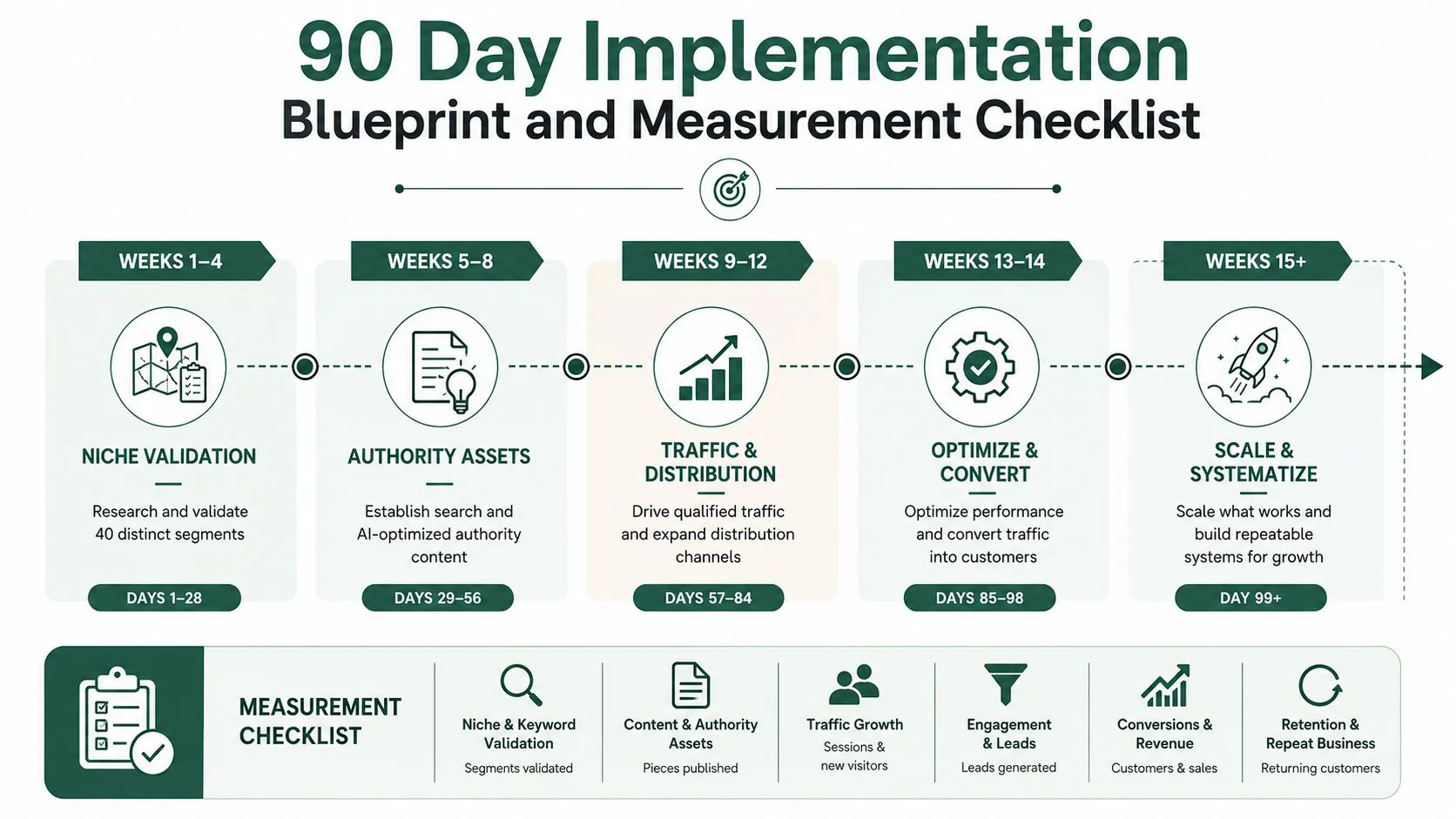
Pipeline generation only becomes useful when the rollout is tied to what the market is doing. A practical 90-day plan should separate segment validation, asset creation, and outbound activation, so each phase produces evidence before the next one starts. That sequencing also helps with the measurement problem, because segment-level pipeline quality shows whether a niche is producing real opportunities or just activity. 90-day implementation blueprint and measurement checklist

The 90-day sequence
The first four weeks should identify the segments worth pursuing and document the buying triggers, likely buyers, and proof points your team can support. That work is the filter, because it forces the agency to decide which segments have enough signal to justify content and outbound effort. The next four weeks should convert the shortlist into visible assets, niche landing pages, proof pages, and message angles that sales can use without rewriting the story for every conversation. The final four weeks should activate outreach only against accounts that fit the segment and show a clear reason to engage now.
Measurement checklist
| Metric | Weekly check | Monthly check | Why it matters |
|---|---|---|---|
| Pipeline volume by segment | New opportunities added | Segment trend | Shows whether the niche is producing |
| Conversion rate by stage | Movement between stages | Stage health | Shows whether quality is real |
| Pipeline velocity | Time in motion | Movement trend | Shows whether deals are progressing faster |
| Pipeline age | Stagnant opportunities | Aging pattern | Shows where forecast quality breaks |
The operating rhythm matters as much as the activities themselves. If a team only reviews campaigns and response volume, it can miss whether the pipeline is moving by segment, channel, and owner. Sopro on pipeline generation metrics and as noted earlier, Outreach.ai’s guidance on segment-level pipeline measurement point to the same conclusion: teams need weekly and monthly reviews that isolate where the niche is working and where it is stalling.
Conclusion
What is pipeline generation? For a dev agency, it’s the disciplined process of turning niche authority into qualified opportunities, then tracking those opportunities by segment instead of hiding behind company-wide totals. That’s how you separate attention from revenue.
If your agency is still measuring success by lead volume, pull the reporting apart by segment, channel, and owner this week. Then decide whether your niche is creating opportunities that can actually close, or just generating more noise in the CRM.