What Is Full Funnel Marketing
What is full funnel marketing. Learn what full-funnel marketing is, how TOFU, MOFU, and BOFU work, and how software agencies measure search, AI, LinkedIn
Full-funnel marketing coordinates awareness, consideration, conversion, and post-sale demand around a buyer’s readiness, with different messages and measures for each stage. In 6sense’s 2024 research, 81% of B2B buyers had selected a winning vendor before speaking with a sales representative, so a pipeline system that starts at the first sales conversation starts late.
For a software development agency, full-funnel marketing is an account-level influence system, not a sequence of campaigns or a chart that ends at lead capture. It connects niche visibility, buyer research, technical proof, sales activity, and customer outcomes, even when much of the early journey happens before a prospect is identifiable in the CRM.
What Full-Funnel Marketing Actually Means
Full-funnel marketing matches buyer readiness, message, channel, and measurement across attention, education, proof, and action. At the top, an agency earns visibility among people researching a problem. In the middle, it helps a buying group evaluate approaches and vendors. At the bottom, it reduces the risk of taking the next step, such as discussing scope or reviewing a technical plan. Post-sale, the same system can support retention, expansion, referrals, and advocacy.
For a 100–500-person development agency, the operating consequence is direct: a channel’s value can’t be judged only by whether it generates a form fill. A niche architecture guide may influence an account’s vendor preference before anyone visits a contact page. A last-touch report may credit the final outbound reply while missing the search, LinkedIn, or third-party evidence that made the reply possible.
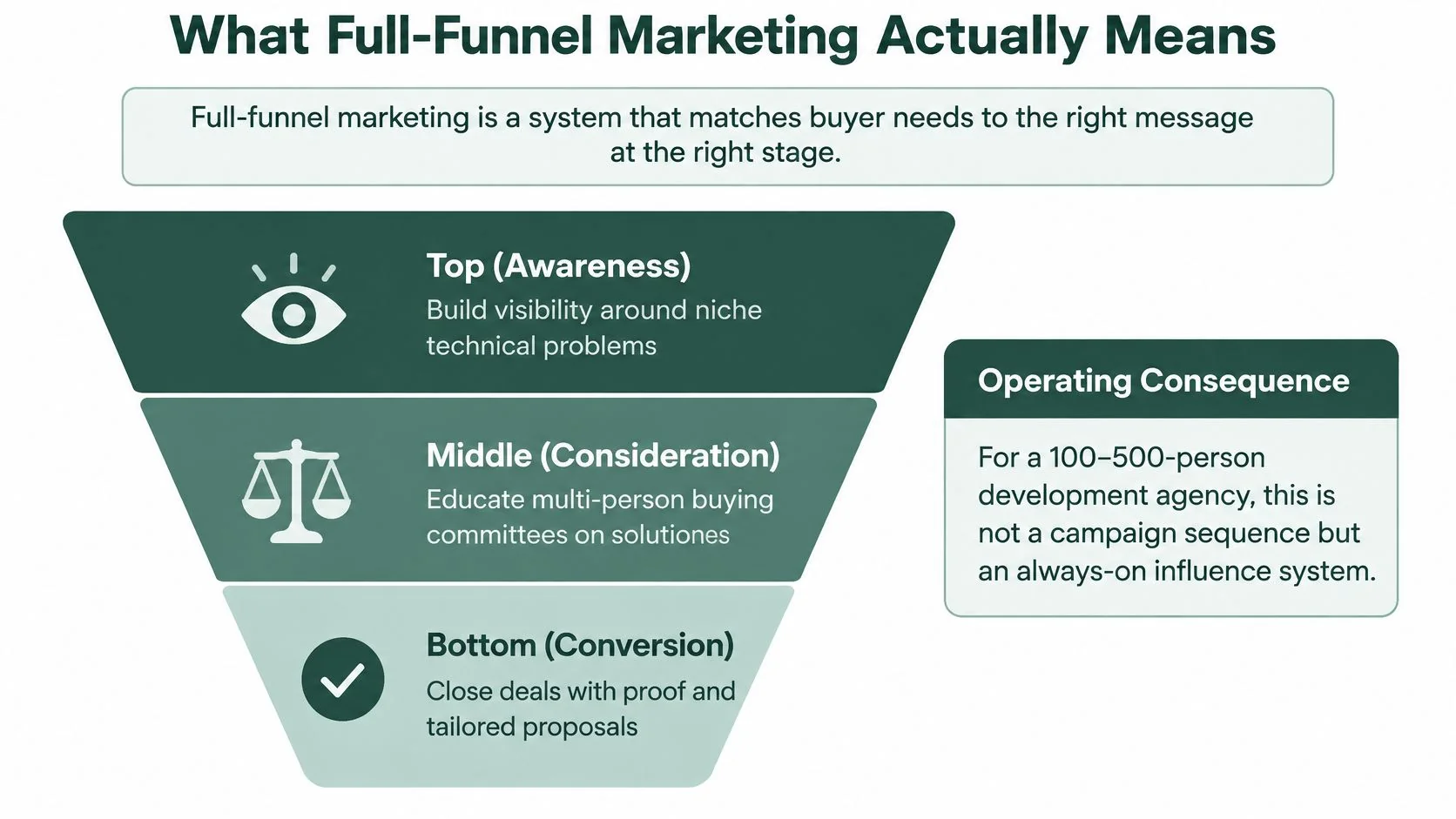
The framework has a long history. The AIDA progression describes attention, interest, desire, and action; Elias St. Elmo Lewis described the sequence in 1898, and William Townsend illustrated the funnel metaphor in his 1924 sales manual, Bond Salesmanship (funnel framework history). What lasts is the principle, not the shape: a buyer at different stages needs different information, and leadership should judge each activity against the job it’s meant to do.
A useful leadership model is simple: visibility creates the chance to be considered; evidence earns preference; sales engagement converts preference into a commercial decision; delivery determines whether that decision creates future value. Marketing and sales therefore need to review accounts and progression together, not argue from channel totals in isolation.
Why Linear Funnels Mislead Agency Pipeline
The funnel is useful for internal reporting. It isn’t a faithful map of how a buying group makes a decision. A CTO may research architecture while a business sponsor weighs delivery risk, and procurement may only enter once a preferred vendor is taking shape. These people can revisit options and consult evidence outside the agency’s analytics or CRM.
A 2009 McKinsey study of almost 20,000 consumers across five industries and three continents described purchasing as a circular decision journey, not a simple funnel. Google research also found that 60% of consumers in surveyed markets took six or more actions before choosing a new brand or product (McKinsey’s consumer decision journey). The point for an agency is to keep the stages but stop treating them as a literal account timeline.
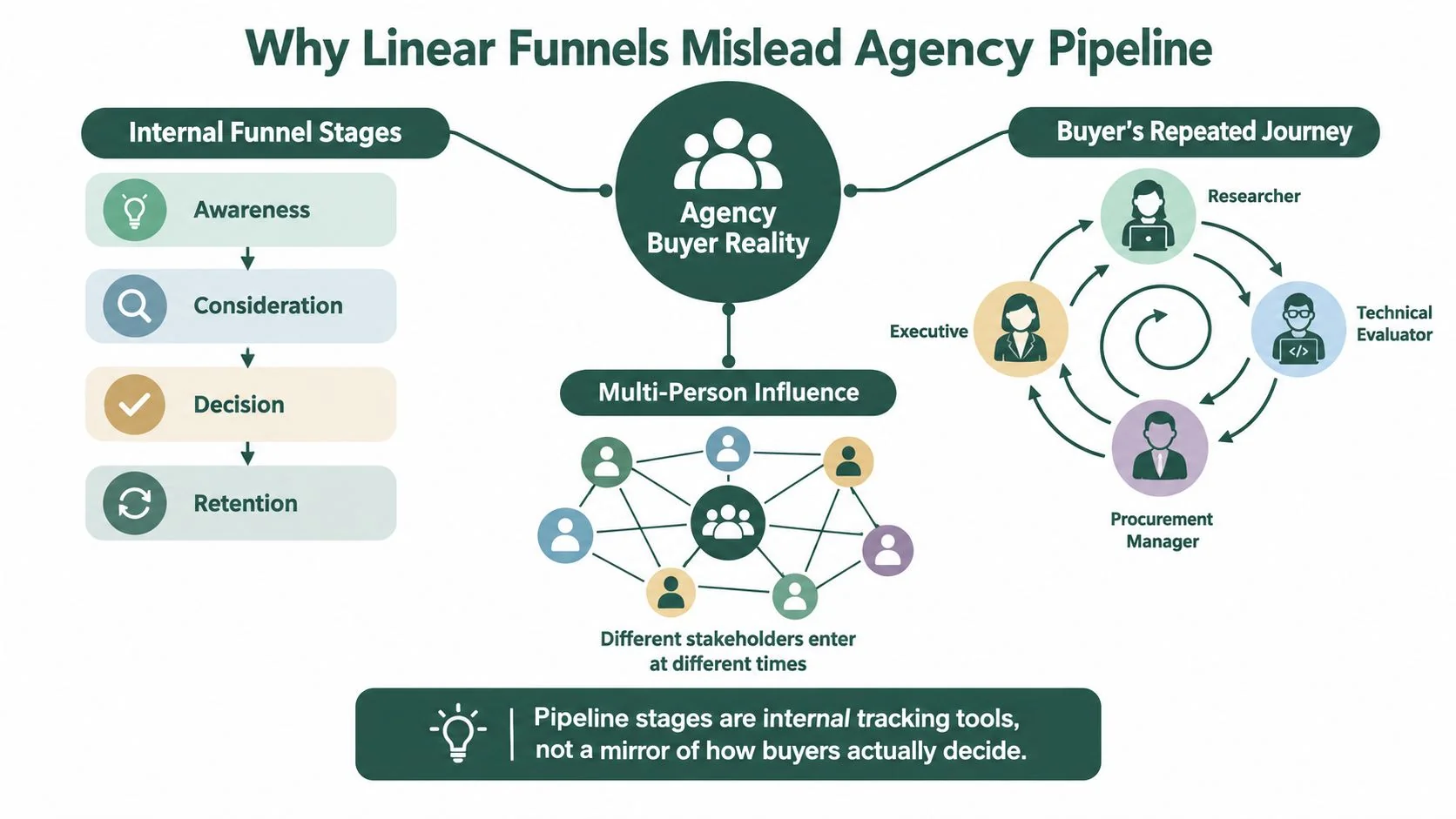
A buyer might encounter a niche search page, ask an AI assistant for implementation options, check a review or peer recommendation, and later respond to outbound. Each signal answers a different question. A click can indicate discovery, repeat engagement can indicate evaluation, and a sales meeting can indicate active intent. None proves the others happened in a tidy order.
Keep TOFU, MOFU, and BOFU as reporting categories, then add account-level views of repeated engagement, buying-group roles, and stage progression. A practical companion is PostSyncer’s funnel analysis tips, which can help teams think through the measurements attached to each internal stage.
Operating rule: Use stages to organize your reporting. Use account evidence to understand buyer behavior.
That distinction matters when most research is anonymous. The CRM begins recording an account once a person identifies themselves or sales connects the dots. It doesn’t follow that the account’s buying process began at that moment.
Build the TOFU MOFU and BOFU System
Build the system around the buyer’s job at each stage, not around a content calendar. 6sense’s 2024 research found that 81% of B2B buyers had selected a winning vendor before speaking with a sales representative, which makes pre-conversation evidence a selection asset (6sense’s 2024 Buyer Experience Report).
| Stage | Buyer job | Agency evidence and channels | Primary KPIs |
|---|---|---|---|
| TOFU, awareness | Recognize a problem and define its context | Niche search pages, technical explainers, LinkedIn expertise, AI-readable answers | Qualified search visibility, branded search, target-account engagement |
| MOFU, consideration | Compare approaches and assess delivery risk | Architecture guidance, implementation plans, relevant client proof, migration or security material | Repeat account engagement, high-intent actions, buying-group participation |
| BOFU, conversion | Validate a preferred supplier and agree on a next step | Technical consultation, scoped proposal, tailored demo, direct sales follow-up | Qualified opportunities, win rate, pipeline, sales-cycle duration |
| Post-sale, lifecycle | Confirm value and decide whether to continue or expand | Delivery evidence, outcome reviews, customer stories, referral requests | Retention, expansion, referrals, advocacy |
TOFU should establish authority around a defined problem, not chase broad traffic. For example, an agency serving healthcare platforms might explain how to plan a legacy-system integration, then make the next step a deeper technical resource rather than an immediate sales pitch.
MOFU content should answer what a buying group needs to agree on: architecture choices, security requirements, implementation risks, and the tradeoffs between build and integration. A generic capability page rarely supplies enough evidence to settle those questions. Keep a set of software agency marketing resources available to shape a stage-matched program.
At BOFU, make action specific. Invite a technical review, offer a discussion of a defined migration, or tailor a proposal to the account’s requirements. The next step should follow the evidence already consumed, not reset the conversation with a generic pitch.
Post-sale activity belongs in the system because delivery affects whether a buyer renews, expands, or recommends the agency. Track those outcomes alongside acquisition, but don’t confuse customer health with marketing influence. Sales, delivery, and marketing should agree on which evidence indicates progression at each stage.
Match Channels to Distinct Buyer Jobs
Channels aren’t interchangeable lead sources. Each contributes different evidence to an account’s evaluation, and its performance should be judged against that role.
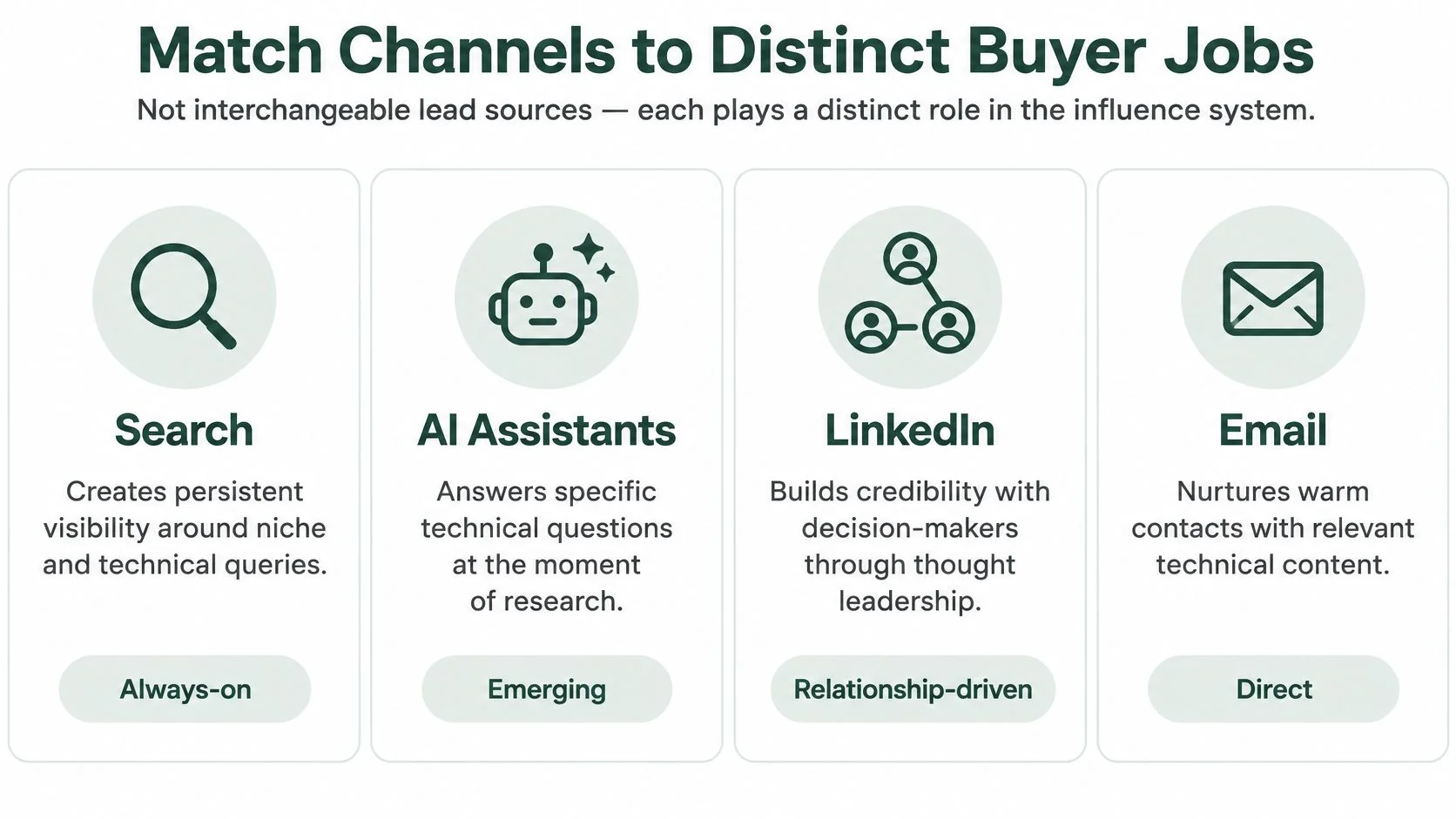
| Channel | Buyer job it supports | Signal worth tracking | What it should feed |
|---|---|---|---|
| Search | Find useful answers to a niche or technical problem | Relevant queries, branded search, engagement from target accounts | Recognition and evaluation |
| AI assistants | Get concise answers, compare options, build a shortlist | Accurate brand mentions or citations, then account-level validation where observable | Discovery and shortlist inclusion |
| Assess people, expertise, and relevance to a role | Engagement from named accounts and relevant buying-group members | Familiarity and informed sales follow-up | |
| Outbound | Start a direct conversation with an account | Replies and meetings interpreted alongside prior account evidence | Qualification and opportunity progression |
AI visibility can’t be equated with an opportunity. Still, agencies shouldn’t ignore it: G2’s 2025 survey of 1,169 B2B decision-makers found nearly eight in ten respondents said AI search had changed how they research, while 29% started research through large language models more often than Google (G2’s 2025 AI buying research).
The operational mistake is scoring every channel by leads. Search may show category presence without producing an immediate form fill; LinkedIn may help an account recognize a specialist; outbound may earn the final reply. Sales should record the evidence it can verify, including the buyer’s stated problem and material already reviewed, rather than claiming certainty about anonymous exposure.
Budget decisions should follow channel purpose and downstream account quality. If search attracts visitors outside the agency’s target niche, more traffic won’t solve the pipeline problem. If outbound gets replies but few qualified opportunities, examine the targeting and proof before increasing volume.
Apply Full-Funnel Tactics to Your Agency
The execution test is whether each tactic helps a specific account answer a real question. Demand Gen Report’s 2024 coverage of PathFactory’s benchmark reported that time spent on blogs fell 23%, while buyers increasingly favored clear insights, immediate answers, and actionable solutions (Demand Gen Report’s coverage of the PathFactory benchmark). That’s a reason to prioritize useful depth over a publishing schedule built around generic topics.
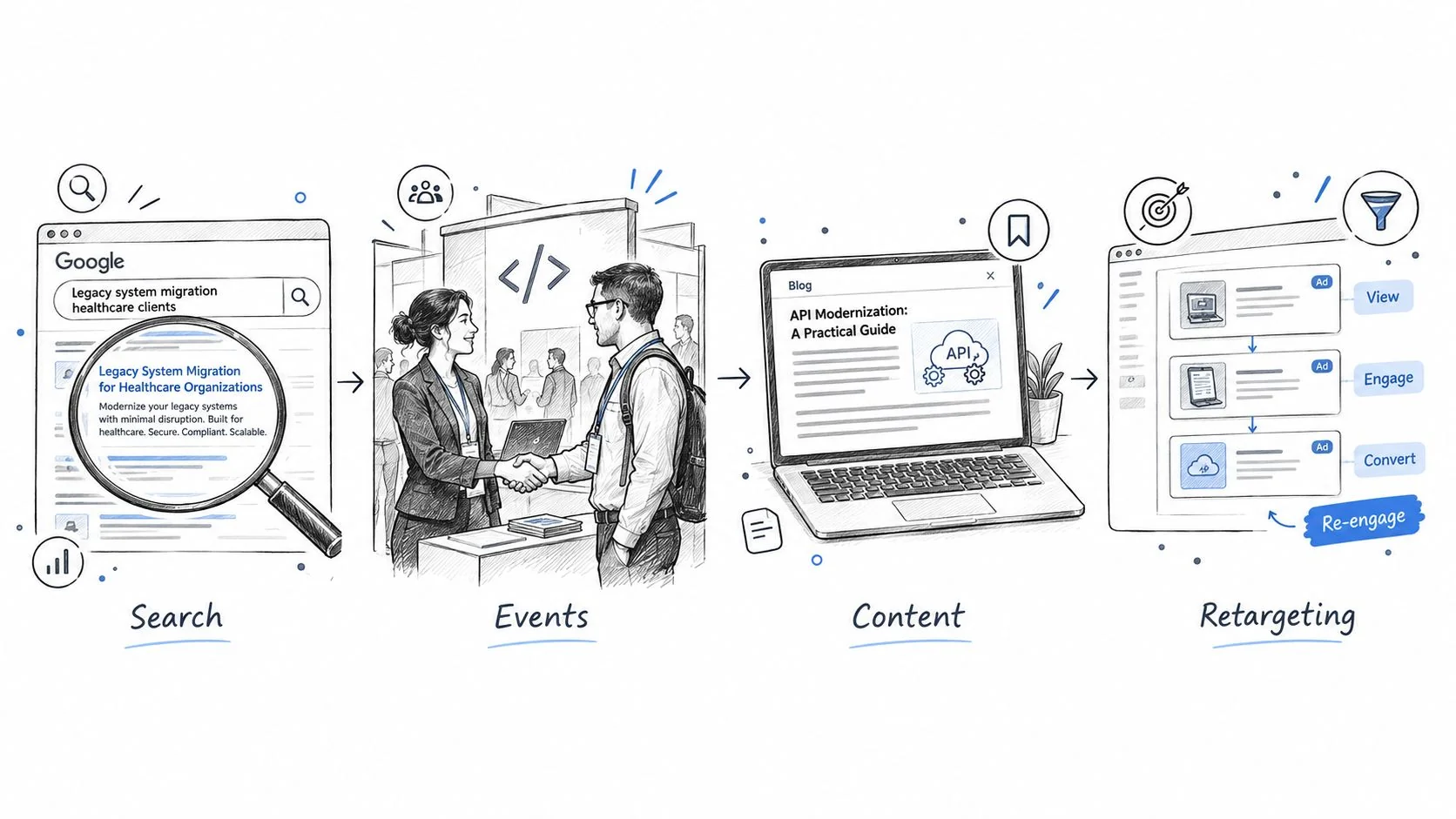
Search: Build a page around a specific industry problem, such as integrating a legacy claims platform with newer services. Explain the constraints, decisions, and delivery risks. Judge it by relevant search visibility and evidence that target accounts engage, not by visits alone. The failure mode is broad traffic that doesn’t match the agency’s niche.
AI assistants: Publish clear, consistent explanations of the agency’s specialization, technical approach, and relevant proof. Make expertise easy to verify across the agency site and credible third-party sources. Then record observable citations and mentions as market-influence signals, not attributed revenue. The failure mode is reporting AI visibility without connecting it to identifiable account activity.
For sales and marketing, the practical test is whether an asset gives a particular role evidence it can use. A CTO needs technical fit; a commercial sponsor needs clarity on delivery and business impact. A lead generation guide for software agencies can help connect asset choices to the next sales action.
LinkedIn: Map content to people in the buying group. A founder can explain a technical tradeoff, while delivery leaders address implementation risk. Track engagement from relevant accounts and roles, then give sales the context for a useful follow-up. A founder-only stream of general service announcements is unlikely to supply that account-level evidence.
Outbound: Reference a relevant niche problem and any known interaction, then offer a useful point of view rather than treating the account as untouched. Sales should capture the response, the buyer’s role, and the evidence needed for the next step. Cold messaging that ignores prior research can make an agency look unfamiliar even when its material has already shaped the buyer’s evaluation.
The video below adds context on coordinating marketing activity across stages.
Measure Pipeline Without Misattributing Influence
A defensible measurement system joins what the agency can observe without pretending every anonymous exposure can be tied to a closed deal. Preserve source, campaign, content asset, account, contact, opportunity, and revenue identifiers as records become known. Google’s attribution guidance describes assigning credit across ads, clicks, and other interactions, and recommends capturing the customer journey and integrating CRM information with analytics (Google Analytics attribution guidance).
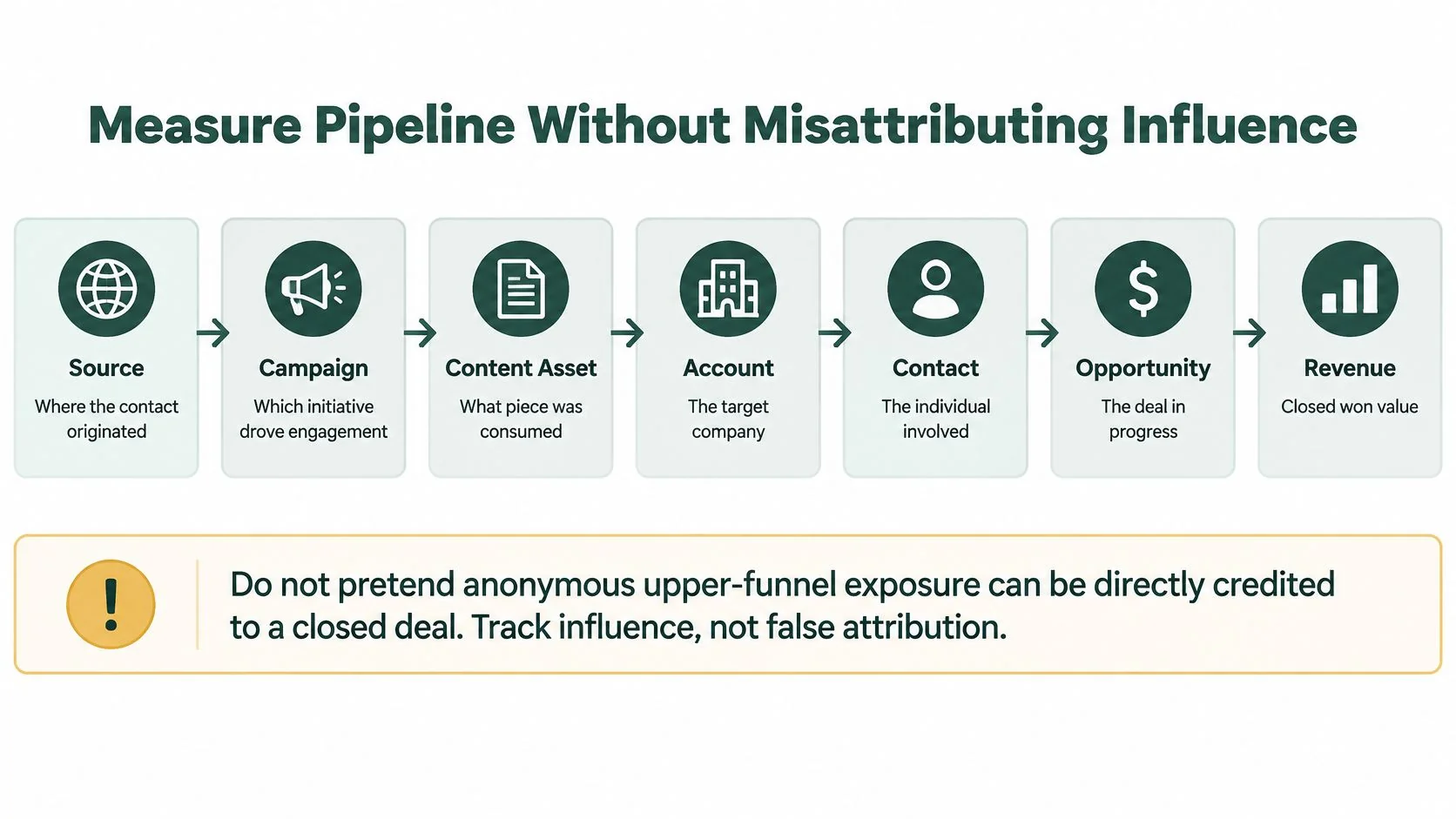
Separate influence signals from commercial outcomes. Branded search, direct traffic, AI citations, and target-account engagement can indicate market presence. High-intent actions and participation across a buying group can signal evaluation. Opportunities, win rate, cycle duration, pipeline velocity, revenue, retention, and referrals show commercial performance, but don’t reveal a perfect chain of cause and effect.
| Review stage | Leading indicator | Business outcome | Review cadence |
|---|---|---|---|
| Market presence | Niche visibility, branded search, account engagement | More target accounts entering evaluation | Monthly |
| Evaluation | Repeat visits, technical-content engagement, buying-group activity | Qualified opportunities and stronger opportunity quality | Monthly |
| Commercial | Meetings, proposals, stage progression | Win rate, pipeline velocity, revenue | Monthly |
| Customer lifecycle | Delivery proof, customer advocacy, expansion discussions | Retention, expansion, referrals | Monthly |
Last-click reporting gives the final form or reply the credit and can hide earlier recognition. Google’s attribution document describes position-based modeling as a way to assign credit to both early awareness and later conversion interactions. It also cites Nielsen research reporting a 70% ROI increase when brands added upper-funnel activity to existing mid-funnel campaigns (Google’s attribution modeling overview). Treat that finding as evidence for evaluating coordinated activity, not as a forecast for an individual agency.
Measurement rule: Compare more than one attribution approach over a consistent lookback window, then check whether the account evidence aligns with opportunity creation and closed revenue.
For a practical introduction to attribution tradeoffs, see Come Together Media’s attribution guide. In the monthly review, marketing and sales should discuss what signals appeared, what progressed, and what remains unobservable, rather than debating whether one channel “owns” the deal.
Align Marketing and Sales Around Accounts
6sense’s 2024 Buyer Experience Report found buyers were nearly 70% through the purchasing process before engaging a seller, initiated first contact more than 80% of the time, and had an average buying cycle of 11.3 months (6sense’s buyer experience report announcement). For an agency, that makes account-level coordination a working requirement: sales may enter after much of the research has already happened.
Use a recurring account review to compare target accounts with recent activity. Marketing can bring search and content engagement; sales can add known stakeholder roles, conversations, objections, and opportunity status. Together, they can identify where the account lacks proof, whether a follow-up is timely, and which material supports the next decision.
The evidence has to fit the role. A CTO may need architecture and delivery details. A security reviewer needs relevant controls. Procurement needs commercial clarity, while a business sponsor needs to understand the operational case. A single generic capability deck rarely covers every concern; sales feedback should tell marketing which missing evidence to build.
Quarterly focus: Choose a defensible niche, then build coverage across its problems, buyer roles, and evaluation questions instead of spreading authority across unrelated services.
Budget reviews should distinguish presence, evaluation, and commercial progression. Increase investment where the evidence shows that the right accounts engage and move toward qualified opportunities; revise the channel or asset where activity is disconnected from account quality. Post-sale reviews then feed delivery proof, expansion conversations, and referrals back into the system.
An account-based marketing breakdown can help teams frame shared account ownership without reducing the work to a list of target logos. An agency that repeatedly appears in niche search, AI answers, LinkedIn, third-party validation, and relevant outreach has more chances to enter a shortlist before a salesperson arrives. For software agency leaders, that is the point of full-funnel marketing: turn niche authority into account recognition, and account recognition into qualified pipeline.
Ask 100Signals for a free positioning scan to identify where your agency is visible in its niche and where buyers may be missing evidence before vendor selection.