Voila Norbert Email Finder: Honest Take for Dev Agencies
Voila Norbert email finder, evaluated for software development agencies: coverage rates, pricing, integrations, and whether it still earns a seat
Independent tests put Voila Norbert’s email find-rate at roughly 17% to 30%, while its public marketing highlights an up to 98% success rate. For a dev agency, that gap means Norbert is a filtering and enrichment tool, not a dependable source of broad net-new contact coverage.
Voila Norbert is a single-purpose email finder and verifier. It works best when you already know a prospect’s full name and company domain, then need a work address that can survive basic deliverability checks. That narrow job still has value for a software development agency building authority in one niche, but only when the agency measures cost per usable contact and qualified meeting, rather than the number of searches completed.
The product has been active since 2014, according to independent company-profile data from Tracxn. It entered the category before prospecting platforms bundled databases, intent signals, enrichment, sequencing, and CRM workflows into one product. That history explains both its appeal and its limitations.
What Voila Norbert Is and Why Agencies Still Test It
Voila Norbert’s reported find-rate sits between 17% and 30%, while its marketing cites an up to 98% success rate. These measures describe different stages. The lower range reflects how often a lookup produces a usable email from a tested list. The higher figure concerns the addresses returned after the system identifies them, as documented in the independent Voila Norbert review and benchmark summary. For an agency, the practical question is therefore not whether Norbert can resolve every prospect, but whether its successful matches justify another tool in the workflow.
Norbert is a single-purpose email finder and verifier. Its primary input is a person’s first name, last name, and company domain, and its output is a business email with a confidence signal. A separate verification product and published API let an agency connect the tool to a spreadsheet, CRM, or custom enrichment process without adopting a full prospecting database.
That narrow design explains its continued testing. An agency can purchase usage without committing to a broad bundled platform, keep account research in its existing tools, and separate contact resolution from verification. For a team that owns a well-defined niche, this may cost less operationally than maintaining unused contact data and extra workflow features.
Operational reading: Norbert merits consideration when the agency already has target accounts and named prospects. It is a lookup layer, not the agency’s primary source of accounts, intent, or buyer context.
The tradeoff is structural. Norbert does not center on LinkedIn-only prospecting, buying-intent signals, or broad enrichment. It cannot identify a CTO whose company is actively replacing a development partner, or generate a niche account list from market criteria alone. It returns contact data, not the business reason that makes outreach relevant.
That distinction should guide how you assess any agency lead generation guide. A niche agency still has to select the right accounts, understand their operating problems, and build recognition before outreach. Norbert can handle the final contact-resolution task. It cannot create the positioning, account strategy, or evidence needed to make a cold message credible.
How Voila Norbert Actually Finds an Email
Norbert’s workflow has two operational stages: discovery first, verification second. Confusing those stages is the fastest way to overestimate coverage.
Stage one starts with identity data
The finder needs a full name and a corporate domain. A company name may help with disambiguation, but it doesn’t replace the domain. If the input is only a LinkedIn profile, a job title, or a company name without a domain, the standard lookup is missing information it expects.
The system can test likely address patterns against the company’s known email conventions. Common patterns include combinations such as a first name and last name, an initial with a surname, or a first name with a surname initial. It can also compare the prospect against available business records. The result is a candidate address, not automatic proof that the person still uses the mailbox.
Domain configuration creates a hard failure point. A catch-all domain may accept messages for unknown addresses, making a positive server response less useful. A domain without functioning mail records can also prevent a meaningful verification result. Those aren’t copywriting problems or workflow problems. They’re limits in what the receiving domain reveals.
Stage two tests the returned address
Voila Norbert describes a multi-step verification sequence that includes deduplication, syntax validation, domain and mail-server checks, catch-all detection, freemail flagging, gibberish filtering, and SMTP authentication, as documented in its public email-finding and verification explanation.
The confidence score belongs to the address returned from that process. It doesn’t measure how many sources Norbert searched or how difficult the prospect was to resolve. A high score says the candidate matches available signals strongly. It doesn’t guarantee that the employee is still at the company or that the mailbox will accept a message when you send it.
For agencies collecting contacts through forms, events, or manual research, a separate email capture for outbound marketing workflow can provide the identity inputs Norbert needs. That creates a clear handoff: capture the person and account first, resolve the address second, then verify again before sending.
Accuracy, Find-Rate, and What 98% Really Means
The headline 98% accuracy describes returned addresses, not coverage. That distinction matters because a tool can validate a high share of the addresses it finds while resolving only a modest share of the names and domains submitted.
A 2,500-contact benchmark reported 29.9% valid emails, while other summarized tests placed Voila Norbert’s find-rate between 17% and 30%. The benchmark analysis of Voila Norbert’s performance documents those results. For an agency, the operational consequence is clear: many input rows produce no usable address, even when returned addresses pass a strong verification process.
Marketed vs. Benchmarked Accuracy
| Metric | Voila Norbert Marketing | Independent Benchmark | What It Actually Measures |
|---|---|---|---|
| Returned-address quality | Up to 98% | Not directly equivalent | Whether an address Norbert returns passes its quality process |
| Find-rate | Not represented by the 98% figure | 17% to 30% across summarized tests | How many name-and-domain inputs produce a valid email |
| 2,500-contact test | Not represented by the 98% figure | 29.9% valid emails | Coverage on one independently tested contact list |
| Operational role | Discovery plus filtering | Modest discovery coverage | Useful for known contacts, weak as a complete prospect database |
For a dev agency, the starting list determines whether this narrow tool earns its place. A carefully researched list of CTOs and engineering leaders gives Norbert specific names and domains to resolve. Incomplete account data creates a different workload: the agency processes blanks, then needs another source to identify decision-makers.
Norbert fits a list-enrichment and hygiene layer, not a high-coverage discovery database. That position suits an agency with a defined niche and a tightly selected account list. The team can accept incomplete resolution when the contacts that resolve are well qualified. A broad outbound motion cannot rely on the same coverage.
The distinction also changes how the team handles returned records. A confidence score reflects the strength of discovery signals, not proof that the mailbox remains active. Export the results, verify them again, remove duplicates, and create the CRM or sequence record only after that review. This ordering limits wasted credits and keeps unresolved source-list problems from entering the outbound system. Norbert is therefore a single-purpose legacy tool inside a market built around bundled prospecting stacks. Its modest find-rate can still justify a role, but only after the agency supplies the niche, names, and domains that the product does not discover well on its own.
The Standalone Verifier and Why a Second Pass Still Matters
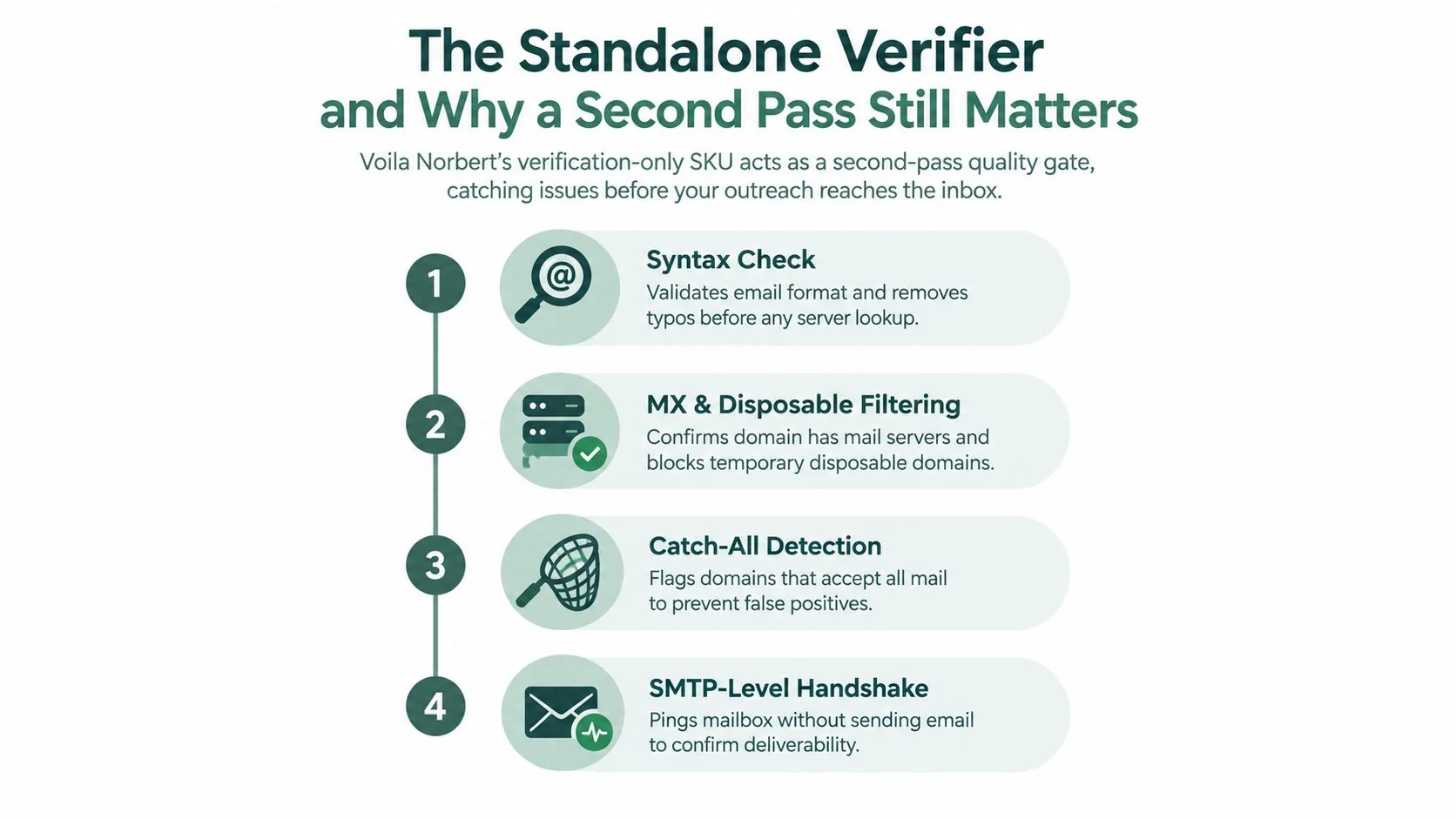
Voila Norbert separates verification from prospecting and prices the verifier as a pay-as-you-go product. Its published process includes deduplication, syntax validation, domain and MX checks, catch-all detection, freemail flagging, gibberish filtering, and SMTP authentication, according to the technical review of the Voila Norbert verification workflow.
Structural checks aren’t mailbox proof
Syntax validation catches malformed addresses. Domain and mail-server checks establish whether the domain appears configured to receive mail. Catch-all detection identifies a domain that may accept any address, which prevents a server response from being treated as strong evidence. SMTP authentication can provide a deeper signal when the receiving server permits that interaction.
Those checks answer different questions. An address can have correct syntax, sit on a functioning domain, and still belong to an inactive mailbox. A server can also restrict confirmation requests, leaving the verifier with an uncertain result rather than a definitive answer.
Practical rule: Treat a green verification result as a risk filter, never as proof that an email will reach a human inbox.
A second pass can catch changes that occurred after discovery, duplicate records, and ambiguous catch-all outcomes. Teams that already use NeverBounce or ZeroBounce may reasonably keep one of those services as the final gate, but the point isn’t that a named verifier guarantees delivery. The point is that discovery and send-readiness are separate control points.
For CRM hygiene, the same discipline applies before records enter multiple systems. Agencies that need to fix duplicates in Salesforce and HubSpot should clean identity fields before enrichment, not after two platforms have created competing records. A valid email attached to the wrong person is still a pipeline defect.
The 100Signals email deliverability guidance fits the same operating principle. Validate the address close to the sending event, preserve the verification status and date, and prevent uncertain records from entering automated sequences.
Agency Workflow and Per-Contact Economics
A practical agency motion starts with a defined account list, not with Norbert. For example, the RevOps owner can assemble 500 target CTOs and engineering directors across selected software accounts, collect each person’s first name, last name, and company domain, then submit only those rows to Norbert.
The workflow should remain deliberately boring:
- Target accounts: Build the niche account list outside Norbert.
- Identity inputs: Confirm the person and corporate domain before lookup.
- Enrichment: Use Norbert to resolve available work emails and add its confidence signal.
- Export: Keep unresolved, catch-all, and uncertain rows separate.
- Verification: Run a second validation pass before CRM import.
- Activation: Push accepted contacts into HubSpot or Pipedrive, then use Instantly or Smartlead for sequencing if those tools already govern sending.
Norbert’s verification price is published at $0.003 per email, falling to $0.001 per email above 500,000 emails, according to the Voila Norbert pricing page. Its enrichment product is priced at $0.04 per email, with the highest listed scale reaching $0.015 per email, as shown on the published enrichment pricing page.
What the cost table can and can’t prove
| Step | Tool | Unit Cost | Cost per Contact |
|---|---|---|---|
| Email discovery | Voila Norbert | Not stated in the verified data | Must be confirmed in the current Norbert plan |
| Verification | Voila Norbert | $0.003 per email | $0.003 at the published standard rate |
| High-volume verification | Voila Norbert | $0.001 per email above 500,000 emails | $0.001 at that published scale |
| Enrichment | Voila Norbert | $0.04 per email | $0.04 at the published rate |
| Higher-scale enrichment | Voila Norbert | $0.015 per email at the highest listed scale | $0.015 at that published scale |
| SDR review | Internal team | Agency-specific | Calculate from loaded labor cost and time per row |
| CRM acceptance | HubSpot or Pipedrive | Agency-specific | Include only contacts that pass the second verification gate |
The requested “bulk 1,000-credit tier” comparison can’t be stated responsibly from the verified data because the available sources don’t provide its price. Don’t fill that gap with a guessed rate. Pull the current checkout price, then calculate two ratios: total tool spend divided by accepted CRM contacts, and total tool plus labor spend divided by qualified meetings.
For a niche agency targeting 1,500 qualified contacts per quarter, raw lookup volume is the wrong success metric. If the niche list is small but highly relevant, incomplete resolution may be acceptable. If the agency needs broad coverage, a bundled database may create more accepted records with fewer manual handoffs. The right decision follows from the agency’s target account quality, not from the cheapest visible credit.
Where Voila Norbert Wins, Where It Loses
Voila Norbert wins when the agency wants a narrow component that can be budgeted independently. It doesn’t force the team to adopt a full prospecting database, and its verification product can sit beside an existing CRM and sending stack. That separation is useful for agencies with technical RevOps teams that prefer composable workflows over a single vendor owning every stage.
Its main weakness is coverage. The independent benchmark range described earlier places returned-email coverage well below what a broad discovery platform must deliver for volume prospecting. Norbert also requires the team to bring identity information, so a LinkedIn-native motion or an account search based on intent has to happen elsewhere.
Comparison against broader platforms
| Criterion | Voila Norbert | Hunter | Apollo | Snov.io |
|---|---|---|---|---|
| Domain-to-email coverage | Strongest when name and domain are already known, with modest independent find-rate results | Suited to domain and name lookups | Broader database-led prospecting workflow | Finder, enrichment, verification, and outreach in one platform |
| LinkedIn-driven discovery | Not a fit for LinkedIn-only workflows | Better suited when paired with known profile or domain data | Built around broader prospecting and LinkedIn-related workflows | Supports a more integrated prospecting motion |
| Billing clarity | Separate finder, verification, and enrichment cost centers | Product scope is centered on finding and verification | Bundled platform economics can be harder to isolate | Bundled workflow reduces handoffs but mixes usage |
| Privacy posture | Requires careful governance because the agency supplies identity data | Requires the same source and consent review | Broader data operations require broader governance | Integrated outreach increases the need for clear process controls |
| API maturity | A practical fit for custom enrichment workflows | Useful for domain-led workflows | Better suited to teams wanting database and sequencing together | Useful when the agency wants one platform for prospecting and outreach |
| Buying intent | Not provided | Not the core product role | More suitable for broader sales intelligence workflows | More suitable than Norbert only when the bundled features match the motion |
Norbert’s predictable usage model and clean handoff can beat a bundled platform for a small, curated list. It loses when the agency needs LinkedIn triggers, buyer signals, phone data, sequencing, or database search in one operating surface. The apparent simplicity becomes manual work if the team has to stitch together account research, enrichment, verification, CRM import, and outreach.
Before choosing, use a grounded resource to compare B2B prospecting platforms, then run the same agency-owned test list through each shortlisted tool. Don’t compare homepage claims. Compare resolved contacts, accepted contacts after verification, and qualified meetings created from the same niche.
CEO test: If Norbert saves license cost but adds enough research and cleanup time to slow account coverage, the software is cheaper and the outbound motion is more expensive.
When Voila Norbert Belongs in an Agency Outbound Stack
For a 100 to 500 person software development agency, the defensible recommendation is to keep Norbert only when the agency controls the upstream data and accepts a second verification layer. A narrow niche can make that arrangement practical. The team may know its target accounts, already have names from research or inbound conversations, and need a lightweight way to resolve work emails without purchasing a full prospecting stack.
Keep it when the agency’s quarterly list is curated, the sales team works primarily from Gmail or Outlook, and LinkedIn triggers aren’t central to qualification. In that environment, Norbert is a component, not the strategy. The agency’s advantage comes from account selection, technical credibility, and a message tied to a specific delivery problem.
Replace it when the workflow depends on discovering contacts from LinkedIn, filtering by intent, or activating sequences inside the same platform. Replace it also when the team has consolidated operations around HubSpot Sequences, Apollo, or Clay and the standalone lookup creates another export, another verification state, and another billing system.
Decision Matrix
| Agency Scenario | Verdict | Operational Rationale |
|---|---|---|
| A narrow niche with a carefully researched list | Keep | The team can use Norbert for known name-and-domain lookups without paying for unused database breadth |
| Manual enrichment of a limited quarterly contact set | Keep, with a second verifier | The workflow stays controlled, provided uncertain records don’t enter sequences |
| LinkedIn is the primary prospecting surface | Replace | Norbert’s required inputs and workflow don’t match LinkedIn-only discovery |
| The team needs intent signals and account prioritization | Replace | Norbert returns contact data, not a buying reason or account-level trigger |
| HubSpot, Apollo, or Clay already governs prospecting | Supplement or remove | A fallback role is defensible only for contacts that fail to resolve through the primary system |
| Volume expands beyond the agency’s ability to review records | Replace | Manual handoffs create operational cost that the standalone price doesn’t show |
| Privacy-sensitive outbound in major markets | Keep only with governance | Document the source, purpose, verification status, and suppression process before activation |
The strongest compromise is to run Norbert behind a primary prospecting database. Send it only the contacts that fail elsewhere, cap usage by niche and account tier, and track cost per enriched contact, cost per qualified meeting, and internal review time. That preserves its utility without pretending it can replace a modern prospecting stack.
Pipeline math should decide the seat. If Norbert resolves enough high-fit contacts to create meetings from a niche where the agency has credible authority, it earns its place. If it produces a thin list that forces SDRs to compensate with more research, the agency should spend the same budget on better discovery and stronger positioning.
If your agency is deciding whether Voila Norbert belongs in a niche outbound motion, start with a sample of your own target accounts, record the input rows, returned addresses, second-pass approvals, labor time, and qualified meetings, then compare that result with one bundled alternative. For agencies that want the next step tied to niche validation and defensible positioning, request a free 100Signals positioning scan and use the findings to decide whether your bottleneck is contact resolution, market authority, or account selection.