Scale AI Competitors 2026: 10 Vendors Compared by Fit
10 Scale AI alternatives, compared by fit: Labelbox, Appen, Sama, and more. Plus who picked up Scale's clients after the 2025 Meta deal.
In June 2025, Meta paid $14.3 billion for a 49% stake in Scale AI and hired its CEO, Alexandr Wang, to lead a new superintelligence lab. Within days, Google, Scale’s largest customer at roughly a $200 million annual contract, announced it was severing ties. Microsoft, xAI, and OpenAI followed. Scale laid off 14% of its staff the following month. The concern behind the defections was neutrality: clients sharing proprietary training data and model roadmaps with Scale could no longer be confident that data stayed away from Meta’s competing AI teams.
That event made Scale AI alternatives a live topic in AI services for 2026. It also made vendor selection a strategy question, not a procurement formality. For a dev agency positioning around AI delivery, your data partner choice signals what kind of firm you are. If you sell “enterprise healthcare AI” and your data partner can’t support auditability, domain review, or secure deployment, your positioning collapses the first time a buyer asks how your training pipeline works. Read this list as a go-to-market filter. The right partner reinforces what you’re trying to own in a market. The wrong one just helps you finish a project.
Scale posted roughly $870M in revenue in 2024, exiting the year at a $1.5B annualized run rate, built on a global workforce of around 240,000 people across Kenya, the Philippines, and Venezuela through its Remotasks subsidiary. The disruption that followed matters more for 2026 than those numbers.
The 2026 disruption: who is winning Scale’s defectors
Before the platform-by-platform comparison, three vendors are worth naming directly. They are the primary beneficiaries of the post-Meta exodus, and they don’t fit neatly into the established platform/service framework the rest of this list uses.
Surge AI: bootstrapped since 2020, Surge posted over $1 billion in 2024 revenue, outpacing Scale for the year. It runs on a vetted expert-contractor model (roughly 50,000 specialists, 130 full-time employees), has been profitable since launch, and initiated its first external capital raise in July 2025 at a reported $15B-$25B valuation. Surge’s pitch is precision over volume, which makes it a natural option for frontier AI labs that need an independent vendor.
Mercor: a contractor marketplace connecting AI labs with expert annotators. Mercor hit roughly $450M in annualized run rate by mid-2025 and fielded unsolicited offers valuing it at $10B (up from $2B in February 2025). Scale sued Mercor for trade-secret misappropriation in September 2025.
Turing: $300M ARR, profitable on $225M raised. CEO Jonathan Siddharth’s line after the Meta deal: “neutrality is no longer optional, it’s essential.” That framing suits any independent player in the category.
If you’re building authority in AI delivery, neutrality is now a vendor criterion you can articulate to clients. “We work with data partners operating without the conflicts that now complicate Scale’s relationships” is a specific, defensible market message, not a generic quality claim.
A different kind of vendor check
Every profile above turns on one question: who controls the data. Buyers ask the same question about your firm.
Picking a data partner from this list means checking who touches the data, who reviews it, and what a client hears if they ask how the pipeline works. Buyers evaluating a software development agency can run a version of that same check, except they ask ChatGPT and Gemini instead of a vendor questionnaire. We are not a data vendor. We run AI visibility scans on software development agencies, and the free 100Signals Scan shows what those tools currently say about yours: whether you show up, who gets recommended instead, and why.
Run the free scan ->Free. No call. If we find nothing useful, we say so.
1. Labelbox
Labelbox is the cleanest pick if you want to sell a governed AI delivery system, not just annotation labor. An expert comparison describes Labelbox as serving enterprise teams with 10,000+ domain experts in its Scale AI alternatives analysis. That matters because buyers in regulated or high-stakes domains want more than a labeler. They ask who owns workflow control, review logic, and evaluation.
If your agency wants to build authority around a vertical such as industrial vision, insurance document AI, or clinical imaging support, Labelbox gives you a better story than a labor-only vendor. You can show clients a system: annotation, review, model-assisted workflows, evaluation, permissions, and deployment controls.
Why it matters for niche authority
A niche agency wins by making its process legible. Labelbox helps with that because it fits an operating model where your team defines ontology, review thresholds, escalation paths, and model-in-the-loop feedback. That’s stronger positioning than saying you “work with an external labeling provider.”
Practical rule: If your sales pitch includes governance, QA, or MLOps maturity, choose a platform-centered partner. Otherwise your delivery model and market message won’t match.
Use Labelbox when your commercial strategy depends on showing structured delivery maturity to enterprise buyers. Skip it if you only need temporary throughput and don’t want platform adoption friction. For agencies building thought leadership around repeatable AI operations, this is the strongest fit, and it pairs well with disciplined competitive intelligence practice.
Visit Labelbox.
2. Appen

Appen is the right choice when your niche depends on language breadth, regional coverage, or large-volume human data operations. In the same expert comparison cited earlier, Appen is described as a high-volume multilingual crowd network with 1M+ contributors. That makes Appen useful for agencies selling multilingual search, voice, support automation, or global LLM evaluation programs.
Appen suits agencies that need to look operationally credible at scale. If your pitch is “we can run multilingual evaluations, collection, and annotation across markets without rebuilding ops every quarter,” Appen supports that.
Where agencies get this wrong
Agencies often treat Scale AI alternatives as interchangeable labeling shops, but Appen’s value is operational reach. That helps if your agency wants to own a niche where breadth itself is a differentiator, such as localization-heavy AI systems or trust-and-safety programs across many languages.
A narrower vertical specialist may beat Appen on domain intimacy. But Appen is stronger when your authority comes from handling distributed, messy, multilingual workloads that smaller vendors can’t organize cleanly.
- Best fit: Agencies selling multilingual AI services, global search relevance work, or enterprise content operations
- Weak fit: Agencies whose niche authority depends on a highly branded proprietary workflow inside one regulated subdomain
If your agency is trying to become visible for AI consulting in a crowded market, your delivery model has to support the promise your positioning makes. That’s where a broad-coverage vendor helps reinforce AI visibility for AI consultancies, rather than undermining it.
Visit Appen.
3. TELUS International (AI Data Solutions)
TELUS is the enterprise procurement answer. If your agency wants to win programs where the client’s vendor management team, legal team, and security team all have veto power, TELUS is a serious option. It’s built for organizations that need managed data operations, validation, and testing under a mature delivery wrapper.
That matters for agencies because large clients rarely buy “annotation.” They buy a risk-managed operating partner. TELUS helps when your go-to-market motion targets big accounts that expect formal QA, compliance review, and large-scale delivery discipline from the first call.
Why this matters for pipeline
A lot of agencies want enterprise logos but still run vendor selection like a startup. That mismatch shows up in due diligence. TELUS is useful when your niche positioning depends on buyer confidence in program continuity, process control, and organizational depth.
Buyers don’t reward technical ambition alone. They reward vendors that can survive procurement.
Choose TELUS if your target accounts are enterprise buyers who want a named service layer and formal operating controls. Don’t choose it if your niche strategy relies on speed, experimentation, and lightweight deployment. The tradeoff is obvious. You gain procurement credibility and lose some agility.
Visit TELUS AI Data Solutions.
4. Sama
Sama is a strong fit if your agency sells precision and managed quality, especially in computer vision and validation-heavy work. It suits agencies that want to say, truthfully, “we don’t outsource judgment to an undifferentiated crowd.” That’s a stronger niche position than generic “we build AI solutions.”
The reason Sama earns a place in this comparison is its service posture. You buy a managed process with explicit QA orientation. A blank platform leaves your team to build the reliable factory on its own. That’s useful when your agency’s authority depends on repeatable output quality more than workflow customization.
Recommended use case
Pick Sama if your agency is building a reputation in manufacturing vision, retail image QA, or other categories where bad labels become obvious business failures later. In these niches, your brand improves when your delivery partner is conservative and process-heavy.
Avoid Sama if your strategy depends on tooling ownership or if you want clients to see your agency’s own platform-centric operating model. Sama supports authority built on quality assurance. It does less for authority built on proprietary infrastructure.
- Use Sama when: Your niche promise is quality control, validation discipline, and managed execution
- Avoid Sama when: Your niche promise is custom workflow software and direct platform ownership
Visit Sama.
5. iMerit
iMerit is one of the clearest alternatives if your agency wants to own a high-stakes vertical. Market-intelligence coverage cited from apistemic names iMerit among Scale AI’s rivals and positions it around high-quality data services for computer vision, NLP, and content workflows in its Scale AI market landscape. That maps well to agencies trying to become known for specialized delivery instead of broad AI services.
If your target niche is healthcare, autonomous systems, or document-heavy enterprise workflows, iMerit is easier to align with than a generalist high-volume crowd model. It lets you talk about domain-specific quality control without sounding like you’re improvising.
Why niche agencies should care
This is the core agency question: are you building authority around expertise, or around throughput? iMerit supports expertise-led positioning. That’s valuable because niche authority comes from showing judgment, process rigor, and familiarity with domain edge cases.
Agencies often lose deals by sounding broad and operationally vague. iMerit helps if your delivery story needs specialized teams, configurable workflows, and human review for hard cases. It’s weaker if your market message is “we can label anything at commodity scale.”
If your niche involves auditability, edge-case handling, or regulated review, don’t buy a commodity workforce and hope process fills the gap.
Visit iMerit.
6. Hive (thehive.ai)
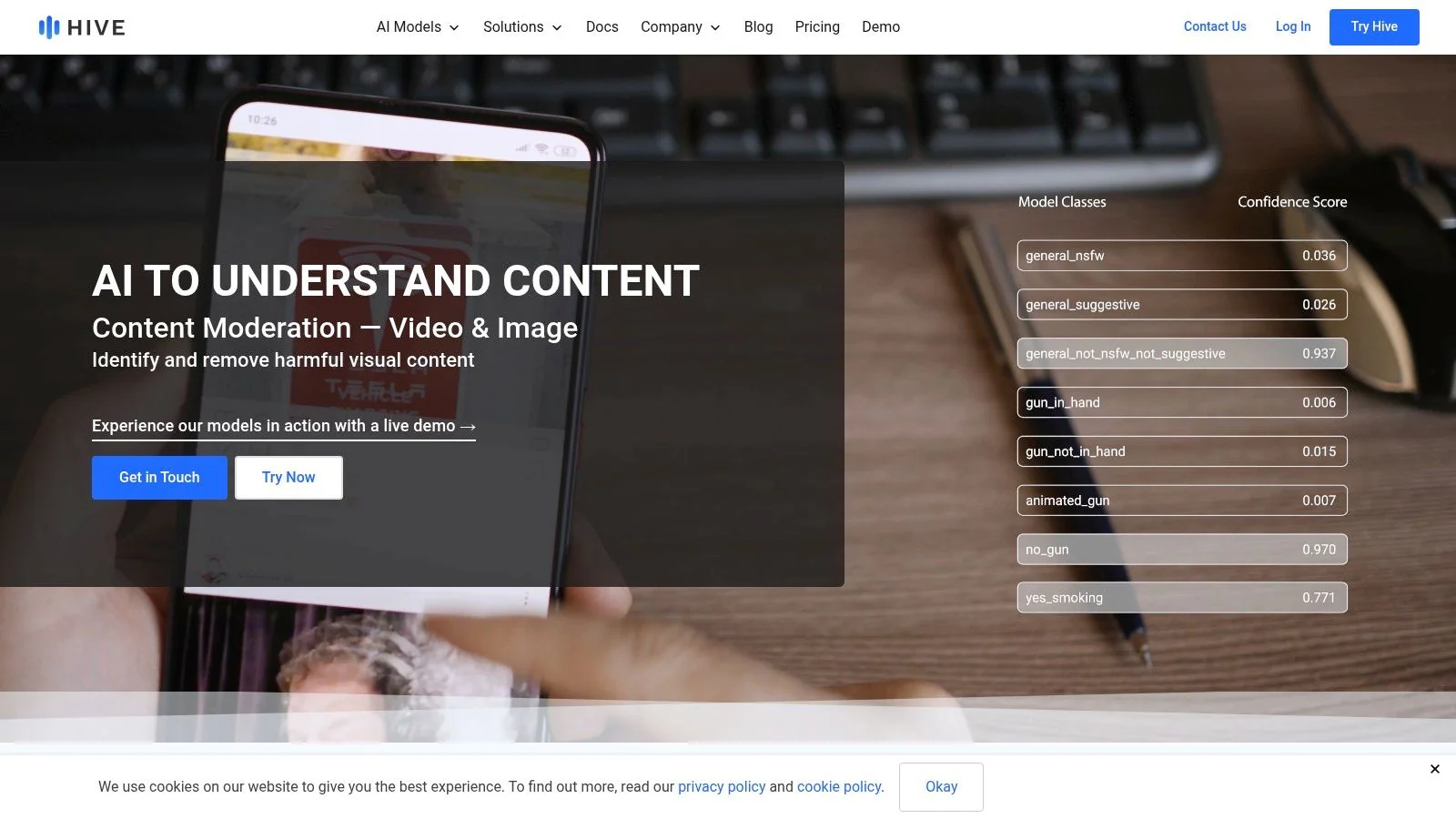
Hive is the practical choice when you want both data services and production-ready model capability in the same commercial conversation. That combination matters for agencies building authority around moderation, content understanding, and fast deployment use cases. Buyers in those categories often care less about abstract annotation sophistication and more about time to operational value.
That makes Hive useful for agencies selling applied AI systems rather than pure model-development support. If your niche is trust and safety, marketplace moderation, or media classification, a vendor that combines labeling with hosted AI APIs can tighten your pitch.
The partnership model advantage
An agency can use Hive to present a shorter path from pilot to production. That’s commercially useful. The pitch becomes “we can help you operationalize classification and moderation workflows with fewer vendor handoffs,” not “we’ll prepare data.”
The tradeoff is strategic. Hive is best when your authority comes from solution delivery speed and operationalization. It is less useful if your firm wants to foreground its own proprietary annotation methodology as the differentiator.
- Strong fit: Agencies selling moderation stacks, media operations, or content policy tooling
- Weak fit: Agencies whose authority depends on fully bespoke human-data processes
Visit Hive.
7. Toloka
Toloka is the flexible option for agencies that haven’t decided whether they want self-serve control, managed support, or both. That flexibility matters if your niche is still hardening and you need to test where you want to sit in the value chain. Early in a specialization, that’s often the right call.
Toloka is especially relevant for LLM-focused agencies. It supports pipelines for preference data, evaluations, and related human-data tasks. If your sales motion is built around iterative tuning, red-teaming, or multi-language evaluation, Toloka maps better than a vision-first managed vendor.
Why this matters for niche development
Agencies usually overcommit too early. They pick a vendor that forces them into either full-service outsourcing or full tooling ownership before they’ve learned what clients in the niche buy. Toloka gives more room to evolve your operating model while still looking credible in front of discerning buyers.
That makes it a good bridge vendor. You can use managed workflows when you need delivery help, then shift toward more direct control as your niche playbook gets sharper. For a CEO, that protects optionality while your positioning matures.
Visit Toloka.
8. Defined.ai
Defined.ai is the best fit when your niche authority depends on data acquisition speed and multilingual speech or text coverage. Unlike vendors that center the entire pitch on annotation operations, Defined.ai offers a marketplace orientation plus commissioned data services. That changes your commercial posture.
If your agency sells voice AI, speech evaluation, conversational systems, or multilingual dataset work, marketplace access can help you move faster in presales and pilots. Speed matters because niche authority compounds when you can publish results, demos, and client examples sooner.
The go-to-market implication
Agencies often overlook lead time as a positioning variable. Authority comes from outcomes and also from how quickly you can demonstrate competence in a live niche. A marketplace-oriented partner can reduce the delay between “we want to enter this vertical” and “we have something credible to show.”
Use Defined.ai when fast access to multilingual or speech-related data supports your offer design. Skip it if your niche relies on bespoke managed annotation workflows where marketplace inventory is secondary.
The fastest agency to produce niche proof often becomes the agency buyers remember first.
Visit Defined.ai.
9. DataForce by TransPerfect
DataForce is the language-services answer. If your agency’s niche sits near localization, relevance, multilingual search, conversational AI, or e-commerce content operations, DataForce gives you a more coherent story than a generic annotation vendor. That’s because the parent company context matters. You’re buying a workflow partner shaped by language operations, not labeling labor.
This matters for pipeline because agencies selling international or multilingual AI systems need credibility beyond model talk. Buyers want to know who handles regional variation, language nuance, transcription quality, and localization workflows.
Recommended positioning use
DataForce works best when your agency wants to own a specialization at the intersection of AI and language operations. That includes cross-market search quality, multilingual chatbot tuning, and customer support automation with localization demands.
It’s a weaker fit for agencies that need highly visible self-serve platform control as part of their pitch. The value here is managed execution plus program management, not productized annotation software that clients can tour in a demo.
Visit DataForce.
10. Label Studio (Heartex / HumanSignal)
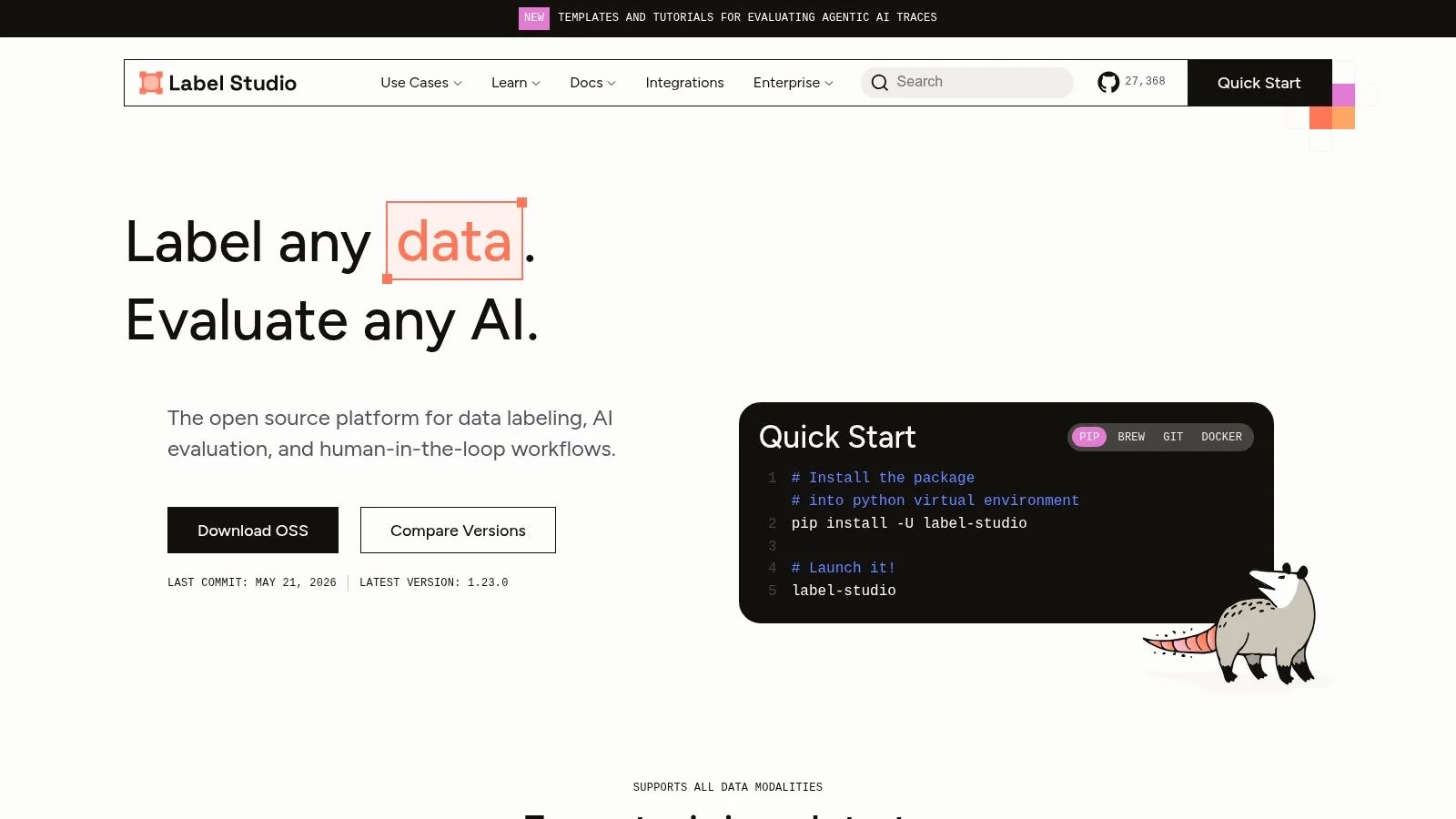
Label Studio is the right answer if your agency wants ownership, self-hosting, and minimal vendor lock-in. For CEOs building a niche around secure delivery, private environments, or custom data workflows, that can be a commercial advantage. Clients in sensitive environments often respond well when you can say the tooling can live inside their stack.
This is also the most credible option if your authority strategy depends on showing engineering depth. You assemble the operating model rather than outsourcing it. That can support a strong market position in sectors where buyers value control over convenience.
The hard truth
Label Studio is tooling, not labor. That’s the point. It works when your agency wants to own the workflow, bring its own reviewers, or integrate annotation into a broader proprietary delivery system.
A separate industry commentary makes the strategic split clear. The market has divided into managed human-data providers and tooling-first annotation platforms, and the fundamental buyer question is whether a team should buy labeled data, labeling infrastructure, or expert operations, as argued in this analysis of alignment-as-a-service and human data vendors. If your niche authority comes from process ownership and governance design, Label Studio is one of the strongest ways to make that visible.
Visit Label Studio.
Scale AI Competitors, 10-Company Comparison
| Vendor | Key features | Delivery model & scale | Best fit / target use cases | Pricing & contract model | Notable USP |
|---|---|---|---|---|---|
| Labelbox | Annotation across image/video/text/audio; model-in-the-loop; programmatic workflows; SDKs/APIs | Platform-first with managed labeling option; enterprise-ready governance | Teams needing end-to-end platform + governance and MLOps integration | Pricing not public; enterprise deals via sales | Mature governance, clear enterprise scaling path |
| Appen | Large-scale collection & annotation; LLM SFT/RLHF & evaluations; broad language coverage | Managed, global contributor network; enterprise delivery ops | LLM training, multilingual programs, regulated industries | Variable; typically scoping calls / custom quotes | Extremely broad language & regional coverage at scale |
| TELUS International (AI Data Solutions) | Full-stack: collection, 3D/AV, validation, model testing; QA automation | Enterprise-scale (billions of annotations); 500+ languages; strong ops tooling | Safety / Trust & Safety, autonomous vehicles, large multimodal programs | Custom SOWs; not self-serve | Analyst-recognized, operational tooling for large, secure programs |
| Sama | End-to-end annotation with strict QA playbooks; generative AI eval & synthetic data | Fully managed services with enterprise onboarding and QA workflows | High-precision CV and generative-AI evaluation in regulated contexts | No public pricing; sales engagement required | Emphasis on instruction quality and continuous QA to reduce rework |
| iMerit | Domain-specialized teams; LiDAR, medical imaging, sensor fusion; automation+human | Managed services for complex domains; configurable workflows | High-stakes domains (AV, healthcare, vision-language) needing auditability | Enterprise SOWs; pricing undisclosed | Deep domain expertise and rigorous process/auditability |
| Hive (thehive.ai) | High-volume labeling; hosted models & APIs for moderation and understanding | Combines off-the-shelf models + managed labeling; large global workforce | Content moderation, rapid high-volume delivery, production models | Model API pricing public; labeling quotes via sales | Blend of data services with ready-to-use models to shorten time-to-value |
| Toloka | Self-serve & managed pipelines for SFT/RLHF/evaluations; automated QA; 40+ languages | Flexible marketplace: self-serve or managed; automated QA tools and assistant | Multi-language LLM work, evaluations, rapid iterative pipelines | Detailed pricing gated or in-product; some quoting | Flexible deployment modes and AI-assisted pipeline config |
| Defined.ai | Marketplace + commissioned datasets; strong multilingual speech coverage; SLAs | Off-the-shelf datasets plus custom commissioned pipelines via proprietary crowd | Speech and multilingual datasets; teams wanting faster dataset procurement | Tiered dataset plans for some products; bespoke work via SOW | Marketplace model reduces lead time; quality SLAs on commissioned data |
| DataForce by TransPerfect | Annotation, transcription, localization, chatbot/data labeling via DataForce platform | Managed enterprise programs leveraging global language services & PM | E‑commerce, search/relevance, conversational AI, localization | SOW-based pricing; limited self-serve | Global language services footprint with program management expertise |
| Label Studio (Heartex / HumanSignal) | Open-source annotation tool; templates for multiple modalities; APIs | OSS community edition + paid Cloud/Enterprise; self-hosting and on‑prem options | Teams wanting rapid prototyping, self-hosting, strict data governance | OSS free; paid Cloud/Enterprise tiers for QA/governance features | Avoids vendor lock-in; fast to try and integrate into existing MLOps |
From Vendor Selection to Niche Ownership
For an agency CEO, features matter less than what your vendor choice lets you claim, prove, and repeat in a market you want to own.
A service-first vendor helps you deliver quickly. That’s useful, but it doesn’t automatically build defensible authority. If the partner relationship is opaque, your client sees execution but not method. You finish the project, but you don’t create a visible operating advantage you can reuse in sales. That’s why agencies that want category authority usually do better with one of two approaches. Either pick a specialized managed partner that reinforces a vertical promise, such as iMerit for domain-heavy workflows, or pick a platform-centered option like Labelbox or Label Studio that lets your agency expose more of its process.
A second distinction matters even more. An industry summary of the space notes a split between managed human-data providers and tooling-first annotation platforms, and it frames the core buyer choice as whether to buy labeled data, labeling infrastructure, or expert operations. That framing is useful for agencies because each path creates a different go-to-market identity. Managed providers make you look like an orchestrator of outcomes. Tooling-first partners make you look like an owner of systems. Expert operations partners make you look like a vertical specialist.
A few direct recommendations make the selection simpler.
- Choose Labelbox: when your niche strategy depends on demonstrating workflow maturity, governance, and enterprise-readiness.
- Choose Appen or DataForce: when multilingual breadth and operational scale are central to your sales narrative.
- Choose iMerit or Sama: when your market position depends on quality control and domain-specific review.
- Choose Label Studio: when control, self-hosting, and anti-lock-in are part of your offer.
- Choose Toloka: when your niche is still emerging and you need flexibility before standardizing your operating model.
Your data partner affects what case studies you can publish, what enterprise objections you can answer, and how credible your niche specialization sounds when buyers compare firms. That means vendor selection shapes pipeline. The agencies that win turn delivery choices into proof of authority, then use that proof to become the obvious option in one tightly defined vertical.
If you’re not sure which niche to pursue or how your positioning reads to buyers today, the free 100Signals Scan shows you where your agency has market visibility and one recommended next step.
Frequently Asked Questions
Who are the top Scale AI alternatives in 2026? The most widely evaluated platforms include Labelbox, Appen, TELUS International, Sama, iMerit, Hive, Toloka, Defined.ai, DataForce, and Label Studio. Surge AI, Mercor, and Turing are three independents picking up business from customers that left Scale after Meta’s 49% stake acquisition in June 2025.
Why did companies leave Scale AI? Meta’s $14.3 billion investment for a 49% stake (June 2025) raised conflict-of-interest concerns. Companies sharing proprietary training data with Scale worried that data could reach Meta’s AI teams. Google, Microsoft, xAI, and OpenAI all began reducing or ending Scale contracts within days of the deal. Scale subsequently laid off 14% of its staff.
Is Surge AI bigger than Scale AI? By 2024 revenue, yes. Surge posted over $1 billion in 2024 against Scale’s roughly $870 million, despite being bootstrapped with no external capital until July 2025. Surge operates on a vetted expert-contractor model and has been profitable since its 2020 launch.
Which data-labeling vendor should a dev agency choose? It depends on your niche promise. If your authority depends on governance and enterprise MLOps, start with Labelbox. Multilingual or speech coverage points to Appen or DataForce. Quality control in a regulated vertical points to iMerit or Sama. Platform ownership and anti-lock-in points to Label Studio. The decision shapes what case studies you can publish and what enterprise objections you can credibly answer.
Related on 100Signals
- AI Visibility for AI Consultancies: How AI consultancies build authority in search, LLM citations, and AI Overviews before buyers start comparing vendors.
- Positioning for Software Development Companies: How to claim a defensible niche in a market being reshaped by AI and commoditized delivery.
- Demand Generation for Software Development Companies: Turn niche authority into a repeatable pipeline that does not depend on referrals or founder hustle.
- What Is Competitive Intelligence for Dev Agencies?: How to use public signals to identify market opportunities before competitors act on them.