Outsource B2B Lead Generation: How to Vet Partners and Set KPIs That Matter
Should you outsource B2B lead generation? A no-fluff guide for heads of growth at software dev agencies: how to evaluate partners, avoid common traps, and set KPIs tied to revenue, not activity.
You’ve already tried outsourcing lead gen. Maybe an appointment-setter who booked meetings with companies three tiers below your ICP. Maybe a cold email agency that promised 30 qualified opportunities per month and delivered a CRM full of strangers. Maybe you spent six months and $40K before pulling the plug.
Before trying again, work out what you missed.
TL;DR
- Outsourcing only works when positioning is already clear. A partner cannot fix a vague value proposition.
- Three partner types exist: appointment setters, data brokers, full-service demand gen. Most agencies need the third.
- Vet on process and data exclusivity, not pitch quality or SDR headcount.
- Tie contracts to accepted meetings and sourced pipeline, not MQLs or email opens.
- Keep positioning, offer strategy, and sales judgment internal. Outsource execution layers only.
Most agencies miss the real problem, which is buying motion without a market position, not outsourcing itself. You can’t pay a vendor to generate qualified pipeline if you haven’t defined what “qualified” means in the context of a specific niche, a specific buyer, and a specific problem you actually solve.
Fix that first. Then outsourcing works.
What is outsourced B2B lead generation? Outsourced B2B lead generation is the practice of engaging a specialist partner to identify, research, and contact target accounts on behalf of a company, with the goal of generating sales-qualified conversations. For software development agencies, this includes prospecting, outbound sequencing, and account research. It does not replace positioning, messaging strategy, or sales judgment. Those stay internal.
When Outsourcing Makes Sense (and When It Doesn’t)
Outsourcing works when execution capacity is the bottleneck, not positioning clarity. Agencies that can name their niche, their buyer, and what qualifies a meeting are ready. Agencies that can’t will amplify confusion, not pipeline. Hinge’s 2026 High Growth Study found high-growth firms invest 12% of revenue in marketing vs. 5% for no-growth firms, a gap that compounds across every deal cycle.
Most agencies outsource for the wrong reason. They outsource because pipeline is thin and they want someone else to fix it. That’s a fast path to wasted money.
Outsourcing makes sense in one situation: your pipeline is constrained by execution capacity, not by unclear positioning. If you know your niche, you know your buyer, and your messaging holds up in sales conversations, a specialist partner can accelerate what you’ve already validated.
If any of those three are still unclear, an outside partner will just amplify the confusion. They’ll generate activity around a vague value proposition and call it qualified.
A readiness check before you sign anything
Answer these five questions. If you can’t answer them cleanly, don’t outsource yet.
| Question | Weak answer | Strong answer |
|---|---|---|
| What is our exact niche? | ”Mid-market companies that need software” | A specific vertical, buyer type, and service angle |
| What counts as a qualified meeting? | ”Someone who took the call” | Firmographic fit, problem fit, and active project context |
| Where does pipeline currently stall? | ”It’s inconsistent” | A specific handoff, channel, or conversion stage |
| Who owns follow-up after an introduction? | ”Sales will handle it” | Named owner, defined SLA, CRM workflow |
| What happens if quality drops? | ”We’ll review later” | Review cadence, thresholds, and a correction plan |
If you can answer all five, you’re ready. If not, that’s the work to do before you pay for outreach.
What Outsourced Lead Gen Partners Actually Do (and Don’t Do)
Three partner types exist, and most buyers conflate them: appointment setters book meetings without qualifying fit, data brokers sell contact lists without context, and full-service demand gen partners co-build ICP logic and report against pipeline progression. For 80-person dev agencies without in-house outbound ops, only the third category produces qualified pipeline.
| Partner type | What they deliver | Core risk | Best fit |
|---|---|---|---|
| Appointment setter | Meetings booked | Low-intent meetings, brand damage from bad-fit outreach | Companies with strong in-house qualification and high meeting volume |
| Lead data broker | Contact lists | Bad data, non-exclusive records, compliance exposure | Teams with disciplined in-house outbound ops |
| Full-service demand gen partner | Pipeline quality and progression | Misalignment if strategy and reporting stay vague | Agencies building niche authority and repeatable pipeline |
Most 80-person dev agencies don’t have the in-house infrastructure to turn raw contact lists into qualified pipeline. That makes the first two categories risky. The third is what you’re looking for.
A full-service demand gen partner should be able to co-build your ICP, show account-level logic for why a target list makes sense, connect outreach to authority assets your buyer would have seen before contact, and report against pipeline progression, not activity counts.
If a provider leads with volume, tooling, or SDR headcount, they’re selling labor, and labor is not the same thing as pipeline.
How to Vet a Partner Without Getting Sold a Good Pitch
The right vetting questions expose operational reality before the contract is signed. Ask how they define a qualified meeting for your category, whether contact data is exclusive to your account, how they adjust messaging after early market signal, and whether they work with competing agencies in your niche. Vague answers to any of these are disqualifying.
The first call is easy to pass. Vendors are good at sounding credible. The right questions get past the pitch.
Ask these. If the answers are vague, end the process.
| Vetting question | Why it matters | Red flag answer |
|---|---|---|
| How do you define a sales-qualified meeting for agencies like ours? | Forces operational clarity before any contract | ”We optimize for booked calls” |
| What data do you use, and is it exclusive to our account? | Exposes list quality and saturation risk | ”We have a large proprietary database” |
| How do you adjust messaging after early market signal? | Tests whether they have a learning loop | ”We stick to the approved sequence for consistency” |
| How do you integrate with our CRM and pipeline reviews? | Shows whether they’ll operate transparently | ”We send weekly reports” |
| Do you work with competing agencies in our niche or geography? | Determines whether you’re buying a differentiated playbook or the same one your competitor already has | Vague answer or deflection |
If a partner won’t show you their process, KPI definitions, and how they handle bad data, they’re asking you to fund a black box.
One more filter: ask whether they support authority-building before outreach, or whether they focus on direct response only. Agencies that rely on cold outreach alone see reply rates below 1%. Agencies where buyers have seen the brand through search, AI results, or LinkedIn content before contact see materially higher response. A partner who doesn’t understand this distinction is selling a 2018 playbook.
Structuring the Contract to Protect You
Most outsourced engagements fail because contracts are too loose, not because the channel is wrong. Get in writing: an explicit qualified meeting definition, data ownership covering all contact records and messaging assets, review triggers tied to quality thresholds, and transparency rights covering campaign logic and list sources. If a partner resists any of these, the process is weak.
Most outsourced engagements fail because the contract was too loose and onboarding was too thin, not because the channel was wrong.
If your SOW says “lead generation services” and you hand the partner a logo deck and a few case studies, you’ve already lowered the odds. Get these terms in writing before you start.
Qualified meeting definition. Every qualification criterion should be explicit: industry fit, company size, buyer role, problem relevance, and active project context. “Interested prospect” is not a definition.
Data ownership and usage rights. Who owns the contact records, messaging assets, enrichment work, and performance data generated during the engagement? Get this in writing. You want to own all of it.
Review triggers. If meeting quality drops, if outreach drifts from the approved approach, or if CRM hygiene breaks, there should be a formal review and correction process written into the agreement, not left to goodwill.
Transparency requirements. You should have access to campaign logic, list sources, qualification notes, and reporting views. If a partner resists this, assume they’re hiding weak process or weak data.
A practical onboarding sequence
Treat onboarding like integrating a new system into your revenue operations. Inputs, controls, owners, and review cycles have to be explicit.
| Week | What should happen | What you’re testing |
|---|---|---|
| Week 1 | ICP workshop, offer positioning review, CRM access, meeting qualification criteria | Strategic alignment |
| Week 2 | List-building logic, messaging draft review, workflow setup, reporting dashboard agreement | Process integrity |
| Week 3 | Pilot outreach to a narrow segment, call note standards, feedback loop with sales | Signal quality |
| Week 4 | Pipeline review against actual outcomes, not just activity | Commercial relevance |
Non-negotiable: bring the partner into pipeline reviews from week four onward. If they never see what happens after the meeting, they can’t improve what they send you.
When to Use Intent Signals (and How)
Cold outreach to cold accounts produces sub-1% reply rates. Intent-led outreach changes the sequence: detect in-market accounts first, enrich with firmographic and role context, build recognition through niche authority assets, then activate outreach tied to the specific signal. Buyers reply when the email confirms a vendor they’ve already started to recognize.
Cold outreach to cold accounts is the lazy version of demand generation. It still exists because it’s easy to explain. It’s also why many agencies conclude that “outbound doesn’t work” after one bad engagement.
Smarter outreach starts with intent data: find accounts already showing in-market behavior, enrich them, build visible authority where those buyers research vendors, then contact them with context that matches the signal.
The operating order matters:
| Stage | What happens | Why it matters |
|---|---|---|
| Detect intent | Spot accounts researching relevant problems or categories | Outreach lands at a better moment |
| Enrich context | Add firmographics, service fit, buyer role, and likely need | Outreach is specific, not templated |
| Build recognition | Publish niche authority assets buyers can discover | Your agency looks known before contact |
| Activate outreach | Run email, LinkedIn, and call sequences tied to the signal | Conversations start closer to opportunity |
Intent platforms like 6sense or Bombora flag account-level research behavior. LinkedIn shows role-based engagement. Search-facing content and AI citation make your brand recognizable before an outreach email arrives. These aren’t interchangeable: together, they change how the first touch lands.
Buyers reply when the email confirms a vendor they’ve already started to recognize, and rarely because the email was clever.
The KPIs That Actually Tell You If It’s Working
Track five metrics that link outreach to revenue: cost per qualified meeting, meeting-to-opportunity rate, pipeline sourced, opportunity-to-close rate, and payback period. Skip MQLs, email opens, and raw meeting counts as primary metrics. Tie partner compensation or review status to downstream outcomes, not top-of-funnel activity.
If your outsourced partner reports MQLs, opens, clicks, and meetings booked, they’re optimizing a dashboard, not your revenue engine.
Those metrics can be useful diagnostics. They are poor primary success metrics for a software agency with long deal cycles and meaningful deal sizes.
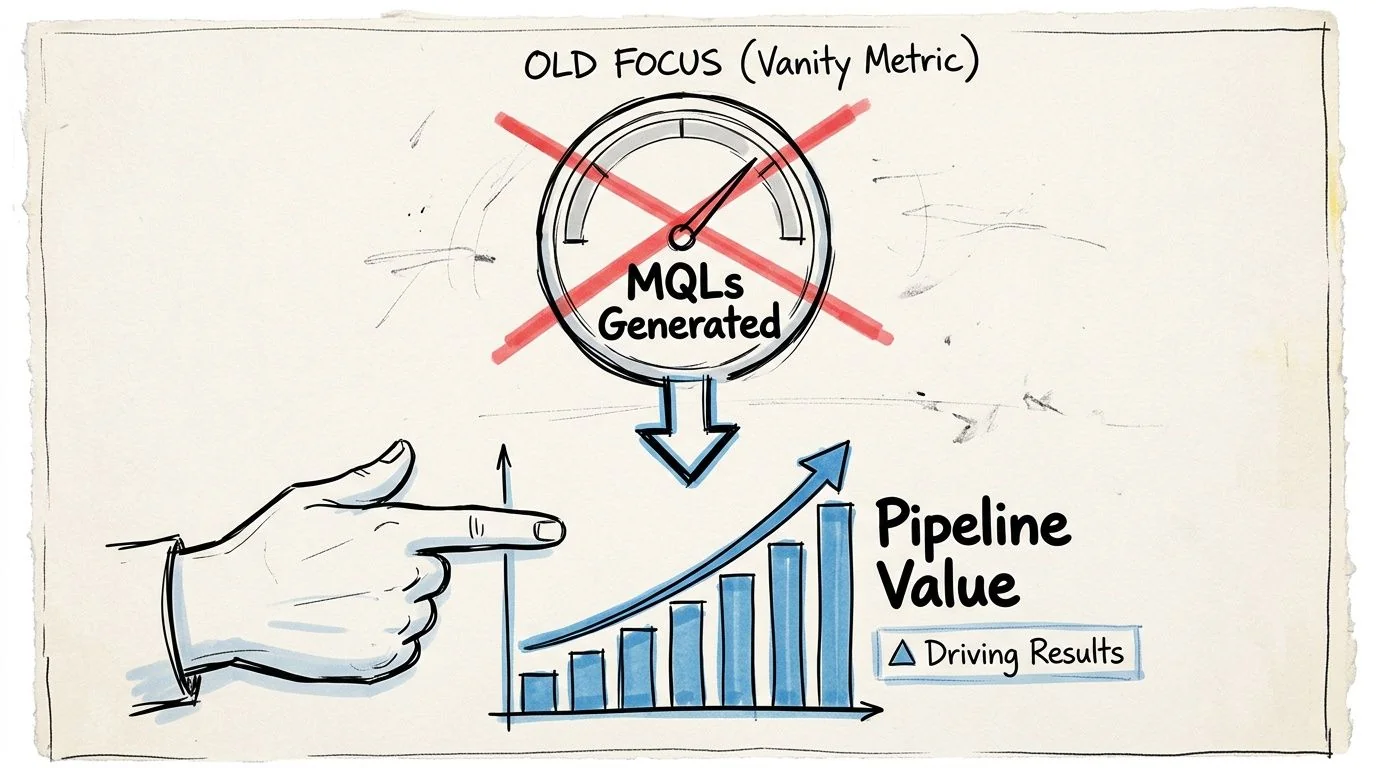
Track only what links outreach to revenue movement.
| KPI | Formula | Why it matters |
|---|---|---|
| Cost per qualified meeting | Total partner cost divided by qualified meetings accepted by sales | Filters out low-fit calendar spam |
| Meeting-to-opportunity rate | Sales-qualified opportunities divided by qualified meetings held | Shows whether targeting and qualification are working |
| Pipeline sourced | Total pipeline value from partner-originated opportunities | Measures commercial contribution |
| Opportunity-to-close rate | Closed deals divided by partner-originated opportunities | Shows downstream fit, not just top-of-funnel activity |
| Payback period | Time for sourced gross profit to cover partner fees | Forces economic discipline |
A weak provider can always boost meeting count by lowering standards: broaden the targeting, relax qualification, incentivize booking anything that breathes. The spreadsheet looks busy, sales loses confidence, and the pipeline gets slower.
Tie compensation or review status to downstream metrics, not top-of-funnel output. If a partner isn’t willing to be measured against accepted meetings and sourced pipeline, that tells you what they think they’re actually selling.
SLA language worth pushing for
- Accepted meeting standard. Sales marks each partner-sourced meeting accepted or rejected within a defined review workflow, with reason codes.
- Opportunity attribution rule. If a qualified meeting creates an opportunity within the agreed attribution window, it counts toward sourced pipeline.
- Remediation trigger. If rejection reasons show recurring mismatch in niche, buyer role, or need, the partner must revise targeting and messaging.
- Review cadence. Weekly campaign review. Monthly pipeline review. Quarterly decision on expansion, revision, or exit.
For more on how to handle lead qualification and pipeline management once meetings are booked, the guide on managing sales leads covers routing, scoring, and nurture in depth.
The Moat Frame: Outsourcing as Capability Design
The right outsourcing model keeps category positioning, offer strategy, and sales judgment internal, and brings in a specialist for execution layers that need dedicated systems. Commodity systems book meetings. Moat systems build preference before the meeting exists through coordinated search visibility, AI citation, LinkedIn presence, and outreach working together.
Treating outsourcing as a delegation move (hand off outreach, save time, maybe lower cost) is too narrow.
The better frame is capability design. What capabilities should stay internal because they define your market point of view, and what capabilities should be supported by a specialist because speed, data quality, and execution precision matter more than ownership?
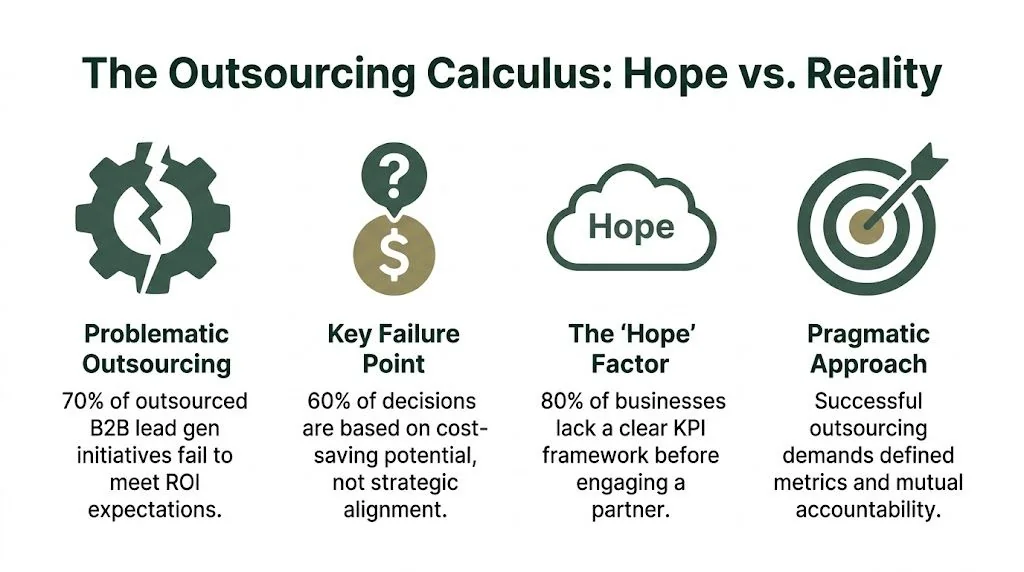
Two failure modes to avoid:
Zero outsourcing. The founder still drives top relationships. Internal marketing posts occasionally on LinkedIn. Outbound happens in bursts when pipeline is thin. The agency stays dependent on inconsistent heroics.
Full dependency. You hand a third party your brand, your list strategy, your first-touch messaging, and your reporting standards. Quality drifts. Control evaporates. By the time you notice, you’ve funded six months of noise.
The right model sits between those: keep category positioning, offer strategy, and sales judgment internal. Bring in a specialist for execution layers that need dedicated systems and repeated learning loops.
A useful comparison across the full outsourcing decision:
| Element | Commodity approach | Moat approach |
|---|---|---|
| Targeting | Broad TAM lists | Narrow niche account maps |
| Messaging | Generic service claims | Problem-specific positioning |
| Visibility | Outreach only | Search, AI, LinkedIn, and outreach working together |
| Data | Shared or opaque records | Vetted signals and tighter fit criteria |
| Governance | Vendor sends reports | Joint pipeline reviews and shared definitions |
The end state you want is a market where your agency gets recognized earlier, shortlisted faster, and compared against fewer real competitors, not more lead gen. That’s what turns outsourced execution into a competitive asset instead of a temporary fix.
For more on where outsourcing fits across the full sales and marketing operating model, this breakdown on sales and marketing outsourcing is useful because it frames the decision as operating model design, not a staffing shortcut.
Frequently Asked Questions
What is outsourced B2B lead generation?
Outsourced B2B lead generation is when a company hires a specialist partner to identify, research, and contact target buyers on their behalf. The goal is to generate sales-qualified conversations, not just contact records or meetings. For software development agencies, this typically means outbound prospecting, account research, and sequenced outreach across email and LinkedIn. A strong partner helps define who to target, not just how to reach them.
When does outsourcing lead generation make sense?
Outsourcing makes sense when execution capacity is the constraint, not positioning clarity. If you know your niche and your buyer, a specialist partner can accelerate what you’ve already validated. If your positioning is still vague, a partner will amplify the confusion. Run the readiness check first: define your niche, your qualified meeting criteria, and who owns follow-up. If you can’t answer those, that’s the work to do before you pay for outreach.
How do I evaluate outsourced lead generation companies?
Ask five questions on the first call: How do you define a qualified meeting for agencies like ours? What data do you use, and is it exclusive? How do you adjust messaging after early signal from the market? How do you integrate with our CRM? Do you work with competing agencies in our niche? Vague answers to any of these are disqualifying. A credible partner shows their process, explains their data sources, and ties reporting to pipeline progression, not activity.
What KPIs should I use for outsourced lead generation?
Skip MQLs, email opens, and raw meeting counts as primary metrics. Track: cost per qualified meeting, meeting-to-opportunity rate, pipeline sourced, opportunity-to-close rate, and payback period. These tie outreach directly to revenue movement. If a partner won’t accept measurement against accepted meetings and sourced pipeline, they’re optimizing a dashboard rather than your revenue.
What should an outsourced lead gen contract include?
At minimum: an explicit definition of what counts as a qualified meeting (in writing, not implied), data ownership language covering all contact records and messaging assets, review triggers that define what happens if quality drops, and transparency requirements giving you access to campaign logic, list sources, and reporting views. If a partner resists any of these, assume they’re protecting a weak process.
How is outsourced lead gen different from just buying leads?
Buying leads means acquiring a list of contacts. Outsourced lead generation means a partner researches, sequences, qualifies, and hands off conversations. The distinction matters because list quality, message quality, and qualification standards all determine whether meetings are worth having. A list of contacts without positioning and qualification produces noise. A demand gen partner who understands your niche and buyer produces pipeline.
If you want to see where your agency stands in terms of niche visibility and discoverability before reaching out to any vendor, run a free 100Signals scan at 100signals.com. It shows how you look across AI search, organic, and intent signals, which is a better starting point than a vendor call.
Related on 100Signals
Lead Generation for Software Development Companies: How dev agencies build repeatable pipeline through niche positioning and coordinated outbound, without buying a generic lead list.
Lead Generation for Consulting Firms: The specific pipeline challenges consulting firms face and how structured outbound paired with authority content changes the economics.
Demand Generation for Software Development Companies: Why demand gen for dev shops looks different from SaaS, and how to build a system that shortens the sales cycle without discounting.
Outbound for IT Companies: A practical look at how IT service firms run outbound that converts: target account selection, sequencing, and what separates response from noise.
Outbound for Consulting Firms: How consulting firms structure outbound around niche credibility rather than volume, and what to measure to know if it’s working.