7 Marketing Company for Manufacturing Options
Compare 7 marketing company for manufacturing options by services, fit, pricing signals, trade-offs, and buyer checks for complex industrial sales.
A marketing company for manufacturing should understand technical products, long buying cycles, multiple stakeholders, channel complexity, and sales enablement. An agency that can produce industrial-looking content but can’t connect buyer research to qualified pipeline is a production vendor, not a revenue partner.
This roundup compares seven agencies by specialist fit, delivery model, published evidence, pricing transparency, and likely implementation trade-offs. A software development agency building manufacturing authority needs a partner that can turn a narrow industrial position into buyer recognition, sales assets, and qualified conversations, without hiding behind traffic or lead-volume metrics. Industrial buyers use multiple media types during vendor evaluation, and research cited by Accenture’s industrial B2B buyer-experience material reports that nearly 90% use at least three. A single-channel agency is therefore a weak fit for a niche software firm selling into complex manufacturers.
Selection standard: Choose the agency whose operating model matches the revenue bottleneck, not the one with the longest service menu.
For broader context on specialist agency selection, see this analysis of top mattress industry ad agencies. The category differs, but the operating principle holds: specialization matters when the buyer, channel, and sales process constrain the work.
1. Gorilla 76 Industrial Marketing Agency
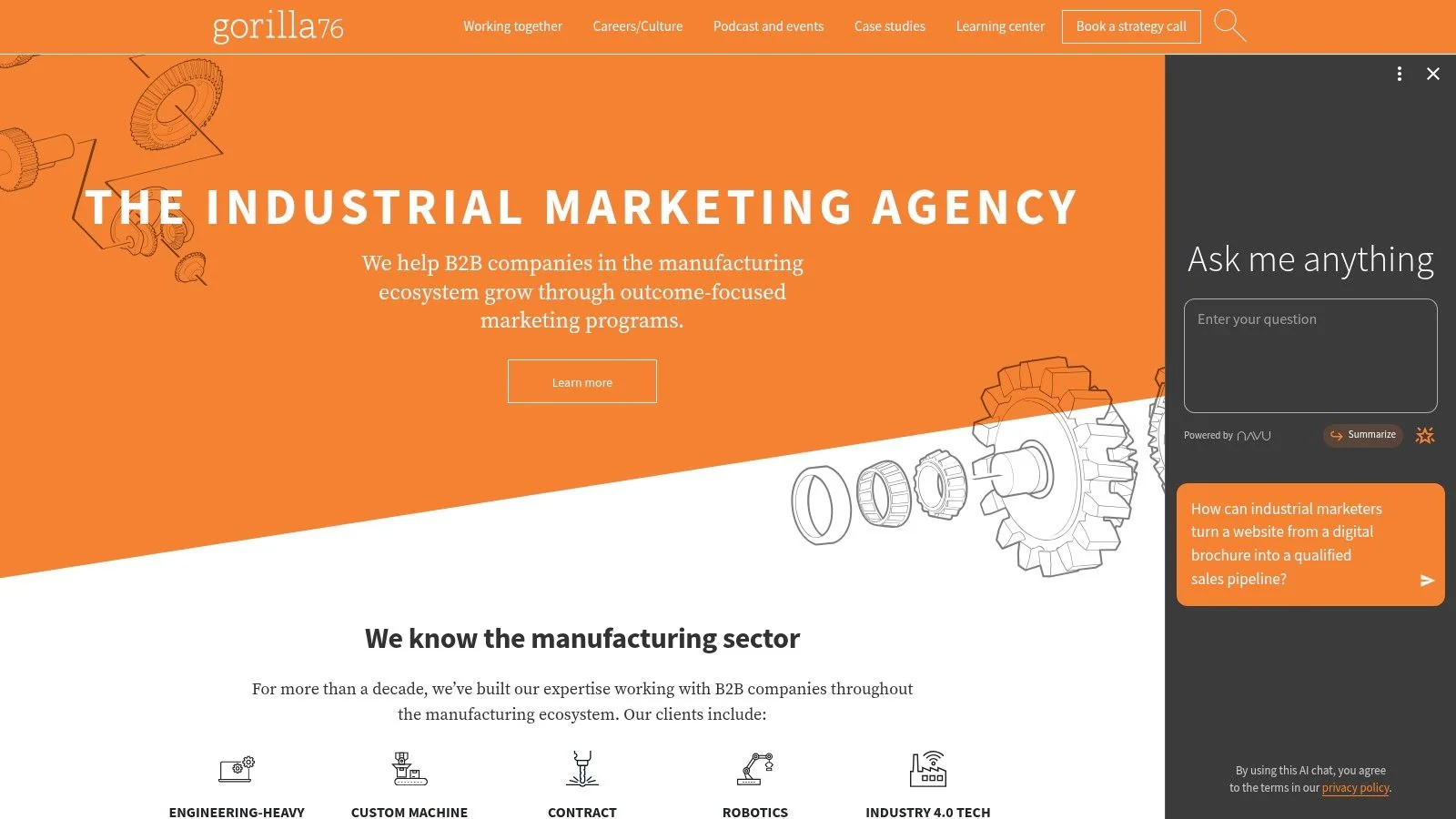
Gorilla 76 is the clearest fit when the problem is industrial niche authority, not general campaign execution. The St. Louis-based boutique works almost exclusively with mid-market manufacturers and engineering-heavy industrial firms, including OEMs, machine builders, contract manufacturers, and systems integrators. Its services cover positioning, technical content, SEO, answer-engine optimization, account-based marketing, and sales enablement.
That mix maps closely to the current manufacturing discovery problem. Industrial marketing coverage from Konstruct Digital describes manufacturers optimizing for generative AI and AI overviews while buyers discover vendors through LinkedIn, AI assistants, and knowledge hubs. A software development agency trying to own a manufacturing vertical needs more than pages about “digital transformation.” It needs expert-led material that answers specific operational and technical questions across those surfaces.
Best fit and trade-off
Gorilla 76’s strongest advantage is its industrial playbook. Its published guidance, Industrial Marketing Collective, and Industrial Marketing Summit give in-house teams a way to learn the category rather than outsource every judgment. The agency also presents case work involving multi-million-dollar pipeline impact for complex CapEx manufacturers, but the published detail is too thin to compare methodology or attribution quality.
The trade-off is capacity and cost visibility. The agency is a boutique specialist, pricing isn’t publicly posted, and a narrow team may impose onboarding windows. That is fine if category credibility is your constraint. It becomes a problem if you need a large parallel program across several regions, product lines, or channel partners.
Practical rule: Ask Gorilla 76 to show how one technical topic becomes search content, AI-readable evidence, an account asset, and a sales enablement document. If the answer stops at blog production, the specialist fit is weaker than the positioning suggests.
For a software development agency, Gorilla 76 makes sense when sales already knows the manufacturing segment it wants and marketing lacks the authority system to support it. It’s less suitable when the first unresolved question is whether the niche itself is commercially defensible.
2. TREW Marketing Marketing to Engineers
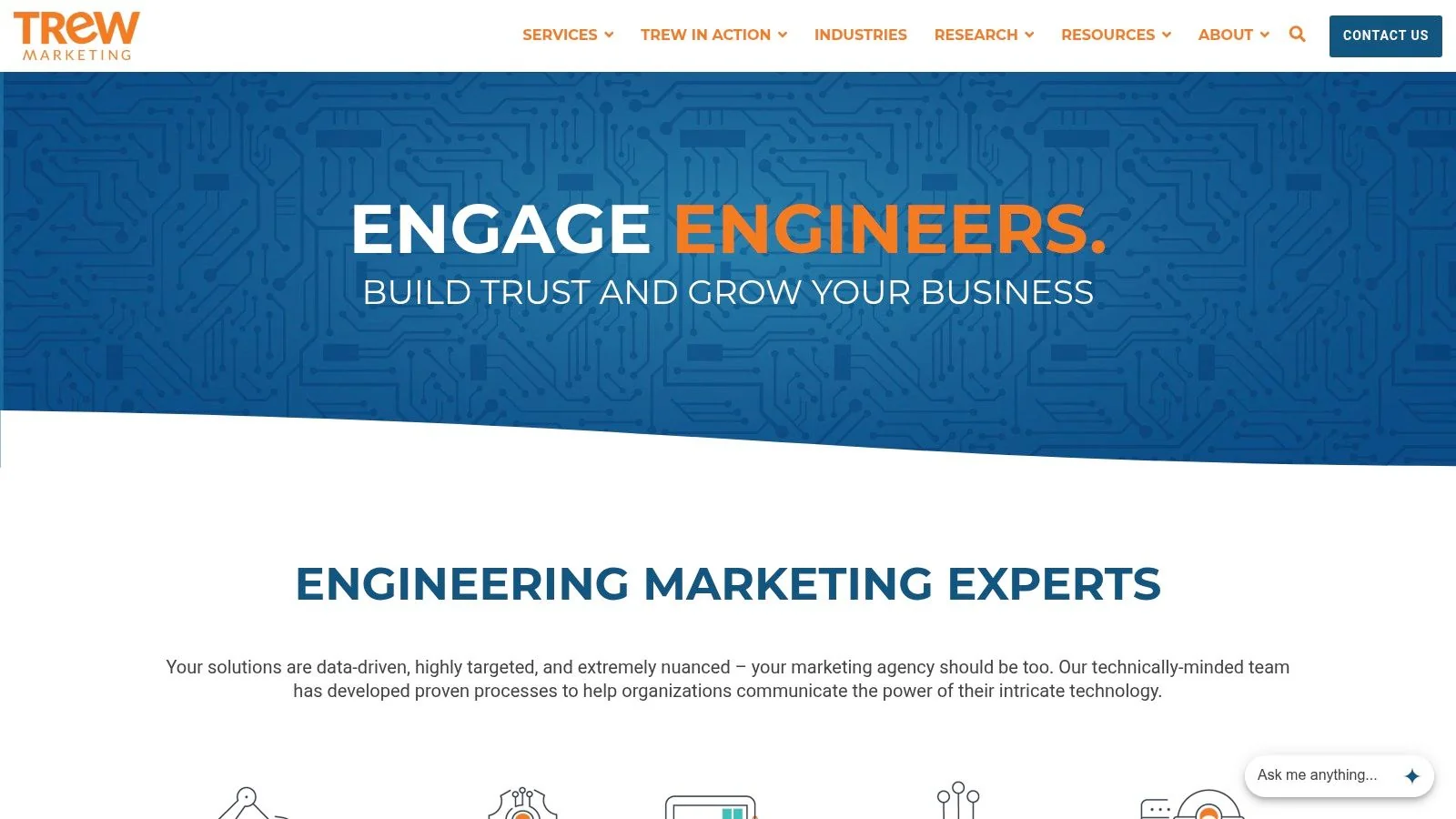
TREW Marketing starts with a different constraint: technical-buyer understanding. The U.S. agency is built around engineers and industrial buyers, and its work includes brand, content, demand programs, research, strategy, and enablement. Its “State of Marketing to Engineers” research is a useful differentiator because it gives the agency a stated basis for choosing channels and content formats.
That matters for a dev agency selling software development into manufacturing because engineering buyers don’t evaluate vendors like general business audiences. The buyer study summarized by Visable reports that 88% want less product specification detail and more explanation of business benefits, while 78% prioritize source trustworthiness. Technical detail still matters. It needs to support a credible business case.
Best fit and trade-off
TREW is a strong match when your team needs customer interviews, research, audits, and a structured content system before committing to a broad retainer. Its fixed-scope quick-start packages and transparent pricing reduce the risk of buying a large program before the agency understands the buyer, technical vocabulary, and approval process.
The downside is focus. TREW is designed for technical and engineering-led markets, so it may be less effective for broad consumer-adjacent industrial companies or manufacturers whose growth depends more on distribution, retail, or field marketing. Research-heavy work can also cost more than a generic content shop because the agency is selling interpretation, not just output.
A software development agency should use TREW when its manufacturing proposition is technically credible but poorly translated for engineers, plant leaders, procurement, or operations executives. The first deliverable should establish which buying roles need which proof. Case studies, technical explainers, and ROI material should support different stages rather than repeat the same product message.
TREW’s model is especially relevant because the same buyer study records that 79% used case studies in the prior 12 months, 71% read blog posts during the buying journey, and 48% still want ROI calculations near decision time. Those figures support a content architecture, not a publishing quota.
3. Godfrey Full-Service B2B for Complex Industries
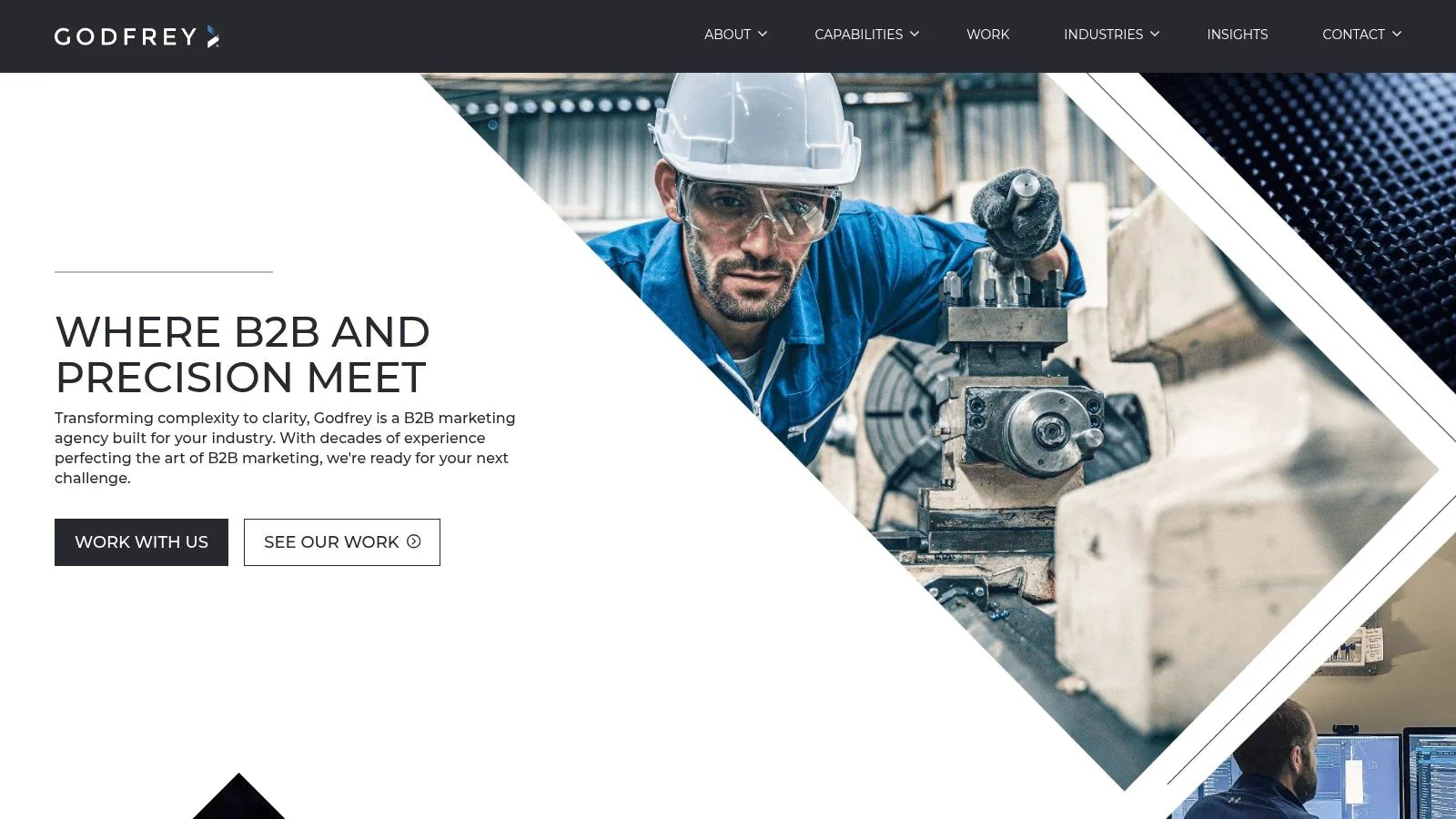
Godfrey solves the enterprise coordination problem. The Pennsylvania-based independent B2B agency has decades of experience across complex industrial categories, including chemicals, building materials, and manufacturing. Its scope spans brand strategy, creative, media, public relations, trade media, demand generation, digital campaigns, and ABM.
That breadth matters when a manufacturer’s pipeline depends on several systems operating together. A technical product may need a new market position, trade publication coverage, account targeting, sales collateral, and digital demand at the same time. Hiring separate specialists can create handoff problems between brand, PR, media, and demand teams. Godfrey’s integrated model is designed to reduce that fragmentation.
Where enterprise scale earns its cost
Godfrey’s trade media work matters in industrial categories where credibility depends partly on third-party context. Its experience with Industry 4.0 and IIoT narratives also gives it a foundation for translating technical subjects into market-facing stories. Multi-stakeholder buying groups benefit when the agency can coordinate executive messaging, technical content, account campaigns, and media activity instead of treating each as an isolated channel.
The cost is scope. Premium full-service agencies usually bring minimums, senior oversight, and processes designed for larger organizations. A 100–500 person software development agency entering manufacturing may not need a complete brand, PR, media, and demand system on day one. It may need a narrow vertical position, a small set of account assets, and a reliable sales handoff.
The useful discovery question is whether Godfrey can assign the right level of enterprise infrastructure to a niche software provider without forcing an enterprise engagement. The agency should also define how trade media exposure, content engagement, account activity, and sales opportunities connect to revenue.
For teams building a broader acquisition system, the agency’s model pairs conceptually with the lead generation approach in our method, but that approach still needs an owner, account definition, and revenue event inside the engagement.
4. Windmill Strategy Industrial Web and Digital Marketing
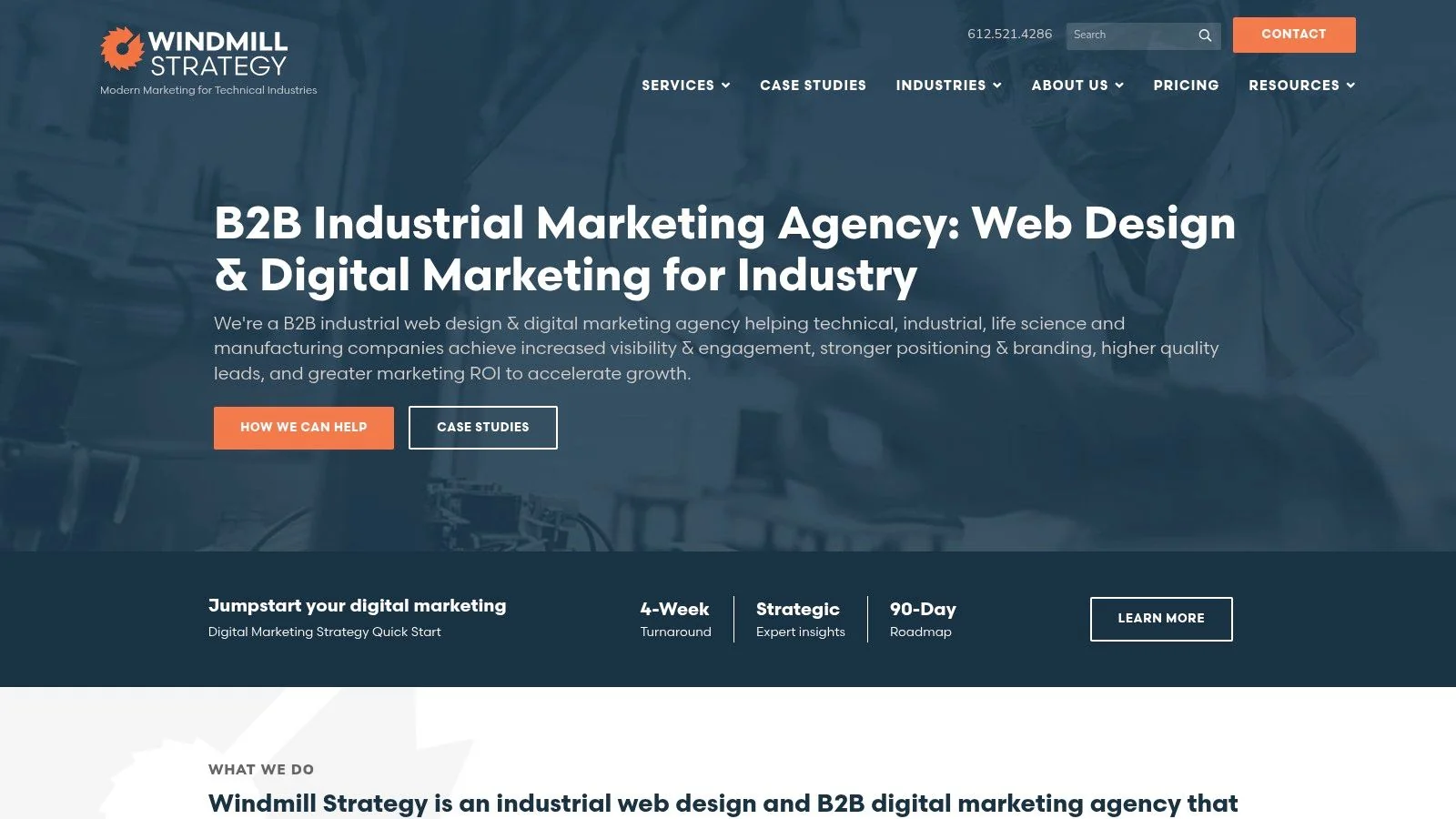
Windmill Strategy is the practical choice when the main bottleneck is website performance. The Minneapolis-based agency works with technical, industrial, and life-science companies and focuses on websites that clarify complex offerings. Its services include industrial website redesigns, UX, SEO, content, paid campaigns, and sales enablement.
That focus matches a market where buyers self-educate before contacting sales. Research cited by RH Blake reports that 81% of buyers already had a shortlist before contacting a vendor, 48% used AI to research suppliers in the past 90 days, and 83% of purchases involved five or more evaluators. A development agency that waits until outreach to explain its manufacturing relevance has already surrendered part of the decision.
Channel coverage beyond the website
Windmill’s advantage is its ability to turn a complicated service or product catalog into a navigable buying experience. For a software development agency, that could mean industry landing pages, application pages, technical service explanations, proof assets, conversion paths, and content structures that help different evaluators find relevant evidence. The agency’s month-to-month model also reduces vendor risk when the website is the first major intervention.
The limitation is channel coverage. A web-led program may need add-on partners for major public relations, trade media, or global ABM. That matters if your manufacturing authority strategy depends on distributor ecosystems or a coordinated enterprise account list rather than inbound discovery alone.
Windmill is strongest when the existing site is confusing, technically thin, or unable to support sales conversations. It’s a weaker choice if the site already converts qualified traffic and the actual constraint is account selection, outbound orchestration, or attribution. Don’t approve a redesign without a page-level plan for buyer roles, proof, internal approval, and sales use.
The agency’s flexible contract structure is useful for testing this hypothesis, but scope-based quoting means the buyer still needs a precise 90-day sequence. Otherwise, month-to-month flexibility can become month-to-month activity without a defined pipeline outcome.
5. Kula Partners Built for B2B Manufacturers
Kula Partners is the strongest option for channel-aware ABM. The North American agency focuses exclusively on manufacturers and industrial brands, combining strategy, account-based marketing, web, and always-on execution. Its work addresses both direct manufacturers and organizations that sell through distributors, representatives, or ecommerce channels.
A manufacturing software offer often sits inside a wider commercial system. The economic buyer may be a manufacturer, but the implementation path can involve a distributor, systems integrator, plant team, procurement function, or external partner. An agency that treats every account as a direct web conversion misses the channel mechanics that shape pipeline.
The account list must reflect the route to revenue
Kula’s manufacturing-only focus should shorten the learning curve around technical and regulated products. Its Industrial Buyer Pulse research and The Kula Ring podcast also give internal teams material for aligning around buyer behavior and digital experience design. That educational layer matters when a software development agency’s sales and delivery teams use different definitions of a “manufacturing account.”
The trade-off is that ABM requires discovery-driven scoping. Pricing isn’t publicly listed, and a program involving websites, account targeting, partner alignment, and always-on execution can become expensive before the account model is proven. Kula is also headquartered in Canada, so buyers should clarify how regional coverage, travel, and U.S. field support will work.
Ask for an account map that separates direct manufacturers, distributors, reps, and ecosystem partners. Then ask which accounts receive personalized content, which receive channel support, and which revenue event proves movement. The SemDash B2B SEO guide is relevant background for the search layer, but it shouldn’t substitute for a channel-specific account strategy.
Kula fits a dev agency when manufacturing authority depends on winning a defined set of high-value accounts through several routes. It’s less suitable for a firm that has no vertical account hypothesis and is hoping ABM will discover one through execution.
6. Weidert Group Industrial Inbound and RevOps
Weidert Group addresses the systems and handoff problem. The Wisconsin-based employee-owned agency has more than 40 years in industrial marketing, deep HubSpot experience, industrial website capability, sales enablement, automation, and revenue operations. It also publishes price bands, which makes it unusually useful for an early fit assessment.
Manufacturing marketing has a measurement problem. An industrial marketing research summary from Barchart reports increased use of marketing automation, intent-data platforms, and virtual or interactive content alongside significant gaps in measurement and attribution. The same source cites 57% identifying internal resource shortages as their biggest challenge and 66% saying their content isn’t converting effectively. Those are operating problems, not copywriting problems.
HubSpot is a decision, not a detail
Weidert’s HubSpot specialization can connect forms, lifecycle stages, automation, sales tasks, content engagement, and opportunity data. That helps a software development agency distinguish an anonymous manufacturing visitor from a target account, a marketing-qualified contact, a sales-accepted opportunity, and a revenue event. The agency’s training experience also matters when internal teams need to own the system after implementation.
The limitation is stack dependency. If your agency is standardized on Salesforce, Marketo, Clay, or a custom RevOps architecture, Weidert must show how its HubSpot model will integrate without forcing a migration. Its inbound heritage may also require add-ons if your core requirement is outbound, brand development, or channel marketing.
Use Weidert when the pipeline leak occurs between marketing activity and sales action. Require a lifecycle map, ownership rules, data fields, attribution logic, and a definition of sales acceptance before approving campaigns. The 100Signals demand generation method can provide adjacent planning context, but the agency you hire must own the actual system design and handoff.
7. Industrial Strength Marketing Made for Manufacturers
Industrial Strength Marketing, branded as INDUSTRIAL, solves the coverage problem. The Nashville-based full-service agency works with manufacturers, distributors, and industrial service providers across digital marketing, content, catalogs, trade shows, public relations, workforce marketing, and distributor or representative ecosystems.
That broad model fits manufacturers whose pipeline still depends on a mix of digital discovery, field sales, channel relationships, trade events, catalogs, and hiring. The manufacturing budget benchmark from Manufacturing Lead Generation reports average manufacturer marketing spend rising from 6.7% of revenue in 2024 to 9.5% in 2025, a 42% year-over-year increase in that share. More budget creates room for integrated programs, but it also raises the cost of disconnected execution.
Broad coverage can be the wrong specialization
INDUSTRIAL’s familiarity with OEMs, fabricators, contract manufacturers, distributors, reps, and workforce marketing can reduce the need to assemble several vendors. Its practical education resources on budgeting and catalog best practices are useful for teams that need traditional and digital work under one operating model.
The downside is focus dilution. A software development agency trying to own a narrow manufacturing niche may not need catalogs, trade show support, workforce campaigns, and PR at the same time. Full-service scope can raise total cost, and pricing isn’t publicly listed. The buyer must prevent a wide service menu from replacing a clear market position.
Choose INDUSTRIAL when the manufacturing target’s route to revenue spans digital, traditional, channel, and workforce concerns. Reject the fit if the agency can’t explain which activities create buyer recognition before outreach and which directly support qualified sales conversations.
The right brief should name the target manufacturing segment, buying roles, route to market, technical proof required, and sales event being measured. Without those constraints, broad coverage becomes activity insurance.
Top 7 Marketing Agencies for Manufacturers, Comparison
| Agency | Implementation complexity | Resource requirements | Expected outcomes | Ideal use cases | Key advantages |
|---|---|---|---|---|---|
| Gorilla 76, Industrial Marketing Agency | High, end-to-end programs for complex sales cycles | Specialist industrial marketers, training, premium budget | Revenue-tied pipeline growth (multi‑million examples) | Mid-market OEMs, machine builders, complex CapEx sales | Deep manufacturing playbooks, training, industry events |
| TREW Marketing, Marketing to Engineers | Medium, strategy‑first, research-driven process | Original research, structured engagements, clear scopes | Evidence-based engagement with technical buyers | Engineering-led markets needing research-backed programs | Original research, transparent quick-start packages |
| Godfrey, Full‑Service B2B for Complex Industries | High, full‑funnel integrated campaigns | Scalable teams, PR/media contacts, enterprise budgets | Integrated brand-to-demand programs, strong trade reach | Enterprise/global manufacturers needing PR and ABM | Scales for enterprise, deep trade media relationships |
| Windmill Strategy, Industrial Web + Digital Marketing | Medium, web-led + ongoing digital programs | Web/UX, SEO, content, paid media; flexible retainers | Higher-performing website, improved lead quality | Teams prioritizing site performance and flexible engagements | Strong UX for complex catalogs, month-to-month model |
| Kula Partners, Built for B2B Manufacturers | Medium‑High, ABM and channel-aware programs | ABM expertise, buyer research, channel alignment work | Win and grow high‑value accounts, improved channel sales | Manufacturers with distributor/channel ecosystems and ABM needs | Manufacturing-only focus, ABM and channel specialization |
| Weidert Group, Industrial Inbound & RevOps (HubSpot Experts) | Medium, inbound + RevOps with HubSpot focus | HubSpot implementation, automation, published price bands | Improved inbound pipeline, automation, sales enablement | Teams standardized on HubSpot seeking RevOps and clarity | Deep HubSpot expertise, transparent pricing ranges |
| Industrial Strength Marketing (INDUSTRIAL), “Made for Manufacturers” | Medium‑High, broad digital and traditional mix | Digital, catalogs, trade show, workforce marketing resources | Practical multi-channel programs covering digital and field needs | Manufacturers needing both digital and traditional tactics | Broad practical toolkit, distributor/rep and workforce expertise |
Turn the Shortlist Into a Pipeline Decision
Don’t choose from this list by asking which agency has the most services. Choose by locating the break in your revenue path. Manufacturing marketing budgets have moved upward, with a separate benchmark placing B2B product companies at 7.0% of revenue for marketing in 2026, while the overall CMO Survey average is 9.0%, according to NPWS’s manufacturing budget benchmarks. That gap suggests a buyer should demand operating discipline, not just approve more activity.
The fit changes with the bottleneck.
For a software development agency, the outcome should be defensible manufacturing ownership. The partner should help buyers recognize your agency before outreach, make your expertise visible in search and AI-assisted discovery, and give sales assets that support qualified conversations with the right accounts. The website matters because Konstruct Digital’s industrial trend coverage describes it as the single most important channel in a buyer journey that starts earlier and becomes more independent. The operating system matters just as much as the content.
100Signals is one relevant alternative for a software development agency validating and owning a manufacturing niche. Its approach covers niche validation, search and AI visibility, LinkedIn, outbound, mapped accounts, and exclusive territory. Those capabilities make it relevant when the problem is not serving a manufacturer as a client, but helping a dev agency become the recognized specialist for a defensible manufacturing segment.
The decision is simple to state, even if execution isn’t. Pick the partner that can connect niche authority to account recognition, account recognition to sales action, and sales action to a defined revenue event. Then require the 90-day plan before approving the engagement, because pipeline claims without sequencing, ownership, and measurement are only positioning.
Request a positioning scan from 100Signals if your software development agency is deciding which manufacturing niche to own. Use the result to test the segment, map target accounts, define the authority assets buyers need, and set the sales handoff before committing budget to a marketing company for manufacturing.