A Guide to Competitive Intelligence for Dev Agencies
A no-jargon guide to what is competitive intelligence for software agency founders. Use CI to build pipeline, own a niche, and win against larger competitors.
Competitive intelligence is the systematic collection and analysis of public data to find your next contract before your competition does. It is a revenue operation, not a marketing function, and it answers questions like: “Which of our competitors just lost a senior engineer, putting their key project at risk?” or “Which well-funded startups are hiring for skills we have on the bench right now?” A proper CI system turns public market signals (job postings, employee turnover, tech stack changes, funding announcements) into a predictable pipeline. Anything less is data tourism.
TL;DR
- CI is a revenue operation, not a research function. It turns public signals into pipeline.
- Job postings, executive changes, and competitor reviews are all buying signals.
- A four-pillar CI program covers competitors, market trends, buyer intent, and internal fit.
- The biggest CI failure mode is manual tracking. Speed of action determines who wins the deal.
- 56% of VP and C-level respondents say win-loss analysis has helped increase win rates (Klue, 2025).
Competitive Intelligence Feeds the Pipeline
CI moves agencies from reactive to proactive. It connects public market signals directly to the sales team’s outreach list, identifying companies with validated, immediate needs before they start a formal vendor search.
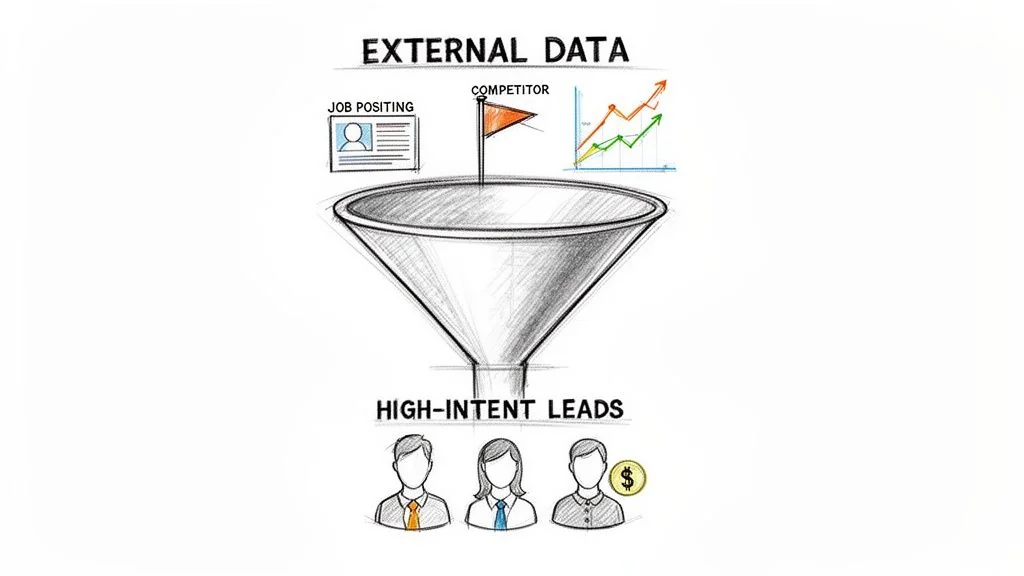
For a dev agency, CI matters because it moves you from a reactive sales model (waiting for RFPs and referrals) to a proactive one (engaging prospects who have a validated, immediate need). Market research that sizes your Total Addressable Market (TAM) answers a different question. CI tells your sales team who to call this week.
From Passive Observation to Active Hunting
Most agencies practice a lazy form of CI. They notice a competitor launched a new website or see a rival’s case study. This is observation, not intelligence. An active CI program translates those observations into revenue-generating actions.
For example, an agency specializing in fintech platform development saw a competitor’s senior project manager and two lead developers change their LinkedIn statuses to “Open to Work” in the same week. A passive agency sees gossip. An agency with a CI process sees an operational failure. They identified that competitor’s top three clients from public case studies. Their sales team reached out with a message about ensuring project continuity and offered a “rescue audit” for at-risk projects. That single action, prompted by a specific competitive signal, led to a six-figure contract to take over a failing project. This is what a functional CI program produces: a competitor’s weakness, converted into your pipeline.
Why Guesses Lose Deals
In B2B software services, data-driven decisions beat intuition. A 2021 Gartner report found that organizations using data-driven CI improve win rates by up to 20%. Most companies analyze only about 12% of the data they collect, which leaves most opportunities and threats unseen. You can explore more data on how competitive intelligence is being used across industries. Your next contract is more likely to come from a competitor’s misstep or a client’s declared need than from a cold outbound campaign. CI provides the evidence to find those opportunities first.
Why CI Matters for a Dev Agency: Pipeline and Niche Authority
For dev agencies, CI delivers two returns: short-term pipeline from in-market signals (job postings, exec changes), and long-term niche authority from trend tracking. The CI software market is projected to reach $122.8B by 2033.
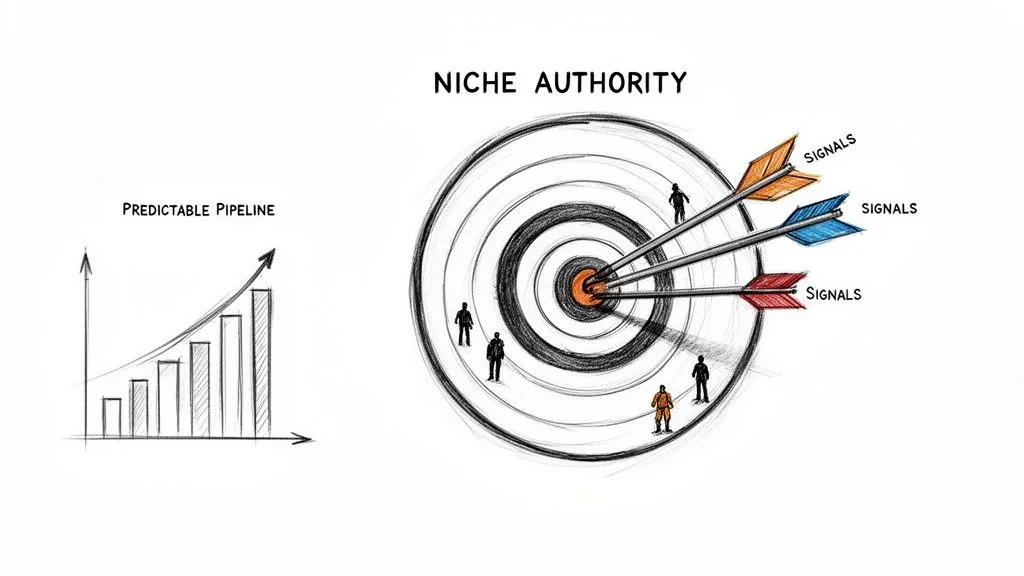
For a software development agency, competitive intelligence creates a predictable pipeline and builds defensible niche authority. It is an investment in revenue operations, not a marketing expense. This is how you stop relying on inbound luck and start finding opportunities on purpose. The CI software market is projected to grow from $50.9 billion in 2023 to $122.8 billion by 2033, according to a report from Visiongain. Data from the Competitive Intelligence Alliance shows CI team sizes grew 24% year-over-year.
Filling the Pipeline with In-Market Signals
The most immediate return from CI is filling your sales pipeline by spotting ‘in-market’ signals: public clues that a company is actively looking for a solution. A classic example is job postings. When a target account posts multiple job descriptions for “Salesforce developers” or “data migration specialists,” it signals an urgent need. An agency specializing in Salesforce integration can use that signal to reach out with a perfectly timed and relevant pitch. According to intent-data provider 6sense, acting on high-intent signals increases conversion rates. The outreach matches the buyer’s immediate problem. You are capturing existing demand before your competitors know it’s there. Your best leads are already broadcasting their needs publicly through job postings, tech stack changes, and executive turnover. They are not on the list you bought.
Building Defensible Niche Authority
While pipeline is about the next 90 days, niche authority is about owning a market segment. CI allows your agency to anticipate trends, not just react to them. Authority comes from being ahead of the market, not from saying you’re an expert. By tracking a competitor’s service launches, client wins, and the topics their leadership discusses at conferences, you can map the competitive landscape. This reveals both saturated markets and underserved needs. For instance, an agency could monitor developer forums and competitor case studies to spot rising chatter around ‘headless commerce integration with Shopify.’ By catching this trend early, you can develop focused service packages and publish authoritative content before the market becomes commoditized. This proactive positioning turns market noise into a defensible revenue stream.
The table below breaks down how specific CI activities support these two goals.
| Objective | CI Activity / Signal to Track | Direct Business Outcome |
|---|---|---|
| Predictable Pipeline | Monitoring job postings for “React Native developers” at target accounts. | Timed sales outreach to a company with a validated, immediate need. |
| Niche Authority | Analyzing competitor case studies to find underserved tech stacks (e.g., lack of ‘GraphQL API’ expertise). | Development of a new service offering that positions the agency as a leader in an emerging niche. |
| Predictable Pipeline | Tracking negative reviews for a key competitor on platforms like Clutch or G2. | Targeted outreach to the competitor’s former client, offering a “project rescue” service. |
| Niche Authority | Monitoring VC funding announcements in a vertical (e.g., a surge of investment in health-tech AI). | Creation of thought leadership (webinars, whitepapers) on “AI for Health-Tech” to establish market expertise. |
A mature CI program creates a feedback loop. Tactical wins from signal-based outreach inform your strategic understanding of the market, allowing you to build a dominant position in your chosen niche.
The Four Pillars of a Dev Agency CI Program
A functional CI program rests on four pillars: competitor monitoring, market signal analysis, buyer intent identification, and internal data synthesis. Ignoring any one creates a blind spot that costs deals. All four must run simultaneously.
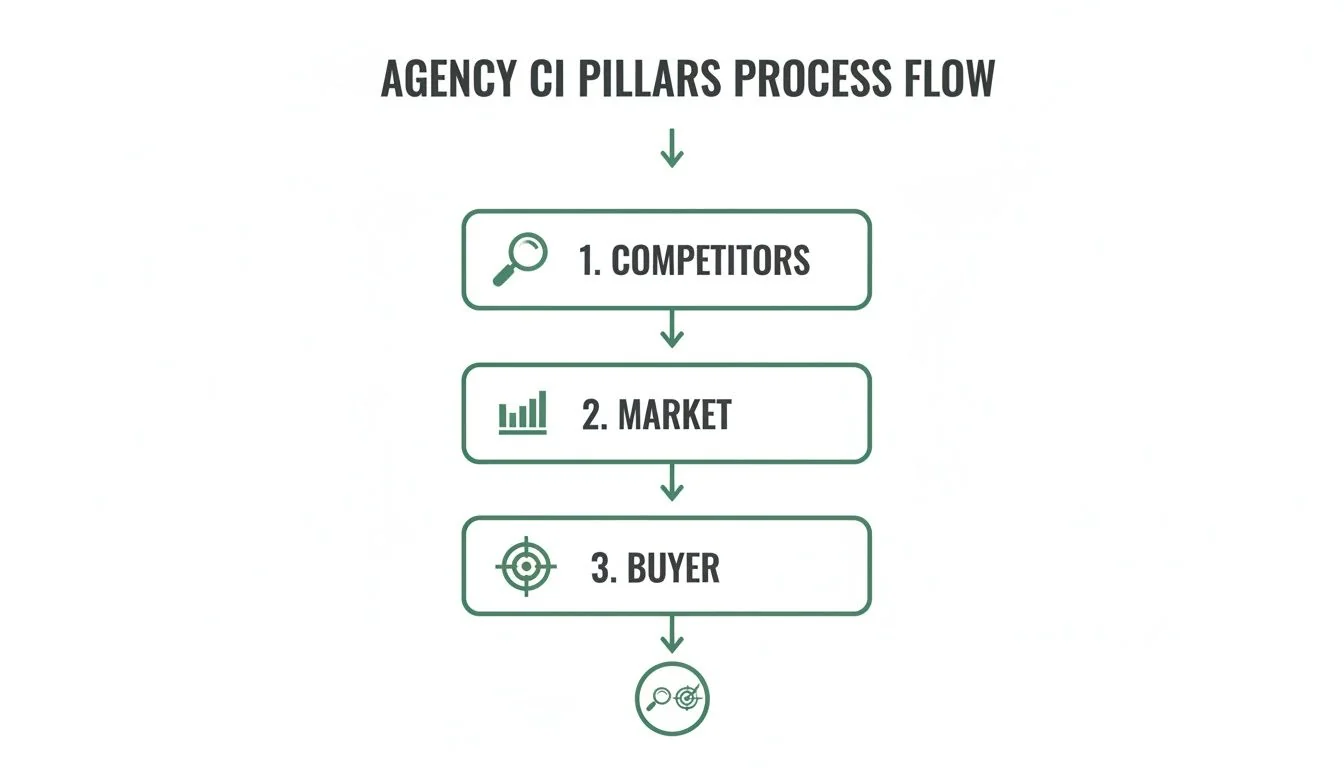
Pillar 1: Competitor Monitoring
This is the systematic tracking of specific changes that signal opportunity or threat. For a dev agency, this means looking past marketing content. You track hiring trends on LinkedIn to see if a rival is staffing up for a new service. You dissect their case studies to find gaps. What tech did they not use? What problems were left unsolved? You watch their tech stack with tools like BuiltWith to detect shifts in their capabilities. A rival shedding three senior developers in a month is a direct sign of project instability and a prime opportunity for a ‘project rescue’ pitch to their clients.
Pillar 2: Market Signal Analysis
This pillar tracks broader industry shifts to see trends before they become mainstream, which niche authority depends on. The signals are concrete and measurable. Tracking venture capital announcements on Crunchbase shows where money is flowing; a surge in funding for B2B fintech startups signals future tech spend in that vertical. Monitoring agendas of major tech conferences reveals topics gaining executive attention; a spike in sessions on ‘AI-powered logistics’ tells you where to focus your next thought leadership piece. Watching patent filings in a target industry can signal long-term tech roadmaps, giving you a one-to-two-year head start on building relevant services. Here the job is anticipating demand before it arrives.
Pillar 3: Buyer Intent Identification
This is the most direct pipeline-filling activity, focused on pinpointing companies actively seeking solutions now. This shifts your sales team from cold prospecting to engaging warm leads. Platforms offering solutions tailored for marketing agencies can accelerate this process. Key intent signals include executive job changes (a new VP of Engineering often creates a 90-day window of strategic review), content consumption spikes (using data from platforms like Bombora to see which companies are binge-reading content on a topic like ‘migrating from monolith to microservices’), and RFP alerts. This pillar answers one question: “Who should our sales team call today?”
Pillar 4: Internal Data Synthesis
This final pillar connects external signals to your internal reality. It asks: “We spotted an opportunity. Do we have the team, case studies, and credibility to win it?” For every signal, you must map it to your agency’s capabilities. If you spot a trend toward ‘green-tech’ software but have zero case studies in that domain, the signal is a strategic directive for marketing to build that credibility, not a sales opportunity for today. This internal check keeps your sales team from wasting cycles on pursuits you cannot win and improves the odds when you act on a CI signal.
An Actionable CI Process for Agency Teams
Effective CI runs a four-step loop: weekly signal identification, a 30-minute triage meeting, same-day assignment with a named owner, and monthly feedback from CRM outcomes. Each step is time-boxed. No owner, no action.
A CI program that lives in a spreadsheet is worthless. The difference between CI that generates pipeline and CI that generates reports is a repeatable, four-step process that connects your sales, marketing, and leadership teams. The objective is to turn market signals into concrete actions.
Step 1: Signal Identification (Weekly)
This step runs continuously, with a formal weekly review. Assign sources to the people already closest to the information to integrate signal-spotting into existing roles.
- SDRs and Sales Teams: Own bottom-of-funnel signals. They track target accounts hiring developers on Indeed, watch for executive changes on LinkedIn, and monitor RFP databases.
- Marketing Teams: Own top and mid-funnel signals. They track competitor case studies, monitor negative reviews of rivals on G2 and Clutch, and follow industry news for emerging trends.
Step 2: Triage and Qualification (30 Mins, Weekly)
This is a mandatory 30-minute weekly meeting with sales, marketing, and leadership. The agenda is to review the week’s signals and decide what is actionable now. Use the framework below to qualify or disqualify signals in under two minutes each.
| Signal Category | Example Signal | Responsible Team | Immediate Action | Metric to Track |
|---|---|---|---|---|
| High-Intent | Target account posts 3+ “React Developer” jobs | Sales | Immediate, personalized outreach referencing the hiring need. | Meetings Booked |
| Competitor Weakness | Rival receives multiple 1-star reviews on Clutch for project management. | Sales & Marketing | Sales targets the dissatisfied clients. Marketing creates content on “Avoiding Agency PM Failures.” | New Opps Created |
| Market Trend | VC funding for AI in logistics surges 200% in a quarter. | Marketing & Leadership | Marketing drafts a thought leadership article. Leadership evaluates service offering fit. | Content Engagement |
| Niche Opportunity | Competitor sunsets their legacy system migration service. | Sales & Marketing | Sales targets the competitor’s known clients. Marketing launches a “Seamless Migration” campaign. | Pipeline Value |
Step 3: Action and Assignment (Immediate)
After the triage meeting, every qualified signal gets an owner and a specific, time-bound action. “Look into it” is not an action. “Draft an outreach sequence to their VP of Eng” is an action. A high-intent signal goes to an Account Executive with a 24-hour deadline for initial contact. A market trend signal goes to marketing with a two-week deadline to produce a blog post outline. This creates direct accountability. For a deeper look at this, see our guide on the strategic account planning template.
Step 4: Measurement and Feedback (Monthly)
This is a monthly review led by the CEO or head of sales. Using data from your CRM like HubSpot or Salesforce, trace qualified signals back to their outcomes. The only question that matters: “Of the 20 signals we acted on last month, which ones generated pipeline?” If “executive job change” signals have a 5% conversion rate to meetings, while “competitor negative review” signals have a 25% rate, you prioritize the latter. Run monthly, this loop shows which signal types predict revenue and which don’t.
The Right CI Tools and Data Sources for a Dev Agency
Build your CI stack in three tiers: free tools (Google Alerts, LinkedIn, BuiltWith) to start, paid tools (Ahrefs, Bombora) when manual work exceeds subscription cost, and a consolidated platform or managed service when manual data work becomes the bottleneck.
Your intelligence is only as good as its inputs. Building a CI stack should start lean, with tools added only when the cost of manual work exceeds the subscription price. The aim is actionable signals that feed your sales pipeline, without drowning in data.
Tier 1: The Free and Essential Sources
This tier costs nothing but time.
- Google Alerts: Set up alerts for every direct competitor’s name, their CEO’s name, and their core services to catch news and press releases.
- LinkedIn Sales Navigator: Use it to build account maps and track employee changes. A 2022 LinkedIn report showed sales pros using Sales Navigator see a +17% lift in pipeline. A competitor losing senior talent is a poaching opportunity; a target account hiring a new CTO is a pipeline signal.
- BuiltWith: Use the free version to track the tech stacks of your top 20 competitors and top 50 target accounts. When a target adds or removes a technology you specialize in, that’s a buying signal.
This tier should take no more than 2-3 hours per week to manage, combined, across your marketing and sales teams.
Tier 2: Paid, High-Impact Tools
Invest here only when you can prove that a lack of deeper insight is costing you deals. The decision should be a simple ROI calculation: if a team member spends five hours a week manually tracking competitor content, an Ahrefs subscription (the Lite plan is $129/month) is an immediate productivity gain. Exploring social listening API solutions can add a qualitative layer by tapping into public sentiment.
| Tool Category | Example Tools | Why It Matters for a Dev Agency | When to Buy It |
|---|---|---|---|
| Content Intelligence | Ahrefs, Semrush | See what content drives competitor traffic and which keywords they rank for. Use it to plan how to capture their audience. | When content is a core part of your growth plan and you must outrank competitors for high-value keywords. |
| Customer Voice | G2, Capterra, Clutch | Track competitor reviews to find their weaknesses. A pattern of complaints about “poor project management” is a sales angle. | When you’re in a crowded niche and differentiation depends on service quality, not just a list of technologies. |
| Intent Data | Bombora, 6sense | See which companies are actively researching topics related to your services, even if they have never visited your website. | When your outbound sales team is mature and needs higher-quality, problem-aware leads to book meetings. |
Tier 3: Consolidated Intelligence Platforms
The first two tiers take real time. Someone has to log into several platforms every week and connect the dots in a spreadsheet, and that work competes with selling and delivery. Consolidated intelligence platforms and managed services bundle those signals into one feed, usually at a higher price than the individual tools.
The choice to build a CI stack or buy a consolidated solution comes down to your agency’s scale. For a 60-person shop trying to own a niche, time spent on manual data collection is time not spent on sales or delivery. Those are the only two activities that generate revenue.
100Signals does not sell CI reports. We use these kinds of signals, such as hiring, funding, and buyer intent, to choose the accounts for the outbound programs we run for software development firms. You can see how that work is structured on our services page.
Related on 100Signals
- ABM for Software Development Companies: How account-based marketing turns CI signals into coordinated, multi-touch campaigns targeting your highest-value accounts.
- Positioning for Software Development Companies: Use competitive data to carve out a defensible niche before rivals catch up.
- Positioning for Consulting Firms: How consulting firms use market intelligence to own a category instead of competing on price.
- Demand Generation for Software Development Companies: Connect CI-driven signals to a demand gen engine that fills pipeline without waiting for referrals.
- Digital PR for Consulting Firms: Turn niche authority built through CI into earned media that compounds over time.