ABM for software development companies: stop marketing to thousands, start selling to the hundred that matter
✓ Request received
Thanks! We'll review your site and send your report within 24 hours.
Something went wrong. Try again or email [email protected].
Free. No call required. Results in your inbox in 24 hours.
TL;DR
- 97% of marketers report ABM delivers higher ROI than any other strategy — making it the benchmark approach for dev agencies with long sales cycles.
- ABM inverts the funnel: select the 25-50 best-fit accounts first, then build targeted campaigns to win them rather than casting a wide net.
- ABM-sourced accounts close with 48% higher win rates and generate 171% higher average contract values than traditional lead generation.
- Most dev agencies should start with 1:few ABM — 50-100 accounts segmented into clusters — before scaling to strategic 1:1 or programmatic 1:many tiers.
- Intent data reduces acquisition costs by 25% and increases lead conversion by 37% when integrated into account-level marketing and sales plays.
Account-based marketing for software development companies is the strategy that replaces “generate more leads” with “win the specific accounts that matter.” 97% of marketers report ABM delivers higher ROI than any other approach. For dev agencies — where a single enterprise contract can run six or seven figures, sales cycles stretch 8+ months, and buying committees include 6-10 stakeholders — ABM isn’t an upgrade to your marketing. It’s a structural correction to how your pipeline should have worked all along. This guide covers the data, the tier model, the implementation playbook, and the mistakes that kill ABM programs before they produce results.
The problem: why traditional lead generation fails software development agencies
Most dev agencies cycle through the same failing loop: buy a lead list, blast cold emails, book meetings with unqualified prospects who treat them as commodity vendors, close nothing, and repeat. ABM breaks this cycle by inverting the funnel — selecting the right accounts first, then building campaigns to win them.
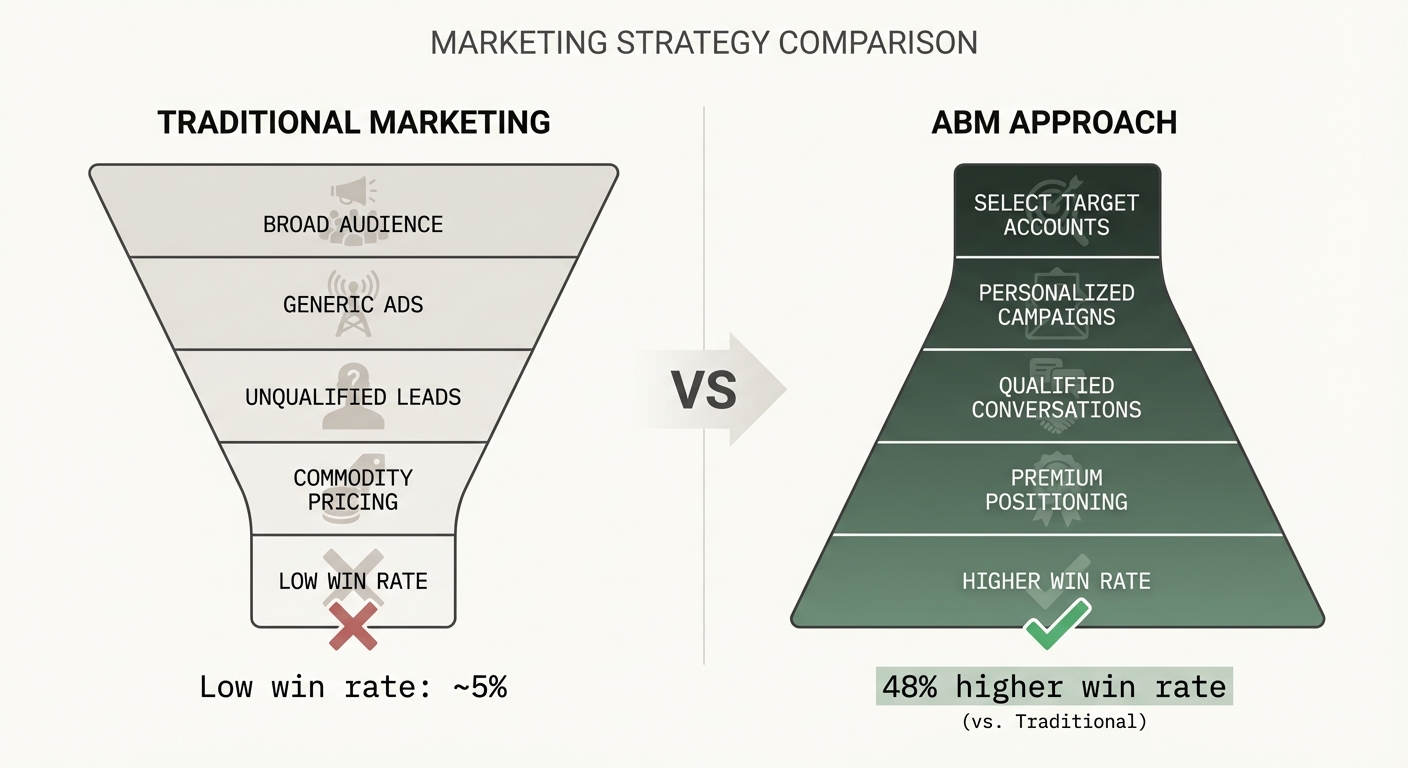
We’ve analyzed pipeline data across 1,700+ software development agencies. The pattern is consistent: 70%+ of revenue comes from referrals and founder networks. Growth is feast-or-famine. When a key connector changes jobs, lead flow drops off a cliff. The agency isn’t scaling — it’s waiting.
The typical response is to invest in lead generation tactics: cold email agencies, LinkedIn ads, Clutch profiles, SEO blog posts. Most agencies spend $20K-40K per year cycling through these channels. The dashboard shows activity — emails opened, ads clicked, content published. None of it produces meaningful pipeline. The leads that do convert get treated as commodity vendors because the prospect has no prior relationship with the agency and no reason to trust them.
87% of B2B tech leads never convert to customers using traditional methods. The problem isn’t the channel. It’s the approach. Traditional lead generation treats every prospect the same — same messaging, same content, same outreach cadence regardless of whether the account is a perfect fit or a complete mismatch. For dev agencies selling high-consideration services with long evaluation cycles, this spray-and-pray model wastes the majority of marketing spend on accounts that were never going to convert.
ABM inverts the funnel. Instead of casting a wide net and hoping to filter down to good prospects, you start by identifying the 50-100 accounts most likely to buy — based on fit, intent signals, and relationship proximity — and then build targeted campaigns to engage the specific decision-makers within those accounts. Every piece of content, every outreach message, every ad dollar is directed at accounts you’ve already validated as worth pursuing.
The economics are straightforward:
| Metric | Traditional lead gen | ABM | Difference |
|---|---|---|---|
| Win rate | Baseline | 48% higher | ABM accounts convert nearly 1.5x more often |
| Average deal size | Baseline | 171% higher | Targeted accounts are larger by design |
| Sales cycle length | Baseline | 25-28% shorter | Warm accounts move faster |
| Customer lifetime value | Baseline | 3x higher | Better-fit clients stay longer and expand |
| Marketing-sourced revenue | Baseline | 208% higher | Focused spend on validated accounts |
| Cost per meeting | $500-1,200 (cold outbound) | $150-400 (intent-sourced) | 2-3x more efficient per qualified conversation |
Why ABM is built for services firms — not just SaaS
Every characteristic that makes software development sales difficult — long cycles, multiple stakeholders, relationship-driven evaluation, high deal values — is exactly the condition ABM was designed to address. SaaS companies adopted ABM first, but services firms benefit more.
ABM gets talked about primarily in SaaS contexts: product-led growth companies targeting enterprise accounts. But the strategy maps even better to services firms, and especially to dev agencies. The sales motion is inherently account-based — you’re already pursuing specific companies, not anonymous traffic.
Long sales cycles demand sustained engagement. Dev agency deals average 8+ months from first contact to signed contract. A buying committee of 6-10 stakeholders — CTO, VP of Engineering, procurement, sometimes legal — evaluates options over multiple rounds. Traditional lead gen generates a burst of initial interest that fades without sustained nurture. ABM maintains engagement across the full cycle, delivering the right content to the right stakeholder at the right time.
Relationship-driven sales map to personalized campaigns. Dev agencies don’t sell products on feature lists. They sell trust, expertise, and past performance. ABM’s personalized approach — account-specific messaging, role-based content, executive-to-executive engagement — mirrors how services firms already win their best deals. The difference is that ABM systematizes what currently happens only through the founder’s personal network.
High average deal values justify the investment. When a single contract is six or seven figures, the cost of a highly personalized campaign targeting that one account is trivially small relative to the potential return. ABM excels when annual contract value exceeds $50,000 — a threshold most dev agency enterprise deals clear easily.
Limited addressable market is a feature, not a bug. Most dev agencies have a naturally constrained set of best-fit accounts: companies in their target vertical, of the right size, in the right geography, with the right technical needs. This isn’t a problem for ABM — it’s the ideal condition. ABM was designed for finite account universes, not mass markets.
Multiple stakeholders need different value propositions. The CFO evaluating your agency cares about TCO and ROI timelines. The CTO cares about architectural approach and team seniority. The VP of Engineering cares about integration complexity and delivery methodology. End-users care about working process and communication. ABM lets you speak to each decision-maker in their own language — a capability traditional lead gen doesn’t even attempt.
51% of IT buyers say a vendor’s disconnected internal communication is a major red flag. When your marketing sends a CFO a technical deep-dive and your sales team pitches the CTO on cost savings, it doesn’t just fail to convert — it actively damages trust. ABM aligns every touchpoint to every stakeholder.
The ABM tier model for software development agencies
ABM operates in three tiers — strategic (1:1), high-touch (1:few), and programmatic (1:many) — each balancing personalization depth against account volume. For most dev agencies, the 1:few tier delivers the strongest ROI: personalized enough to convert, broad enough to generate pipeline.
Tier 1: Strategic ABM (1:1)
Accounts: 5-25 — your highest-value, highest-probability targets.
Strategic ABM treats each account as a market of one. Every interaction is custom-built for the specific company, its current challenges, and its buying committee.
What this looks like for a dev agency:
- Custom landing pages per account: “How [Account Name] could reduce migration risk by 60% based on our [similar client] engagement”
- Founder-to-CTO personalized video message referencing a specific technical challenge you’ve identified
- Account-specific case studies showing work with comparable companies in the same vertical
- Bespoke technical assessments or architecture reviews offered as value-first engagement
- Executive briefings on trends specific to the account’s industry
- Handwritten direct mail referencing the prospect’s recent conference talk or published article
Investment: Highest per account. Justified when a single deal is worth $500K+ over the contract lifetime.
Results data: Strategic ABM captured 47% of ABM market share in 2024. One-to-one campaigns average 39 target accounts.
Tier 2: High-touch ABM (1:few)
Accounts: 25-100 — segmented into 3-5 clusters by vertical, company size, or technical need.
This is the sweet spot for most dev agencies. Accounts are grouped by shared characteristics, and campaigns are personalized to the cluster level with account-level touches where the data justifies it.
What this looks like for a dev agency:
- Role-based email sequences: the CFO track focuses on ROI and cost savings, the CTO track focuses on architectural approach and team expertise, the VP of Engineering track focuses on delivery methodology and integration
- Cluster-specific webinars: “API Integration Challenges for Mid-Market Healthcare Companies” targets 15-20 accounts in the same vertical
- LinkedIn ad campaigns targeted to buying committees at specific companies
- Personalized outbound sequences where SDRs reference exact content the prospect engaged with
- Industry-specific case study collections curated for each cluster
- Coordinated marketing-sales plays: marketing warms with ads and content, sales follows up referencing the specific engagement
Investment: Moderate per account. Scales well for agencies running $3K-7K/month marketing budgets.
Results data: Organizations implementing 1:few ABM report 20-40% higher win rates versus broad demand gen. Pipeline velocity improvements of 25-40% are common in mature 1:few programs. Campaigns average 177 target accounts.
Tier 3: Programmatic ABM (1:many)
Accounts: 100-1,000+ — broad account list receiving automated but targeted engagement.
Programmatic ABM uses automation and intent data to deliver relevant content to a larger account universe. Less personalized per account, but dramatically more efficient than untargeted demand gen.
What this looks like for a dev agency:
- Dynamic website content that changes based on the visitor’s industry (detected through reverse IP lookup)
- Automated nurture sequences triggered by specific behaviors: downloading a case study, visiting the pricing page multiple times, engaging with LinkedIn content
- LinkedIn advertising to the full target account list, segmented by vertical
- Retargeting campaigns keeping the agency top-of-mind across the buying cycle
- Content syndication to industry publications your target accounts read
Investment: Lowest per account. Requires platform investment but minimal per-account customization.
Results data: Programmatic ABM is the fastest-growing segment at 19.8% CAGR. 46% of B2B organizations practice 1:many ABM.
| Factor | Tier 1: Strategic (1:1) | Tier 2: High-touch (1:few) | Tier 3: Programmatic (1:many) |
|---|---|---|---|
| Accounts | 5-25 | 25-100 | 100-1,000+ |
| Personalization depth | Fully custom per account | Cluster-level with account touches | Segment-level automation |
| Channels | Direct mail, personalized video, executive outreach | Email sequences, LinkedIn ads, webinars, targeted content | Display ads, content syndication, automated nurture |
| Best for dev agencies | Your top 10-20 dream clients | Your core target market | Broader awareness in your vertical |
| Time to results | 3-6 months per deal | 60-120 days to pipeline | 30-90 days to engagement signals |
| Monthly cost range | $5K-15K+ per account cluster | $3K-7K total | $1K-3K total |
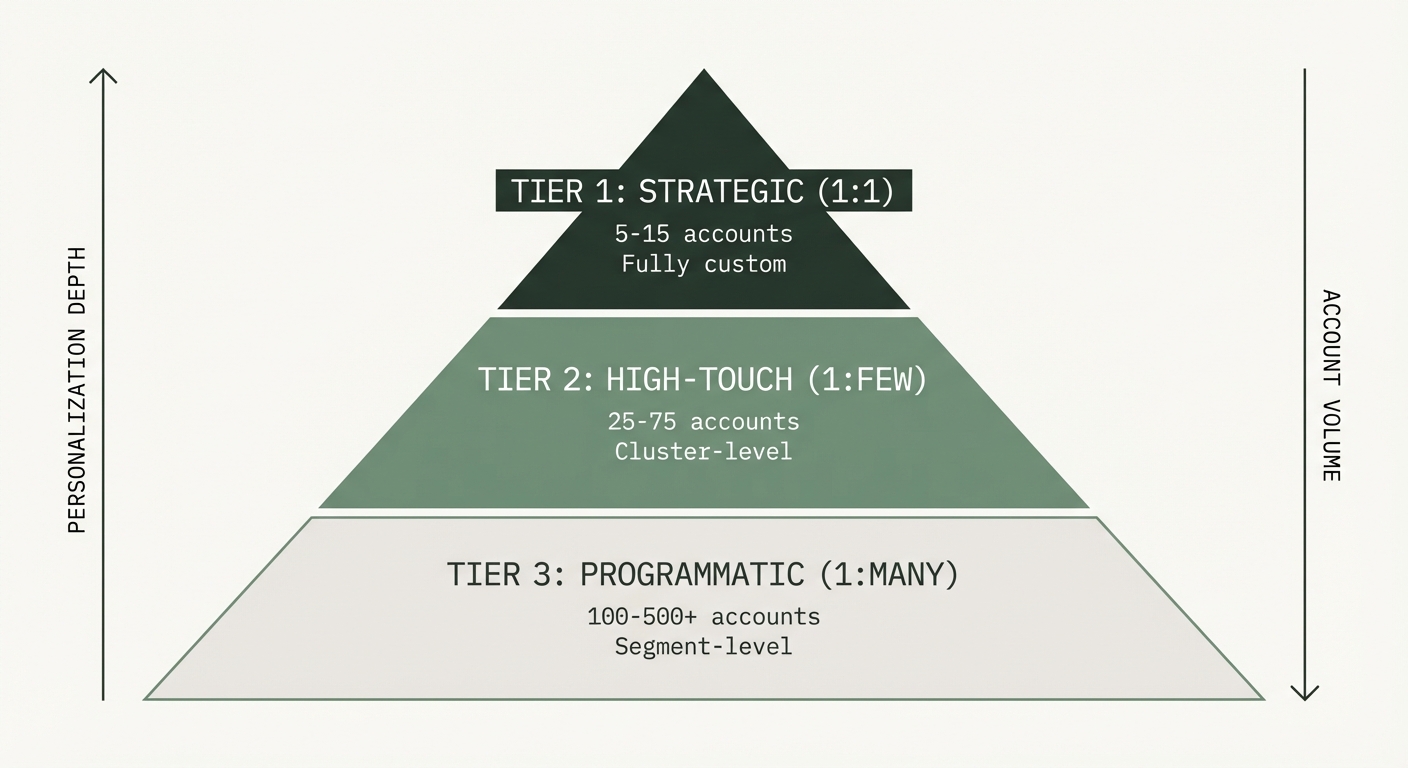
For most dev agencies under 300 people, start with Tier 2. Build a list of 50-100 accounts grouped into 3-5 clusters. Run coordinated campaigns for 90 days. Expand to Tier 1 for your highest-value targets only after Tier 2 proves the motion works.
Intent data: knowing when your target accounts are ready to buy
Only 5% of B2B accounts are actively looking to buy at any given time. Intent data — behavioral signals indicating that a company is researching solutions you provide — lets you focus resources on the accounts most likely to convert right now, rather than equally distributing effort across your entire target list.
Up to 70% of the buyer journey happens in the “dark funnel” — research that’s invisible to your analytics. B2B buyers spend only 17% of their total buying time talking to suppliers. With 8-12 people in a buying committee, any single vendor gets roughly 5-6% of the decision-making process. Without intent data, you’re guessing which accounts to prioritize and when to engage.
Three types of intent data
First-party intent (highest quality, lowest cost). Signals from your own properties: website visits, content downloads, email engagement, pricing page views. A company visiting your case studies three times in a week is a strong buying signal. This data is free to collect and the most actionable — but it only captures buyers who already know you exist.
Second-party intent (high quality, moderate cost). Partner data from review platforms — G2, Clutch, TrustRadius, TechTarget. Reveals when target accounts are actively comparing vendors in your category. Lower false-positive rate than third-party data because the signals come from explicit research behavior.
Third-party intent (broadest reach, highest cost). Aggregated signals from providers like Bombora, 6sense, and ZoomInfo across thousands of B2B websites. Catches buyers before they visit your site — valuable for early-stage awareness — but carries higher false-positive rates. Enterprise providers cost $25K-100K+ annually.
Intent signals specific to dev agency sales
Not all intent signals are equal. These are the most predictive for software development agency sales, ranked by confidence:
| Signal strength | Signal type | Confidence |
|---|---|---|
| Strongest (75-90%) | Direct engagement: form fill, RFP request, chatbot conversation | Highest — act immediately |
| Strong (55-70%) | Multi-signal: topic surge + website visit + Clutch comparison | High — prioritize for outreach |
| Strong (40-55%) | Visiting your case studies, pricing page, and services pages | High — warm outreach within 48 hours |
| Moderate (30-40%) | Champion job change — former client moved to a new company | Medium — research and engage |
| Moderate (25-35%) | G2 or Clutch activity comparing dev agencies in your vertical | Medium — begin nurture sequence |
| Weak (15-20%) | Company posting multiple engineering job openings | Low — possible capacity problem they might outsource |
| Weak (10-20%) | Third-party topic surge on "custom software development" | Low — research needed before outreach |
Buying signals dev agencies should actively monitor:
- Companies posting multiple engineering job openings (capacity problem — potential outsourcing trigger)
- Searches for “staff augmentation,” “outsourced development team,” “software development partner”
- Leadership changes — a new CTO or VP of Engineering often re-evaluates vendor relationships
- Funding announcements — post-funding companies need to ship fast and often hire agency support
- Technology-specific surges: “React Native development,” “cloud migration services,” “API integration”
- Visits to competitor dev agency websites and Clutch/G2 profiles
Start with first-party before investing in third-party. Companies that integrate intent data into marketing increase lead conversion rates by 37% while reducing acquisition costs by 25%. But buying Bombora before you can identify who visits your own website is backwards. Your website visitors are your highest-quality intent signals — implement visitor identification (Clearbit Reveal, Dealfront, or similar) before investing in expensive third-party data.
Signal decay matters
A buying signal from 3 weeks ago is noise. The window between “actively researching” and “selected a vendor” can be 2-4 weeks for mid-market deals. Intent data is perishable — act within 48 hours of a strong signal, or the opportunity may be gone. This is why ABM requires sales-marketing alignment: marketing surfaces the signal, sales acts on it immediately.
The ABM technology stack for dev agencies
You don’t need enterprise ABM platforms to start. A CRM, LinkedIn Sales Navigator, and basic website visitor identification form a starter stack that outperforms expensive tools without strategy behind them. Scale the technology after proving the motion.
The ABM technology market is projected to reach $3.8 billion by 2030. There’s no shortage of vendors selling you a platform. But 50% of marketers identify ABM as their primary target for tech stack upgrades — which means most are still building, not optimized.
The starter stack (sufficient for most dev agencies)
| Layer | Recommended tool | Monthly cost | What it does |
|---|---|---|---|
| CRM | HubSpot (free/starter) or Pipedrive | $0-50 | Account tracking, deal pipeline, activity logging |
| Stakeholder mapping | LinkedIn Sales Navigator | $99/seat | Find decision-makers, track job changes, save accounts |
| Contact data | Apollo or ZoomInfo Lite | $50-200 | Email addresses, phone numbers, firmographic data |
| Website visitor ID | Clearbit Reveal or Dealfront | $100-300 | Identify which companies visit your site — first-party intent |
| Email automation | HubSpot sequences or Lemlist | $50-100 | Personalized outreach sequences triggered by behavior |
Total: $300-750/month. This stack handles 50-100 target accounts effectively. The bottleneck is execution, not tooling.
The scaled stack (for agencies running $5K+ monthly ABM budgets)
When your starter stack proves ROI and you’re ready to scale to 100+ accounts with deeper automation:
- Intent data platform: 6sense (AI-powered predictive scoring, best for complex sales cycles) or Demandbase (comprehensive account intelligence + advertising). Both cost $25K+ annually.
- Account-based advertising: Terminus or RollWorks for serving ads to specific people at specific companies.
- Conversation intelligence: Gong or Chorus for analyzing sales calls and identifying what messaging resonates with which stakeholder roles.
- Personalized video: Vidyard or Loom for account-specific outreach.
- Direct mail: Sendoso or Reachdesk for high-impact physical touchpoints in Tier 1 campaigns.
The core principle: strategy before software. Companies using a comprehensive ABM tech stack see 208% higher marketing revenue. But the most common ABM mistake is over-investing in tools before validating the strategy. You can run effective ABM with the starter stack for 90 days, prove pipeline results, and then invest in scaling infrastructure with confidence.
The 90-day ABM implementation playbook
ABM ROI typically shows in 6-12 months from launch, but the leading indicators — account engagement, pipeline creation, and meeting quality — appear within 90 days. This plan sequences the work to produce early wins while building the foundation for compounding results.
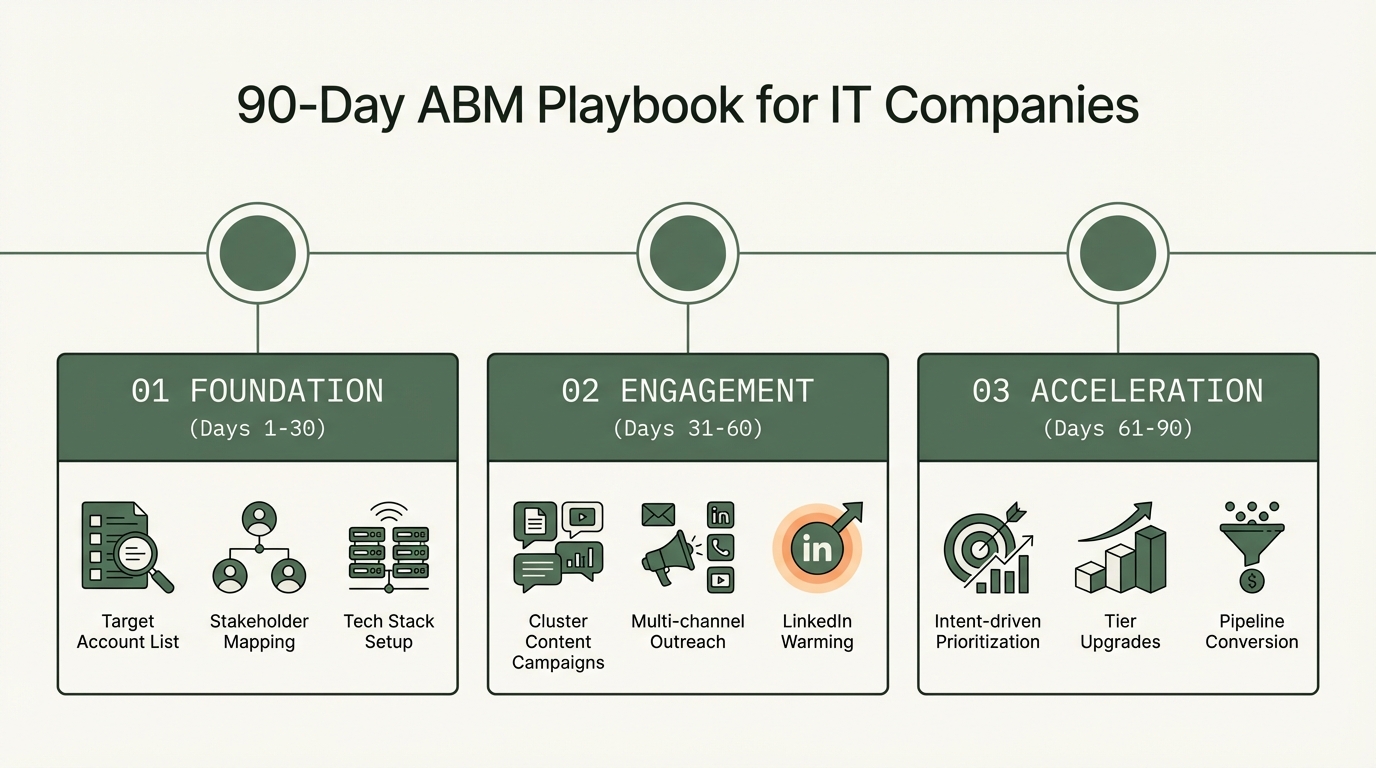
Days 1-30: Foundation — accounts, stakeholders, and infrastructure
Define your target account list using three criteria:
- Fit. Company size, vertical, geography, and technology needs that match your capabilities. Use your existing client base as the template — what do your best three clients have in common?
- Intent. Are they showing buying signals? Hiring engineers, posting RFPs, researching competitors on Clutch, visiting your website? Layer in whatever intent data you can access.
- Relationship proximity. Do you have any existing connections? Former clients at new companies? Second-degree LinkedIn connections? Warm paths convert dramatically faster than cold outreach.
Start with 50 accounts. Group them into 3-5 clusters by shared characteristics — same vertical, same company size, same technical need. Each cluster gets its own messaging angle.
Map stakeholders for every target account. Use LinkedIn Sales Navigator to identify:
- The champion — the person most likely to advocate for hiring your agency internally (usually a VP of Engineering or technical lead)
- The decision-maker — the person who signs the contract (usually CTO, CEO, or VP of Technology)
- The budget holder — the person who controls the spend (may be the same as the decision-maker, or CFO/procurement)
- Influencers — team members who’ll use your services and whose opinion matters in the evaluation
Document each stakeholder’s role, likely priorities, and what content would resonate with them. 77% of B2B purchasers won’t even speak to a salesperson without first encountering personalized research or content.
Set up your technology stack. Implement the starter stack described above. Configure your CRM with account-level tracking (not just contact-level), set up website visitor identification, and build initial outreach sequences for each cluster.
Days 31-60: Engagement — multi-channel campaigns by cluster
Launch cluster-specific content campaigns. For each account cluster, create or repurpose content that speaks directly to their shared challenges:
- A case study from a similar engagement (vertical and company size match)
- A technical point-of-view piece on a challenge specific to their vertical
- A comparison or evaluation framework they can use internally (“How to evaluate API integration partners for healthcare compliance”)
72% of buyers claim they’re more likely to buy from vendors who tailor content to their industry. Personalized landing pages generate 3x more conversions in ABM campaigns.
Execute coordinated multi-channel outreach. For each cluster:
- LinkedIn ads warm the accounts. Serve thought leader ads from your founder to buying committees at target companies. This builds recognition before outreach begins.
- LinkedIn engagement from your team. Connect with stakeholders. Engage with their content. Build familiarity through genuine interaction — not pitch messages.
- Email sequences initiated 2-3 weeks after LinkedIn warming. Reference specific challenges relevant to the account’s vertical. Include the case study or technical content that matches their situation.
- Sales follow-up triggered by engagement. When a stakeholder clicks a case study, visits your site, or responds to an email, sales engages personally — referencing the exact content they consumed.
The timing principle: Omnichannel outreach — email, LinkedIn, and phone coordinated around intent signals — produces 234% faster pipeline progression versus single-channel. The key word is “coordinated.” All three channels should reference the same campaign theme and reinforce each other.
Days 61-90: Acceleration — intent-driven prioritization and expansion
Shift resources to accounts showing intent. By day 60, you have engagement data. Some accounts opened emails, clicked case studies, visited your site repeatedly. Others showed no interest. Double down on the engaged accounts:
- Move high-intent accounts into Tier 1 treatment — personalized video from your founder, account-specific case studies, direct executive outreach
- Maintain Tier 2 campaigns for moderately engaged accounts
- Reduce investment in unresponsive accounts (don’t cut them entirely — they may activate later)
Introduce intent-triggered plays. When a specific signal fires, a specific action follows:
- Account visits pricing page → SDR sends personalized email within 24 hours
- Champion changes jobs to a new company → Research the new company, add to target list
- Account shows funding announcement → Congratulations outreach with relevant case study
- Multiple stakeholders from same account engage → Escalate to executive-level outreach
Measure and iterate. Track account-level metrics, not lead-level:
- Account engagement score — composite of website visits, content downloads, email opens, LinkedIn interactions from each account
- Pipeline created from target accounts — total pipeline value generated from your ABM list
- Meeting quality — are the meetings with the right stakeholders at the right level?
- Pipeline velocity — how fast are ABM-sourced opportunities moving versus other sources?
- Coverage — what percentage of your target accounts have you engaged with at least one stakeholder?
ABM mistakes that kill programs before they produce results
Only 17% of marketers have mature ABM strategies. The 83% who don’t share predictable failure patterns: treating ABM as a campaign instead of a strategy, buying tools before building process, measuring MQLs instead of account engagement, and expecting quick results from a long-cycle approach.
Treating ABM as a campaign, not a strategy
Running targeted ads and personalized emails for a quarter, then declaring ABM “didn’t work” is the most common failure mode. ABM is a go-to-market operating model, not a campaign type. Enterprise dev agency deals involve 8+ month cycles. A 90-day campaign barely gets through the awareness phase. Commit to at least two full cycles (6-12 months) before evaluating strategic ROI.
Buying expensive tools before first-party infrastructure
Starting with Bombora or 6sense before you can identify who visits your own website is backwards. Your website visitors are your highest-quality intent signals — they’ve already found you. Implement visitor identification and basic CRM tracking before investing $25K+ in third-party intent data.
Measuring MQLs instead of account-level metrics
ABM doesn’t produce traditional marketing-qualified leads. It produces account engagement and pipeline from named companies. If your reporting framework still counts form fills as the primary success metric, you’ll misread ABM performance entirely. 90% of the buyer’s journey happens in the dark funnel — traditional MQL tracking misses it.
Using AI to scale volume instead of value
AI-generated personalization at scale sounds efficient. But sending 1,000 “personalized” emails that all follow the same template to the same generic list isn’t ABM — it’s spam with a name token. The agencies that get this right use AI for research and preparation (account analysis, stakeholder mapping, industry insights) and human judgment for the actual outreach.
Building on decaying data
B2B contact data decays at up to 70% per year. Job titles change, people move companies, email addresses become invalid. 43% of marketers say data quality is the biggest obstacle to ABM success. Budget for ongoing data maintenance — verify contacts quarterly, update stakeholder maps after leadership changes, and refresh firmographic data regularly.
Expecting quick results
ABM ROI typically shows in 6-12 months. Only 23% of ABM practitioners identified pressure to prioritize quick wins as a challenge — but it’s one of the most destructive. The programs that produce 7:1 ROI are the ones that sustained investment through the compounding period. The ones that got cut after 90 days of “no leads” never had a chance.
Poor sales-marketing alignment
The targeting overlap between sales and marketing is often less than 20%. If you aren’t chasing the same accounts, you aren’t running ABM — you’re running parallel plays that confuse prospects and waste budget. 93% of companies say aligned sales-marketing teams are crucial to ABM success. ABM-aligned teams achieve 38% higher win rates and move accounts through the pipeline 234% faster.
For dev agencies where the founder is both head of sales and head of marketing, this alignment is actually easier than at larger organizations. That’s an advantage — use it.
How to choose an ABM agency for software development companies
Choosing an ABM agency for a dev shop means finding a partner that understands long B2B services sales cycles, can work with smaller account universes, and won’t default to SaaS playbooks that assume product demos and free trials. Look for services-sector experience and intent data fluency.
We’ve evaluated ten ABM agencies against these criteria — see our ranked list of ABM agencies for software development companies.
| Factor | ABM specialist for services firms | Generic ABM or demand gen agency |
|---|---|---|
| Account selection | Uses fit, intent, and relationship proximity | Uses firmographic data only |
| Content approach | Case studies, architecture reviews, executive briefings | Product demos, free trials, feature comparisons |
| Sales integration | Coordinates with your founder/sales process | Hands off MQLs and expects sales to close |
| Timeline expectations | 6-12 month program with 90-day milestones | Promises pipeline in 30-60 days |
| Measurement | Account engagement, pipeline velocity, win rates | MQLs, form fills, cost per lead |
| Understands | Services sales cycles, buying committees, relationship selling | SaaS funnels, product-led growth, trial conversion |
Red flags when evaluating ABM agencies: they pitch a technology platform before discussing your accounts, they promise lead volume instead of pipeline quality, they can’t explain how intent data works, they don’t ask about your sales process, and their case studies are exclusively from SaaS companies.
Companies working with specialized ABM agencies report 72% higher ROI versus managing ABM internally. But the agency needs to understand your market. A SaaS ABM playbook applied to a dev agency produces SaaS-shaped campaigns aimed at buyers who don’t respond to them.
What ABM services should include for software development companies
A complete ABM engagement for a dev agency covers six deliverables: target account selection, stakeholder mapping, content creation, multi-channel campaign execution, intent signal monitoring, and measurement infrastructure. Missing any layer produces an incomplete program that underperforms.
| Deliverable | What it covers | Table stakes or differentiator? |
|---|---|---|
| Target account selection | ICP definition, account scoring, fit-intent-relationship analysis, account list curation | Table stakes |
| Stakeholder mapping | Decision-maker identification, role-based persona development, buying committee analysis | Table stakes |
| Content creation | Cluster-specific case studies, role-based email sequences, technical POV pieces, personalized landing pages | Differentiator — most agencies use generic content |
| Multi-channel execution | Coordinated email, LinkedIn, ads, and direct mail campaigns across all tiers | Differentiator — coordination is the hard part |
| Intent monitoring | First-party visitor ID, second-party review site signals, third-party topic surges, champion tracking | Differentiator — requires infrastructure and discipline |
| Measurement and reporting | Account engagement scores, pipeline attribution, velocity tracking, competitive displacement analysis | Differentiator — account-level metrics require different tooling than lead-level |
The multi-channel execution layer is where most programs stall. Building an account list and creating content is the easy part. Coordinating email sequences, LinkedIn engagement, ads, and sales follow-up into a synchronized campaign that reaches the right stakeholder at the right time — that requires operational discipline most agencies don’t have internally.
ABM beyond acquisition: retention and expansion
ABM isn’t just for winning new accounts. 69% of marketers say their top ABM objective is growing revenue from existing clients. Post-sale ABM increases expansion revenue by 55%, reduces churn by 22%, and generates referrals 5x more likely to convert. For dev agencies, where upsells and referrals drive the business, this is the most underleveraged application.
Most dev agencies lose significant revenue by treating post-sale relationships as account management rather than marketing opportunities. ABM applied to existing clients looks different — but the principles are the same:
Expansion campaigns. When you deliver a successful engagement, the buyer is at peak satisfaction. ABM expansion campaigns target additional stakeholders within the same company who might benefit from different services. The VP of Engineering you built a mobile app for introduces you to the VP of Data Engineering who needs a data pipeline.
Referral activation. Referrals from ABM accounts are 5x more likely to convert into new customers. A structured referral program — timed to post-delivery satisfaction peaks, with specific asks rather than generic “know anyone?” — turns your best clients into your highest-converting lead source. This is especially powerful for dev agencies, where referrals already account for 70%+ of revenue.
Churn prevention. Customer churn is reduced by 22% in accounts managed through ABM. Monitoring engagement signals from existing clients — declining stakeholder activity, leadership changes, competitor research — lets you intervene before a client considers alternatives. Post-sale ABM increases customer lifetime value by 3x.
Key terms
Account-based marketing (ABM) — A B2B go-to-market strategy that identifies specific high-value accounts first, then builds personalized campaigns to engage decision-makers within those accounts. ABM inverts traditional lead generation: rather than casting a wide net and filtering, you define the accounts worth winning before any marketing activity begins.
1:few ABM — The mid-tier ABM model targeting 25-100 accounts grouped into 3-5 clusters by shared characteristics such as vertical, company size, or technical need. 1:few ABM is the recommended starting point for most dev agencies — personalized enough to convert, broad enough to generate meaningful pipeline.
Intent data — Behavioral signals indicating that a company is actively researching solutions in a category you serve. Intent data comes from three sources: first-party (your own website visitors), second-party (review platforms like Clutch and G2), and third-party (aggregated signals from providers like Bombora or 6sense across thousands of B2B sites).
Buying committee — The full group of stakeholders involved in a B2B purchase decision. For dev agencies, the typical buying committee includes 6-10 people: CTO or VP of Engineering (technical evaluation), CEO or VP of Technology (final approval), CFO or procurement (budget), and end-users (delivery team). ABM requires distinct messaging and content for each role.
Target account list (TAL) — The curated list of specific companies an ABM program is designed to win, scored and ranked by fit, intent signals, and relationship proximity. A well-built TAL of 50-100 accounts — filtered by vertical, company size, technology needs, and buying signals — outperforms a generic contact database of 10,000 unqualified leads.
How 100Signals approaches ABM for software development companies
ABM is the engine behind the 100Signals methodology. When we talk about identifying your “100 target accounts” and running coordinated outreach until they come to you — that’s ABM, applied specifically to dev agencies.
In the 90-day engagement, ABM starts with niche selection and account identification. We use competitive density data, intent signals, and relationship mapping to build a target list of 100 accounts — not from a generic database, but from analysis of which companies in your niche are most likely to buy, have the budget, and are showing early buying signals.
Then we run the coordinated campaign: LinkedIn content builds recognition with buying committees, outbound sequences reference specific challenges relevant to each cluster, intent monitoring tells us when to accelerate, and the authority layer confirms your expertise when prospects check you out.
Two tiers: Authority covers the niche authority foundation — the content, SEO, and AI visibility that makes your ABM outreach credible. System adds the full ABM execution — Dream100 account selection, multi-channel outbound, LinkedIn engagement, intent monitoring, and ongoing pipeline acceleration. Both run for 90 days, async, with weekly reporting.
The agencies generating predictable pipeline from their best-fit accounts aren’t the ones sending more cold emails. They’re the ones who identified 100 accounts, built recognition before outreach, and timed every touchpoint to engagement signals. That’s the system. See how it works →
- Does ABM work for software development agencies?
- ABM was designed for exactly your sales motion — long cycles, high average deal values, multiple stakeholders, and a finite number of best-fit accounts. 97% of marketers report ABM delivers higher ROI than other strategies. Services firms see even stronger results because ABM replaces the spray-and-pray outbound that burns through lead lists with targeted, personalized engagement that matches how dev agency deals actually close: through trust, demonstrated expertise, and relationship building over months.
- How much does ABM cost for a dev agency?
- You can start meaningful ABM with tools you already have — a CRM, LinkedIn Sales Navigator ($99/month per seat), and your existing content. The technology investment scales with ambition: a starter stack runs $200-500 per month, mid-market platforms like HubSpot or Terminus run $1,000-5,000 per month, and enterprise platforms like 6sense or Demandbase cost $25,000 or more annually. Content production typically accounts for 31% of ABM costs. The ROI benchmark is strong: top-performing ABM programs achieve 7:1 returns, and average programs deliver 3:1.
- How long before ABM generates pipeline for a dev agency?
- Leading indicators appear within 30-60 days: increased engagement from target accounts, higher connection acceptance rates on LinkedIn, and more website visits from named companies. Pipeline-qualified meetings typically follow in 60-120 days. Full ABM ROI shows in 6-12 months. The timeline is longer than demand gen but the quality is dramatically higher — ABM accounts see 48% higher win rates and 171% higher average contract values.
- What is the difference between ABM and lead generation?
- Lead generation casts a wide net to capture contact information from anyone who shows interest. ABM inverts this — you select specific accounts first, then build targeted campaigns to engage decision-makers within those accounts. For dev agencies, where a single enterprise contract can be worth six or seven figures, investing in 50 precisely targeted accounts produces better pipeline than generating 5,000 undifferentiated leads. ABM accounts close 67% faster and generate 3x higher customer lifetime value.
- Can a small dev agency do ABM without enterprise tools?
- Yes. The core of ABM is strategy, not software. Start with a curated list of 25-50 target accounts, LinkedIn Sales Navigator for stakeholder mapping, and personalized outreach sequences referencing account-specific pain points. You do not need 6sense or Demandbase to run effective ABM. A CRM with basic tracking, manual intent signal monitoring, and consistent execution will outperform expensive tooling without strategy behind it.
- How many accounts should a dev agency target with ABM?
- Start with 25-50 accounts in a 1:few model — large enough to generate pipeline, small enough to personalize meaningfully. One-to-one ABM campaigns average 39 target accounts. One-to-few campaigns average 177. For most dev agencies under 300 people, the sweet spot is 50-100 accounts segmented into 3-5 clusters by vertical, company size, or buying signal. Resist the temptation to add more accounts — breadth dilutes the personalization that makes ABM work.
- How does ABM integrate with outbound and LinkedIn for dev agencies?
- ABM makes outbound and LinkedIn dramatically more effective by providing context and timing. Instead of cold-emailing a generic pitch, ABM-informed outbound references specific content the prospect engaged with, competitors they researched, and pain points identified through intent data. On LinkedIn, targeted ads warm accounts before outreach begins, and founder content builds recognition with buying committees. Teams using omnichannel ABM — email, LinkedIn, and phone coordinated around intent signals — see 234% faster pipeline progression.
See which accounts in your niche are showing buying signals — free scan.
✓ Request received
Thanks! We'll review your site and send your report within 24 hours.
Something went wrong. Try again or email [email protected].
Free. No call. Results in 24 hours.
Not ready for the scan?
Which niches are heating up, which agencies are moving, where the gaps are.
✓ Done — you're on the list for monthly reports.
Something went wrong. Try again or email [email protected].