ABM for IT companies: stop marketing to everyone, start winning the accounts that matter
✓ Request received
Thanks! We'll review your site and send your report within 24 hours.
Something went wrong. Try again or email [email protected].
Free. No call required. Results in your inbox in 24 hours.
TL;DR
- ABM delivers 48% higher win rates and 171% higher average contract values versus traditional lead generation for IT companies, because every dollar targets accounts that have already been validated as worth pursuing.
- For MSPs, the sweet spot is Tier 2 ABM — targeting 25–75 accounts grouped into 3–5 vertical clusters — personalized enough to convert, broad enough to generate meaningful pipeline within 60–120 days.
- 72% of IT buyers are more likely to buy from vendors who tailor content to their industry; a healthcare practice must never see manufacturing OT security content, and vertical segmentation is non-negotiable in ABM execution.
- Omnichannel ABM outreach — email, LinkedIn, and phone coordinated around intent signals — produces 234% faster pipeline progression versus single-channel approaches for IT company target accounts.
- A starter ABM stack for IT companies (CRM, LinkedIn Sales Navigator, contact data, website visitor ID, email automation) runs $300–800 per month; strategy discipline matters more than tool sophistication.
MSPs operate in a fundamentally different market than most B2B businesses: your total addressable market is finite and local, your revenue is recurring, and your best clients stay for years. That changes how marketing should work. Instead of generating volume — running Google Ads against every MSP in your metro, blasting cold emails to undifferentiated lists, publishing generic cybersecurity blog posts — the leverage is in identifying the specific 50-100 businesses in your service area most likely to become long-term managed services clients, and building campaigns that establish credibility with those accounts before the first sales conversation happens. That’s account-based marketing. 97% of marketers report ABM delivers higher ROI than any other approach, and the underlying mechanic is straightforward: focused attention on pre-validated accounts outperforms diffuse effort on undifferentiated audiences. For an MSP where average client lifetime value exceeds $72,000, the math rewards selectivity. This guide covers the data, the tier model, the implementation playbook, and how to run ABM on a realistic IT company budget.
Why traditional marketing fails IT companies
Most IT companies cycle through the same failing loop: buy a lead list, blast cold emails or run generic Google Ads, book meetings with business owners who treat them as a commodity, close nothing, and repeat. ABM breaks this cycle by inverting the funnel — selecting the right accounts first, then building campaigns to win them.
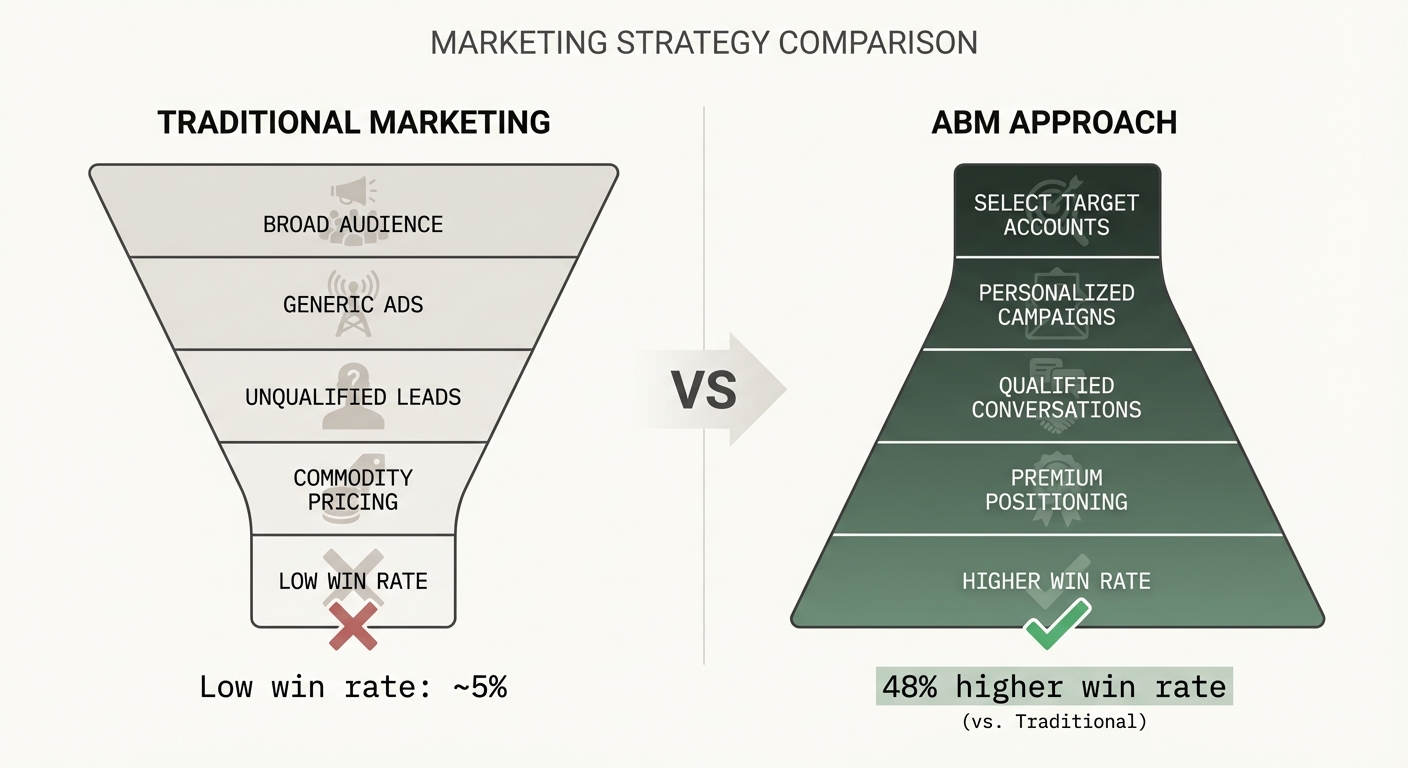
We’ve analyzed pipeline data across hundreds of IT companies and MSPs. The pattern is consistent: 70-80% of revenue comes from referrals and the founder’s personal network. Growth is feast-or-famine. When a key referral source retires or a channel partner shifts priorities, lead flow drops off a cliff. The IT company isn’t scaling — it’s waiting.
The typical response is to invest in lead generation tactics: cold email campaigns, Google Ads for “IT support near me,” a Clutch or UpCity profile, maybe a blog with generic cybersecurity tips. Most IT companies spend $15K-40K per year cycling through these channels. The dashboard shows activity — emails opened, ads clicked, content published. None of it produces meaningful pipeline because none of it reaches the right businesses at the right time with the right message.
The failure modes are structural, not tactical.
Spray-and-pray doesn’t work for recurring services. An MSP sells trust. A business owner is handing you the keys to their infrastructure — their email, their data, their compliance, their uptime. That decision isn’t made from a cold email. It’s made after weeks or months of building confidence that you understand their industry, their size, and their specific risks. Traditional lead generation produces volume with no targeting precision, which means the leads that do arrive treat you as a commodity vendor competing on price.
No targeting means commodity positioning. When your Google Ads campaign targets “IT support for small business” alongside 50 other MSPs in your metro area, you’re competing on cost-per-click for undifferentiated attention. The business owner clicking that ad has no prior relationship with you and no reason to prefer you over the next result. You’ve paid $15-30 for a click from someone who will request three quotes and choose the cheapest — or the one their friend recommended.
The “we serve everyone” trap. Most IT companies describe their ideal client as “any business with 10-200 employees.” That’s not an ICP — it’s the absence of one. Without vertical specialization, your marketing can’t speak to the specific compliance requirements, operational challenges, or technology needs that drive IT purchasing decisions in healthcare, legal, financial services, or manufacturing. A 40-person law firm and a 40-person dental practice have completely different IT needs, risk profiles, and compliance requirements. Marketing that addresses both the same way addresses neither effectively.
Local market saturation. In any mid-sized metro area, there are 20-50 MSPs competing for the same set of businesses. Most run similar marketing: generic websites, identical service descriptions (“we offer managed IT, cybersecurity, cloud solutions, backup and disaster recovery…”), and undifferentiated outreach. The business owners receiving this marketing have no way to distinguish between providers. ABM cuts through saturation by building recognition and trust with specific accounts before the sales conversation begins.
The economics make the case clearly:
| Metric | Traditional lead gen for IT companies | ABM for IT companies | Difference |
|---|---|---|---|
| Win rate | Baseline | 48% higher | ABM accounts convert nearly 1.5x more often |
| Average contract value | Baseline | 171% higher | Targeted accounts are better-fit by design |
| Sales cycle length | Baseline | 25-28% shorter | Warm accounts with prior exposure move faster |
| Customer lifetime value | Baseline | 3x higher | Better-fit clients stay longer and expand services |
| Marketing-sourced revenue | Baseline | 208% higher | Focused spend on validated accounts |
| Cost per meeting | $400-1,000 (cold outbound) | $100-300 (intent-sourced) | 2-3x more efficient per qualified conversation |
| MRR retention (24 months) | 60-70% of clients still active | 80-90% of clients still active | Better-fit clients churn less — compounding effect on recurring revenue |
For an MSP where average client lifetime value is $72,000+ (based on $3,000/month MRR over 24 months, which is conservative), the difference between closing 10% of pipeline and closing 15% of pipeline is transformative. ABM doesn’t just improve marketing efficiency — it structurally changes the quality of every conversation in your pipeline.
What ABM actually looks like for IT companies
ABM operates in three tiers — strategic (1:1), high-touch (1:few), and programmatic (1:many) — each balancing personalization depth against account volume. For most IT companies, the 1:few tier delivers the strongest ROI: personalized enough to convert, broad enough to generate pipeline. The tier model lets you invest proportionally based on each account’s potential value.
Tier 1: Strategic ABM (1:1)
Accounts: 5-15 — your highest-value, highest-probability targets. For an MSP, these are the specific businesses you’ve identified as perfect fits: right vertical, right size, right location, and showing some form of buying signal.
Strategic ABM treats each account as a market of one. Every interaction is custom-built for that specific business, its industry, and its decision-makers.
What this looks like for an IT company:
- Custom landing pages per account: “How [Account Name] could reduce IT incidents by 60% based on our experience with similar [vertical] firms”
- Founder-to-owner personalized video message referencing a specific challenge relevant to their industry — a new compliance requirement, a recent industry-specific threat, or a technology shift affecting their vertical
- Account-specific case studies showing work with comparable businesses: “How we helped a 45-person law firm achieve SOC 2 compliance in 90 days”
- Bespoke IT assessments or security audits offered as value-first engagement — a free network assessment targeting the specific infrastructure profile of that business
- Executive briefings on industry-specific trends: ransomware targeting healthcare, compliance changes for financial services, manufacturing OT security
- Direct mail — a physical package referencing the prospect’s recent office expansion, industry award, or hiring activity
Investment: Highest per account. Justified when a single managed services contract is worth $50,000+ annually — or when the account is a flagship reference that would open doors in the vertical.
Tier 2: High-touch ABM (1:few)
Accounts: 25-75 — segmented into 3-5 clusters by vertical, company size, or geographic sub-market.
This is the sweet spot for most IT companies. Accounts are grouped by shared characteristics — all healthcare practices, all law firms, all manufacturing companies — and campaigns are personalized to the cluster level with account-specific touches where the data justifies it.
What this looks like for an IT company:
- Role-based email sequences: the business owner track focuses on uptime, productivity, and risk reduction; the office manager track focuses on day-to-day IT friction and support experience; the CFO track focuses on cost predictability and compliance risk
- Cluster-specific webinars: “HIPAA IT Compliance for Medical Practices Under 100 Employees” targets 15-25 healthcare accounts simultaneously
- LinkedIn ad campaigns serving founder content to business owners at target companies in specific verticals
- Personalized outbound sequences where your team references the specific compliance requirements, technology challenges, or operational pain points relevant to each vertical cluster
- Industry-specific case study collections: “3 healthcare practices that eliminated downtime” for the healthcare cluster, “How 5 law firms secured client data” for the legal cluster
- Coordinated marketing-sales plays: marketing warms accounts with LinkedIn content and ads, sales follows up referencing the specific content engagement
Investment: Moderate per account. Scales well for IT companies running $2K-5K/month marketing budgets. This is where most MSPs should start.
Results data: Organizations implementing 1:few ABM report 20-40% higher win rates versus broad demand gen. Pipeline velocity improvements of 25-40% are common in mature programs.
Tier 3: Programmatic ABM (1:many)
Accounts: 100-500+ — your broader target market receiving automated but targeted engagement.
Programmatic ABM uses automation and intent data to deliver relevant content to a larger account universe. Less personalized per account, but dramatically more efficient than untargeted advertising.
What this looks like for an IT company:
- Dynamic website content that changes based on the visitor’s industry (detected through reverse IP lookup): a healthcare visitor sees healthcare case studies and HIPAA content; a legal visitor sees legal case studies and data security content
- Automated nurture sequences triggered by specific behaviors: downloading a compliance checklist, visiting the managed services pricing page multiple times, engaging with LinkedIn content
- LinkedIn advertising to the full target account list, segmented by vertical
- Retargeting campaigns keeping your IT company top-of-mind across the buying cycle
- Local business event sponsorships and community involvement targeted to specific vertical associations
Investment: Lowest per account. Requires platform investment but minimal per-account customization.
| Factor | Tier 1: Strategic (1:1) | Tier 2: High-touch (1:few) | Tier 3: Programmatic (1:many) |
|---|---|---|---|
| Accounts | 5-15 | 25-75 | 100-500+ |
| Personalization depth | Fully custom per account | Cluster-level with account touches | Segment-level automation |
| Best for IT companies | Your top 10-15 dream accounts (large businesses, flagship verticals) | Your core target market by vertical | Broader awareness across your service area |
| Channels | Personalized video, free IT assessments, direct mail, executive outreach | Email sequences, LinkedIn ads, webinars, vertical-specific content | Display ads, automated nurture, retargeting |
| Time to results | 2-4 months per deal | 60-120 days to pipeline | 30-90 days to engagement signals |
| Monthly cost range | $3K-8K+ per account cluster | $2K-5K total | $500-2K total |
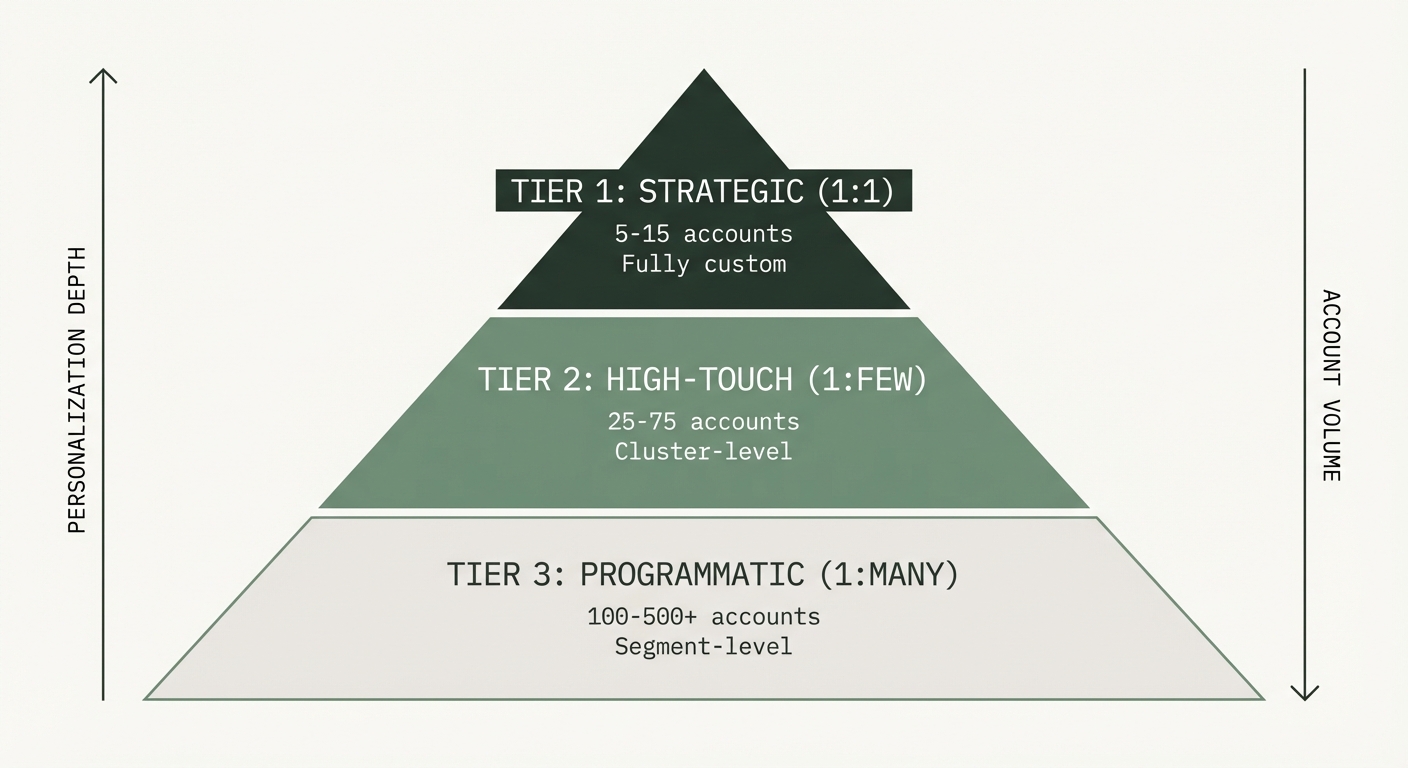
For most IT companies under 50 employees, start with Tier 2. Build a list of 25-50 accounts grouped into 3-5 vertical clusters. Run coordinated campaigns for 90 days. Promote your highest-engagement accounts to Tier 1 treatment only after Tier 2 proves the motion works.
Building your ABM target account list
The target account list is the foundation of everything that follows. Get it wrong and every campaign, every piece of content, every dollar of ad spend goes to accounts that won’t convert. For IT companies, the advantage is that your total addressable market is finite and identifiable — every business in your service area meeting your size and vertical criteria is a potential account.
Defining your ICP for ABM
Your Ideal Customer Profile for ABM isn’t “any business with 10-200 employees.” It’s the specific combination of attributes that predict high lifetime value, low churn, and expansion potential. Work backwards from your best existing clients:
Vertical. Which industries generate your highest-MRR, longest-retained clients? For most MSPs, the answer clusters around regulated industries — healthcare, legal, financial services — where compliance requirements make professional IT management non-optional. If your three best clients are all medical practices, that’s your primary ABM vertical.
Company size. What employee count correlates with your ideal MRR? Typically 20-200 employees for MSPs: large enough to need managed IT services, small enough that they don’t have an internal IT department. Refine further: your best clients might cluster at 40-80 employees, which gives you a tighter targeting range.
Geography. Your service area. For on-site MSPs, this is typically a 30-60 mile radius. For remote-first IT companies, the geographic constraint loosens, but local proximity still matters for trust and response time.
Technology profile. What current technology stack signals a good fit? A business running an aging on-premise server with no backup solution is a strong signal. A business already using a modern cloud-native stack with an internal IT hire is a weak signal. Technology profiling tools can help identify which businesses in your target list are running outdated infrastructure.
Compliance requirements. Businesses in regulated industries that must meet HIPAA, SOC 2, CMMC, PCI DSS, or other standards are higher-value ABM targets because compliance creates an ongoing, non-discretionary need for professional IT management. These businesses can’t rely on the “nephew who does IT.”
Signal detection for IT company ABM
Only 5% of B2B buyers are actively in-market at any given time. Intent signals help you focus resources on the accounts most likely to convert right now.
First-party signals (highest quality). Website visits to your managed services page, case study downloads, pricing page views, IT assessment requests. A business visiting your site multiple times in a week is actively evaluating. This data is free to collect and the most actionable.
LinkedIn signals. A business owner engaging with your founder’s LinkedIn content, accepting a connection request, or viewing your company page. These signals indicate awareness and interest. Track them through LinkedIn Sales Navigator.
Technology and compliance signals. A business posting job openings for IT staff (they might be building internal — or struggling to hire and open to outsourcing). A healthcare practice expanding to new locations (new compliance requirements). A law firm adopting cloud-based practice management software (needs IT integration support). Monitor these through Google Alerts, industry publications, and local business news.
Competitive displacement signals. A business posting negative reviews of their current IT provider. A company switching from one RMM platform to another (visible through technology profiling). A business whose current MSP was acquired or changed ownership. These signals indicate active dissatisfaction and openness to alternatives.
Lifecycle signals. New office lease signed (infrastructure needs). Business ownership change (new decision-maker evaluating vendors). Insurance renewal coming up (cyber insurance requirements driving IT upgrades). Compliance audit on the calendar (urgency for IT improvements).
Account scoring for IT companies
Score each target account across three dimensions to prioritize your time and budget:
Fit score (0-40 points). How well does the account match your ICP? Right vertical (+10), right size (+10), right geography (+10), compliance requirements (+5), no internal IT department (+5).
Intent score (0-30 points). What buying signals is the account showing? Website visits (+10), LinkedIn engagement (+5), technology change signals (+5), competitive displacement signals (+10).
Relationship proximity (0-30 points). How warm is your path to the decision-maker? Existing connection (+15), mutual connection (+10), same industry association (+5), cold (+0).
Accounts scoring above 60 go into Tier 1 or Tier 2. Accounts scoring 40-60 go into Tier 2 or Tier 3. Accounts below 40 need more data before investment.
The ABM playbook for IT companies
ABM for IT companies isn’t a campaign you run for a quarter. It’s an operating model that coordinates content, outbound, LinkedIn, and ads into a synchronized system targeting the accounts you’ve already validated as worth pursuing. The playbook sequences the work across 90 days to produce early wins while building the foundation for compounding results.
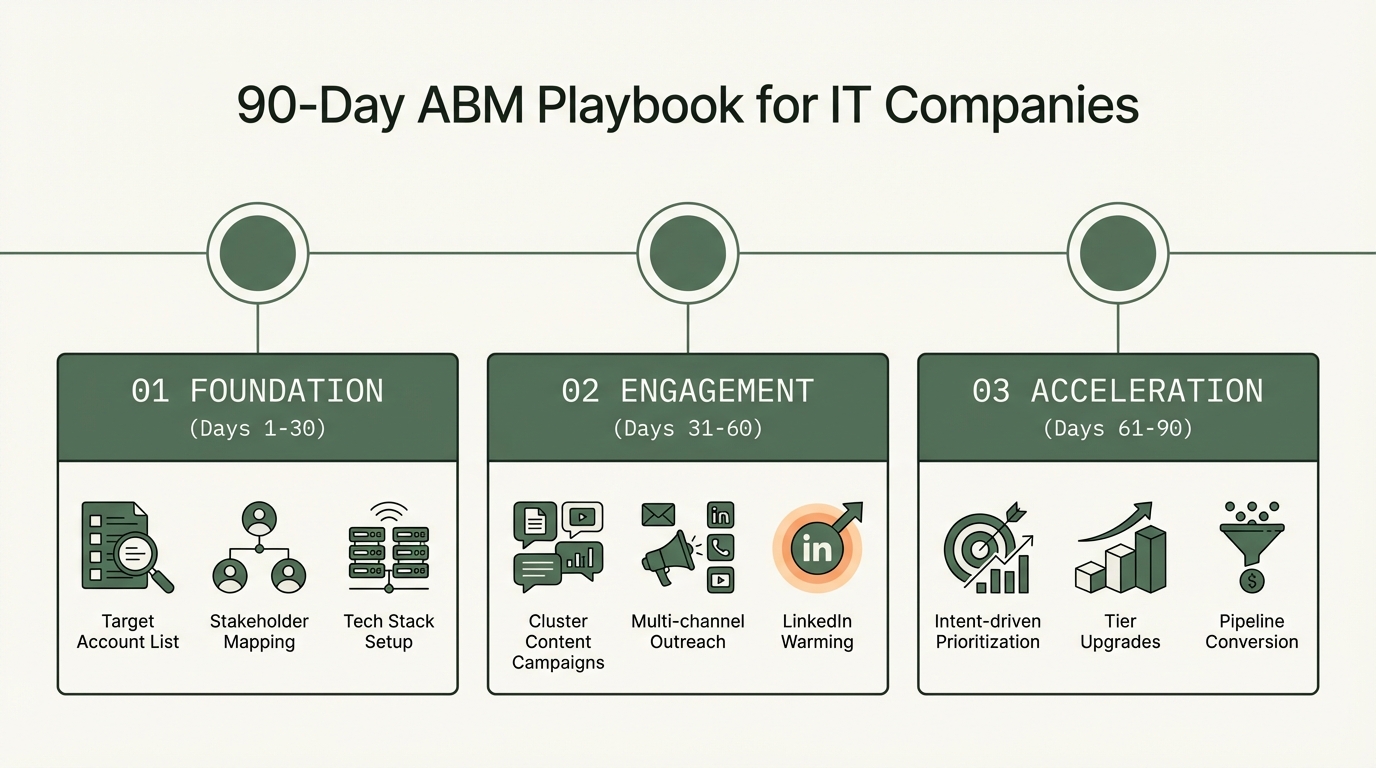
Days 1-30: Foundation — accounts, stakeholders, and infrastructure
Build your target account list. Start with 25-50 accounts, segmented into 3-5 vertical clusters. Use the ICP criteria and scoring model described above. For an MSP serving healthcare, legal, and financial services in a mid-sized metro area, this might look like:
- Cluster 1: 12 medical practices and healthcare organizations (25-100 employees)
- Cluster 2: 10 law firms (15-75 employees)
- Cluster 3: 10 accounting firms and financial advisories (20-100 employees)
- Cluster 4: 8 manufacturing companies (50-200 employees)
- Cluster 5: 10 professional services firms (25-150 employees)
Map stakeholders for every target account. IT purchasing decisions at SMBs are made differently than at enterprises. The buying committee is smaller — often 2-3 people — but the dynamics matter:
- The decision-maker — typically the business owner, managing partner, or CEO. They sign the contract and need to trust that you’ll protect their business.
- The influencer — often an office manager, practice administrator, or operations manager. They deal with IT problems daily and will advocate for or against switching providers.
- The budget holder — sometimes the same as the decision-maker, sometimes a CFO or controller. They care about cost predictability and ROI.
Use LinkedIn Sales Navigator to identify these stakeholders. Document what each person cares about — the business owner cares about risk and uptime, the office manager cares about responsiveness and ease of use, the CFO cares about predictable costs and compliance audit readiness.
Set up your technology stack. Implement the starter stack (detailed in the technology section below). Configure your CRM with account-level tracking, set up website visitor identification, and build initial outreach sequences for each vertical cluster.
Days 31-60: Engagement — multi-channel campaigns by cluster
Launch cluster-specific content campaigns. For each vertical cluster, create or repurpose content that speaks directly to their shared challenges:
- A case study from a similar engagement: “How we helped a 45-person dental practice achieve HIPAA compliance and eliminate unplanned downtime”
- A compliance guide specific to their vertical: “The 2026 HIPAA IT checklist for medical practices under 100 employees”
- A risk assessment framework they can use internally: “7 questions to ask your current IT provider about your backup and disaster recovery plan”
72% of buyers claim they’re more likely to buy from vendors who tailor content to their industry. For IT companies, this means a healthcare prospect should never see content about manufacturing OT security, and a law firm prospect should never see content about HIPAA. Vertical specificity is the personalization that matters most.
Execute coordinated multi-channel outreach. For each cluster:
- LinkedIn content warms the accounts. Your founder posts vertical-specific content that reaches decision-makers at target companies organically or through thought leader ads. A post about “the 3 IT risks keeping healthcare practice owners up at night” reaches the medical practices on your list.
- LinkedIn engagement from your team. Connect with stakeholders at target accounts. Comment on their posts. Engage with their content. Build familiarity through genuine interaction — not pitch messages.
- Email sequences initiated 2-3 weeks after LinkedIn warming. Reference specific challenges relevant to the account’s vertical. Include the case study or compliance guide that matches their situation. The email feels relevant because it is — it speaks directly to their industry’s concerns.
- Sales follow-up triggered by engagement. When a stakeholder clicks a case study, visits your managed services page, or responds to an email, your team engages personally — referencing the exact content they consumed.
The coordination principle: A business owner who sees your healthcare IT case study on LinkedIn on Tuesday, receives an email referencing that same HIPAA compliance challenge on Thursday, and gets a follow-up call on Friday isn’t experiencing three separate outreach attempts — they’re experiencing a single coherent message that builds on itself. That coordination is what produces 234% faster pipeline progression compared to single-channel outreach. Every touchpoint should reinforce the same vertical-specific theme, not compete for attention independently.
Days 61-90: Acceleration — intent-driven prioritization and expansion
Shift resources to accounts showing intent. By day 60, you have engagement data. Some accounts opened emails, clicked case studies, visited your site repeatedly, accepted LinkedIn connections. Others showed no response. Double down on the engaged accounts:
- Move high-intent accounts into Tier 1 treatment — personalized video from your founder, a free IT assessment offer, direct executive outreach
- Maintain Tier 2 campaigns for moderately engaged accounts
- Reduce investment in unresponsive accounts (don’t cut them entirely — lifecycle signals may activate them later)
Introduce intent-triggered plays. When a specific signal fires, a specific action follows:
- Account visits your managed services or pricing page → founder sends personalized email within 24 hours offering a free assessment
- Decision-maker changes jobs to a new company → research the new company, add to target list if it fits
- Account posts about IT frustration on social media → respond with genuine help, followed by a direct outreach from your team
- Multiple stakeholders from the same account engage → escalate to executive-level outreach with a bespoke proposal
- Compliance deadline approaching for the account’s industry → send a compliance readiness checklist with a personal note
Measurement: what to track
ABM measurement for IT companies is account-level, not lead-level. The metrics that matter:
Account engagement score. A composite of website visits, content downloads, email opens, LinkedIn interactions, and event attendance from each target account. Track engagement trends — an increasing score indicates an account moving toward buying readiness.
Pipeline created from target accounts. Total pipeline value (in estimated annual MRR) generated from your ABM list. This is the number that proves ABM works.
Meeting quality. Are meetings with the right decision-makers — business owners and managing partners — or with office managers who can’t sign contracts? ABM should produce meetings at the right level.
Pipeline velocity. How fast are ABM-sourced opportunities moving compared to other sources? ABM accounts should move 25-28% faster through your pipeline.
Coverage. What percentage of your target accounts have you engaged at least one stakeholder? Aim for 60-80% coverage within 90 days.
Win rate. ABM-sourced deals should close at a materially higher rate than cold-sourced deals. If they don’t, your account selection or personalization needs refinement.
ABM technology stack for IT companies
You don’t need enterprise ABM platforms to start. A CRM, LinkedIn Sales Navigator, and basic website visitor identification form a starter stack that outperforms expensive tools without strategy behind them. Scale the technology after proving the motion.
The starter stack
| Tool category | Options | Monthly cost | IT company-specific use |
|---|---|---|---|
| CRM | HubSpot (free/starter), Pipedrive, ConnectWise Manage | $0-50 | Account-level tracking, deal pipeline, activity logging. ConnectWise Manage integrates with PSA tools most MSPs already use. |
| Stakeholder mapping | LinkedIn Sales Navigator | $99/seat | Find business owners, office managers, and CFOs at target accounts. Track job changes. Save account lists by vertical cluster. Monitor buying signals. |
| Contact data | Apollo, ZoomInfo Lite, Lusha | $50-200 | Email addresses and phone numbers for decision-makers at target SMBs. Apollo is strongest for small business data coverage. |
| Website visitor ID | Clearbit Reveal, Dealfront, Leadfeeder | $100-300 | Identify which companies visit your managed services and pricing pages. First-party intent data — your highest-quality buying signal. |
| Email automation | HubSpot sequences, Lemlist, Smartlead | $50-150 | Vertical-specific outreach sequences triggered by engagement or intent signals. Personalization at the cluster level. |
| LinkedIn ads | LinkedIn Campaign Manager | $500-2,000 (ad spend) | Thought leader ads serving founder content to decision-makers at target accounts. Geographic and industry targeting for local market focus. |
Total starter stack: $300-800/month plus ad spend. This handles 25-75 target accounts effectively. The bottleneck is execution discipline, not tooling.
The scaled stack
When your starter stack proves ROI and you’re ready to scale to 100+ accounts with deeper automation:
| Tool category | Options | Monthly cost | IT company-specific use |
|---|---|---|---|
| Intent data platform | Bombora, 6sense, ZoomInfo Intent | $1,000-3,000 | Detect when target accounts are researching "managed IT services," "IT support," or vertical-specific IT needs. Prioritize outreach to accounts showing active buying signals. |
| Account-based advertising | Terminus, RollWorks, Demandbase | $1,000-3,000 | Serve display ads to specific people at target accounts across the web — not just on LinkedIn. Build awareness before outreach. |
| Marketing automation | HubSpot Professional, Marketo | $800-2,000 | Multi-touch nurture campaigns triggered by account-level engagement. Automated workflow: website visit → email sequence → LinkedIn outreach → sales notification. |
| Personalized video | Vidyard, Loom | $20-80 | Founder-recorded videos referencing account-specific challenges. "Hi [Name], I noticed your practice is expanding to a second location — here's what we typically help medical practices think through on the IT side." |
| Direct mail | Sendoso, Reachdesk | $50-200 (plus per-item) | Physical touchpoints for Tier 1 accounts. High impact in local markets where business owners are saturated with digital outreach. |
The core principle: strategy before software. The most common ABM mistake for IT companies is buying a platform before validating the strategy. You can run effective ABM with the starter stack for 90 days, prove pipeline results, and then invest in scaling infrastructure with confidence. Companies using a comprehensive ABM tech stack see 208% higher marketing revenue — but only when the strategy is sound underneath.
How to choose an ABM agency for IT companies
Choosing an ABM agency for an IT company means finding a partner that understands local market dynamics, recurring revenue models, SMB buyer behavior, and vertical-specific compliance requirements. Most ABM agencies serve SaaS companies and assume product demos, free trials, and enterprise buying committees. That playbook doesn’t translate to MSPs.
The ABM agency market is growing rapidly, but the vast majority of agencies specialize in SaaS or enterprise technology sales. An IT company hiring an ABM agency needs a partner who understands that your buyers are business owners (not CTOs), that your deals are recurring (not one-time), that your market is local (not global), and that compliance drives purchasing decisions in your target verticals.
Red flags when evaluating ABM agencies:
- They pitch a technology platform before discussing your target accounts and verticals
- They promise lead volume instead of pipeline quality and meeting quality
- Their case studies are exclusively from SaaS companies or enterprise technology vendors
- They don’t ask about your service area, target verticals, or recurring revenue model
- They measure success by MQLs and form fills rather than meetings with business owners
- They can’t explain how intent data works for local services businesses
| Factor | ABM specialist for IT companies | Generic ABM or demand gen agency |
|---|---|---|
| Account selection | Uses fit, intent, relationship proximity, and vertical compliance needs | Uses firmographic data only |
| Content approach | Vertical-specific compliance guides, IT assessments, local case studies | Product demos, free trials, feature comparisons |
| Sales integration | Coordinates with your founder/sales process and local relationship dynamics | Hands off MQLs and expects sales to close |
| Timeline expectations | 6-9 month program with 90-day milestones | Promises pipeline in 30-60 days |
| Measurement | Account engagement, pipeline from target accounts, MRR attribution | MQLs, form fills, cost per lead |
| Understands | MSP economics, recurring revenue, local market dynamics, compliance-driven sales | SaaS funnels, product-led growth, enterprise procurement |
Companies working with specialized ABM agencies report 72% higher ROI versus managing ABM internally. But the agency needs to understand your market. A SaaS ABM playbook applied to an MSP produces campaigns aimed at buyers who don’t respond to them — and wastes the months of runway you need to prove the strategy works.
What ABM services should include for IT companies
A complete ABM engagement for an IT company covers six deliverables: target account selection, stakeholder mapping, content creation, multi-channel campaign execution, intent signal monitoring, and measurement infrastructure. Missing any layer produces an incomplete program that underperforms — and most agencies only deliver the first two.
The deliverables that make ABM work for IT companies:
Target account selection and scoring. ICP definition specific to IT services — vertical, size, geography, compliance requirements, technology profile. Account scoring combining fit, intent signals, and relationship proximity. Account list curation based on data, not guesswork. Quarterly refreshes to add new high-signal accounts and deprioritize unresponsive ones.
Stakeholder mapping. Decision-maker identification at every target account — business owner, office manager, CFO. Understanding who influences the IT purchasing decision and what each stakeholder cares about. Building a contact database with verified emails and phone numbers. Monitoring job changes and role transitions that create new opportunities.
Vertical-specific content creation. Cluster-specific case studies, compliance guides, risk assessments, and thought leadership content. Role-based email sequences — different messaging for business owners, office managers, and CFOs. Content that speaks to the specific challenges of each vertical: HIPAA for healthcare, data security for legal, SOX for financial services. This content feeds both ABM campaigns and LinkedIn founder content.
Multi-channel campaign execution. Coordinated email, LinkedIn, ads, and direct mail campaigns across all tiers. The orchestration layer — timing outreach across channels so each touchpoint reinforces the others. Marketing warms accounts with content and ads; sales follows up referencing specific engagement. This coordination is where most programs stall because it requires operational discipline that’s hard to maintain internally.
Intent signal monitoring. First-party website visitor identification, LinkedIn engagement tracking, Google Alerts for target accounts, technology change monitoring, and compliance deadline tracking. The system that tells you when to accelerate engagement with a specific account — and when to conserve resources on unresponsive ones.
Measurement and reporting. Account-level engagement dashboards, pipeline attribution from target accounts, meeting quality scoring, velocity tracking, and coverage reporting. Weekly reports that show the connection between ABM activity and pipeline outcomes — not vanity metrics.
| Deliverable | What it covers | Table stakes or differentiator? |
|---|---|---|
| Target account selection | ICP definition, account scoring, fit-intent-relationship analysis, vertical segmentation | Table stakes |
| Stakeholder mapping | Decision-maker identification at SMBs, role-based persona development, contact verification | Table stakes |
| Content creation | Vertical-specific case studies, compliance guides, role-based email sequences, assessment offers | Differentiator — most agencies use generic IT content |
| Multi-channel execution | Coordinated email, LinkedIn, ads, and direct mail campaigns with timing orchestration | Differentiator — coordination is the hard part |
| Intent monitoring | Website visitor ID, LinkedIn signals, technology changes, compliance deadlines, competitive displacement | Differentiator — requires infrastructure and discipline |
| Measurement | Account engagement scores, MRR pipeline attribution, velocity tracking, coverage metrics | Differentiator — account-level metrics require different tooling than lead-level |
The multi-channel execution layer is where the value concentrates. Building an account list and creating content is the straightforward part. Coordinating email sequences, LinkedIn engagement, thought leader ads, and sales follow-up into a synchronized campaign that reaches the right stakeholder at the right time — week after week for 90 days — requires operational discipline that most IT companies don’t have capacity for while running service delivery.
Key terms
Account-based marketing (ABM) — A go-to-market strategy that inverts the traditional funnel by identifying specific target companies first, then building coordinated marketing and sales campaigns to win those accounts. For IT companies, ABM is structurally well-suited because the addressable market is finite, local, and identifiable — every business in your service area meeting your ICP criteria is a potential target.
ABM tier model — A three-level framework organizing target accounts by the depth of personalization they receive. Tier 1 (1:1) covers 5–15 high-value accounts with fully custom campaigns; Tier 2 (1:few) covers 25–75 accounts grouped into vertical clusters with cluster-level personalization; Tier 3 (1:many) covers 100–500+ accounts with automated but targeted engagement.
Account scoring — A methodology for prioritizing target accounts based on three dimensions: fit score (how well the account matches the ICP), intent score (what buying signals the account is showing), and relationship proximity (how warm the existing path to the decision-maker is). IT companies scoring accounts above 60 (of 100) typically enter Tier 1 or Tier 2 campaigns.
Competitive displacement signal — An indicator that a business is actively dissatisfied with its current IT provider, such as negative reviews of an MSP, a technology platform switch, or an MSP acquisition that disrupts the existing relationship. For IT company ABM, displacement signals are among the highest-converting triggers for initiating outreach.
Pipeline velocity — The speed at which sales opportunities move through the stages from initial contact to closed deal. ABM-sourced IT company deals close 25–28% faster than cold-sourced deals because prospects arrive with prior exposure to the MSP’s expertise through coordinated content, LinkedIn, and outreach touchpoints.
How 100Signals approaches ABM for IT companies
ABM is the engine behind the 100Signals methodology. When we talk about identifying your target accounts and running coordinated outreach until they come to you — that’s ABM, applied specifically to IT companies and MSPs.
In the 90-day engagement, ABM starts with vertical selection and account identification. We use competitive density data, intent signals, and relationship mapping to build a target list of accounts — not from a generic database, but from analysis of which businesses in your service area and target verticals are most likely to buy, have the budget, and are showing early buying signals.
Then we run the coordinated campaign: LinkedIn founder content builds recognition with business owners at target accounts. Outbound sequences reference specific challenges relevant to each vertical cluster — HIPAA gaps for healthcare, data security for legal, operational efficiency for manufacturing. Intent monitoring tells us when to accelerate engagement with a specific account. And the authority layer — SEO, content, and AI visibility — confirms your expertise when a business owner checks you out after seeing your outreach.
What the engagement delivers for ABM:
- Target account list of 50-100 accounts segmented into 3-5 vertical clusters, scored by fit, intent, and relationship proximity, and refreshed quarterly
- Stakeholder mapping for every target account — decision-makers identified, contact data verified, role-based messaging defined
- Vertical-specific content — case studies, compliance guides, risk assessments, and thought leadership content tailored to each cluster
- Multi-channel campaign execution — coordinated email, LinkedIn, and ads orchestrated around engagement signals and intent data
- Weekly reporting with account-level metrics: engagement scores, pipeline attribution, meeting quality, and coverage
Two tiers: Authority covers the niche authority foundation — the content, SEO, and AI visibility that makes your ABM outreach credible. When a business owner receives your email and Googles your company, they need to find evidence of expertise, not a generic MSP website. System adds the full ABM execution — target account selection, multi-channel outbound, LinkedIn engagement, intent monitoring, and ongoing pipeline acceleration. Both run for 90 days, async, with weekly reporting.
The IT companies generating predictable pipeline aren’t the ones sending more cold emails or spending more on Google Ads. They’re the ones who identified the specific businesses in their market worth pursuing, built recognition with decision-makers before the first outreach, and timed every touchpoint to engagement signals. That’s the system.
Software development companies running ABM face similar structural challenges — long cycles, relationship-driven evaluation, multiple stakeholders. See our ABM playbook for software development companies for the dev agency version of this approach.
94% of B2B marketers use ABM. The top programs achieve 7-9x ROI. For IT companies, where average client lifetime value exceeds $72,000 and the addressable market is finite, ABM isn’t a marketing experiment — it’s the operating model that turns a referral-dependent business into a pipeline machine. See how it works →
- Does ABM work for IT companies and MSPs?
- ABM is particularly well-suited for IT companies because you serve a finite, identifiable market — every business in your service area with 20-200 employees in your target verticals is a potential account. 97% of marketers report ABM delivers higher ROI than other strategies. For MSPs selling recurring managed services with long retention, the economics are compelling: ABM accounts see 48% higher win rates and 171% higher average contract values versus traditional lead gen.
- How much does ABM cost for an IT company?
- Start meaningful ABM with tools you already have: a CRM, LinkedIn Sales Navigator ($99/month), and your existing content. A starter ABM stack runs $200-500 per month. Mid-market platforms like HubSpot or Terminus cost $1,000-5,000 per month. The ROI benchmark: top ABM programs achieve 7:1 returns. For an MSP where average client lifetime value is $72,000+, investing $1,000-3,000 per month in ABM-targeted engagement is straightforward math.
- How many accounts should an IT company target with ABM?
- Start with 25-50 accounts — large enough to generate pipeline, small enough to personalize. For MSPs, segment accounts by vertical (healthcare practices, law firms, accounting firms), company size, and proximity. Resist adding more accounts early — breadth dilutes the personalization that makes ABM work. After 6 months, expand to 50-100 accounts across 3-5 vertical clusters.
- Can a small IT company do ABM without enterprise tools?
- Yes. ABM is strategy first, software second. Start with a curated list of 25-50 target accounts, LinkedIn Sales Navigator for stakeholder mapping, and personalized outreach referencing account-specific pain points. You don't need 6sense or Demandbase. A CRM with basic tracking, manual intent signal monitoring through Google Alerts and LinkedIn, and consistent execution will outperform expensive tooling without strategy.
- What's the difference between ABM and regular marketing for IT companies?
- Traditional marketing casts a wide net — run ads, publish content, hope the right people find you. ABM inverts this: select specific companies first, then build campaigns targeting the decision-makers within those companies. For MSPs, this means identifying the 50 best-fit businesses in your market by vertical, size, and buying signals, then running coordinated content, ads, and outreach aimed specifically at those accounts. Every dollar goes toward accounts you've already validated.
- How long before ABM generates pipeline for an IT company?
- Account engagement signals within 30-60 days: website visits from target companies, LinkedIn connections accepted, content downloaded. Pipeline-qualified meetings in 60-120 days. Full ABM ROI visible in 6-9 months. The timeline is longer than blasting a lead list, but the quality is dramatically higher — ABM-sourced deals close 67% faster and generate 3x higher lifetime value.
See which accounts in your market are showing IT buying signals — free scan.
✓ Request received
Thanks! We'll review your site and send your report within 24 hours.
Something went wrong. Try again or email [email protected].
Free. No call. Results in 24 hours.
Not ready for the scan?
Which niches are heating up, which agencies are moving, where the gaps are.
✓ Done — you're on the list for monthly reports.
Something went wrong. Try again or email [email protected].